
Coffee usually gets blamed too late. The first cup works, the inbox gets less hostile, the document finally opens, and then the bill arrives somewhere else: a noon tremor, a 3 p.m. fog, or the very special misery of being tired at bedtime and alert at midnight. That does not mean coffee failed. It usually means the dose, the timing, or the pairing was too casual for the kind of workday you were asking it to support.
For optimal coffee intake for productivity, the useful question is not “How many cups are allowed?” It is “How much caffeine should land in my body, when should it land, and what should be around it so the effect stays clean?”
| Dial | Practical starting point | Why it matters |
|---|---|---|
| Dose | Use 1-3 mg of caffeine per kg of body weight per dose. | It gives you a personal range instead of pretending every cup means the same thing. |
| Timing | Wait 60-90 minutes after waking before the first coffee. | Cortisol naturally rises after waking, and early caffeine can feel less useful or encourage tolerance. |
| Cutoff | Set the last caffeine window around 2-3 p.m. for most schedules. | Caffeine has a roughly 5-6 hour half-life and about a 12-hour quarter-life, so late doses can still be active at night. |
| Pairing | Drink coffee with protein or fat rather than a sugar-heavy creamer or pastry. | A blood-sugar dip can feel like a caffeine crash even when caffeine is not the only problem. |
| Nap use | Use a coffee nap only when the day genuinely needs a reset. | A short nap can end as caffeine begins to work, but the dose and timing still have to fit your sleep. |

Start With Milligrams, Not Cups
A cup is a ritual. A milligram is a dose. Productivity cares much more about the second one.
A practical working range is 1-3 mg of caffeine per kilogram of body weight per dose, a protocol popularized by Huberman Lab for mental and physical performance. For a 70 kg person, that means 70-210 mg of caffeine for a single dose, not automatically “one coffee” or “two coffees.” Huberman Lab also cites the European Food Safety Authority’s 75-150 mg single-dose range as enough to improve alertness and attention for many people, which is a useful reminder that the productive dose may be closer to modest than heroic. [1]
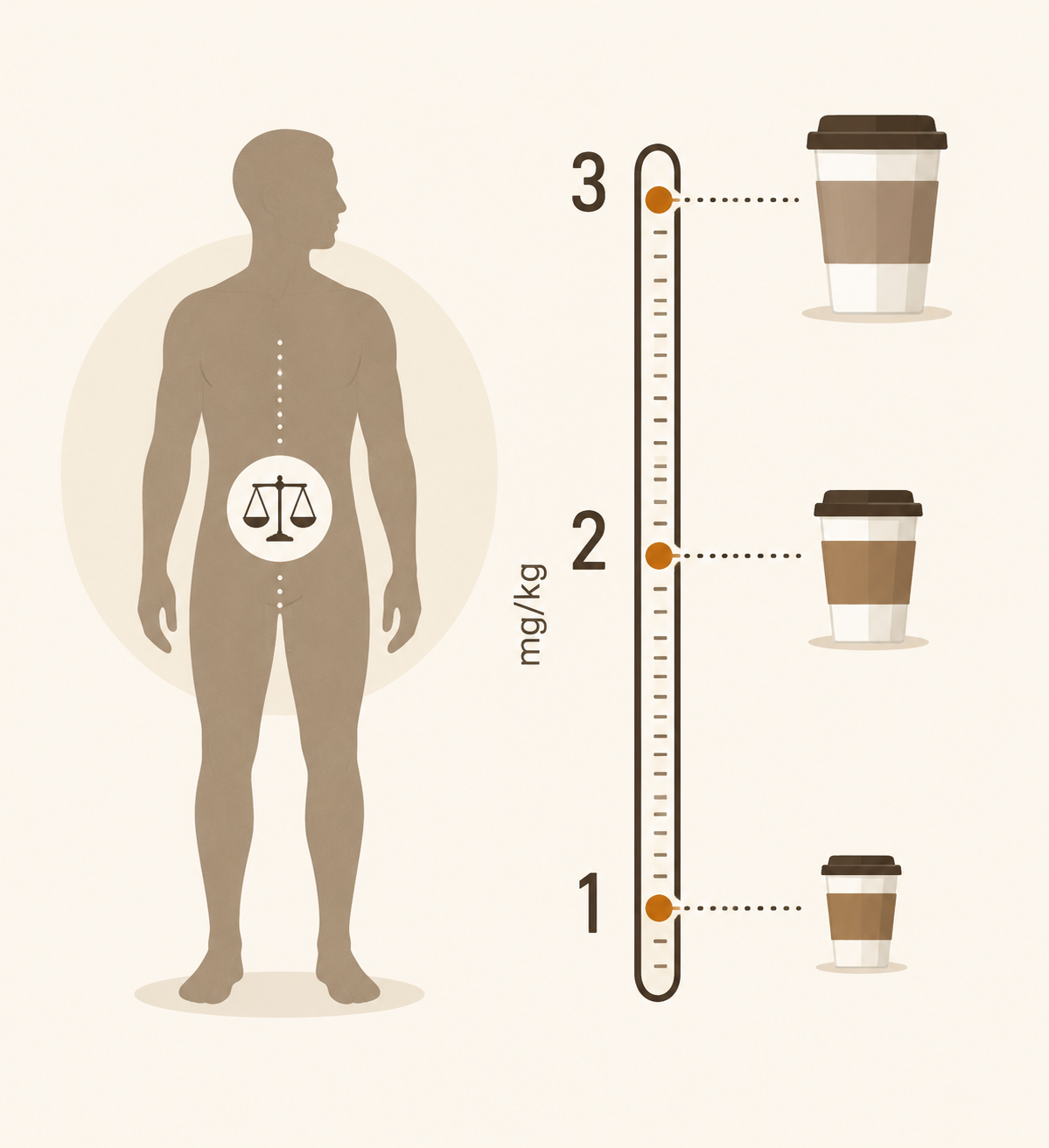
The range matters because caffeine has an inverted-U feel in real life. Too little may do almost nothing. A moderate dose can sharpen attention. More can stop adding useful focus and start adding restlessness, anxiety, or the kind of urgency that looks productive from across the room but produces worse work up close. Coffee Hero’s review of the focus research describes this pattern from a 61-study meta-analysis: moderate doses tend to improve cognitive performance, while higher doses bring diminishing returns and more anxiety. [2]
That is why the FDA’s familiar 400 mg per day figure belongs in your safety math, but not at the center of your morning. The FDA says that, for most adults, 400 mg of caffeine per day is an amount not generally associated with dangerous negative effects. [3] That is a safety ceiling, not a productivity target. A ceiling tells you where the roof is. It does not tell you where to put the desk.
So if you weigh 70 kg, tomorrow’s experiment might start at the low or middle of the range: perhaps 70-140 mg if you are sensitive, anxious, sleep-fragile, or returning after a low-caffeine period; perhaps closer to 140-210 mg if you already tolerate caffeine well and need a demanding morning block. The point is not to hit the top of the range. The point is to find the smallest dose that gives reliable focus without borrowing from the rest of the day.
This is where cup-count advice gets especially sloppy. Brew strength, serving size, beans, and chain recipes can move the caffeine number sharply. A “medium” specialty drink can quietly cross 300 mg, which may be more than a lighter person’s full 3 mg/kg dose before lunch. If you are trying to debug jitters, the label matters more than the cup.
A Simple Dosing Pass for Tomorrow
- Convert your weight to kilograms if needed: pounds divided by 2.2.
- Multiply that number by 1, 2, and 3 to find your low, medium, and high per-dose range.
- Start at the low or middle dose if you care about steady desk work rather than a dramatic jolt.
- Check the caffeine content of the actual drink you use most often.
- Adjust by outcome: focus, anxiety, crash, and sleep are the scoreboard.
The First Cup Should Not Race Your Wake-Up Chemistry
The same caffeine dose can feel precise or chaotic depending on when it lands. Morning is the easiest place to get this wrong because the ritual is so immediate: wake, shuffle, grind, pour, become human. The ritual can stay. The timing may need a small edit.
Neurologist explanations summarized by Wired and a former-Googler productivity protocol described by CNBC both point to waiting about 60-90 minutes after waking before the first coffee. The rationale is that cortisol naturally peaks roughly 30-60 minutes after waking; adding caffeine during that window may blunt the felt effect and encourage tolerance rather than cleanly stacking on top of your body’s own wake-up signal. [4][5]
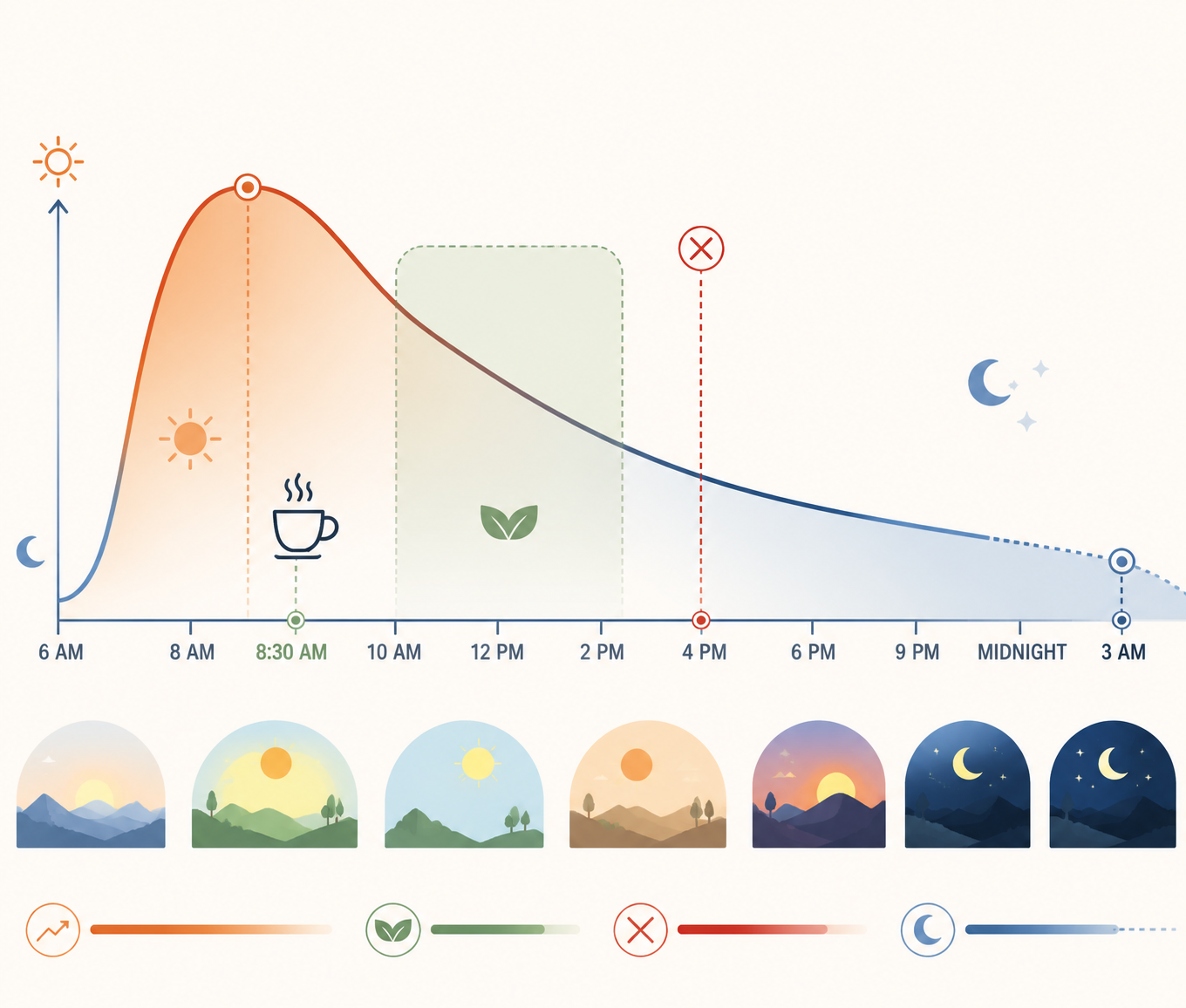
A 7 a.m. wake-up, then, points to an 8-8:30 a.m. first dose. Not because coffee before then is morally weak or medically forbidden, but because the delayed cup tends to make caffeine feel more distinct. It becomes a tool for the first real work block, not a reflex performed while the brain is still booting.
For remote workers, this delay is often easier than it sounds. Keep the ritual, but split it. Make water first. Get light. Move around. Set up the work surface. If the smell and preparation are part of crossing into the day, brew the coffee near the end of the 60-90 minute window rather than treating abstinence as the point. Precision does not require joyless living.
The afternoon cutoff is less negotiable because caffeine lingers. Huberman Lab describes caffeine’s half-life as roughly 5-6 hours and its quarter-life as about 12 hours. That means a 3 p.m. dose can still leave a meaningful fraction circulating at 3 a.m., with potential costs to slow-wave and REM sleep. [1] The problem may not be falling asleep. Plenty of tired people can fall asleep with caffeine still onboard. The quieter productivity loss is sleep that is shallower than it needed to be, followed by a morning that asks for more caffeine to compensate.
For most standard schedules, set the last caffeine window at 2-3 p.m. If your bedtime is early, move it earlier. If you wake unusually late, build the cutoff backward from sleep rather than forward from lunch. The calendar version is simple: do not let the cup that saves a sluggish afternoon become the reason tomorrow morning needs saving.
Prevent the Fake Caffeine Crash
Not every “coffee crash” is caffeine wearing off. Sometimes it is coffee arriving with a sweet creamer, a pastry, or no food at all, followed by a blood-sugar dip that gets misfiled as a caffeine problem. Wired’s neurologist interview recommends pairing coffee with protein or fat to reduce reactive hypoglycemia, especially for people who are prone to feeling shaky after sweetened coffee. [4]
This does not require a complicated breakfast doctrine. Coffee with eggs, Greek yogurt, nuts, a protein-forward smoothie, or a normal meal will usually do more for stable work than coffee plus syrup plus an empty stomach. If you like sweetness, keep it deliberate and watch the result. The useful distinction is whether the drink supports a work block or creates a second problem that caffeine gets blamed for later.
Use the Coffee Nap as a Tool, Not a Personality
The coffee nap, or “nappuccino,” is elegant because the timing makes behavioral sense: drink caffeine, sleep briefly, and wake as the caffeine begins to take effect. Research cited by NBC News found that 200-250 mg of caffeine followed by a 20-minute nap outperformed either caffeine or a nap alone for vigilant attention, including work tied to simulated driving. [6]
That does not make 250 mg the ideal desk-work dose for everyone. The underlying task is closer to sustained vigilance than to writing, analysis, design review, or strategy work. A smaller person using the 1-3 mg/kg range may find that 200-250 mg is near the high end of a full dose. Someone sensitive to caffeine may find it too much, especially after lunch.
A more practical version for knowledge work is situational: use a coffee nap when the afternoon contains a high-stakes attention block, a long meeting, travel, or a planned reset after poor sleep. Keep the nap to about 20 minutes so it does not become groggier sleep, and keep the caffeine inside your cutoff window. A beautiful nappuccino at 4 p.m. is still a 4 p.m. caffeine dose.
What to Track for One Week
The protocol gets better when it is boringly observable. You do not need a biometric dashboard or a moral inventory. For one week, track four things close to when they happen.
- First dose: time, caffeine estimate, and whether it sat in the 1-3 mg/kg range.
- Work effect: when focus improved, when it faded, and whether the work actually got cleaner.
- Body cost: jitters, anxiety, palpitations, stomach irritation, or a wired feeling that outlasted the task.
- Food pairing: whether coffee arrived with protein, fat, sugar, or nothing.
- Sleep: bedtime sleepiness, night waking, and how restored you felt the next morning.
Then make one adjustment at a time. If focus is good but sleep is worse, move the cutoff earlier before cutting the morning cup. If anxiety appears before the useful work begins, reduce the dose. If the morning is sharp and the afternoon collapses, check food and sleep before adding another coffee. If nothing happens at all, confirm the caffeine content rather than assuming you are immune.
Tomorrow’s setup can be that plain: choose a first dose by body weight, place it 60-90 minutes after waking, set a latest caffeine time, pair the cup with real food, and reserve the coffee nap for days that actually need one. Coffee can stay a comfort. It just works better when the comfort has a dial.
References
- Use Caffeine for Mental & Physical Performance, Huberman Lab
- Does Coffee Help You Focus? Science Explained, Coffee Hero
- Spilling the Beans: How Much Caffeine is Too Much?, U.S. Food and Drug Administration
- When to Drink Coffee, According to Science, Wired
- Googlers found a better way to drink coffee for productivity, CNBC
- Science says coffee naps are better than non-caffeinated ones, NBC News
Comments
Join the discussion with an anonymous comment.