
The awkward part of emergency preparedness is not that people have never heard the advice. It is that the advice often arrives as a giant weekend project, and then life quietly wins. In a June 2026 survey of 1,200 U.S. households, only 5% reported having a fully stocked emergency kit, while 20% had no supplies at all; just 54% said they had made any emergency preparations in the previous 12 months.[1]
That gap is not just about motivation. It is also about structure. A household can buy a flashlight, water, and a few cans of food and still have no idea where the insurance documents are, whether the medication list is current, who picks up whom, or what gets checked six months from now. FEMA’s 2023 National Household Survey found that 48% of respondents had assembled or updated disaster supplies, while 37% had made an actual emergency plan.[2]
So the better question is not simply how to create an emergency preparedness checklist. It is how to create one that survives normal life: busy weeks, cost anxiety, expired batteries, forgotten passwords, and the very human belief that “I bought some stuff” means the task is finished.
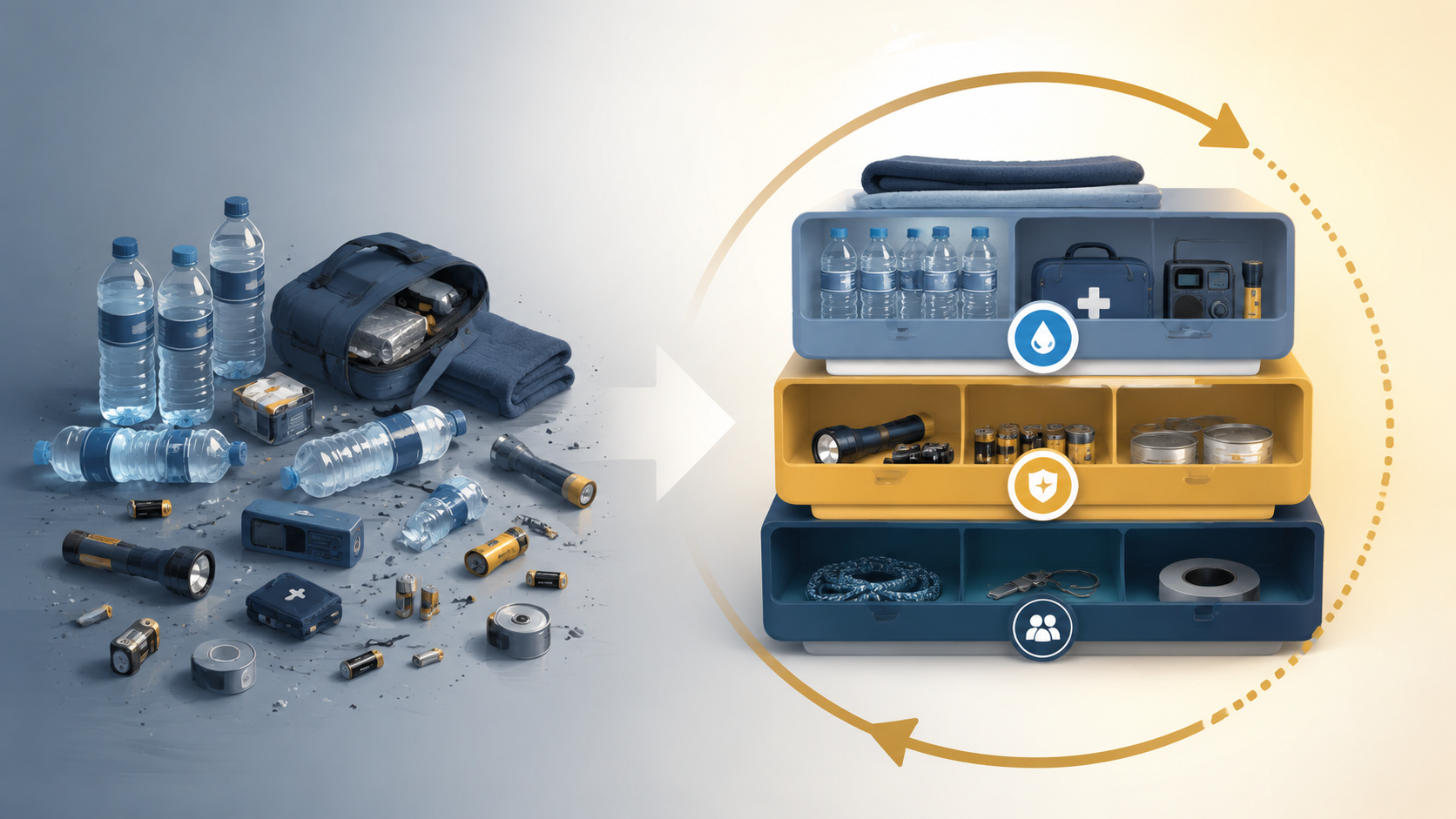
Start With The Minimum Viable Checklist
The first version should be boring on purpose. Before comparing solar chargers or specialized tools, anchor the checklist in the basics that public emergency agencies keep repeating because they cover the widest range of interruptions: water, food, medication, light, communication, first aid, documents, hygiene, and a way to leave if staying put stops making sense.
FEMA’s baseline is a good starting constraint: plan for one gallon of water per person per day, with a three-day supply for evacuation and a two-week supply for sheltering at home.[3] The Red Cross similarly recommends keeping basic emergency supplies and includes a seven-day supply of medications among its core survival kit items.[4]
| Checklist Area | Minimum Decision To Make |
|---|---|
| Water | How many people and pets are you covering, and for how many days? |
| Food | What shelf-stable food will your household actually eat? |
| Medication | What must be available if pharmacies are closed or unreachable? |
| Light and power | Which flashlights, batteries, chargers, or power banks are assigned to emergency use? |
| Communication | Where are phone numbers, meeting locations, and out-of-area contacts stored? |
| Documents | Which IDs, insurance records, medical notes, and financial documents need offline access? |
| First aid and hygiene | What supplies cover minor injury, sanitation, and basic cleanliness? |
| Exit plan | What leaves with you if you have ten minutes? |
This is the same design principle that makes a durable productivity setup work: the first version should reduce friction, not express your entire personality. If you have ever built a task system that collapsed under its own elegance, the same warning applies here. A usable preparedness checklist should behave more like a personal workflow system than a one-time shopping receipt.
Build In Tiers Instead Of One Huge Haul
The easiest way to stall is to treat emergency preparedness as one giant category called “get ready.” That turns every decision into a prerequisite for every other decision. A better checklist separates supplies by where they are used and how quickly they need to move.
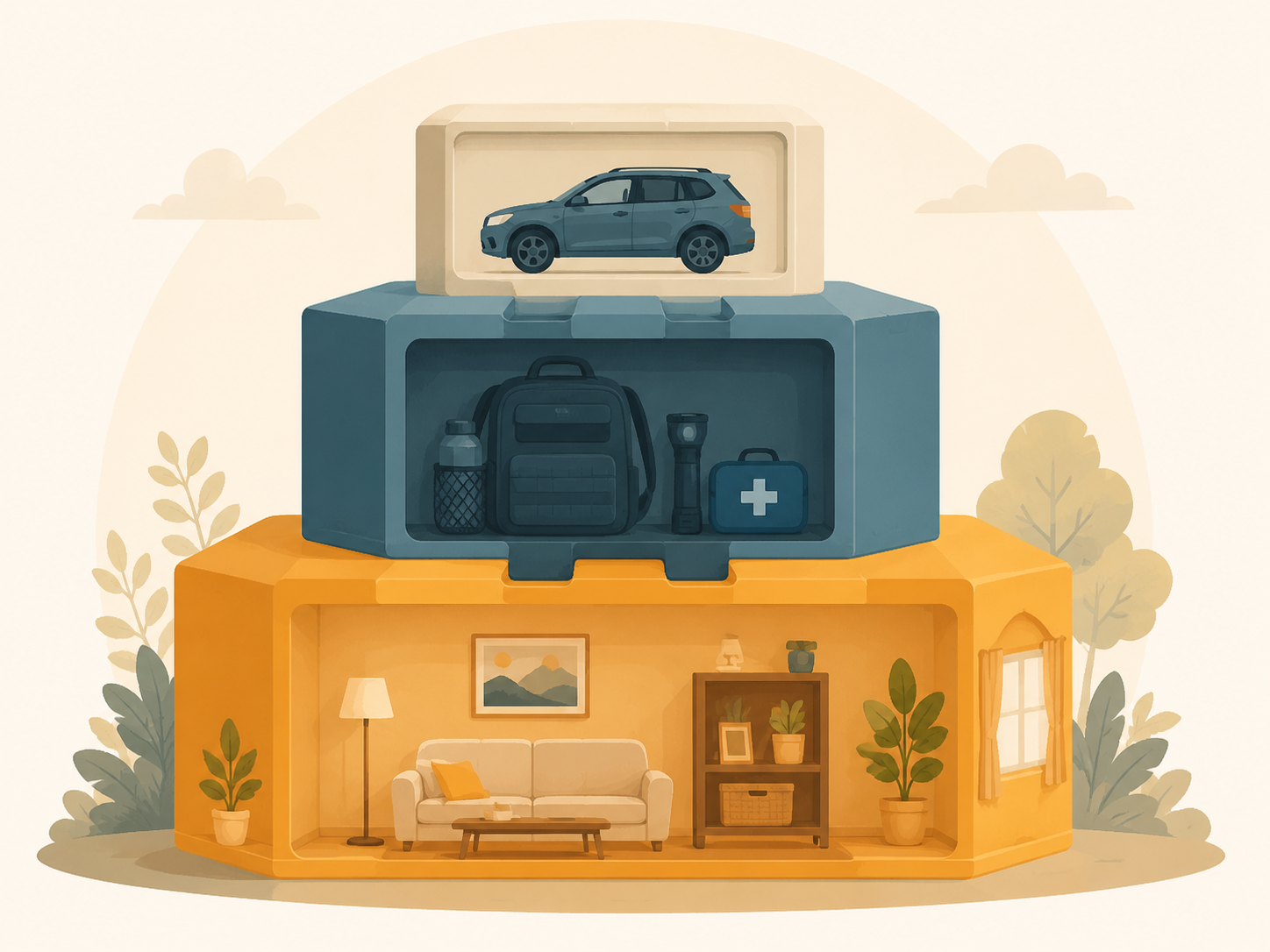
| Tier | Purpose | What Belongs Here |
|---|---|---|
| Shelter-in-place setup | Stay home through a disruption | Water, shelf-stable food, medications, first aid, flashlights, batteries, power banks, hygiene items, pet supplies, basic tools, copies of key documents |
| Go-bag | Leave quickly with essentials | Medication list, small first aid kit, water, snacks, flashlight, charger, cash, copies of IDs and insurance information, clothing layer, hygiene basics |
| Car kit | Handle delays or being away from home | Water, snacks, flashlight, phone charger, first aid basics, blanket, weather-appropriate extras, local maps if useful |
The shelter-in-place tier is the base because many disruptions do not require leaving. Power outages, closed stores, boil-water notices, storms, and short-term access problems all punish the same weak points: no water plan, no backup light, dead power banks, food nobody wants to eat, and prescriptions that are almost empty. SafeHome’s 2026 survey found that 55% of Americans expected lengthy blackouts in the coming year, which makes this tier feel less like disaster theater and more like household operations.[1]
The go-bag is narrower. It is not a portable version of your house. It is the set of things that matter if you need to leave faster than your brain can calmly prioritize: identity, medication, communication, payment, warmth, light, water, and enough food to avoid making every decision while hungry.
The car kit is even more situational. It covers the fact that emergencies do not always begin while you are standing in your kitchen. For some households, the car kit is essential; for others, especially people without a car or with minimal driving, it may be irrelevant. The point of tiers is not to make everyone build the same three containers. It is to keep each container honest about its job.
Use Progressive Stacking To Avoid The Cost Wall
Cost is not a fake objection. In SafeHome’s 2026 survey, 52% of respondents cited cost as a barrier to preparedness.[1] That matters because a checklist that assumes a large upfront purchase is going to lose a lot of otherwise responsible people before they even start.
The better move is progressive stacking: start with what is already in the house, then add the highest-friction gaps first. NPR’s budget go-bag guidance makes the useful point plainly: something is better than nothing, and people can begin by checking drawers, reusing items, buying secondhand where appropriate, and building gradually instead of trying to buy a perfect kit at once.[5]
- Pass 1: collect what you already own — flashlight, batteries, power bank, basic first aid, spare glasses, backpack, manual can opener, hygiene items.
- Pass 2: fill life-critical gaps — water, medication plan, key documents, emergency contacts, food your household can actually use.
- Pass 3: reduce failure points — label containers, assign storage locations, charge power banks, replace weak batteries, print the plan.
- Pass 4: expand comfort and duration — add more food variety, pet supplies, weather-specific items, backup lighting, and household-specific tools.
This order is less exciting than a shopping list, which is why it works. The first pass turns scattered objects into assigned emergency assets. The second pass handles the things that become urgent quickly. The third pass fixes the classic maintenance problems: no one knows where anything is, nothing is charged, and the plan lives only in someone’s head.
For example: if you already own two flashlights, a half-used first aid kit, a backpack, and a power bank, the first checklist task is not “buy emergency gear.” It is “put these in one place, test them, label them, and write down what is missing.” That is a smaller task, which means it is much more likely to happen on a Tuesday night.
Write The Plan Next To The Supplies
Supplies without a plan create a specific kind of false comfort. They make the household feel prepared until the moment someone needs to know whether to stay, leave, call, drive, wait, unlock, retrieve, or bring the dog. The FEMA survey gap between updated supplies and actual planning is a useful warning here: objects are easier to buy than decisions are to make.[2]
The written plan does not need to be elaborate. It needs to answer the questions people should not have to improvise under stress.
- Who is the out-of-area contact if local networks are overloaded?
- Where does the household meet if home is not accessible?
- Who is responsible for children, pets, older relatives, or anyone who needs assistance?
- Where are medications, medical notes, IDs, insurance details, and emergency cash?
- What is the first action during the most likely local disruptions: power outage, severe weather, evacuation notice, water issue, or communication outage?
Store that plan where the supplies live, and store a copy somewhere digitally accessible. If your household already uses a shared notes app, cloud folder, or home binder, do not invent a more impressive system just for this. Match the emergency checklist to the way you already manage life. If your productivity setup only works when it fits your habits, preparedness will behave the same way; this is where a diagnostic approach to matching systems to your work style becomes practical rather than theoretical.
Give The Checklist A Review Cycle
The checklist becomes maintainable when it has a next review date before anything goes wrong. “Check emergency stuff sometime” is not a reminder; it is a wish. Tie the review to a calendar marker that already interrupts the year. Daylight saving time changes work well for many U.S. households because they are visible, recurring, and already associated with small home-maintenance tasks like checking clocks and smoke alarm batteries.
| Review Item | What To Check |
|---|---|
| Water and food | Expiration dates, damaged packaging, realistic quantities, household preferences |
| Medication | Current prescriptions, dosage notes, expiration dates, special storage needs |
| Power and light | Battery charge, spare batteries, working flashlights, charging cables |
| Documents | Updated IDs, insurance information, medical notes, contact lists |
| Go-bag | Seasonal clothing, cash, snacks, copies of documents, fit and weight |
| Car kit | Weather-appropriate items, water condition, food condition, charger compatibility |
| Plan | Meeting locations, school or workplace changes, caregiver responsibilities, pet needs |
Keep the review small enough that you will actually do it. A useful review might take less time than reorganizing a closet. Replace expired food. Recharge the power bank. Update the medication list. Confirm the emergency contact. Move the winter layer out of the go-bag when it no longer makes sense. Then write the next review month on the checklist.
If you use a task manager, create a recurring task. If you use a paper planner, put it on the same page as seasonal home maintenance. If your household runs on a shared calendar, invite the other adult instead of assuming they will absorb the system by proximity. The maintenance mechanism matters more than the tool.
Add Triggers For Updating, Replacing, And Expanding
Scheduled reviews catch slow decay. Triggers catch life changes. Without both, the checklist slowly becomes a museum of who your household used to be.
| Trigger | Checklist Action |
|---|---|
| New medication or diagnosis | Update medication list, storage instructions, prescriber information, and go-bag supplies |
| Move to a new home | Recheck local risks, utility shutoffs, evacuation routes, storage locations, and meeting points |
| New baby, pet, roommate, or dependent | Recalculate water, food, medication, documents, transport, and caregiving responsibilities |
| New job, school, or commute | Update contact information, pickup plans, car kit needs, and meeting locations |
| Major weather season approaching | Add or rotate seasonal items before the first warning arrives |
| Used an item | Replace it immediately or put it on the next grocery or pharmacy list |
The “used an item” trigger is especially easy to ignore. If the emergency flashlight becomes the regular flashlight, that is fine only if the checklist knows it happened. Otherwise you do not have a flashlight; you have a memory of owning one.
Expansion should also be triggered, not guilt-driven. Add more water when storage becomes possible. Add pet-specific supplies when the pet arrives. Add weather-specific items before the season that makes them relevant. Add backup power when your work, medical needs, or household communication depends on it. The checklist grows because the system learns something, not because you read another alarming list at midnight.
A Maintainable Emergency Checklist Template
Use this as a working structure, not as a final inventory. The point is to create one place where supplies, decisions, and review dates live together.
| Section | What To Record |
|---|---|
| Household coverage | People, pets, medical needs, mobility needs, dietary constraints |
| Shelter-in-place supplies | Water, food, medication, first aid, light, power, hygiene, tools, documents |
| Go-bag | Location, assigned owner, contents, missing items, seasonal notes |
| Car kit | Vehicle location, contents, weather-specific items, last checked date |
| Emergency plan | Contacts, meeting places, responsibilities, evacuation notes, utility shutoff notes |
| Maintenance | Last review date, next review date, items replaced, items to buy gradually |
| Triggers | Life changes or seasonal events that require an update before the next review |
If the template feels too large, start with three lines: what you have, what is missing, and when you will review it. That is still a system. It is a small one, but it has a current state, a next action, and a maintenance loop.
What To Do This Week
Do not spend the first week shopping. Spend it making the checklist real.
- Choose one storage location for shelter-in-place supplies.
- Walk the house and collect items you already own that belong in the system.
- Write down the FEMA water baseline for your household size and compare it with what you have.
- Create a one-page emergency plan with contacts, meeting places, medical notes, and responsibilities.
- Add one recurring review tied to a visible calendar marker.
- Put the next three missing items on normal shopping lists instead of treating them as a separate emergency project.
That is enough to move from intention to maintenance. A good emergency preparedness checklist is not the longest list of supplies. It is the smallest workable version you can maintain, reviewed on a schedule, and expanded in layers when your household actually changes.
References
- Home Emergency Preparedness Study, SafeHome.org, June 2026
- Are Americans Prepared for Disasters? FEMA’s Survey Reveals Key Findings, Risk & Resilience Hub
- Build A Kit, Ready.gov
- Survival Kit Supplies, American Red Cross
- How to build an emergency go bag on a budget, NPR, May 2025
Comments
Join the discussion with an anonymous comment.