

If you already keep an Obsidian vault, a Notion workspace, or a smaller Apple Notes inbox, AI context engineering for note taking and knowledge work can sound like either a useful description or a new name for ordinary prompt writing. The distinction matters because the proposed work happens before the model generates an answer: deciding which instructions, notes, records, and retrieved material should enter the context for a particular task.
The useful part is concrete. A project decision should be findable, its status should be visible, and stale background should not crowd out the current facts. The less settled part is the payoff. The available material gives a plausible account of how better note selection could help an assistant, but it does not establish that the practice produces a measured reduction in hallucinations or a general improvement in knowledge work.
A dated definition, not a claim about who coined the term
The firmest starting point is Anthropic’s engineering post, “Effective context engineering for AI agents,” published September 29, 2025. It describes context as the set of tokens sampled for a task and frames context engineering as composing that set at the right altitude: enough material to support the task, without filling the available window with low-value information. The post explicitly contrasts this with prompt engineering, which more narrowly concerns the instructions given to a model.[1]
That gives the term a real, dated first-party definition. It does not establish a universally accepted origin story. A ZDNET social caption from 2025 connects “context engineering” with Andrew Ng and AI Dev, but the available item is caption-only. It cannot support a claim that Ng coined the term, nor does it provide a stable public definition.[2] A separate data-science essay presents the difference as “Instructions vs. Ecosystems,” a helpful shorthand for the same broad contrast, but its headings-only, undated form makes it supporting commentary rather than an authority on provenance.[5]
So the practical distinction is this: a prompt is one part of what the model receives; context engineering concerns the composition of the larger working set. That may include the current request, instructions, retrieved documents, summaries of earlier work, tool results, and other task-specific material. The boundary is about scope and assembly, not about a magical new kind of note.

Why notes are a context surface
Notes become relevant because they often contain the material an assistant needs but cannot infer from the latest prompt alone: why a decision was made, which assumption changed, what remains unresolved, and where a project currently stands. A vault may hold all of that information, but a model does not automatically receive the whole vault in a useful form.
Anthropic’s account identifies structured note-taking as one response to context pollution. In the described pattern, an agent records information outside its immediate context, then later retrieves what is relevant instead of carrying every prior interaction forward. The post also discusses embedding-based retrieval before inference: material can be selected on the basis of relevance before the model attempts the task.[1]
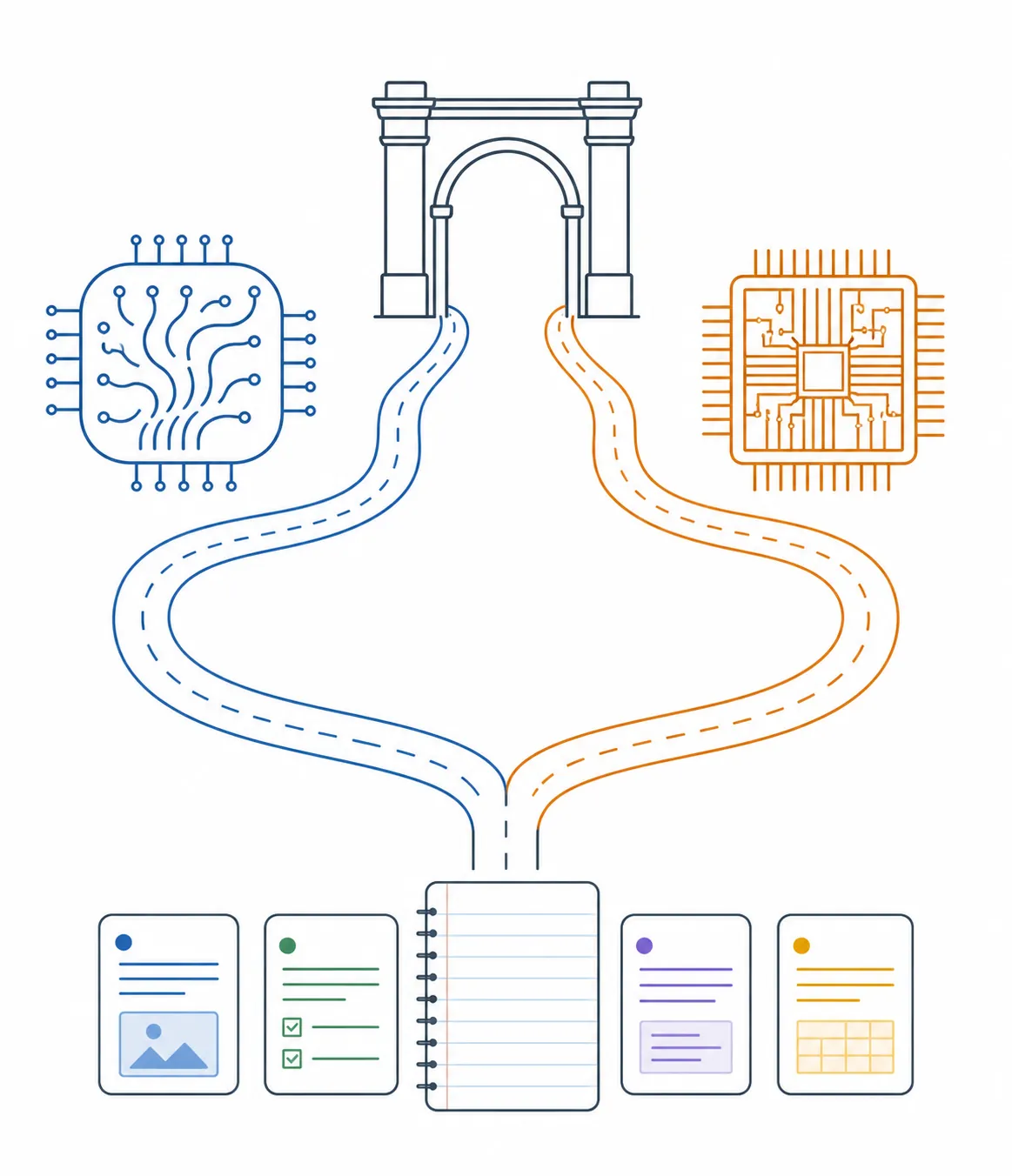
The mechanism is easier to see as a chain:
- A note captures an observation, decision, source, or open question.
- Structure makes its subject, date, status, and relationship to other material easier to interpret.
- A selection or retrieval process identifies material related to the current request.
- The assistant receives that assembled context and generates an answer from it.
Each stage can fail independently. A perfectly retrieved note can still contain an unmarked outdated assumption. A carefully written decision record is of little use if retrieval cannot find it. A large collection of loosely related notes can also create noise: the assistant may receive technically relevant terms while missing the one record that explains what is current.
This is why note quality matters even without AI. If a human cannot tell whether a page records a proposal, a decision, or an abandoned direction, an assistant has no reliable status signal to recover. Labels such as “current,” “superseded,” and “open” are not guaranteed to solve retrieval, but they preserve distinctions that a later reader—or a later system—can use.
The same principle applies to project history. A short decision note with the conclusion, reasoning, date, and owner may be more useful than a long meeting transcript. That is not because shorter context is always better. It is because the note has already separated the information needed to answer a likely future question from the surrounding conversation.
The proposed mechanism is not a measured outcome
Anthropic’s post is useful engineering guidance, but it is not a benchmark or controlled study of note-taking. It explains why structured external memory and pre-inference retrieval may reduce pollution in an agent’s working context. It does not, in the material available here, isolate structured notes as a variable and report how much they improve accuracy, completion time, factuality, or another outcome.[1]
That distinction becomes important when the language gets stronger. A practitioner post by Gaurav Tupe describes context injection as something that “drastically reduces hallucinations.” The post supplies no sample, measurement, comparison group, or test procedure in the evidence packet. It is therefore an example of practitioner anecdote, not evidence that the claimed effect has been established.[3]
The precise conclusion is not that context engineering never reduces hallucinations. The packet does not support that conclusion, and the absence of a benchmark here is not proof that no wider evidence exists. The narrower conclusion is that a note-system owner cannot treat the stronger payoff claim as measured on the basis of these sources.

“Start with your notes” is a translation, not a competing definition
Luca Vettor’s practitioner framing makes the idea more approachable: you do not need to become an AI engineer; you can turn notes, decisions, and project history into working memory for an assistant.[4] For someone maintaining a vault after the meeting, this is a sensible translation of the technical problem. It points attention toward the information already being created rather than toward elaborate infrastructure.
It is still a translation. Anthropic is describing the assembly of a task-specific token set, including retrieval and other agent techniques. Vettor is emphasizing the note system as a practical source of that material. Those framings operate at different levels; they do not establish two conflicting definitions, and neither one proves that a particular app or storage setup will deliver a particular result.
Implementation questions are consequently separate from the definition. Whether an app can read, write, retrieve, or act across notes depends on its own architecture and integrations. Readers comparing those surfaces can use which note app is actually ready for agentic AI or examine the broader map of AI features in note-taking apps. Those are product and architecture questions, not evidence that context engineering itself has a documented productivity effect.
What is worth changing in an existing note system
A reasonable response is to adopt practices that improve the notes before asking whether they improve the assistant. For a working system, that usually means making future selection easier rather than redesigning the entire vault around an unverified promise.
- Record decisions separately from discussion, including the date, decision status, and the reasoning that future readers will need.
- Mark stale, superseded, and provisional material instead of leaving its status to inference.
- Keep project history close enough to current work that a related request can retrieve it, while avoiding the assumption that every historical note belongs in every context.
- Review the material selected for a task when accuracy matters: check whether the retrieved notes are current, relevant, and sufficient to support the answer.
These changes have a direct human benefit. A colleague can find the decision. You can distinguish an open question from a settled fact. A later review can expose where an assumption entered the project. An AI assistant may also receive a cleaner working set, but that remains a hypothesis to test in your own workflow.
The test does not need to be elaborate. For repeated tasks such as summarizing a decision or preparing a next step, compare the answers produced from a deliberately selected set of notes with answers produced from the ordinary workflow. Keep track of what was actually supplied, whether the answer cited the right decision, and how often you had to correct its status or chronology. This is an observation of your process, not a claim of general scientific proof.
There is also no reason to restructure a functioning system merely because a new label has become popular. If your current notes are understandable, retrievable, and useful to you without an assistant, the term may simply give a more technical name to work you were already doing. If the notes are difficult to interpret, improving them is justified even if the AI experiment produces no visible gain.
Context engineering, as defined in the dated Anthropic guidance, describes a plausible way to control what an assistant sees before inference. Structured notes and relevance-based retrieval fit that description. The evidence supplied here does not justify buying the promised outcome in advance. Keep the practices that make the record clearer, the current state easier to identify, and the retrieval set more deliberate; treat any improvement in AI behavior as something to observe rather than something already purchased.
References
- Effective context engineering for AI agents — Anthropic, September 29, 2025
- Andrew Ng / AI Dev 25 caption — ZDNET, 2025
- Gaurav Tupe practitioner post — LinkedIn
- Context engineering is too technical? Start with your notes instead — Luca Vettor, Medium
- Context engineering vs prompt engineering — Data Science Collective, Medium

Comments
Join the discussion with an anonymous comment.