
The awkward part of AI note taking does not start when the transcript is wrong. It starts earlier, when a notetaker bot appears in the participant list and the room briefly stops being a room. Someone asks whether the call is being recorded. Someone else wonders whether the client agreed to this. The meeting owner has to decide, in real time, whether the productivity gain is worth the shift in tone.
Granola’s answer is to avoid sending a visible bot into the meeting at all. It captures audio from the user’s own device, then turns the conversation and the user’s typed notes into structured AI notes. That puts it in a different branch of the ai note taking market from tools that automatically join calendar events as named participants.
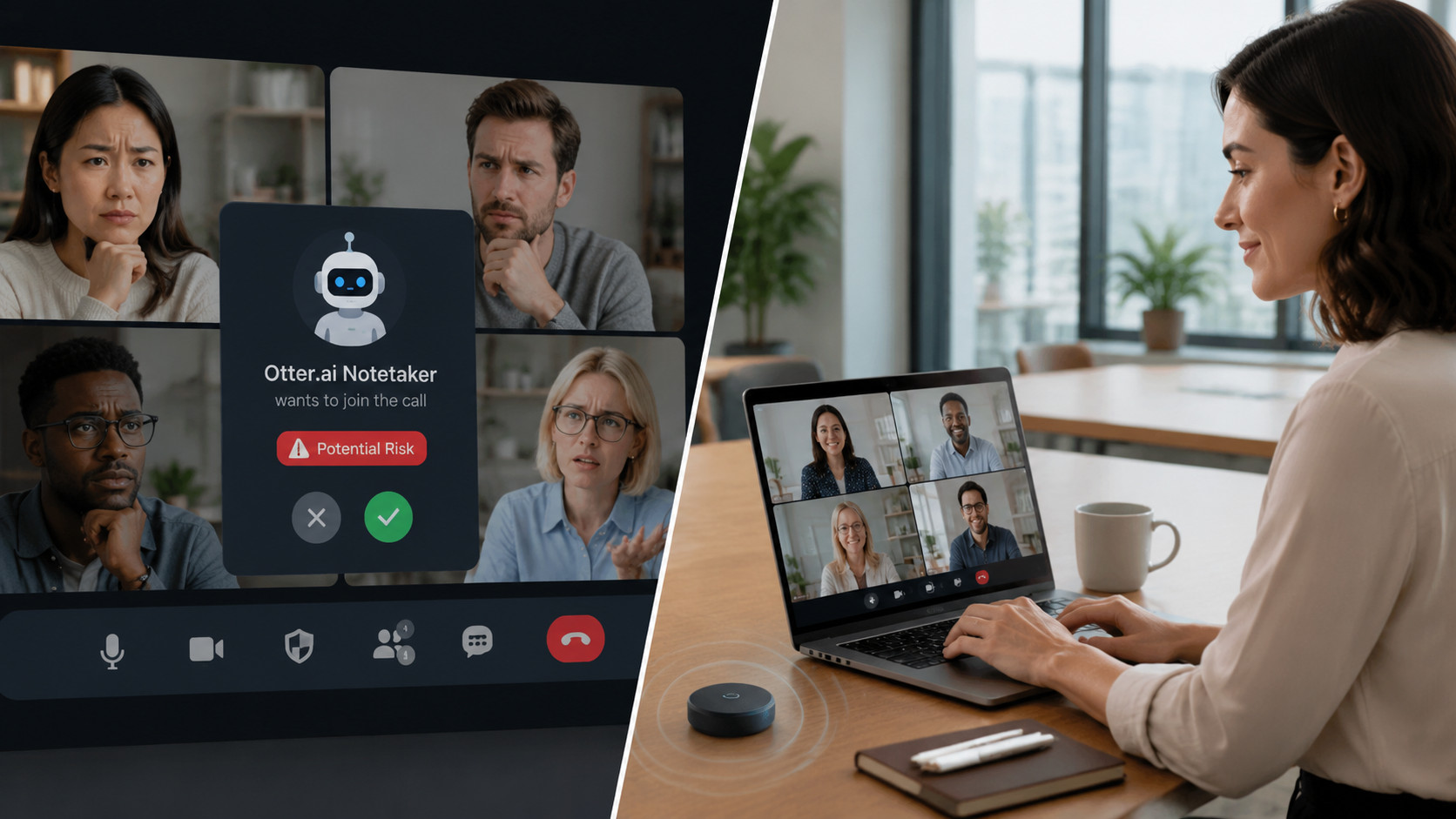
That distinction used to sound like a preference. In 2026, it looks more like a procurement question. tl;dv has reported that a March 2026 Google Meet change flags third-party notetaker bots as a “potential risk” and defaults to denying entry, a claim that should be checked against Google’s own changelog before treating it as official platform policy.[1] Separately, a proposed class action filed against Otter.ai in August 2025 alleges that Otter recorded conversations without all participants’ consent and used recordings to train AI models; those are allegations in a complaint, not court findings.[2]
Together, those two developments explain why Granola is being discussed as more than another meeting-summary app. It does not make consent irrelevant. It does not remove the need for company policy. But by not placing a third-party attendee inside the call, it changes the social and technical surface area of the tool.
What Granola Changes By Removing the Bot
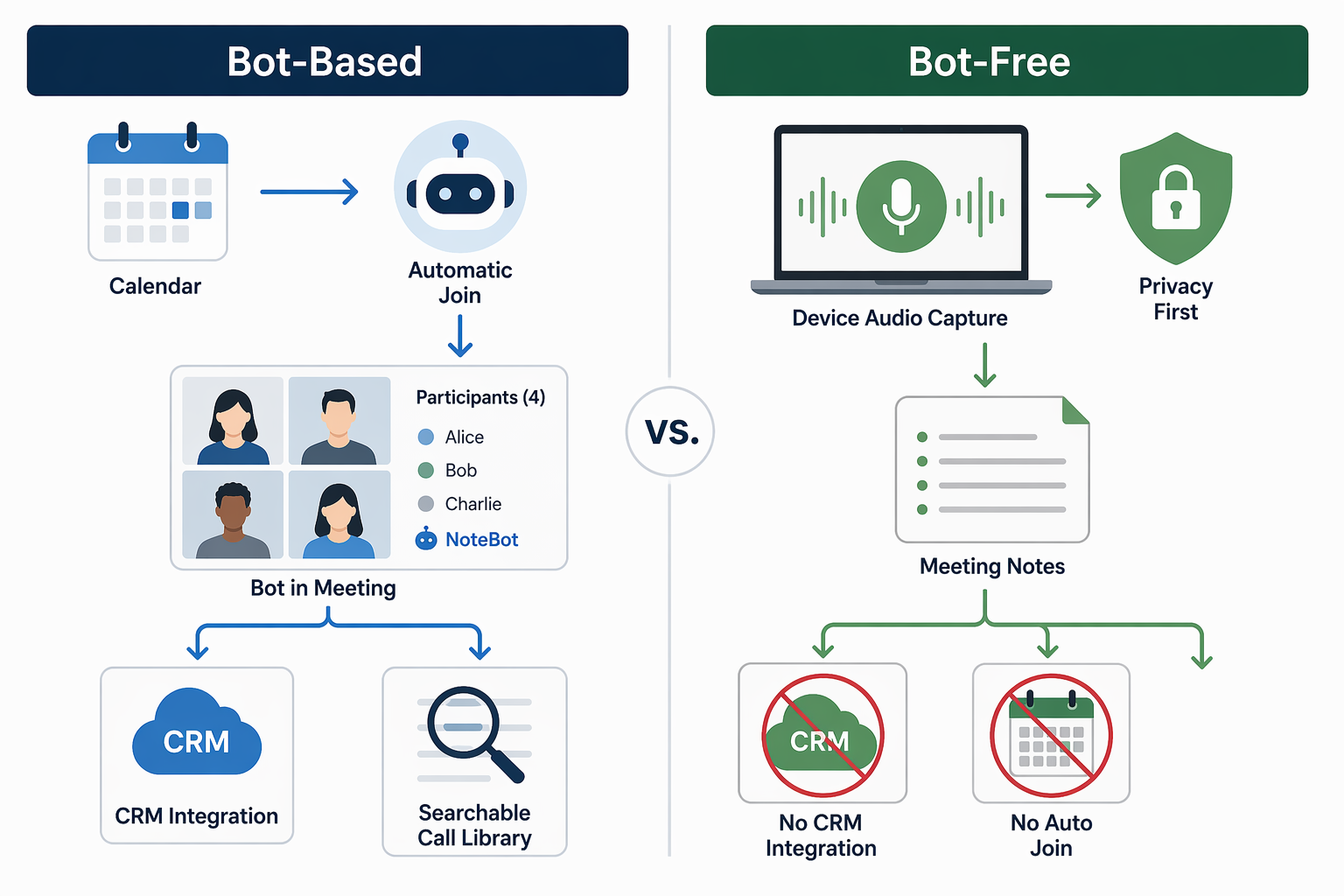
A bot-based note taker usually behaves like a meeting participant. It joins a scheduled call, appears in the attendee list, listens, records or transcribes, and then pushes notes into a workspace, library, CRM, or follow-up workflow. That model is easy to understand and, for some teams, operationally convenient.
Granola works from the user’s side instead. The meeting does not need another attendee. The tool can capture what the user can hear from the device and combine it with notes typed during the conversation. In practice, that means the tool is less likely to interrupt the start of the call, less likely to trigger a platform-level bot warning, and more useful in rooms where there is no video meeting for a bot to join.
| Decision point | Bot-based tools | Granola-style bot-free capture |
|---|---|---|
| How it enters the meeting | Joins as a visible participant or notetaker | Captures from the user’s own device |
| Common strength | Calendar automation, call libraries, CRM handoff | Lower meeting friction, in-person capture, fewer visible-bot issues |
| Common weak point | Consent friction and possible platform or IT restrictions | Less automatic attendance and fewer revenue-workflow integrations |
| Best-fit meeting type | Scheduled sales, support, recruiting, and customer calls | Executive, internal, hybrid, sensitive, phone, or in-person conversations |
The practical difference shows up most clearly outside the neat calendar-invite scenario. A leadership offsite in a conference room. A hallway follow-up after a formal meeting. A phone call. A hybrid meeting where the important discussion happens around the table, not only inside the video platform. A bot has nowhere natural to sit in those situations. A device-capture tool does.
This is why Granola’s design feels especially relevant for teams that already have enough meeting etiquette to manage. If the first two minutes of a sensitive conversation are spent debating whether the AI participant should be admitted, the tool has already imposed a cost.
The Safer Fit: Sensitive Rooms, Hybrid Work, and Meetings Where Candor Matters
Granola’s strongest case is not that it is invisible magic. The stronger case is more mundane: it respects the fact that meetings are social spaces before they are data sources.
In executive conversations, legal-adjacent discussions, investor updates, healthcare-adjacent workflows, finance reviews, HR conversations, and customer escalations, the visible presence of a notetaker bot can change behavior. People may speak less directly. They may ask who owns the transcript. They may wonder whether a vendor’s retention settings match company policy. Even if everyone eventually agrees, the meeting has had to route through the tool before getting back to the work.
A bot-free app does not eliminate those questions, but it puts the responsibility back where it belongs: on the user and the organization’s recording, transcription, and disclosure rules. The call does not suddenly acquire an unfamiliar participant. The team can set norms in advance instead of negotiating with a pop-up at the door.
That matters for IT as much as for etiquette. If a platform or admin policy starts blocking third-party bots, a bot-based note taker becomes a support ticket. The user may believe they bought an AI productivity tool; the admin sees an external actor trying to enter meetings across the organization. Granola’s capture model reduces that specific point of conflict because the meeting platform is not being asked to admit another participant.
The same logic applies to in-person and hybrid work. A conference room conversation is often the exact place where notes are most fragile: people interrupt, decisions are made quickly, and the person typing is also trying to participate. Bot-based systems are built for scheduled online meetings. Granola is better aligned with the messier reality that important conversations happen through laptop speakers, around a table, or on a phone.
Granola is not alone in recognizing this gap. Jamie, Krisp, Superpowered, Tactiq, and Laxis all point toward versions of the same shift: note taking that does not depend on a visible meeting bot. Superpowered, for example, markets a “No bots. No recordings” approach, with live transcription and short transcript retention, while Laxis highlights hardware support through OSO AI earbuds for face-to-face capture.[3] The market is not just adding more summaries; it is experimenting with less intrusive ways to remember what was said.
Why Bot-Based Note Takers Still Win Some Workflows
The bot-free argument gets weaker when the meeting is not a sensitive room but a repeatable revenue process. Sales teams, customer-success teams, recruiters, and support organizations often want the notetaker to behave like infrastructure: join every scheduled call, capture the conversation even if the rep forgets, create a searchable record, and push structured outputs into the systems the team already uses.
That is where traditional tools such as Otter, Fireflies, Fathom, and similar bot-based products remain compelling. A sales manager may care less about whether the bot creates a moment of awkwardness and more about whether every discovery call is logged, searchable, coachable, and connected to the CRM. A support lead may need a call library that makes it easy to review escalations across the whole team. A recruiting coordinator may prefer automatic joining because missed notes create more damage than an extra participant in the call.
If that is the operating model, Granola may feel too manual. A person has to be present with the device. The capture is centered on the individual user’s meeting experience, not on a centralized call-recording machine. That can be a strength for trust and discretion, but a weakness for teams that measure note-taking success by coverage, automation, and downstream data flow.
This is also where buyers should avoid turning the bot debate into a moral sorting exercise. A visible bot can be the wrong tool for a confidential leadership meeting and the right tool for a high-volume sales floor. The same organization may need both. For a deeper look at two common bot-based options, see the Otter AI Pro Plan review and the Fireflies.ai review.
Granola’s Growth Says Something, but Not Everything
Granola’s fundraising gives the product more weight in the conversation, but valuation should be treated as a market signal rather than proof that one workflow has won. TechCrunch reported in May 2025 that Granola raised a $43 million Series B at a $250 million valuation and launched collaborative features.[4] Forbes reported in January 2026 that the company was in talks to reach a $1 billion valuation.[5] Sifted later reported that Granola hit unicorn status with a $125 million Series C at a $1.5 billion valuation.[6]
That trajectory suggests investors see demand for AI meeting notes that stay closer to the person actually sitting in the meeting. It does not answer the implementation question for a team lead or IT admin. The right question is still narrower: does your organization need less friction in the room, or more automation around the room?
How to Decide Whether Granola Fits Your Team
Start with the meeting types, not the feature grid. If most of your valuable conversations happen in scheduled customer calls, with clear consent language and a strong need for CRM handoff, a bot-based system may still be the operationally cleaner choice. If your highest-risk conversations happen in leadership meetings, client strategy calls, hybrid rooms, or in-person discussions, Granola’s bot-free model deserves serious attention.
- Choose Granola first when visible bots make participants uncomfortable, when in-person capture matters, or when meeting-platform bot restrictions create avoidable friction.
- Choose a bot-based tool first when automatic calendar attendance, centralized call search, CRM syncing, and team-wide coverage matter more than a bot’s presence.
- Use both models when different departments have different meeting risks: executive and internal teams may prefer bot-free capture, while revenue teams may still need automated call workflows.
- Set the policy before rollout: who may use AI notes, what must be disclosed, what data can be retained, and which meeting types are off-limits.
The policy point is not paperwork theater. It is what prevents the tool from becoming a surprise participant, even when no bot appears. A bot-free recorder can still create transcripts. AI notes can still contain sensitive information. The absence of a bot lowers one kind of meeting friction; it does not replace consent norms, retention rules, or vendor review.
Teams still shopping across the broader category can use a meeting note-taking apps comparison after deciding whether bot presence is acceptable. If the real need is not meetings at all but quick personal capture, dictated thoughts, or field notes, the better starting point may be a voice-note app type guide rather than a meeting assistant.
The Practical Fit
Granola is strongest where meeting trust is part of the work: sensitive internal discussions, executive calls, hybrid rooms, in-person meetings, and organizations that do not want a visible third-party bot negotiating entry into every conversation. Its device-capture model makes AI notes feel less like another attendee and more like a quieter layer on top of the user’s own participation.
It is weaker where the note taker needs to operate as automated revenue infrastructure. Teams that rely on calendar auto-join, searchable libraries across every call, CRM-connected handoff, and manager review may still need a traditional bot-based tool. The cleanest answer is not that Granola replaces every AI note-taking app. It is that Granola is the safer and more culturally acceptable choice when bot presence itself has become the problem.
References
- tl;dv blog (Google Meet update) — tl;dv
- New Lawsuit Highlights Concerns About AI Notetakers: 7 Steps Businesses Should Take — Fisher Phillips
- Best AI Note Taker 2026 — Laxis
- AI notetaking app Granola raises $43M at $250M valuation, launches collaborative features — TechCrunch
- VCs' Favorite Note-Taking App Granola In Talks To Hit $1 Billion Valuation — Forbes, January 30, 2026
- AI notetaking startup Granola hits unicorn status with $125m Series C — Sifted