
Last verified: 2026-06-25. The fastest way to buy the wrong workflow orchestration tool is to compare feature grids before deciding who will own the system after launch. A developer team, an operations team, and an enterprise IT group can all say they need orchestration, but they are usually buying three different things: code-level control, business-app automation, or governed process execution.
The shortlist should start with the maintainer, not the logo. Developer-first teams usually belong with Airflow, Prefect, or Temporal. No-code and operations-led teams should usually look at Zapier, Make, Wrike, or n8n, with n8n sitting in the blurrier zone between app automation and lightweight orchestration. Enterprise IT teams evaluating audit-heavy, cross-department processes should look at Camunda, ServiceNow, Pega, or Appian, and should assume the project is as much implementation program as software subscription.
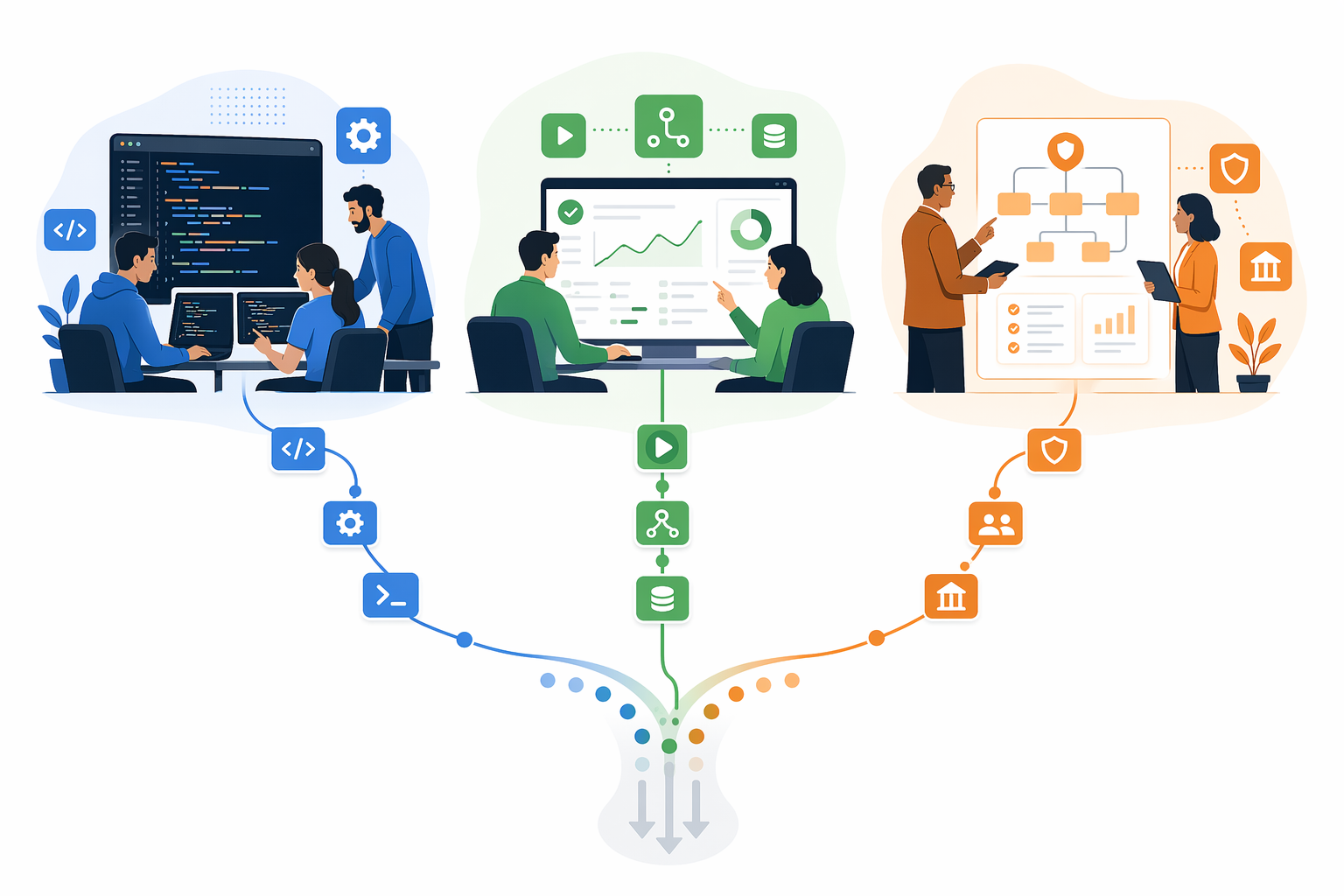
| Team profile | Likely fit | What you are really buying | Cost and maintenance warning |
|---|---|---|---|
| Developer-first data, platform, or product teams | Airflow, Prefect, Temporal | Code-defined workflows, retries, state handling, observability, and engineering control | Open-source licensing does not remove infrastructure, monitoring, or on-call work |
| Ops, RevOps, support, marketing ops, and small business teams | Zapier, Make, Wrike, n8n | Fast connection of business apps without waiting for a sprint cycle | Usage, task, and scenario limits can become the ceiling before feature breadth does |
| Enterprise IT, shared services, regulated operations | Camunda, ServiceNow, Pega, Appian | Governance, access control, auditability, process modeling, and implementation support | Custom pricing and months-long implementation cycles are normal, not exceptions |
If you are still sorting out whether you need orchestration, automation, BPM, or iPaaS, start with a category map before procurement gets involved. The practical distinction is covered in Workflow Orchestration vs. Automation. In this comparison, orchestration means coordinating multi-step work across systems, with dependencies, failures, retries, handoffs, and visibility into what happened when something breaks.
The Market Is Growing, But That Does Not Make Every Buyer Enterprise
Workflow orchestration is getting pulled into more buying committees because the work itself is crossing more systems. The narrow service orchestration and automation platform market reached $3.8 billion in 2024 and is projected to reach $4.9 billion by 2028, according to Gartner figures cited by BMC Software.[1] A broader workflow orchestration market estimate puts the category at $21.93 billion in 2026 with a 13.3% compound annual growth rate.[2]
Those two numbers are useful context, not interchangeable proof that every buyer needs a bigger platform. The smaller figure refers to a narrower service orchestration and automation platform category. The larger figure uses a broader workflow orchestration definition. Procurement decks tend to flatten those distinctions because a larger market makes a purchase feel safer. It does not tell you whether your team needs BPMN modeling, a DAG scheduler, or a cleaner way to move new customer data from a form into a CRM and support queue.
The pressure is real, though. A 2025 McKinsey global survey found that 88% of organizations use AI in at least one function, while fewer than 6% have scaled AI across workflows.[3] Teamwork.com’s Sprint to AI report found that 92% of respondents said current tools fall short on end-to-end workflows and integrations.[4] That gap is where orchestration decisions become expensive: pilots are easy to admire, but production workflows need owners, failure paths, and monitoring.
Developer-First Tools: Airflow, Prefect, and Temporal
Developer-first workflow orchestration tools make sense when workflows are part of the technical estate, not a side project owned by a business analyst. These teams need workflows in code, version control, testability, dependency management, retry logic, observability, and a clean way to reason about state. The people building the workflow are usually also close to the systems that will fail.
Airflow remains the familiar choice for scheduled data pipelines and DAG-based orchestration. It is strongest when the team already thinks in Python, jobs, dependencies, and infrastructure. Its weakness is not that it lacks power; it is that a self-hosted Airflow deployment is a system, not a download. The scheduler, workers, metadata database, queue, logging, alerting, upgrades, and monitoring all need care. Orchestra’s 2026 analysis notes that Airflow’s open-source label can hide a meaningful operating burden, while managed options such as Astronomer, listed around $3,679 per month, or AWS Managed Workflows for Apache Airflow at several hundred dollars per month, may be cheaper than a fragile internal setup once engineering time is counted.[5]

Prefect is often the more approachable developer platform when a team wants Python-native orchestration without inheriting all of Airflow’s operational shape. Published comparison data places Prefect Cloud in the approximate $100 to $400 per month range, depending on plan and usage.[6] Temporal belongs in a different conversation: durable execution, long-running workflows, stateful coordination, and application-level reliability. It is a better fit when workflow correctness is part of product behavior, not just back-office scheduling. Temporal Cloud pricing is custom, so teams should treat evaluation as both an architecture decision and a vendor negotiation.[6]
This tier is the right place to be if engineering owns the consequences. It is the wrong place to hide a business workflow that no engineer wants to maintain. A finance approval chain, a support handoff, or a marketing lead-routing process can technically be expressed in code. That does not make code the best operating model if the people who understand the process cannot safely change it.
No-Code and Middle-Tier Tools: Zapier, Make, Wrike, and n8n
No-code orchestration tools earn their keep when waiting for engineering is the bottleneck. An operations manager can connect a form, CRM, spreadsheet, ticketing tool, email sequence, and Slack alert in an afternoon. That speed is not a toy benefit. It is often the difference between a team fixing its own workflow and living with manual copy-paste for another quarter.
Zapier is the easiest recommendation when the work is mostly app-to-app automation and the team values a polished interface over architectural flexibility. Make gives operations teams more visual control over branching and multi-step scenarios. Wrike is closer to work management, useful when the workflow is embedded in project execution rather than system-to-system automation. Published 2026 comparisons place Make roughly in the $9 to $199 per month range and Zapier roughly in the $20 to $200-plus per month range, though usage-based limits can matter more than the sticker tier.[6][7]
n8n deserves separate treatment because it blurs the category line. It can serve a nontechnical team through a visual builder, but it also gives technical users more control than typical no-code tools, including self-hosting options and custom logic. Published comparisons place n8n around $20 to $800 per month, depending on plan and deployment model.[6] For teams deciding between n8n and adjacent tools, the deeper question is whether the owner wants app automation with occasional code, or a lightweight orchestration layer that someone will operate deliberately. The n8n tool profile is the better next stop if that distinction is the decision point.
The ceiling in this tier usually appears in one of three places: visibility, change control, or economics. A workflow fails and nobody can quickly see which step broke. A departed employee built a chain of automations without naming conventions or documentation. A low monthly plan becomes expensive because every task, scenario, or run is now production traffic. None of those outcomes means the original tool was bad. It means the workflow graduated and the ownership model did not.
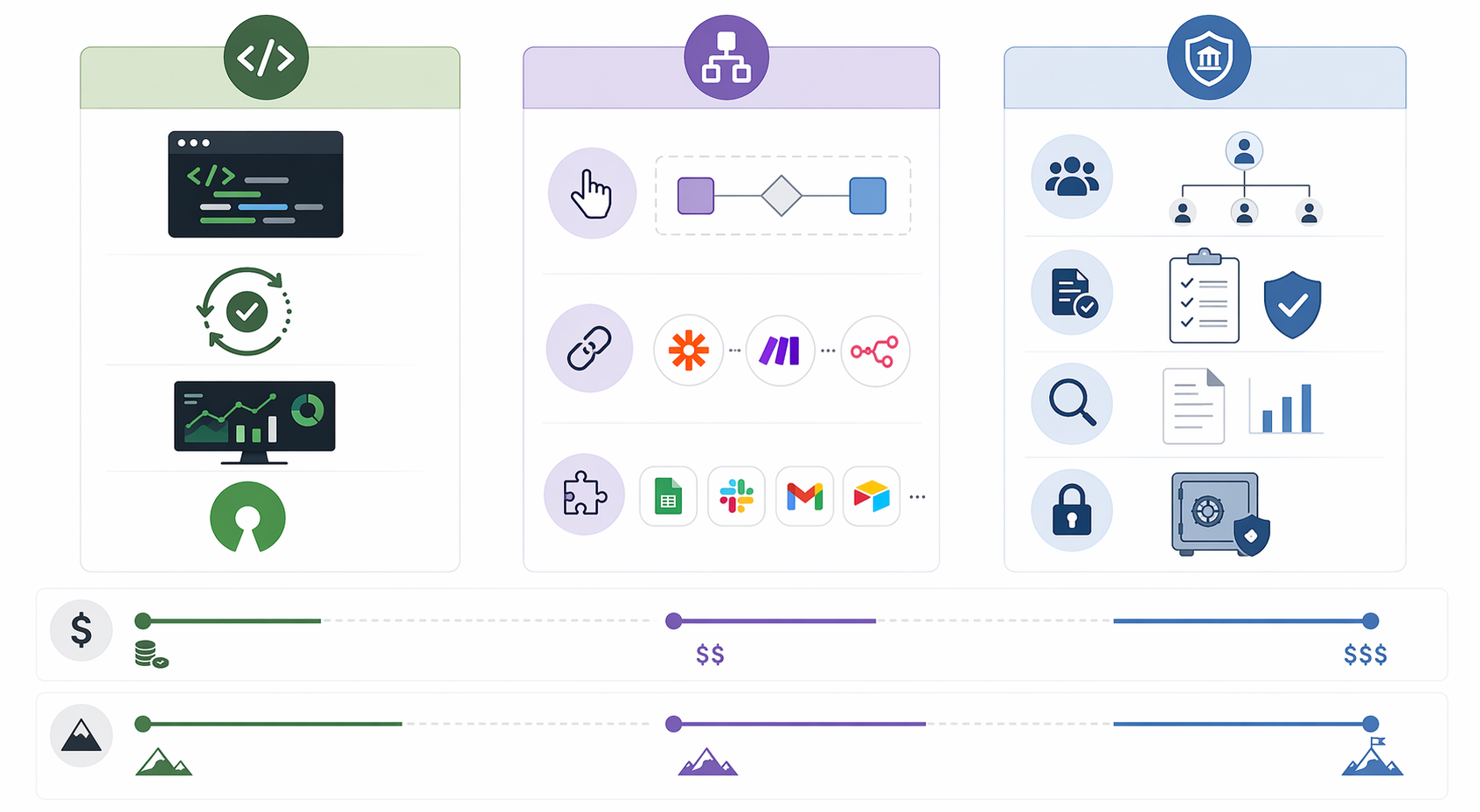
Enterprise Platforms: Camunda, ServiceNow, Pega, and Appian
Enterprise workflow orchestration platforms are built for environments where process design, security, auditability, role-based access, integration governance, and compliance matter as much as the workflow logic itself. Camunda is often evaluated where BPMN, process modeling, and technical orchestration intersect. ServiceNow fits organizations already standardizing IT service, operations, or employee workflows on the platform. Pega and Appian are stronger candidates when the buyer is modernizing complex case management, business processes, or low-code enterprise applications.
The tradeoff is cost and time. 2026 comparison sources consistently describe enterprise tools such as Camunda, ServiceNow, Pega, and Appian as custom-priced, commonly reaching thousands to tens of thousands of dollars per month, with implementation cycles that can run for months.[8][9][10] That is not automatically a strike against them. A regulated claims process, cross-border finance workflow, or shared-services intake model may need the governance those platforms provide. The mistake is buying that tier before the organization has the process discipline to use it.
Enterprise tools also shift the definition of maintenance. The maintainer is no longer just the person editing the workflow. It may be a platform owner, a process owner, an integration team, a security reviewer, an implementation partner, and a steering group deciding whether a change is safe. That overhead looks excessive when the workflow is simple. It becomes reasonable when the process touches customer commitments, financial controls, or regulated data.
The Hidden Cost Is Usually the First Broken Handoff
The worst workflow tool choice usually looks fine at purchase. The demo runs. The integration list checks out. The first automation works. The cost shows up later, when the workflow owner leaves, a vendor changes an API, a credential expires, a queue backs up, or a downstream team says the data is wrong and nobody can trace where it changed.
That is why observability is the production-readiness divider in 2026. Digital Applied, n8n, and BMC all emphasize that tracing multi-step failures is central to serious orchestration, especially as AI and distributed systems add more moving parts.[1][11][12] A prototype only needs to prove that a path can run. A production workflow needs to show which step ran, which step waited, which system returned an error, who was notified, whether a retry happened, and what data moved forward.
Open source makes this easier to underestimate because the invoice can be small while the responsibility is large. A team may choose self-hosted Airflow, n8n, or another open-source tool for good reasons: control, data residency, customization, or lower vendor dependency. The practical question is not whether open source is cheaper in the abstract. It is whether the team has someone who will patch it, monitor it, document it, back it up, and answer for it when a workflow becomes business-critical. For a deeper cost model, see Open Source Workflow Automation TCO.
Where AI Orchestration Fits
AI has made orchestration sound new again, but most AI workflow problems still reduce to ownership, state, visibility, and failure handling. The AI orchestration market is projected to grow from $9.76 billion in 2024 to $58.92 billion by 2033, according to Grand View Research.[13] Tools and frameworks such as LangGraph, CrewAI, Microsoft Agent Framework, Zapier AI, and n8n AI are changing quickly enough that current availability should be verified before a final shortlist.[11][14][12]
The important distinction is adoption versus scaled operation. Using AI inside a workflow is not the same as orchestrating AI-dependent work reliably across teams. Gartner projects that 75% of workflows will use generative AI to increase troubleshooting efficiency by 50% by 2029, as cited by BMC.[1] That is a reason to demand better traceability, not a reason to let an agentic demo bypass normal operating questions.
If the workflow depends on agents making decisions, calling tools, waiting for human review, or handing off to another system, the maintainer needs to see more than a successful run. They need logs, prompt and tool-call history where appropriate, retry behavior, exception paths, and a clear escalation route. The dedicated AI workflow orchestration tools comparison goes deeper on that segment.
A Practical Shortlist by Ownership Model
Choose Airflow when your workflows are scheduled, code-defined, and owned by data or platform engineers who can operate the stack. Choose Prefect when you want developer control with a more modern orchestration experience and less inherited Airflow machinery. Choose Temporal when durable execution and application-level reliability are the real problem, not just task scheduling.
Choose Zapier or Make when the work is mostly connecting business apps and the maintainers sit in operations, marketing, sales, support, or admin teams. Choose n8n when you need more technical flexibility than a typical no-code tool but do not want to build a full developer orchestration platform. Choose Wrike when workflow orchestration is tied closely to project execution and team coordination rather than system-level dependency management. Readers comparing business-ops tools may also want the no-code-first BPM workflow tools comparison.
Choose Camunda, ServiceNow, Pega, or Appian when governance is not optional: regulated processes, enterprise access controls, audit trails, shared-service models, complex case management, or organization-wide process standardization. If the main need is simply to reduce repetitive admin work, the broader process automation tools comparison may be a better starting point than enterprise orchestration.
Before signing, ask three questions that do not appear cleanly on a feature grid: who can safely change the workflow, who gets alerted when it fails, and what cost appears when the workflow runs ten times more often. The wrong feature set is annoying. The wrong operating tier is usually expensive.
References
- Workflow Orchestration: Enterprise Automation at Scale, BMC Software
- Workflow Orchestration Market Size Report 2026, The Business Research Company
- 2025 Global Survey on AI, McKinsey & Company, 2025
- 10 Best Workflow Orchestration Tools for 2026, Teamwork.com
- Top 10 Open Source Data Orchestration Tools 2026, Orchestra
- 10 Best Workflow Orchestration Tools Reviewed in 2026, The Digital Project Manager
- Workflow vs. Orchestration: What Engineers Must Know, n8n Blog
- Workflow Orchestration Tools: 9 Best Platforms Compared (2026), Elementum
- Best 7 workflow orchestration tools compared (2026), Enate
- AI Workflow Orchestration Platforms: 2026 Comparison, Digital Applied
- AI Orchestration Market Size & Share Report 2033, Grand View Research
- The 4 best AI orchestration tools in 2026, Zapier