
The cleanest answer to how screen time affects teen focus and productivity is also the least headline-friendly one: the link is real, modest, conditional, and mostly correlational. Total hours are a blunt measure. A single daily number can mix homework portals, note photos, music, group chat, gaming, streaming, dictionaries, school announcements, and the late-night scroll that keeps a teenager awake. Those uses do not carry the same evidence or the same consequence.
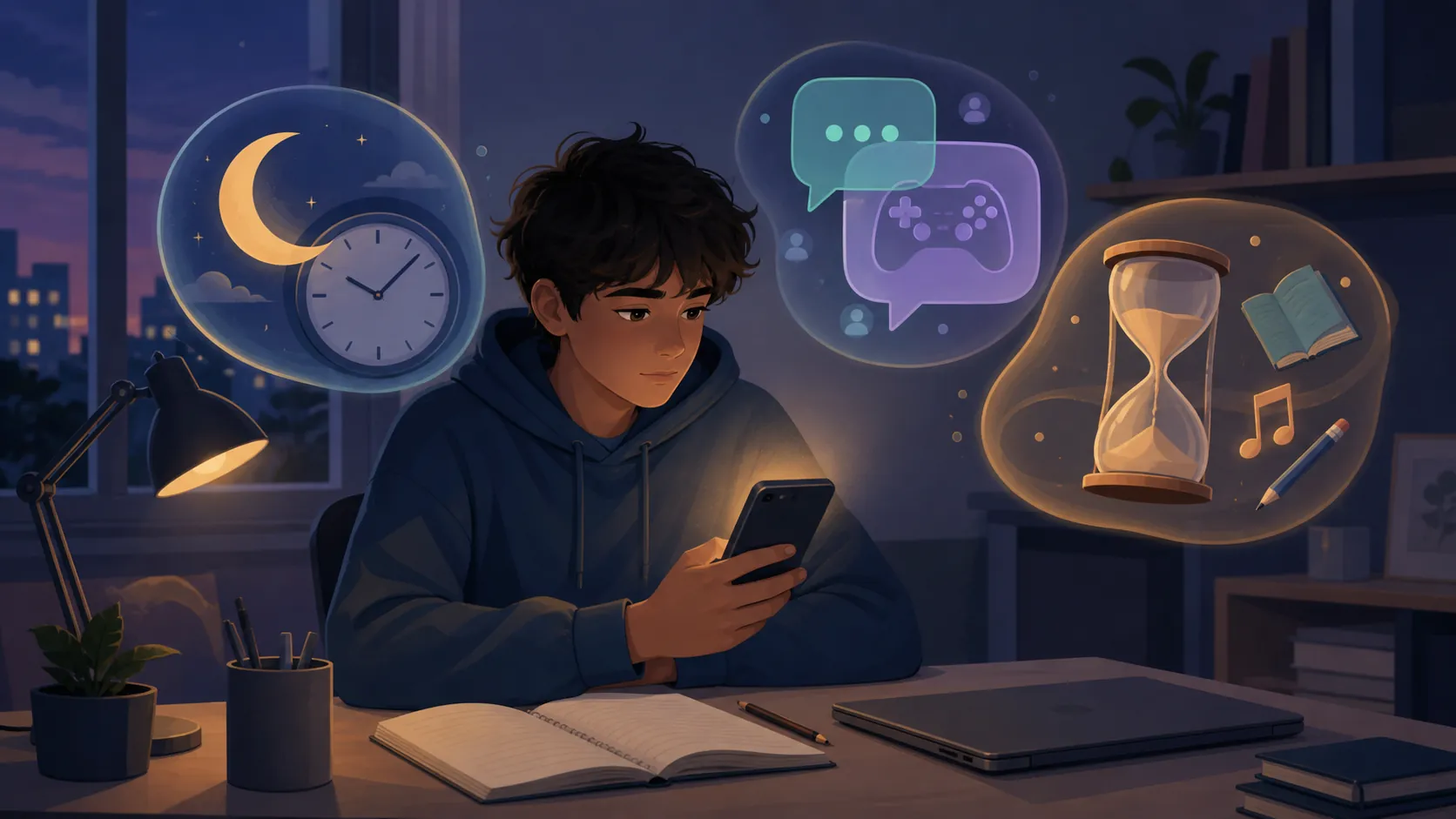
The better unit is not “screen time.” It is what kind of screen use, at what time, during what task, replacing what. The strongest evidence points to three mechanisms: sleep disruption, media multitasking during homework or classwork, and time displacement. The evidence does not support a confident causal claim that screens are damaging teen brains.
Evidence grade, before the argument
| Source | Sample | Design | Finding | Caveat |
|---|---|---|---|---|
| CDC Preventing Chronic Disease, 2025 [1] | 1,952 US teens ages 12–17 | Cross-sectional, self-reported association study | 50.4% reported 4+ hours/day of non-school screen time; high screen time was associated with depression symptoms, anxiety symptoms, and irregular sleep routines. | Association only. It cannot show that screen time caused the symptoms or the sleep routines. |
| JAMA Pediatrics systematic review and meta-analysis, 2019 [2] | 58 studies; 480,479 participants ages 4–18 | Meta-analysis | Overall screen media time showed no significant association with academic performance; television and video games showed small inverse associations, stronger among adolescents than children. | Academic performance is not identical to moment-by-moment focus, and included studies varied in measures and quality. |
| Children and Youth Services Review scoping review, 2025 [3] | 33 studies; ages 6–25 | Scoping review | Screen use had a small but consistent correlation with concentration difficulty; recreational media multitasking in school settings was consistently correlated with inferior learning; poor sleep was the clearest mediating pathway. | Mostly correlational evidence. Associations shrank after socioeconomic adjustment and may be bidirectional. |
| AAP Center of Excellence QA guidance, updated July 23, 2025 [4] | Expert guidance; no study sample | Review-based clinical guidance | Negative academic and mental-health effects are described as running through displacement and multitasking; entertainment uses such as streaming and gaming tend to pull longer attention shifts than quick email or search breaks. | Guidance, not a causal trial. It translates evidence for families rather than estimating an effect size. |
| APA Health Advisory on Social Media Use in Adolescence, May 2023 [5] | Expert advisory; no study sample | Review-based advisory | Causal findings are rare, long-term data are limited, and effects depend on content, features, and context; bedtime use is associated with sleep disruption, and teens need 8+ hours of sleep. | Focused on social media, not every form of screen use. |
| Upshaw et al., PLOS ONE, 2022 [6] | Lab participants; sample size not provided in the brief | Experimental notification study | Notification sounds slowed reaction times on easy trials but not demanding trials; higher smartphone-addiction proneness predicted slower responses and reduced early attention activation. | Lab distraction effects are measurable but narrow; they should not be inflated into whole-school causal claims. |
| Böttger et al., Behavioral Sciences meta-analysis, 2023 [7] | 22 studies; 43 effects | Meta-analysis | The mere presence of a smartphone had a small significant pooled negative effect on cognitive performance, driven mainly by memory; attention and general performance effects were not significant. | Small effect, marked heterogeneity, and not specific to every teen study situation. |
| Pew Research Center, 2024 [8] | US teens and parents; sample size not provided in the brief | Survey | 95% of US teens had smartphone access; 38% of teens said they spent too much time on their smartphone; 45% said smartphones made doing well in school easier. | Attitudes and self-reports, not productivity measurement. |
| Frontiers in Public Health CEPS study, 2025 [9] | 17,150 Chinese junior middle-school students | Correlational study using CEPS data | Screen time was negatively correlated with Chinese, math, English, and total academic scores; internet/gaming correlations were worse than TV. | China-context caveat. Generalizing to US or Western teens is a synthesis judgment, not the study’s direct claim. |
| Whiting and Murdock, Quarterly Journal of Experimental Psychology, 2021 [10] | Adolescents and adults; sample size not provided in the brief | Notification experiment, abstract-verified only | Adolescents showed greater compromise in math accuracy and reaction time, plus heart-rate-variability increases, in response to text alerts than adults. | Abstract-verified only here. Use cautiously, and do not treat it as a broad classroom estimate. |
| Cureus review, 2023 [11] | Review article; sample not provided in the brief | Review-based recommendation | Suggested discretionary screen-time limits ranging from 0.5–1 hour for ages 3–7 up to 2 hours for ages 16+. | One review’s suggestion, not a universal threshold and not the central standard for teen productivity. |
Why total hours are the wrong first fight
The 2019 JAMA Pediatrics meta-analysis is the useful guardrail here because it refuses to make “screen media time” do more work than it can. Across 58 studies and 480,479 participants ages 4–18, overall screen media time had no significant association with academic performance, with an effect estimate of −0.29 and a 95% confidence interval from −0.65 to 0.08 [2].
That does not mean screens never matter. The same meta-analysis found small inverse associations for television with composite academic performance, language, and math, and for video games with composite performance; the negative associations were greater for adolescents than for children [2]. The important move is narrower: activity type matters more than the broad screen-media average.
This is why a parent rule based only on daily hours can feel unfair and still be hard to enforce. A phone used to photograph the whiteboard, check a class portal, translate a word, or maintain a homework group chat is not the same exposure as two hours of autoplay video at midnight. Teens know this distinction. In Pew’s 2024 survey, 45% of US teens said smartphones made doing well in school easier, even while 38% said they spent too much time on their smartphone [8].
There is a practical implication for classrooms and homework rooms: regulate the part that interferes with the task. A tablet used as a notebook belongs in a different category from a phone buzzing through a math set. For study-tool context, that is also why comparisons of note-taking apps for students are only useful when they ask whether the tool supports the assignment rather than whether it technically counts as screen time.
The clearest pathway is sleep
Sleep is where the evidence becomes most usable. The CDC’s 2025 cross-sectional study found that US teens with 4 or more hours per day of non-school screen time had higher rates of irregular sleep routines than teens below that threshold: 49.2% versus 29.2% [1]. The same high-screen group also had higher reported depression symptoms, 25.9% versus 9.5%, and anxiety symptoms, 27.1% versus 12.3% [1].
Those are correlations, not proof of direction. A teen who is anxious may scroll more; a teen who scrolls late may sleep worse; a household under stress may produce both. The CDC paper is self-reported and cross-sectional, so it cannot settle causality [1]. But for a family trying to protect tomorrow morning’s attention, the pathway is concrete enough to act on without pretending to know more than the study can prove.
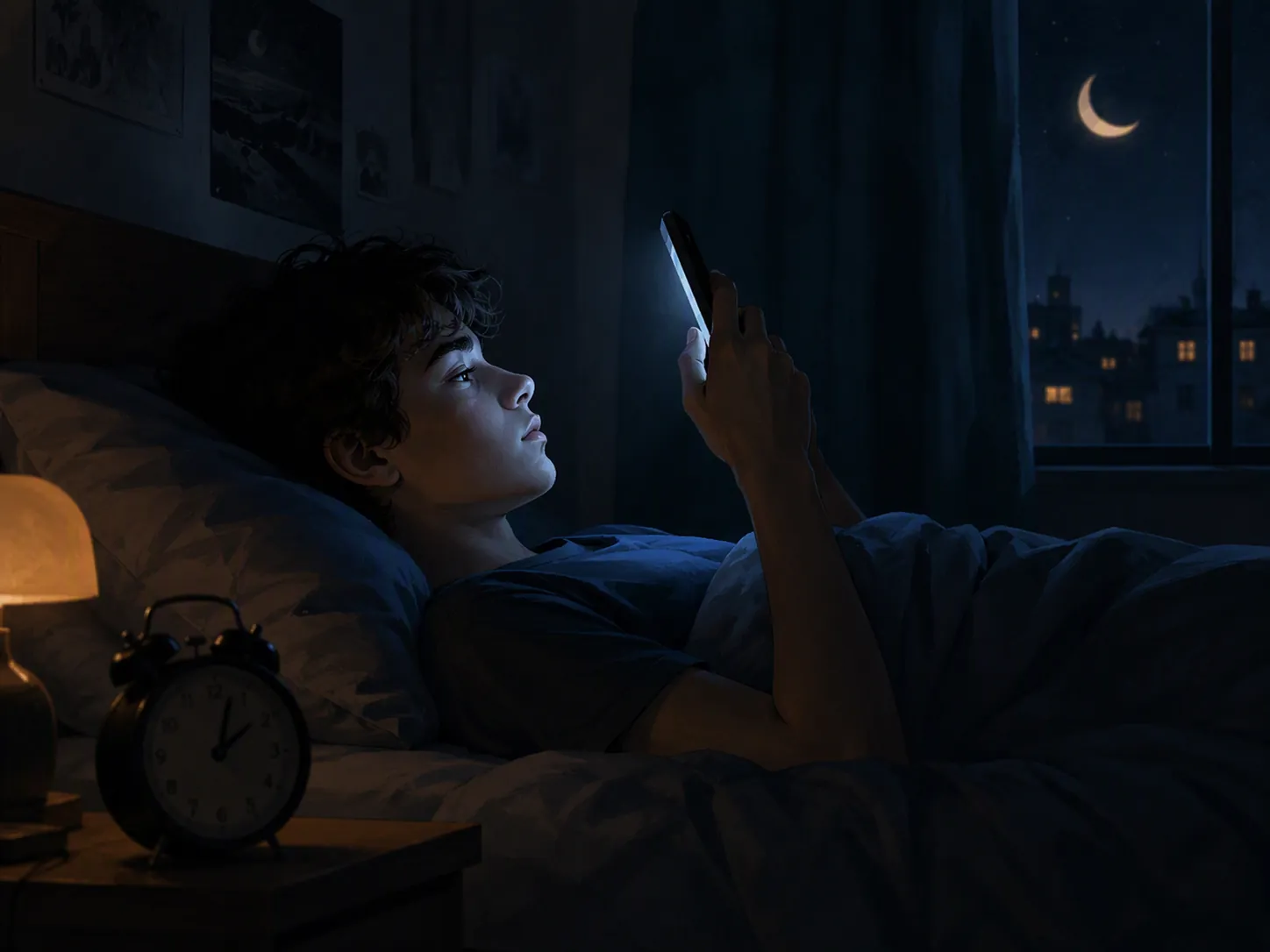
The 2025 scoping review reached a similar evidence-weighted conclusion: poor sleep was the clearest mediating pathway between screen use and concentration difficulty, while the overall screen-use-to-concentration association was small and mostly correlational [3]. The APA’s 2023 advisory also treats bedtime use as a sleep-disruption concern and notes that adolescents need 8+ hours of sleep [5].
This is where a rule can be both stricter and fairer than an all-day hour cap. Protecting the pre-bed period targets the condition most likely to spill into attention the next day. It also avoids punishing school-related daytime screen use just because it happens on the same device as entertainment.
Media multitasking is the homework problem
The second durable mechanism is not screen exposure by itself. It is switching. A teen reading, solving, outlining, or revising while notifications, videos, chats, and short-form feeds keep inviting task changes is working under a different load than a teen using one digital tool for the assignment.
The 2025 scoping review found that recreational media multitasking in school settings was consistently correlated with inferior learning [3]. The AAP’s 2025 guidance makes a useful distinction for parents: quick utility breaks such as email or search are not the same as entertainment uses such as streaming and gaming, which tend to pull longer attention shifts [4]. That distinction matches ordinary homework reality. Looking up a term is a brief tool use; checking one video platform can become a new activity.

Experimental evidence supports a smaller, narrower version of the same concern. In the 2022 PLOS ONE notification study, notification sounds slowed reaction times on easy trials but not demanding trials; higher smartphone-addiction proneness predicted slower responses and reduced early attention activation [6]. This is not evidence that every alert ruins studying. It is evidence that alerts can add friction, especially when the work is easy enough for attention to be pulled away.
The 2023 meta-analysis on smartphone presence also argues for restraint in both directions. Across 22 studies and 43 effects, the mere presence of a smartphone had a small significant pooled negative effect on cognitive performance, g = −0.14, with a 95% confidence interval from −0.24 to −0.03; the effect was driven mainly by memory, with non-significant findings for attention and general performance and marked heterogeneity [7]. A phone face-down on the desk is not a disaster. It may still be a small drag during memory-heavy work.
The strongest classroom and homework rule, then, is not “no devices ever.” It is “one task on the device, no entertainment layer, no avoidable alerts.” Focus mode, Do Not Disturb, app limits, and notification summaries are more evidence-aligned than a family argument about whether the homework took place on a screen. For device-level setup, FlowDesk’s guide to iOS lock-screen widgets for note apps is relevant only if the lock screen reduces checking rather than creating another place to browse.
Whiting and Murdock’s 2021 notification experiment is worth mentioning cautiously because it points in the same direction for adolescents, but the available brief here is abstract-verified only. It reported that adolescents showed greater compromise in math accuracy and reaction time, along with heart-rate-variability increases, in response to text alerts than adults [10]. Useful signal, limited access.
Time displacement is simpler than brain-drain language
The third mechanism is time displacement. Screens matter when they push out sleep, homework, reading, practice, movement, family obligations, or sustained work. This is less dramatic than a claim about dopamine or brain damage, but it is easier to observe and easier to regulate.

The AAP’s 2025 guidance explicitly frames negative effects through displacement and multitasking [4]. The APA’s 2023 advisory similarly emphasizes context, content, and features rather than treating all social media use as a single exposure [5]. For productivity, that means the question becomes: what did the screen session replace?
The 2025 CEPS study from China supports this pattern but should not carry more weight than it can bear in a US parenting argument. Among 17,150 Chinese junior middle-school students, screen time was negatively correlated with Chinese, math, English, and total scores; internet and gaming had worse correlations with total achievement than TV, with β −0.148 versus β −0.123 [9]. That is a correlational academic-achievement finding in a specific education context, not a universal causal estimate for all teens.
Still, it lines up with the broader evidence: the risk is not that every screen minute carries the same cognitive penalty. The risk is that some screen sessions take the hours when sleep, reading, practice, or uninterrupted homework would otherwise happen.
What the evidence does not justify
It does not justify “screens are ruining teen brains.” The APA advisory is explicit that causal findings are rare and long-term data are largely unavailable [5]. The CDC data are cross-sectional and self-reported [1]. The scoping review describes small correlations, socioeconomic confounding, and possible bidirectionality [3]. The lab studies show measurable distraction under particular conditions, not a sweeping causal account of school failure [6][7].
It also does not justify treating a universal hour limit as the main scientific answer. One 2023 review suggested discretionary limits ranging from 0.5–1 hour for ages 3–7 up to 2 hours for ages 16+ [11]. That can be a family starting point, especially for recreational use, but it should not be mistaken for a research-set threshold at which teen focus suddenly drops.
The awkward but more honest standard is situational. A teen using a phone as a planner or dictionary during homework is not in the same position as a teen toggling between algebra, group chat, a game, and short videos. A student reading on a tablet at 4 p.m. is not in the same position as a student scrolling in bed after midnight. The device is the same; the mechanism is not.
A defensible standard for parents and educators
If the goal is focus and productivity, the evidence supports regulating timing, context, and task interference before obsessing over total hours. Protect the pre-bed period because sleep is the clearest pathway. During homework, remove avoidable notifications and separate entertainment from the study task. Treat media multitasking as the problem, not every digital tool. For younger adolescents, the APA’s advisory supports monitoring and developmentally appropriate limits, especially around ages 10–14 [5].
That standard is enforceable because it can be seen: phone out of the bedroom before sleep, focus mode during homework, one study tool open at a time, entertainment after the work block rather than braided through it. It is also fairer to the teen who is genuinely using a device to do schoolwork. The research case is not “less screen time at all costs.” It is fewer late-night screens, fewer interruptions during sustained work, and fewer recreational sessions that crowd out the work or sleep the next day depends on.
References
- Associations Between Screen Time Use and Health Outcomes Among US Teenagers, CDC Preventing Chronic Disease, 2025
- Association Between Screen Media Use and Academic Performance Among Children and Adolescents: A Systematic Review and Meta-analysis, JAMA Pediatrics, 2019
- Leonhardt et al. scoping review on screen use and concentration difficulties, Children and Youth Services Review, 2025
- Effects of Screen Time on Academic Performance and Mental Health, American Academy of Pediatrics, July 23, 2025
- Health Advisory on Social Media Use in Adolescence, American Psychological Association, May 2023
- Upshaw et al. smartphone notification experiment, PLOS ONE, 2022
- Böttger et al. meta-analysis on smartphone presence and cognitive performance, Behavioral Sciences, 2023
- How Teens and Parents Approach Screen Time, Pew Research Center, March 2024
- Frontiers in Public Health CEPS study on screen time and academic achievement, Frontiers in Public Health, 2025
- Whiting and Murdock notification study, Quarterly Journal of Experimental Psychology, 2021
- Effects of Excessive Screen Time on Child Development: An Updated Review and Strategies for Management, Cureus, 2023