
The spring daylight saving time slump feels too specific to be dismissed as laziness. You sit down at the same desk, open the same queue, and the first hour or two of the workday has more drag than it should. The evidence says that feeling is not imaginary. It also says the popular explanation is usually too crude. The useful question is not whether daylight saving time affects productivity and daily routines at all. It is how much work changes, when it changes, and how long the effect survives after the clocks move.

The best evidence for a workday effect is not a survey about how people feel. It is a behavioral study of software developers, where the timestamped work record is clean enough to show the shape of the disruption. That matters, because “one lost hour” is the wrong unit. The spring transition does not simply remove sixty minutes and then hand the day back intact. It dents daily output briefly, and it appears to hit early-morning work for longer.
The cleanest productivity signal comes from GitHub, and it points to the morning
The load-bearing study here is Dickinson and Waddell’s analysis of hourly GitHub activity. The researchers looked at 174,505 GitHub users from 2013 through 2019 and compared activity around the spring and fall daylight saving time transitions. The sample is narrow by design: software developers who leave visible digital traces on GitHub. That is not “all knowledge workers,” and it is definitely not nurses, teachers, warehouse supervisors, or attorneys whose most important work may never appear in a timestamped repository. But for distributed software work, it is unusually direct evidence of actual behavior rather than remembered fatigue or office folklore.[1]
The daily result is modest but real: after the spring transition, GitHub activity declined for one to two days. If that were the whole story, the practical conclusion would be simple: expect a rough Monday, maybe Tuesday, and move on. The hourly analysis is what makes the study more useful. Activity between 8 a.m. and 10 a.m. stayed degraded into a second week after the spring shift, even after the broader daily dip had faded.[1]
That distinction changes the operational reading. A team may not look ruined on paper after the first day or two. Tickets still move. Pull requests still open. Meetings still happen. But the first serious work block of the day can remain weaker than normal. For people who depend on a protected morning — writing code, reviewing architecture, doing analysis, making judgment calls before Slack turns the day into confetti — that is not a cosmetic effect.
It also explains why both common reactions are bad. “It’s only one hour” misses the observed persistence in the 8–10 a.m. block. “DST destroys productivity” ignores the time window: the full-day decline is short, and the lingering signal is concentrated. If the evidence is allowed to stay that specific, it becomes more actionable. The spring change is not a month-long alibi. It is a short disruption with a morning tail.
Why hourly evidence is better than a headline average
A daily average can hide where the day actually breaks. If a developer loses traction at 8:30 a.m. but catches up with lower-value work after lunch, the daily count may look less alarming than the morning felt. If the team’s highest-leverage work normally happens before standup, a small daily decline can still land in an expensive place. The GitHub study’s hourly view makes that visible without needing to invent a grand theory about motivation.
There is a limitation baked into that strength. GitHub activity is not the same thing as good engineering judgment. A useful design review, a difficult debugging conversation, or a decision not to ship a bad change may not show up as neat activity. Still, timestamped behavioral logs are harder to hand-wave away than self-reports. For this question, I would rather start with a trace of what people did than a dramatic estimate of what the economy supposedly lost.
More time at work does not mean more output
The second important productivity finding complicates the tidy “lost hour” story from another direction. In work by Joan Costa-i-Font discussed by LSE, roughly 30,000 individuals were followed from 1984 through 2018. After the spring transition, people worked about 40 more minutes on Mondays, with unchanged start times, while output did not rise accordingly. The same work reports a life satisfaction decline of about 1.44% after the spring change.[2]
That is the kind of result operations teams should take seriously. The problem is not only that people may do less. It is that they may stay longer to get roughly the same or worse result. A calendar shock becomes a friction tax: more minutes spent at the desk, less useful work per minute, and a worse day around it.
The welfare-dollar conversion in that same line of research — estimated gains equivalent to about 754 EUR per capita per year from ending DST — belongs in a different drawer.[2] It may be useful in policy debate, where governments need comparable units. It is not the number I would use to decide whether Tuesday’s planning meeting should move. For daily work, the more concrete result is simpler: after the spring shift, people may spend more time working without getting a matching increase in output.
The safety evidence supports an alertness problem, not a precise office-productivity bill
The productivity evidence is stronger when it stays close to measured work. The safety and health evidence still matters, because it shows that the transition is not merely a bad mood with a clock attached. A Johns Hopkins explainer summarizes research finding about a 6% increase in fatal traffic crashes after the spring transition, with the effect worst in the morning and in western parts of time zones. It also summarizes evidence of about an 8% increase in ischemic stroke in the first two days after the transition, based on more than 3,000 hospitalizations.[3]
Those findings should not be laundered into a claim that every office loses 6% productivity or that every worker’s cognitive output drops by 8%. They do not measure code quality, meeting usefulness, sales calls, writing speed, or decision accuracy. They do support the narrower claim that the spring shift has measurable biological and attention costs, especially around the morning window where the GitHub data also shows weakness.
Survey data adds texture, not proof. In a 2019 American Academy of Sleep Medicine survey of 2,003 U.S. adults, 55% said they felt tired after the spring daylight saving time transition; the survey reported a margin of error of ±2 percentage points at a 95% confidence level.[4] A later AASM resource reports that 63% of respondents supported eliminating seasonal time changes.[5] Those are useful signals about how common the experience feels. They are not output measures.
Which claims I would not treat as direct productivity evidence
This is where daylight saving time coverage often gets sloppy. A policy claim, a sleep-loss claim, and a work-output claim may all be true in their own lanes, but they are not interchangeable. If the question is what the spring transition does to a knowledge worker’s day, the evidence should be sorted by what it actually measured.
| Claim type | What it can support | What it cannot support |
|---|---|---|
| Hourly GitHub activity around DST | A measured dip in software-developer activity after spring DST, with 8–10 a.m. weakness lasting into a second week.[1] | A universal estimate for all workers or all forms of knowledge work. |
| Worked-hours and life-satisfaction research | Evidence that people may work longer on post-transition Mondays without matching output gains.[2] | A simple rule that every worker loses exactly 40 minutes of productive time. |
| Crash and stroke findings | Evidence that the spring transition has measurable alertness and health costs.[3] | A direct percentage estimate of office productivity loss. |
| Tiredness and policy-support surveys | Evidence that many people report fatigue and favor ending clock changes.[4][5] | Proof of actual work-output loss. |
| Large chronic sleep-loss cost estimates | Policy context about the economic burden of insufficient sleep. | A DST-specific cost for the Monday after the clock change. |
The American Academy of Sleep Medicine’s position statement favoring permanent standard time belongs in the policy context, not in the work-output column. It argues from circadian alignment and public health, and the position has been endorsed by multiple organizations.[6] That is relevant background for why the debate exists. It is not, by itself, a measurement of how many tasks a team completes after the spring change.
A caution also cuts the other way. A 2025 medRxiv systematic review, with a published version reported in the European Journal of Epidemiology in 2026, found no or limited effects of DST onset on several non-sleep outcomes.[7] I would treat that as a brake on catastrophic claims. It does not erase the GitHub finding, the Monday worked-hours finding, or the safety signals. It does argue against turning daylight saving time into a catch-all explanation for every bad week in March.
The same caution applies to big economic numbers. PBS coverage has carried the RAND estimate of roughly $411 billion in annual U.S. costs from chronic sleep deprivation, along with discussion of sleep loss around DST.[8] Chronic sleep deprivation is a serious productivity issue. It is not the same as a DST-specific workday estimate. If that number appears under a headline about the spring clock change, it should be read as sleep-policy context, not as the bill for one Monday.
What to protect after the spring change
For an individual worker or a team lead, the evidence points to a modest adjustment, not a ritual overhaul. The most defensible move is to protect the first few mornings after the spring transition, especially the 8–10 a.m. block. Do not schedule the hardest review, the contentious planning meeting, or the work that requires quiet judgment at the exact point where the behavioral evidence shows the most persistent drag.
- Move high-stakes morning decisions later for several days after spring DST when possible.
- Keep the Monday task list narrower than usual; the Costa-i-Font result is a reminder that longer hours do not guarantee more output.
- Use the 8–10 a.m. block for lower-risk startup work if your role allows it: triage, reading, environment setup, or small reversible tasks.
- Avoid interpreting one rough morning as a character flaw. Also avoid letting one rough morning become a month-long excuse.
If you want tactics rather than evidence, FlowDesk already has more practical pieces on sleep conditions and next-day focus, Monday routines versus motivation, and a simple Monday kickoff system. The important thing for this audit is scale: the spring disruption is real enough to plan around, but not big enough to rebuild your entire operating system around.
Why fall is different
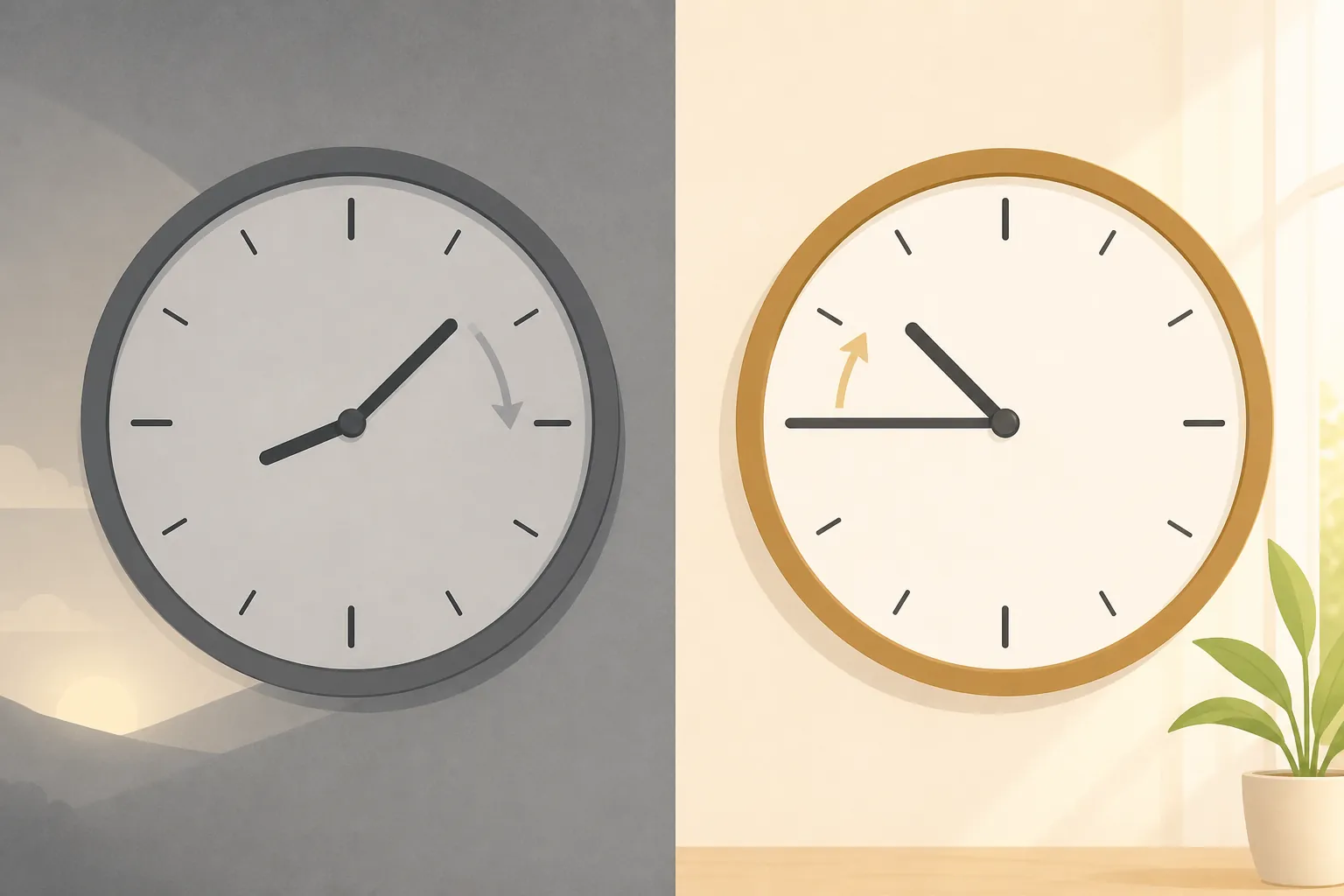
The fall transition is often described as the mirror image of spring: lose an hour in March, gain an hour in November. The GitHub evidence does not support treating the work effect as a simple reversal. In the fall transition, early-morning productivity recovered rather than showing the same kind of degradation seen after spring DST.[1]
That matters in Q3 2026 because the U.S. spring transition has already passed, and the fall-back change on November 1 is approaching. The best available work-output evidence suggests that fall should not be managed as spring with the sign flipped. The concern is not a lingering early-morning productivity hole of the same kind. For many workers, the more practical fall issues are routine disruption, schedule coordination, and the usual mess of clocks, children, commutes, and meetings adjusting at different speeds.
The evidence-backed answer
Spring daylight saving time affects productivity, but the measured effect is narrower than the loudest claims. In the best direct work-behavior evidence available here, daily GitHub activity falls for one to two days after the spring transition, while 8–10 a.m. activity remains degraded into a second week among the software developers studied.[1] A separate long-run study finds that people may work about 40 more minutes on post-transition Mondays without a matching output gain, which is exactly the kind of quiet inefficiency that gets missed when teams only count hours at the desk.[2]
So the practical judgment is bounded. Protect early-morning work for several days after spring DST, and be especially careful with the 8–10 a.m. block. Do not dismiss the slump as imaginary. Do not promote it into a season-long productivity myth. Last verified: August 25, 2026.
References
- Productivity losses in the transition to Daylight Saving Time: Evidence from hourly GitHub activity — Journal of Economic Behavior & Organization, November 2024.
- End daylight saving time — LSE Research for the World.
- 7 Things to Know About Daylight Saving Time — Johns Hopkins Bloomberg School of Public Health, 2023.
- Survey: 55% of Americans Feel Tired After Daylight Saving Time Transition — American Academy of Sleep Medicine.
- Daylight Saving Time — Sleep Education.
- Daylight saving time: an American Academy of Sleep Medicine position statement — Journal of Clinical Sleep Medicine.
- Daylight saving time and health outcomes: a systematic review and meta-analysis — medRxiv, 2025.
- Daylight saving time causes lower productivity and higher health care costs, studies say — PBS NewsHour.