
If you are choosing a note-taking app in Q3 2026, Amazon's AI reorganization is not a reason to move your archive this week. It is a reason to add a new line to the comparison sheet. On July 28, 2026, Amazon reportedly began winding down most of its Nova model lineup, consolidated frontier model research under Pieter Abbeel's FMR group, and pointed toward a new flagship model expected at re:Invent in December 2026.[1][2] For anyone comparing note-taking applications, Amazon's new frontier model under Pieter Abbeel matters because it may shift the practical question from “Which app has the nicest AI button?” to “Which app can hand a model the largest coherent version of my actual notes?”
That distinction is not cosmetic. A note archive is not a stack of clean documents waiting for a demo. It is old meeting notes, half-finished research, PDFs, pasted quotes, backlinks, tags, embedded images, daily logs, database rows, and the occasional sentence that only makes sense because of a link written three years ago. If a frontier model can reliably read much more context, the winning note system is not automatically the one with the most polished AI sidebar. It is the one that can expose the most intact, portable, user-owned context without turning the archive into a brittle export project.

What Amazon Has Actually Changed
The confirmed news is narrower than the temptation around it. Amazon has not announced a note-taking product, has not said the December model will target personal knowledge management, and has not published specifications for that unshipped flagship model. The fresh fact pattern is organizational and strategic: fewer parallel Nova bets, more concentration around frontier capability, and Abbeel's group becoming the center of that work.[1][2]
Abbeel's appointment matters here because Amazon's own leadership update placed him in charge of frontier model research, not because his biography needs to become the story.[3] The more useful signal is what kind of capability already sits near this strategy. Amazon's Nova documentation says Nova Premier supports a one-million-token context window, with long-context inputs described as 300,000 to one million tokens of text, 500 images, or 90 minutes of video.[4] That is a current, checkable capability, not a December promise.
The other signal is technical, not product-specific. Ring Attention, a 2024 ICLR paper co-authored by Hao Liu, Matei Zaharia, and Pieter Abbeel, describes a way to distribute key-value blocks across a ring of GPUs to support extremely long contexts.[5] In a Business Insider interview about the work, Liu said that with 256 GPUs, a 16,000-token baseline could become four million tokens.[6] That does not prove Amazon's December model uses Ring Attention. It does show why Abbeel's consolidation is interesting to people who care about long-context systems rather than just chatbot packaging.
Amazon also has a competitive reason to swing hard. In June 2026, Amazon's AI chief told CNBC the company hoped to catch OpenAI and Anthropic in the “coming year.”[7] That context explains the size of the bet, but it does not answer the note-app question by itself. The note-app question starts where the model announcement ends: if context becomes cheaper and larger, which archives can actually be read?
Long Context Changes the AI-Readiness Test
Most AI note features have been judged at the surface: summarize this page, rewrite this paragraph, extract action items, draft a follow-up, answer a question against selected notes. Those features are useful, but they often work around context limits by searching, chunking, embedding, retrieving, and then hoping the right pieces arrive in the model input.
A much larger context window does not remove the need for retrieval, ranking, or permissions. It does change the penalty for bringing more of the archive along. If a model can accept a whole project folder, a year of daily notes, or a large slice of a vault in one pass, the app's storage model becomes part of the AI feature. The file format, link structure, attachment handling, export path, and plugin surface decide whether the model sees a coherent working memory or a pile of scraped fragments.
| Old AI-note comparison question | Long-context comparison question |
|---|---|
| Can the app summarize the current note? | Can the app expose the related notes, backlinks, files, and project history together? |
| Does the app have a built-in AI assistant? | Can the user route their archive to the best available model without waiting for the app vendor? |
| Does search find the right snippets? | Can the model read enough source material that retrieval mistakes matter less? |
| Is export available? | Is export complete enough for AI use, including links, attachments, and structure? |
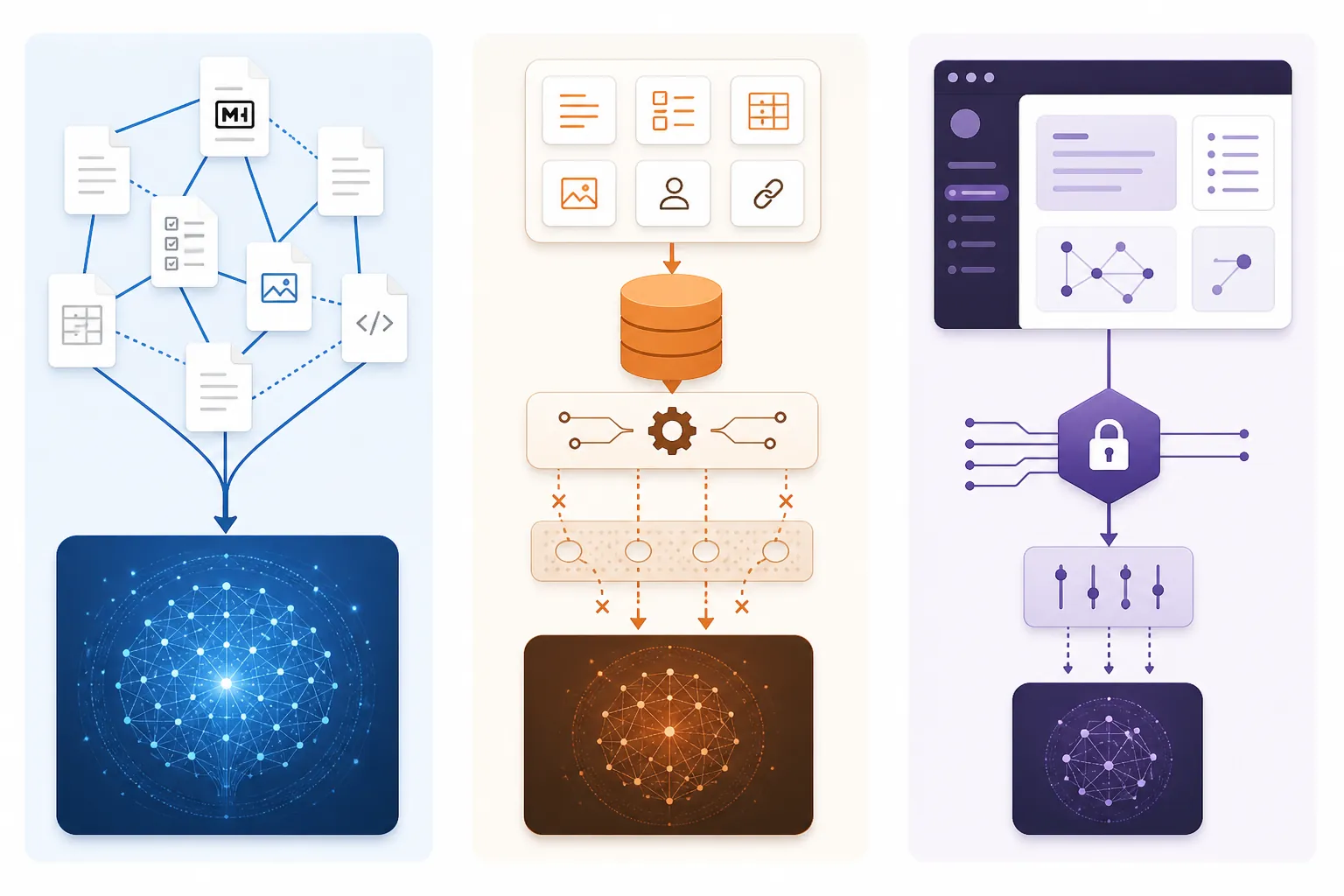
This is where note-taking architecture becomes more important than feature-page language. A markdown folder can be inspected, scripted, versioned, zipped, indexed, and passed to a model pipeline with relatively little ceremony. A proprietary database can still power excellent AI features, but the user is depending on the vendor's interpretation of what the model should see, how much it may see, and which model is allowed to see it.
Why Obsidian and Logseq Are Structurally Better Positioned
Obsidian and Logseq are not automatically better AI products than every cloud notebook. Their advantage is more basic: plain markdown makes the archive legible outside the app. The notes are files. Links are text. A vault can be opened by other tools, processed by scripts, indexed locally, synced through user-chosen systems, and exported without waiting for a vendor to expose a special AI endpoint.
That matters more as context windows grow. With a small context window, every app has to select aggressively. With a very large one, an Obsidian or Logseq user can plausibly use a script or plugin to gather a whole folder, connected backlinks, recent daily notes, and relevant attachments into a model-ready bundle. The hard work becomes governance: which files are included, which private notes are excluded, which attachments are converted, and which model receives the context.
Obsidian's plugin-based model also gives users more paths to adapt when frontier model economics change. A user does not need Obsidian itself to negotiate every model integration if the vault remains accessible to plugins and external tools. That same flexibility is why the Obsidian-versus-Notion AI decision is less about taste than control; FlowDesk's Obsidian vs Notion for AI Notes comparison goes deeper on the native-cloud versus plugin-based split.
Logseq has a similar long-context shape because its graph is also grounded in local files. Its outlining model may require different preparation than a folder of prose notes, but the archive is still inspectable. For AI use, that is the difference between asking permission from an app and pointing an external model at a corpus the user already controls.
This does not make markdown magical. A messy vault remains messy. Broken embeds, duplicate pages, unclear filenames, and inconsistent aliases can still confuse a model. Long context lets more material fit; it does not decide what belongs together. The structural advantage is that the owner can clean, transform, and route the archive without first extracting it from a proprietary system.
Notion Has Product Strength, but the Context Boundary Is Different
Notion deserves a more cautious reading. Its strength is product integration: pages, databases, collaboration, permissions, and AI features live in one managed environment. For teams, that can be exactly the point. The app can know where work happens because the work is already inside its system.
The long-context question is less flattering. Notion's database structure is powerful inside Notion, but it is not the same as a folder of plain text. The user generally experiences AI through Notion's managed surface, not by freely deciding that today's best frontier model should read a complete exported workspace with all relationships intact. That may be acceptable for many teams. It is still a different bargain from owning a markdown vault.
The practical risk is not that Notion cannot add strong AI features. It can. The risk is that the shape of the AI feature is determined by Notion's product decisions: what counts as accessible context, how database relations are represented, which model is used, and whether the user can move the same knowledge base into another model setup without loss. For a reader already worried about migration, that is the part worth testing before committing years of notes.
This is also where AI safety and portability start to overlap. A reader leaving a managed workspace for a local-first vault is often trying to reduce dependency on a vendor's policy, model choice, or export fidelity. FlowDesk's Notion-to-Obsidian AI safety migration guide covers that migration pattern in more detail.
Tana, Mem, and AI-Forward Systems Sit Behind Their Own Mediation Layer
Tana and Mem belong in a different bucket from Obsidian and Logseq. They are AI-forward systems where structure, capture, and retrieval are part of the product promise. A July 2026 Tana landscape piece presents current AI note-taking apps through that feature-oriented lens, with attention to tools that organize, summarize, and retrieve knowledge inside their own environments.[8]
That can produce a smoother daily experience than a hand-built markdown setup. The trade-off is mediation. The app's data model and API decide what the model can see. The user may get a strong assistant inside the product, but not necessarily a clean way to expose the whole knowledge base to whichever frontier model becomes strongest next quarter.
This distinction is easy to miss because AI-forward apps often feel more advanced in short demos. They capture quickly, infer structure, and answer within the boundaries they control. Long context rewards a different property: the ability to move a large, coherent body of notes across model boundaries. A closed or tightly mediated system can still compete, but it has to prove that its export, API, and permission model preserve enough context to matter.
Where Apple Notes, Reflect, and the Rest Fit
Apple Notes, Reflect, and the broader AI-note field should not be forced into the center of this Amazon story. They still belong on a buying shortlist for reasons that may matter more than long context: platform fit, capture speed, privacy posture, mobile reliability, collaboration, aesthetics, and price. FlowDesk's broader best note-taking software 2026 guide is the better place for that wider comparison.
For this narrower decision, the same test applies: can the user get complete, well-structured notes out, and can those notes be routed to an external model without destroying the relationships that made the archive valuable? If the answer is unclear, the app may still be good software. It is just not obviously long-context-ready.
A Practical Test Before You Move Anything
The useful response to Amazon's pivot is not panic migration. It is a more demanding trial. Before moving a serious archive into any note app, test what happens when the archive has to leave and be read elsewhere.
- Export a representative project, not a clean sample note. Include backlinks, attachments, tags, tables, and daily notes.
- Open the export outside the original app and check whether the structure still makes sense to a human.
- Ask whether a script or plugin could gather related files into one model input without vendor approval.
- Check whether private notes, client material, and personal journals can be excluded before any AI tool runs.
- Treat a built-in AI sidebar as a convenience layer, not as proof that the underlying archive is portable.
A hypothetical example makes the difference plain. Suppose a researcher wants an AI to review several years of notes on one client project. In a markdown vault, a script or plugin can gather the project folder, linked meeting notes, selected daily notes, and converted attachments into a single bundle, then send that bundle to a model the user chooses. In a managed database app, the same request may depend on the app's own AI feature, export format, and API limits. The second path may be easier today; the first path is usually more adaptable when the best model changes.
The Bounded Answer for Q3 2026
Amazon's July 2026 move changes the note-taking app decision, but only in a bounded way. It does not make the unshipped December flagship model a reason to migrate now. It does make long-context compatibility a visible comparison criterion beside privacy, price, platform support, collaboration, local-first defaults, plugin ecosystems, and export lock-in.
The current evidence supports a cautious conclusion. Nova Premier already documents a one-million-token context window.[4] Ring Attention shows a credible technical path toward multi-million-token contexts, and Abbeel is now leading Amazon's frontier model research.[3][5][6] Amazon has not confirmed that the December model uses Ring Attention, and note-taking has not been announced as a target use case. Last checked: July 30, 2026.
For readers choosing now, Obsidian and Logseq have the cleaner long-context architecture because plain markdown keeps the archive inspectable and portable. Notion remains strong where managed collaboration and integrated product polish matter more than raw model portability. Tana and Mem remain interesting AI-forward systems, but their own data models and APIs mediate what any frontier model can see. The safer bet is not the app with the loudest AI roadmap. It is the one that lets your notes survive the next model shift with their links, attachments, and context still intact.
References
- Amazon overhauls its AI strategy, winding down most flagship models, Business Insider, July 28, 2026.
- Amazon winds down most flagship AI models in strategy overhaul, Reuters, July 28, 2026.
- Andy Jassy's leadership update, About Amazon.
- Prompting with long context, Amazon Nova Docs.
- Ring Attention with Blockwise Transformers for Near-Infinite Context, ICLR 2024.
- Google researcher: AI models can analyze millions of words at once, Business Insider.
- Amazon AI chief: Hope to catch OpenAI, Anthropic in the 'coming year', CNBC, June 2026.
- Best AI note-taking apps in 2026, Tana, July 2026.