
A note-app roundup that says “tested and ranked” appears to answer the question a switcher cares about: which tool performed best in real work. But the label only carries weight if the testing is visible. In the 2026 Storyflow roundup, Storyflow ranks its own product first with a score of 9.2/10, while the article is published by the vendor and provides no independent testing protocol or evidence from people who actually moved their archives.[1]

That does not prove Storyflow’s product is poor, or that every statement in the article is false. It establishes something narrower and more important: the roundup cannot, by itself, show that changing note apps will leave a user with a better working system. A feature ranking and a migration result are different kinds of evidence.
The ranking has a credibility problem before the features are compared
Storyflow’s “tested for real knowledge work” framing invites readers to imagine a hands-on comparison: several products, a consistent set of tasks, and an account of what happened when each tool was used. What the available material shows instead is a vendor-authored list that places the author’s own product at number one. There is no user-switching survey, migration case, archive-size description, or independent test record showing what users transferred, what structure survived, or how much repair followed.
The same pattern appears in Tana’s “best AI note-taking apps” list. Tana’s own blog compares Notion AI agents with Tana and places Apple Notes in a capture-first category, but it does not provide a user survey, a documented migration, or an independent testing protocol.[2] The article may be useful as a statement of how Tana wants the market categorized. It is not evidence that switching from Notion, Apple Notes, Obsidian, or another system produced a better outcome.
The gaps are also revealing in what they do not let us conclude. Obsidian appears only as a rated row in the retrieved passages. Logseq does not appear in those passages, but that provides no evidence for or against Logseq’s AI capabilities. More broadly, the absence of a switching survey or migration case in the sources reviewed here does not prove that no such evidence exists elsewhere. It means these roundups do not supply it.
AI usefulness after a move is a separate question
AI may still be useful once a migration has already been justified. It can assist with repetitive cleanup, restructuring, or setup work after the data is in its new home; that is a post-migration workflow question, not proof that the destination app deserves the upheaval. FlowDesk’s coverage of AI-assisted post-migration setup addresses that narrower use.
The switching claim needs a harder test. “This app has an AI assistant” describes a capability claim. “This assistant makes switching worthwhile” is a claim about the net result after export, import, cleanup, learning time, privacy exposure, and ongoing dependence are counted. The retrieved rankings do not measure that chain of consequences.
Use decision axes that can survive independent checking
A more durable comparison starts with the system around the AI feature. Three questions are particularly practical:
- Where does the archive live and how does the app synchronize it: in a local-first vault, in a cloud service, or across a combination of both?
- What privacy commitments and data-handling arrangements apply to notes sent to the service or processed by its AI features?
- What does an export preserve, and what does it turn into plain text, detached files, or missing structure?
These questions do not make the choice automatic. They make it inspectable. FlowDesk’s comparison of export formats, lock-in, and data portability is a useful place to examine the migration side, while its discussion of local-first versus cloud tools and privacy keeps the architecture and ownership questions visible.

Export is where an attractive feature meets a real archive
Export deserves more attention than it usually receives in AI rankings because it exposes the difference between a note and a note system. A page that looks complete inside an application may depend on relations, rollups, embedded views, toggles, attachments, backlinks, or other application-specific structures. If those relationships disappear during export, the user has not merely changed interfaces; they have inherited reconstruction work.
The available secondary comparison reports that Notion’s Markdown export flattens relations and rollups and loses embedded views and toggles.[3] That is a concrete portability warning, although it should be treated as a secondary-source finding rather than vendor documentation. The source does not establish how every attachment behaves, so attachment handling should be tested separately rather than inferred from the Markdown result.
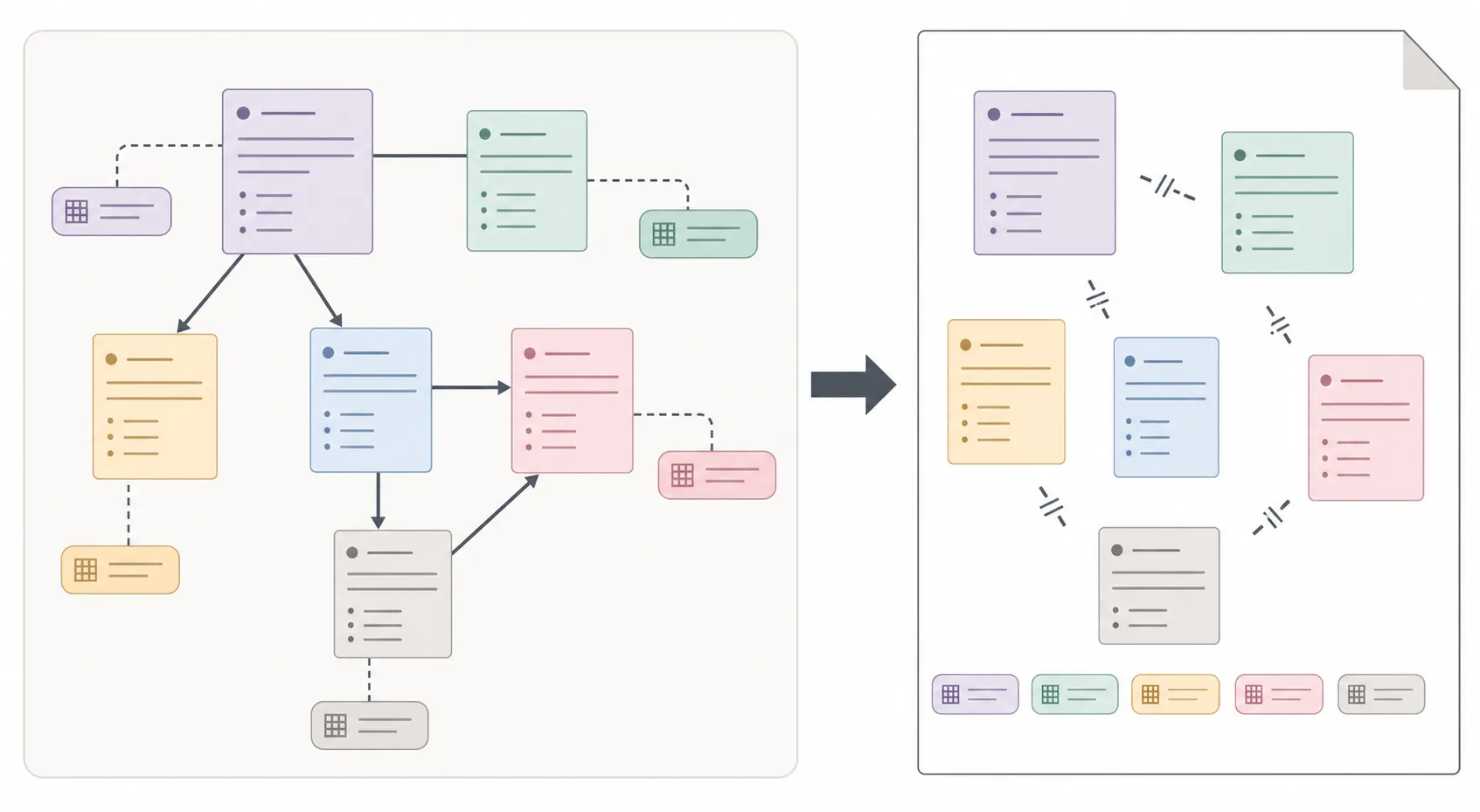
A sensible trial therefore uses a representative sample of the archive, not a blank page. Include linked notes, databases or tables, nested content, views, toggles, and files that the team depends on. Export it, open the result outside the original app, and check which relationships remain usable. Then record the repair work required before anyone calls the move successful.
That test is more informative than a polished demonstration of summarization. A summary can be impressive while the underlying archive becomes harder to navigate. The person who inherits the flattened export will experience the product decision through broken links and missing context, not through the feature list that justified the move.
Price adds context, but it does not resolve the migration decision
Cost can make a difference for an individual or team, but the figures available here are also secondary-source context. A 2026 comparison reports Notion Plus at $10 per user per month and Business at $20 per user per month. It also reports that Obsidian’s core offering is free after the removal of its $50-per-user-per-year commercial license fee in 2025.[3] Plans, billing terms, and included AI features can change, so current vendor pricing should be checked before a purchase.
More importantly, a lower subscription bill does not automatically compensate for lost structure, team retraining, privacy review, or time spent repairing exports. Nor does a paid AI tier demonstrate that its assistance will improve a particular archive. Price belongs in the calculation; it is not a substitute for one.
What these 2026 lists can—and cannot—establish
The two retrieved roundups show that vendors are actively presenting AI note-taking products through rankings, categories, and performance language. They do not show that users who followed those recommendations switched successfully, preserved the structure they needed, or achieved a measurable improvement afterward. That distinction is enough to reject the rankings as standalone switching evidence without rejecting AI as a useful tool.
Before uprooting an archive, inspect the architecture and privacy model, run a representative export, and document what remains usable afterward. If the AI feature still looks valuable after those checks, it can be evaluated as part of the decision. The vendor’s ranked list should not be allowed to perform that evaluation on the user’s behalf.