
A necessary disclosure comes before any list of home cooking hacks to save time for busy people: none of the reviewed sources provides controlled time-motion data. There are no reliable measurements here comparing total chopping, preheating, cooking, pressure release, reheating, and cleanup. Claims such as “quick,” “hands-off,” and “easy” may describe real convenience, but they do not establish how many minutes a method saves.
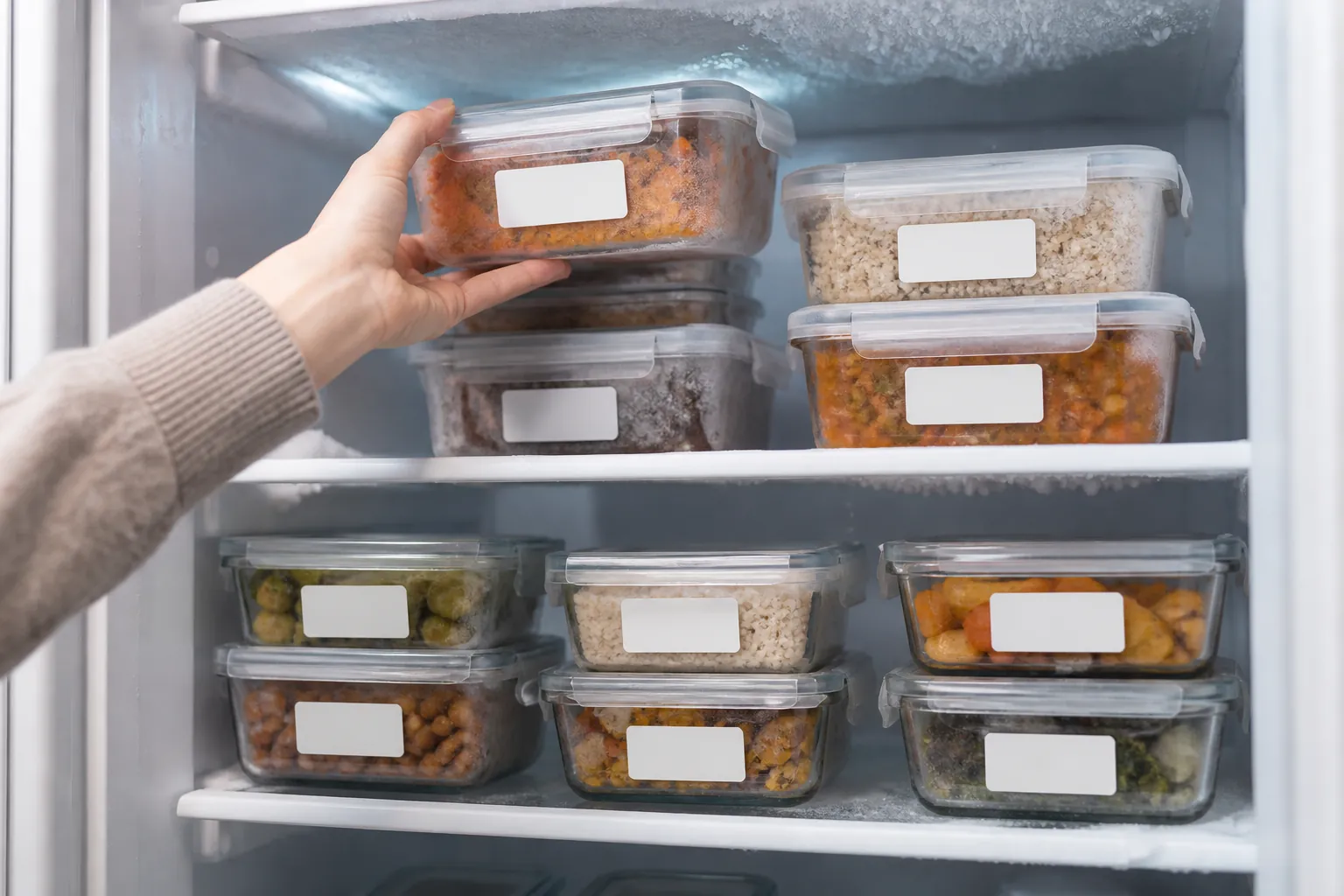
Freezer time-shifting is different. It still has no measured time-saving result in these sources, but it does have firm USDA safety boundaries. That makes it defensible as a setup: cook when you have the capacity, freeze within the documented window, and move the food into a later meal without guessing about the basic handling rules.
The safe-or-excluded triage
| Shortcut or workflow | Verdict from the available evidence | What that verdict means |
|---|---|---|
| Freezing leftovers within the USDA window | Adopt within documented limits | This has agency-defined rules for storage temperature, timing, thawing, and refreezing. |
| Refrigerator thawing | Adopt within documented limits | Food thawed in the refrigerator may be refrozen without cooking, although quality can decline. |
| Microwave defrosting | Immediate-cook workflow only | Defrosting is not a stopping point because parts of the food may begin cooking. |
| Refreezing food left outside the refrigerator too long | Exclude | Do not refreeze after the USDA’s stated time limits have been exceeded. |
| Pressure cookers, air fryers, multicookers, batch cooking, sheet-pan dinners, and pre-chopping | Test as personal workflow choices | The reviewed descriptions establish possible convenience or failure modes, not verified minutes saved. |
| Using a research-stage sous vide temperature as home guidance | Exclude | A commercial reference point under investigation is not finalized permission for a home workflow. |
“Exclude” has a narrow meaning here. Sometimes a practice crosses an explicit safety boundary. In other cases, what must be excluded is the unsupported conclusion—not necessarily the appliance or cooking method. An air fryer can be convenient without having proved that it saves total time.
Build the freezer workflow around the rules
USDA FSIS states that food kept constantly at 0°F remains safe. Freezing inactivates bacteria, yeasts, and molds, but it does not destroy them; they can become active again after thawing. In practical terms, the freezer pauses biological activity rather than sterilizing yesterday’s dinner.[1]
That distinction prevents a common planning error. Freezing cannot repair food that was mishandled before it entered the freezer, and a frozen container does not become risk-free merely because it has turned solid. The value of freezing is that it gives a meal a safe holding state at a defined temperature.
Decide whether to freeze while the leftovers are still eligible
FSIS says to freeze leftovers within three to four days. It also says not to refreeze food that has remained outside the refrigerator for more than two hours, or for more than one hour when the temperature is above 90°F.[1]
The useful operational choice therefore happens early. If Thursday’s leftovers are meant for a later week, waiting until they look unappealing at the back of the refrigerator is not a freezer strategy. Decide within the three-to-four-day window and mark the container with what it is and when it was frozen. The date helps you verify the pre-freezing workflow; it is not evidence that food kept continuously at 0°F suddenly becomes unsafe on an arbitrary freezer expiration date.
The separate USDA danger-zone guidance identifies 40°F to 140°F as the range in which organisms including Staphylococcus aureus, Salmonella Enteritidis, E. coli O157:H7, and Campylobacter grow most rapidly.[2] That is why time spent waiting on a counter matters independently of how cold the food becomes afterward.
Choose the thawing route before the meal needs to be ready
Refrigerator thawing preserves flexibility. FSIS says food thawed in the refrigerator may be refrozen without cooking.[1] That does not promise unchanged texture or flavor, but it does mean that a canceled dinner does not automatically force you to cook the food that night.
Microwave defrosting creates a different sequence. FSIS says food thawed in a microwave should be cooked immediately because some areas may begin cooking during defrosting.[1] The defrost button is therefore not a pause button. Use it when someone is ready to continue directly into cooking, not when the meal might sit while work, a child’s bedtime, or another task intervenes.
- If tomorrow’s plan is reasonably stable, move the meal to the refrigerator ahead of time.
- If the plan may change, refrigerator thawing retains the USDA-supported option to refreeze without cooking.
- If using microwave defrosting, arrange the rest of the cooking workflow first and proceed immediately.
- If food has exceeded the stated limit outside refrigeration, do not use refreezing to rescue the plan.
Keep vegetable quality separate from food safety
Most low-acid vegetables that freeze well need blanching first because freezing slows enzyme activity rather than stopping it completely.[1] This is primarily a quality measure. Blanching helps protect characteristics such as color, flavor, and texture; it should not be turned into a universal safety threshold for every food entering the freezer.
The difference matters when evaluating a disappointing freezer meal. Soft vegetables may indicate a quality or preparation problem rather than proof that the food was stored unsafely. Conversely, food can retain an acceptable appearance without that appearance answering whether its earlier handling stayed inside the relevant limits.
For a more detailed way to organize frozen components and repeatable prep, the related freezer-and-batch-prep setup guide can help translate these boundaries into a household system.
Hard safety boundaries are not measured time savings

The freezer evidence answers whether particular handling sequences remain within documented safety limits. It does not measure whether batch freezing saves time overall. A household may spend a long afternoon cooking, portioning, labeling, washing pans, and reorganizing shelves, then experience much easier weeknights. That is time-shifting and workload redistribution. Whether it produces a net saving depends on what would otherwise have happened.
That personal result can still be worth pursuing. A ready meal may reduce evening decisions, keep cleanup out of a difficult time of day, or make home-cooked food available when nobody has the energy to start from raw ingredients. Those are meaningful forms of convenience, even when they cannot honestly be converted into verified minutes.
What the appliance claims actually establish
Pressure cookers: hands-off is not the same measurement as faster
America’s Test Kitchen tested 12 stovetop pressure cookers and described producing food in less than an hour with most of that time hands-off. It also gave pressure-cooking times such as 10 minutes for dried beans and six minutes for risotto.[3] Those details show what the appliance can do, but the reviewed passage does not provide an active-time comparison with conventional stovetop preparation.
A pressure setting is only one part of the evening. The busy cook still has to prepare ingredients, get the cooker to pressure, choose or wait through a release, open it safely, finish the dish, serve it, and clean the equipment. Without a comparison that measures the entire workflow, “10 minutes at pressure” cannot be reported as “10 minutes to dinner” or as a specific amount of labor avoided.
Multicooker guidance further distinguishes natural release from quick release, but the source provides no active-time figures for the full process.[4] Release choice may affect how the method fits into the evening. It does not, by itself, prove net time savings.
Air fryers: a short preheat answers only one question
In its air-fryer testing, America’s Test Kitchen named the Instant Vortex Plus 6-Quart its winner and praised a two-minute preheat along with cooking “quickly and efficiently.” The cited material does not include a timed comparison against a conventional oven.[5]
A two-minute preheat is a measured feature of that appliance, not a measurement of the household’s total dinner workflow. Capacity can change how many batches are required; food still needs preparation and the basket still needs cleaning. The practical question is whether the appliance improves the cook’s actual meal pattern, including portions and cleanup—not whether the word “quick” appears in a review.
Batch cooking and sheet pans can move work as well as reduce it
The argument for batch cooking over fully preportioned meal prep is supported in the reviewed material by qualitative editorial judgment, without a measurement method or sample.[6] Cooking flexible components in quantity may suit someone who dislikes eating identical assembled meals. Preportioned containers may suit someone who needs lunch to leave the house without further decisions. Neither preference demonstrates a universal time result.
Sheet-pan dinners receive similarly qualitative praise as “quick and easy,” with little mess and easier cleanup. The same guidance identifies a concrete failure mode: crowding the pan can cause vegetables to steam and become mushy rather than roast; lining the pan with foil or parchment is suggested to simplify cleanup.[7]
That warning is more useful than a vague promise of speed. An overloaded tray can save the washing of a second pan while producing food nobody wants to eat. Splitting ingredients across pans may improve browning but create more washing. A sheet-pan dinner therefore changes the distribution of cooking and cleanup; the source does not quantify the net result.
Pre-chopping creates the same accounting problem. Cutting vegetables earlier may make the dinner-hour assembly easier, but the cutting board, knife, containers, and cleanup have not disappeared. They have moved. That move can be valuable if Sunday afternoon is manageable and Wednesday evening is not, but it should be described as scheduling rather than proven time elimination.
Do not turn sous vide research into home permission
USDA research material says the agency is investigating whether Appendix A applies to sous vide cooking. The lowest temperature listed in that research context is 130°F with a 121-minute holding time.[8] That is a commercial reference point under investigation, not finalized home-use guidance.
It would be unsafe editorial practice to pull those two numbers out of the research description and publish them as a household shortcut. Sous vide involves a distinct time-and-temperature safety question. In the absence of finalized home guidance in the reviewed evidence, it does not belong in the adoptable freezer workflow and should not borrow the freezer guidance’s confidence.
A fair way to test an unmeasured shortcut
For an appliance or preparation habit that does not cross a documented safety boundary, the honest alternative is a household trial. Judge the complete sequence rather than the impressive-looking middle step.
- Start counting when preparation begins, not when the appliance reaches pressure or the food enters the basket.
- Separate active work from waiting. Hands-off time may be useful even when elapsed time is unchanged.
- Include release, finishing, portioning, reheating, and cleanup when they are part of the method.
- Note whether capacity forces multiple batches or whether crowding damages the result.
- Record waste and leftovers. A fast method that repeatedly produces unwanted food is not functioning as a useful shortcut.
- Evaluate the time of day when the work occurs. Moving effort away from the hardest part of the evening may be worthwhile without reducing total minutes.
This kind of log does not create a universal result, but it answers the relevant household question. It may reveal that an appliance earns its counter space because waiting time is genuinely usable, or that a supposedly efficient prep session merely turns one large cleanup into several smaller ones.
Keep anecdotes in their proper place
Crowdsourced suggestions such as pounding chicken flat, arranging mise en place, or boiling vegetables in pasta water may be sensible techniques, but the reviewed collection presents them as unmeasured anecdotes.[9] They can supply ideas for a personal test, not proof of a particular saving.
The counterexample is equally limited. One writer described abandoning meal prep because the energy “was NOT worth it” and because food aged six to seven days.[10] That experience identifies plausible failure points—excessive prep burden and food sitting too long—but it is one person’s account. It cannot establish that batch cooking generally costs small households more time.
For the busy cook, the defensible decision is narrow. Adopt freezer time-shifting inside the USDA’s temperature, timing, thawing, and refreezing limits. Treat pressure cookers, air fryers, multicookers, sheet pans, pre-chopping, and batch cooking as personal workflow experiments. Their convenience may be real, but the reviewed evidence does not verify net time saved.
On evenings when the real choice is between cooking and using a prepared frozen meal, it may help to match the task to the fatigue you have. That decision can favor the freezer without pretending an appliance review has measured the minutes.
References
- Freezing and Food Safety — USDA Food Safety and Inspection Service
- Danger Zone (40°F–140°F) — USDA Food Safety and Inspection Service
- Stovetop Pressure Cookers — America’s Test Kitchen
- I Just Got an Instant Pot. Now What? — America’s Test Kitchen
- Air Fryers — America’s Test Kitchen
- Why Batch Cooking Is Better Than Meal Prep — Eater
- 7 Tips for the Perfect Sheet Pan Dinner Every Time — Rejoice Nutrition and Wellness
- Investigation and Determination of Safe Guidelines for Sous Vide Cooking — USDA National Agricultural Library
- Time-Saving Cooking Tips — BuzzFeed
- 3 Reasons Batch Cooking Beats Meal Prep Every Time — Ashley Pardo
Comments
Join the discussion with an anonymous comment.