
A home cooking habit usually does not fail because you suddenly forget how to cook. It fails at 6:30 p.m., when you are tired, hungry, and asked to make one more decision: what is for dinner? The easiest answer is often the one that requires the least thought.
The practical fix is to decide less often. Build a small rotation of meals you genuinely want to eat. Give those meals familiar places in the week without treating the calendar as a contract. Then create a rescue library for nights when even the rotation is too much. The goal is not to become more disciplined or to produce endless variety. It is to remove the nightly blank page.
The system: rotation, context, and rescue
Start with four to six dinners that meet a simple standard: you like eating them, you can cook them without much interpretation, and their ingredients or components are reasonably repeatable. These are not aspirational recipes saved for a more energetic version of yourself. They are meals you would be pleased to see on the table after an ordinary workday.
- Choose a limited rotation of genuinely liked meals.
- Assign meals to familiar contexts, such as a weekday or cooking window, while allowing swaps.
- Keep a rescue library of low-decision meals for depleted nights.
- Allow skip days, leftovers, and takeout without treating them as evidence that the system failed.
A context might be “the quickest dinner after a late meeting,” “the meal for the day after grocery shopping,” or simply “one of the rotation meals this week.” Specific weekdays can help, but they should not become another source of failure. If Tuesday's planned stir-fry becomes Wednesday's stir-fry, nothing important has gone wrong.
The rescue library is separate from the main rotation. It might include a freezer meal, eggs and toast, a reliable pasta, dumplings with greens, or ingredients for a meal that requires assembly rather than planning. The useful question is not whether these meals are impressive. It is whether you can recognize the answer quickly and start eating before the evening disappears.
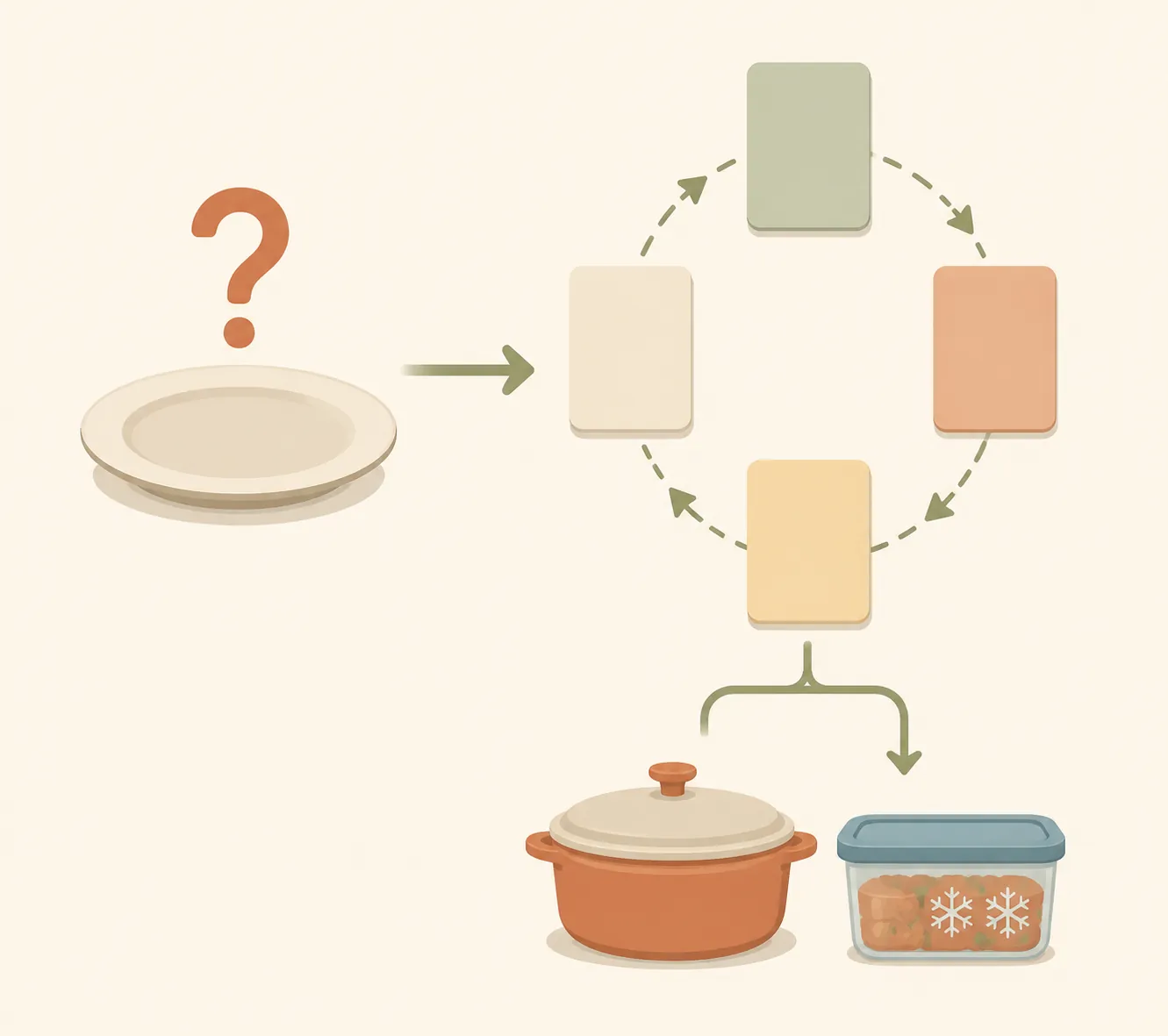
Why fewer dinner decisions can help
Every from-scratch dinner choice contains several smaller choices: which meal, which recipe, whether the ingredients are available, what can be substituted, when to begin, and whether the effort feels worth it tonight. A plan can reduce some of that work, but a plan that requires browsing recipes, checking the pantry, making a shopping list, and revising the list may simply move the decision burden earlier in the week.
A narrative review of decision fatigue describes evidence that effort, convenience, and time pressure shape food choices, and that depleted self-control can push people toward convenient or hedonic options.[1] That is useful mechanism-level evidence for the dinner problem. It is not a direct test of a fixed meal rotation, and it does not establish that meal planning prevents burnout.
The distinction matters. The proposed benefit comes from reducing repeated choices, not from the moral superiority of planning. A rotation may make a home-cooked meal easier to select and begin. It cannot make an exhausting day less exhausting, and it cannot guarantee that cooking will feel enjoyable.
The time involved is also real. In 2023, 52% of US men and 72% of US women cooked on a given day. Among people who cooked, the mean time was 50 minutes per day for men and 71 minutes per day for women.[4] Those figures describe participation and minutes, not stress, enjoyment, or mental load. They are still a useful reminder that “just cook something” can consume a meaningful part of an evening.
Choose meals that survive an ordinary week
The quality of the rotation matters more than its size. A short list of meals you resent will not become sustainable because it is short. Before adding a dinner, test it against three criteria.
1. You actually like it
“Healthy,” efficient, and inexpensive are useful properties, but they do not replace wanting the meal. If the rotation consists of dinners you selected because they looked sensible on paper, you will keep negotiating with it at the end of the day. Include meals you look forward to, even if they are uncomplicated staples.
2. You know the shape of it
Familiarity reduces the number of live decisions. You already know roughly what to buy, how long the active cooking takes, and which parts can be skipped. This does not mean every dinner must be a rigid recipe. It can be a format: grain, roasted vegetable, and a protein; tacos; soup and bread; or a pasta built from a few dependable combinations.
3. You can replace it
A dinner that depends on one missing ingredient, perfect produce, or an uninterrupted hour is fragile. Design a substitution before you need it. Frozen vegetables can stand in for fresh ones. A prepared component can replace a from-scratch one. A rotation meal can become a rescue meal by dropping its least essential parts.
This is where freezer cooking and other time-saving preparation can help, provided the preparation itself does not become a second ambitious project. A small supply of usable components is more valuable than a freezer full of meals you feel obligated to thaw.
For more practical ideas on building those off-ramps, see this guide to safe time-saving home cooking hacks.
A good rotation also has permission built into it. Two meals in a row can be acceptable. Leftovers count. A skip day can be planned. If a meal repeatedly leaves you disappointed, remove it rather than trying to prove that you can tolerate it.
Make the fallback a first-class option
Many cooking systems quietly assume that the cook will have enough capacity to recover when the plan breaks. That recovery is work: ordering food, shopping again, finding a use for neglected ingredients, and absorbing the feeling that the week went off track. A rescue library prevents one collapsed evening from turning into a collapsed system.
Keep the rescue decision narrower than the main dinner decision. Instead of asking what you feel like eating, use a rule such as: choose one freezer meal, one pantry meal, or one assembly meal. The point is not to eliminate all choice. It is to keep a tired person from searching the entire universe of possible dinners.
A rescue meal should also be visible and maintained. Put it where you can find it, check its ingredients occasionally, and replace it after using it. If the fallback requires a separate investigation, it is not much of a fallback.
Use habit research without turning it into a deadline
Habit formation supports the design, but not the promise that a cooking routine will become automatic on a universal schedule. A systematic review reports a median of 66 days to automaticity in the often-cited Lally study, with a range of 18 to 254 days. The review also reports a 59-day median in another study, where only 23% of participants reached the automaticity threshold.[2] These figures come through a secondary review, and they describe habit automaticity rather than a guaranteed cooking outcome.
The more useful lesson is structural. The review links automaticity with enjoyment, planning the time and context, and a preparatory habit in a physical-activity study, not a cooking study.[2] Another cross-sectional study found independent associations between automaticity and frequency, rewards, and contextual stability; it also reported that perceived complexity mediated 42.6% of the association between an unhealthy behavior and automaticity.[3] Those findings are not proof that a dinner rotation causes a lasting home-cooking habit, but they point toward a sensible setup: repeat a behavior you do not dislike, in a recognizable context, with fewer moving parts.
Enjoyment deserves particular attention. If the only reward is that you complied with your own plan, the system may become another obligation. The rotation should contain food you would choose under less organized circumstances. That is a modest design requirement, but it is more credible than a 21-day streak or a promise that willpower will disappear after a certain number of repetitions.
Planning should reduce work, not relocate it
Traditional meal planning can be useful, but it can also add a chain of decisions: selecting recipes, checking ingredients, making a list, shopping around the list, and revising the plan when real life intervenes. A MealThinker editorial makes this point directly and treats planning itself as a possible source of burnout.[5] That is a counterpoint to the idea that more detailed planning automatically creates relief.
So plan only what needs to be decided once. Choose the rotation, establish a rough shopping pattern, and define the rescue options. Leave room for substitutions and appetite. The system is doing its job when it makes dinner easier to enter, not when every box on a weekly calendar is filled.
A first-person Epicurious essay about pandemic kitchen burnout describes depleted “surge capacity,” while also qualifying its account in light of food insecurity.[6] It is a useful illustration of how cooking can feel harder when general capacity is low, but it is an anecdote, not evidence that a rotation produces a measurable reduction in burnout.
Know when a fixed rotation is the wrong tool
A small rotation is most plausible for a moderately skilled cook whose household can agree on a reasonably flexible set of meals. It may fail as a rigid system when dietary restrictions, allergies, medical needs, cultural requirements, or sharply different family preferences make repetition impractical. In those situations, rotate formats, components, or decision rules rather than forcing everyone into the same four dinners.
Novelty also has a legitimate place. A rotation that never permits a new recipe may preserve consistency while draining enjoyment. Keep experimentation separate from the nightly obligation: try something new on a higher-capacity day, or replace one rotation slot temporarily. Discovery works better as an optional activity than as the price of maintaining dinner.
Build the next week around fewer decisions
Write down four to six dinners you already know you like. For each one, note the simplest version, the likely substitutions, and whether it can become leftovers. Add two or three rescue meals that require little judgment. Then give the meals loose contexts rather than sacred appointments.
That arrangement will not prove that you have conquered burnout. No source here directly tests it, and the research on decision fatigue, habits, and cooking time supports the mechanism only indirectly. It is a defensible design judgment instead: for the right household, a liked rotation plus rescue library makes busy-week cooking less dependent on making a fresh decision every evening.
For tonight, the useful question is not how to become more disciplined or inventive. It is which dinner choice can be made once, so that when the day is over, fewer choices remain.
References
- The Effect of Decision Fatigue on Food Choices: A Narrative Review — PMC
- Time to Form a Habit: A Systematic Review and Meta-Analysis of Health Behaviour Habit Formation and Its Determinants — PMC
- How Do Habits Form? Models, Methods and Strategies for Behaviour Change — Frontiers in Psychology
- Trends in Home Cooking among United States Adults from 2003 to 2023: Analysis of American Time Use Survey Food Preparation — PMC
- Meal Planning Burnout — MealThinker, March 11, 2026
- How to Battle Kitchen Burnout and Cooking Exhaustion — Epicurious
Comments
Join the discussion with an anonymous comment.