
The familiar biohacking sleep ritual makes a tidy promise: take the right supplements, let a wearable score the night, follow a carefully timed evening protocol, and arrive at work with more focus. The weak point is the final step. Better-looking sleep data are not the same as better work, and the available evidence does not quantify how much productivity this package would add—or establish that it adds any.
The load-bearing source for checking the underlying sleep-hygiene claims is a 2015 narrative review. That date matters. Its conclusion was that the efficacy of sleep-hygiene education was “limited and inconclusive,” even though some individual practices had plausible or partially supported effects.[1] A protocol assembled from those practices therefore cannot inherit a strong evidence grade merely by becoming longer, more expensive, or easier to track.
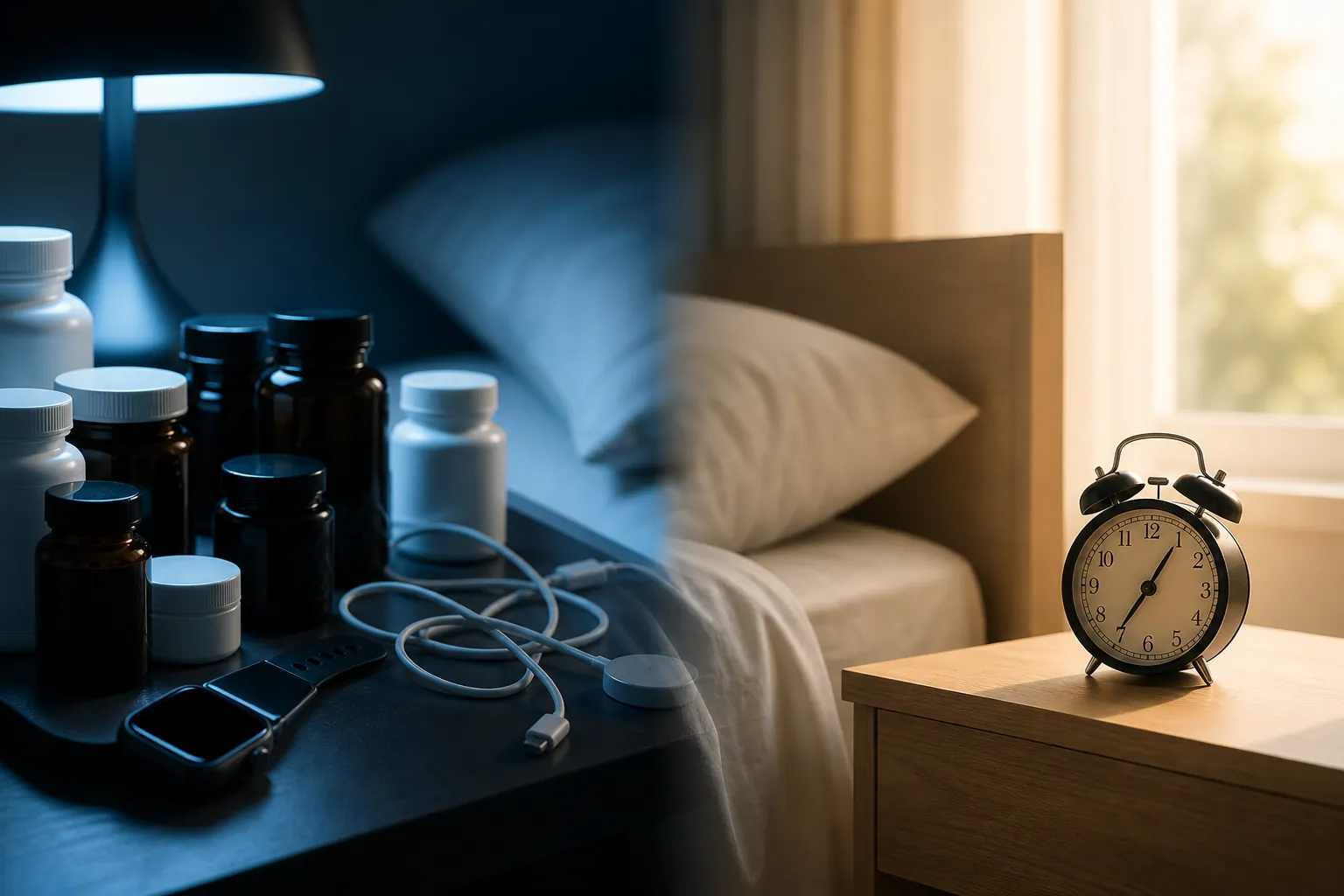
The ritual under audit
A useful audit separates each marketed claim from the outcome actually measured. It also records when the evidence appeared and whether an effect size is available. Without that separation, modest observations about sleep can quietly become claims about concentration, decision-making, or completed work.
| Marketed component or claim | What the available evidence supports | Date and evidence gap | Risk grade |
|---|---|---|---|
| A complete sleep-hygiene ritual reliably improves tomorrow’s productivity | The main review found sleep-hygiene education efficacy limited and inconclusive. No study in this evidence set connects the ritual to measured work output.[1] | 2015 review; no productivity effect size | High |
| A consistent schedule is a strongly supported intervention | A clinical-advice page places schedule consistency in its strong-support Tier 1, but that judgment sits beside the broader review’s more cautious conclusion.[1][3] | Conflicting assessments; no supplied effect size resolves them | Medium |
| Alcohol helps sleep because it makes falling asleep easier | Alcohol near bedtime may reduce sleep-onset latency while increasing arousal in the second half of the night. The effect is dose-dependent, and tolerance can develop within days.[1] | 2015 review; no effect size supplied here | High if sleep onset is treated as whole-night quality |
| A fixed caffeine cutoff reliably improves sleep and next-day output | The review described caffeine-avoidance evidence as weak and inconsistent, including among habitual users.[1] | 2015 review; no supported universal cutoff or productivity estimate | Medium |
| Melatonin, magnesium, glycine, or L-theanine produces a dependable productivity gain | The substances are named in the available material, but no dated dose-and-effect findings are supplied. | No usable dose, population, comparison, or effect-size data | High |
| An Oura score verifies that the ritual improved restorative sleep and work performance | The device is named, but no independent polysomnography validation figures or work-output results are supplied. | No validation figures in the evidence set; no productivity link | High |
| A cue-based evening sequence is proven to become automatic | Habit research supports the importance of contextual cues, but this evidence set contains no implementation-intention or cue-based evening-ritual randomized controlled trial.[2] | Mechanistic context without direct bedtime-ritual trial evidence | Medium |
“High risk” here does not mean that a supplement, tracker, or behavior can never help anyone. It means the marketed conclusion outruns the material available to verify it. A personal experiment may still be reasonable; describing that experiment as a dependable productivity intervention is not.
Why the productivity number is missing
To establish a productivity effect, a study would need to move beyond bedtime behavior and sleep perception. It would need a defined intervention, a comparison condition, a specified population, a measurement window, and an outcome tied to actual work—such as verified task completion, error rates, or performance on a relevant assignment. A readiness score, a self-rated morning, and a workplace result are different endpoints.
The evidence reviewed here supplies no study linking a named sleep intervention to measured work output. It also supplies no effect sizes with which to estimate a gain. That prevents claims such as “more productive tomorrow,” even if an individual component has some support for a sleep-related outcome.
A 2021 meta-analysis provides useful but narrower context: interventions that improved sleep quality were linked with improvements in mental-health outcomes.[4] It does not establish a productivity protocol, and it should not be repurposed as evidence for particular timing, light, temperature, caffeine, supplement, or wearable instructions.
The same discipline applies to tracker data. A wearable can help someone notice patterns or follow a routine, but those uses do not prove that its score precisely measures sleep architecture. Even accurate sleep measurement would leave another question unanswered: did the observed change alter meaningful work the following day?
What the older sleep-hygiene evidence actually says
The 2015 review is more useful when read component by component than when treated as an endorsement of a standardized checklist. Its alcohol finding illustrates why a single convenient metric can mislead: drinking close to bedtime may shorten the time needed to fall asleep, yet increase arousal during the second half of the night. The review also reports that the relationship is dose-dependent and that tolerance to alcohol’s sleep effects can develop within days.[1]
That is enough to make alcohol within an hour of bed a poor fit for this setup. It is not enough to calculate the size of tomorrow’s focus penalty. Avoiding the unsupported number is part of the recommendation, not an omission to fill with intuition.
Caffeine is less tidy. The review characterized avoidance evidence as weak and inconsistent, even among habitual users. One study discussed in the review found only slightly fewer problems falling asleep on no-caffeine days.[1] That supports caution and personal observation, but not a universal clock time presented as scientifically settled. Readers who need practical scheduling can use the separate coffee routine for focus guide without treating its guardrails as an effect-size finding from this audit.
Even conventional checklist advice is not uniformly supported. The review reported no significant association between daytime napping and nocturnal sleep among older adults.[1] That finding applies to the population and outcome studied; it neither clears every nap for every sleeper nor justifies a blanket ban. It does show why a bundled “sleep hygiene” score can hide substantial differences among components.
A habit cue is practical, not magically proven
Habit research offers a plausible reason to simplify the setup. Habits involve automatic attentional biases toward contextual cues, while stress and fatigue can strongly impair habitual performance. The review also reports evidence that morning habits may form faster than evening habits, with the cited work proposing a cortisol-mediated explanation.[2]
For a tired knowledge worker, this changes the design problem. An elaborate evening sequence asks for execution at the point when fatigue may be working against it. A morning anchor—a stable wake time followed by the same immediate cue—places the repeatable part of the protocol after waking. The cue might be opening the curtains, starting a familiar piece of audio, or placing the alarm where standing up is required. Those are implementation examples, not trial-tested prescriptions.
The limitation remains important: the evidence set contains no randomized trial of an implementation intention or cue-based evening ritual.[2] Nor does the habit review provide a measured productivity gain for the proposed morning anchor. Morning cues are the more defensible design choice because they reduce ritual complexity and fit the available habit mechanism—not because this material establishes a precise benefit.
Anyone choosing light as the morning cue can consult the separate morning-light routine. The challenge of preserving the anchor across non-workdays is covered in the guide to sleeping in on weekends. Those guides extend implementation; they do not turn schedule consistency into a quantified productivity result.
The unresolved conflict over schedule consistency
ReachLink’s clinical-advice page ranks sleep-schedule consistency as strong-support Tier 1.[3] Set beside it, the 2015 narrative review concludes that sleep-hygiene education has limited and inconclusive efficacy.[1] These statements do not evaluate the evidence in exactly the same way: one grades an individual practice for public guidance, while the other reviews the broader empirical basis for sleep-hygiene recommendations and education.
Still, the difference should remain visible. The materials provide no comparable effect sizes that would resolve it, and a confident label on an advice page cannot supply the missing magnitude. Schedule consistency survives this audit as a reasonable, low-complexity action—not as a proven lever with a known return on work output.
Supplements and trackers: known issues, not findings
Melatonin, magnesium, glycine, and L-theanine appear by name in the source material, but there are no dated dose-and-effect results to evaluate. Without dose, population, comparator, outcome, timing, and effect size, there is no responsible way to rank them or claim that adding one will improve tomorrow’s work. Their inclusion in a marketed stack is not evidence of the stack’s effectiveness.
Oura presents the same boundary from the measurement side. The available material names the tracker but supplies no independent polysomnography validation figures. It also supplies no evidence connecting its scores to completed work. A reader may still use a wearable as a diary or consistency prompt, but the score should not become the verdict on whether the ritual worked.
The smallest defensible setup for tonight
The remaining setup is deliberately small. Its purpose is to make tomorrow morning more repeatable while avoiding claims the evidence cannot carry.
- Choose a consistent wake time and attach one immediate morning cue. Use something already available and easy to repeat, such as opening the curtains or starting the same first task.
- Do not drink alcohol within an hour of bedtime. The recommendation reflects the review’s warning that easier sleep onset can coexist with more second-half arousal; it does not imply a quantified productivity benefit.[1]
- Use a cautious caffeine cutoff based on your schedule and observed sleep response. Keep it adjustable because the reviewed caffeine-avoidance evidence is weak and inconsistent, and no universal cutoff is established here.[1]
Keep the experiment interpretable. Hold the wake time and cue steady before adding a supplement, a new device, a screen rule, and several environmental changes at once. If the evening decision itself is the obstacle, the comparison of rest versus chores after work and the separate guide to evening screens, sleep, and focus address those implementation questions without adding them to the evidence grade above.
This setup is not for someone seeking a quantified productivity promise. The reviewed evidence cannot say how many tasks, minutes of focus, or percentage points of output it will produce. It supports a qualitative, evidence-aware morning-output setup: one stable wake time, one repeatable cue, no alcohol within an hour of bed, and a caffeine decision made with appropriate caution.
References
- The Role of Sleep Hygiene in Promoting Public Health: A Review of Empirical Evidence, PubMed Central, 2015.
- Habit-formation review, PubMed Central.
- Sleep Hygiene: Evidence-Based Habits That Actually Work, ReachLink.
- Improving Sleep Quality Leads to Better Mental Health: A Meta-Analysis of Randomised Controlled Trials, PubMed Central, 2021.
Comments
Join the discussion with an anonymous comment.