
The old embarrassment of a personal knowledge management system is not that you failed to build one. It is that you probably built too much of one: folders nested three levels deep, tags with private meanings, dashboards for projects that ended months ago, and a capture habit that kept working long after the review habit died.
AI arrives at exactly the sore spot. If the main pain is “I know I saved this somewhere,” semantic search is not decorative. McKinsey data cited by GoLinks reports that knowledge workers spend 9.3 hours per week searching for information; because that figure is being cited secondhand in a vendor guide rather than checked here against the original McKinsey source, it is best treated as a directional signal, not a hard universal benchmark.[1] Still, the shape of the problem is familiar enough: the system contains the material, but the person cannot retrieve it without remembering the filing decision they made weeks ago.
That is the first real rule change. AI moves the daily question from “Where does this go?” to “What do I have on this topic?” Embeddings, semantic search, and retrieval-augmented generation can find related material even when the wording differs. A note about “customer hesitation,” a transcript mentioning “procurement delay,” and a saved quote about “enterprise buying friction” no longer need to share a perfect tag to become retrievable together.

This is why the difference between AI-native tools and AI overlays matters, though not because every reader needs another shopping spreadsheet. AI-native products make query and resurfacing the center of the interaction; traditional note apps with AI features often add that layer on top of an existing manual structure. For a broader map of the current tool field, see Personal Knowledge Management Apps: A 2026 Field Guide to the Five Paradigms. The practical distinction is simple: in one design, the user is primarily maintaining architecture; in the other, the user is interrogating a corpus.
The useful split: retrieval, connection, and output
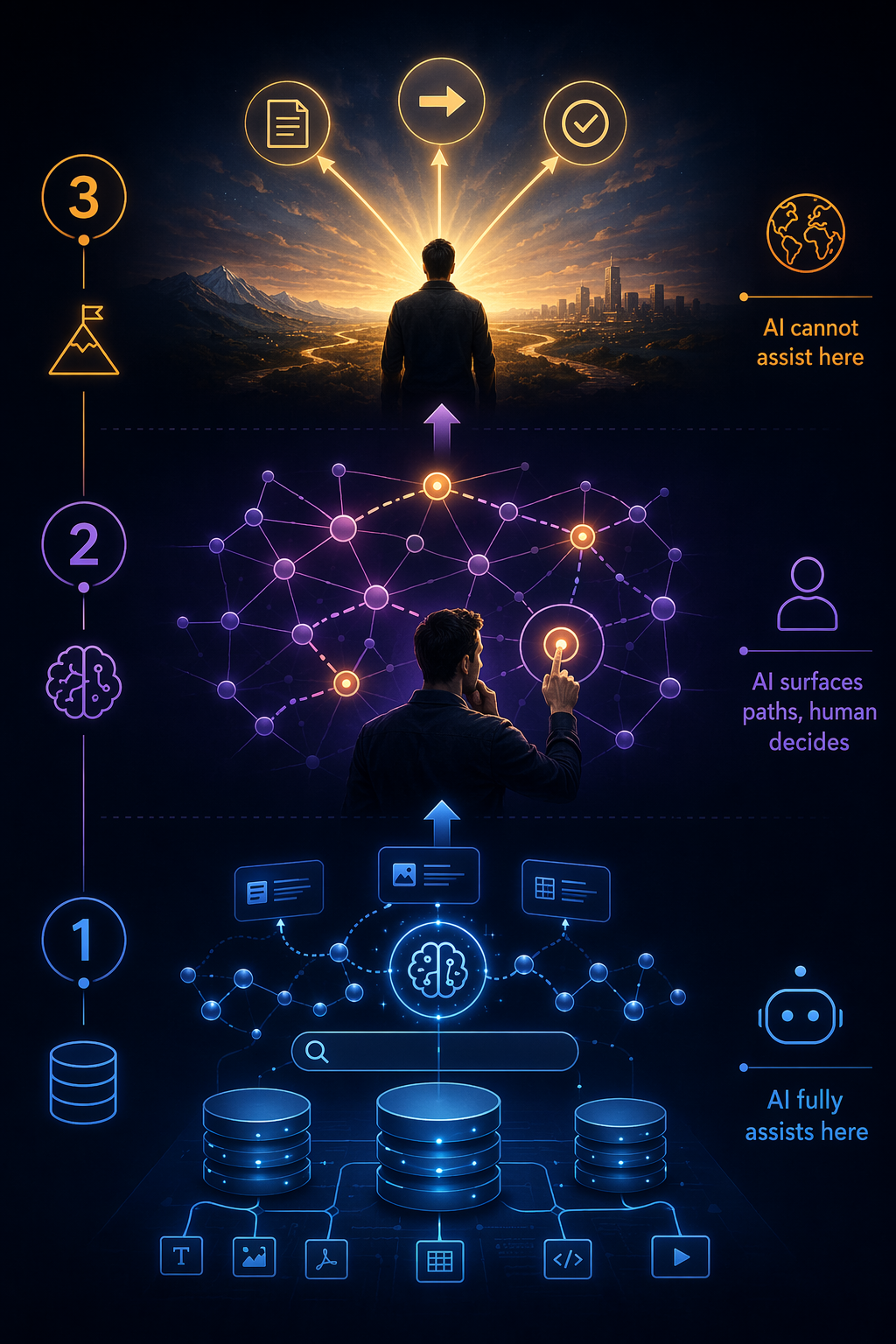
A useful 2026 way to sort the argument comes from Volkov’s three-level PKM model: Level 1 is storage and retrieval, Level 2 is thinking and connection, and Level 3 is model revision through output.[3] This is a conceptual model from a single Medium article, not settled academic evidence. Its value is that it stops “AI for PKM” from becoming one blurry claim.
| PKM level | What AI can plausibly improve | What still belongs to the person |
|---|---|---|
| Level 1: Storage and retrieval | Search across wording differences, resurface related notes, reduce dependence on folders and tags | Decide what is worth capturing and whether the source is trustworthy |
| Level 2: Thinking and connection | Suggest possible relationships, cluster similar material, summarize source trails | Judge which relationships matter and which are noise |
| Level 3: Model revision and output | Assist with drafting or formatting after a decision has been made | Publish, recommend, decide, test ideas against consequences, revise beliefs |
The levels also explain why AI can make an old PKM method feel obsolete in one place and more necessary in another. Manual retrieval structure is genuinely less important than it used to be. Capture quality, curation, and output cadence become harder to avoid.
Level 1: AI is very good at killing filing chores
At Level 1, AI deserves more credit than skeptics sometimes give it. The job is not to think. The job is to find. Semantic search can retrieve a meeting note that never used the keyword you are typing. RAG can assemble an answer from your own saved material rather than from the open web. Auto-resurfacing can bring back notes related to a project before you remember that the notes exist.
That changes the economics of organization. A rigid folder tree once compensated for weak search. Tags once served as hand-built retrieval hooks. Both can still help in some workflows, especially where projects, permissions, or archives need explicit boundaries, but they are no longer the only way to make a knowledge base usable. The burden of predicting the future location of an idea has decreased.
For someone who has abandoned a beautiful PKM setup, this is not a small mercy. The most exhausting part of many systems was not writing notes. It was deciding whether a quote belonged under “strategy,” “positioning,” “customer research,” or “ideas to revisit,” then maintaining that decision forever. AI weakens the need for that kind of false precision.
But the same improvement creates a new mess. When retrieval feels cheap, capture expands. Meeting transcripts, web highlights, pasted Slack fragments, PDFs, voice memos, screenshots, and AI-generated summaries can all enter the system with less resistance. A person who once had a filing problem may now have a survival problem: too much low-quality material that can technically be found.
That is where the older failure mode returns in a new costume. If every capture is treated as equally saveable, AI will retrieve more, not better. The question shifts from taxonomy to intake: Is this note evidence, raw material, a task, a passing curiosity, or digital hoarding with a nicer interface? Readers who recognize that pattern may want the deeper diagnosis in Why 68% of PKM Systems Fail.
What Level 1 methodology becomes
A 2026 Level 1 method does not need to begin with an elaborate folder map. It needs rules for what enters the system and what metadata genuinely matters. Project name may matter. Source may matter. Date may matter. Confidentiality may matter. A mood-based tag invented at 11:30 p.m. probably does not.
- Capture less material verbatim when a short note about why it matters would be more useful later.
- Keep source trails intact so AI retrieval can be checked against the original context.
- Use manual structure for boundaries that AI should not infer: active projects, client work, private material, legal or compliance constraints.
- Let semantic search replace decorative tags whose only purpose was “maybe I’ll need this someday.”
This is a smaller, less romantic methodology than the old second-brain diagrams promised. It is also more likely to survive contact with a normal workweek.
Level 2: Surfacing a connection is not the same as making one
Level 2 is where the temptation gets stronger. Once AI can retrieve related notes, it can also summarize them, cluster them, and suggest patterns. This looks very close to thinking. Sometimes it is useful enough that the distinction feels fussy—until the suggested relationship is plausible, fluent, and wrong in the particular way that matters.
A connection in a PKM system is not merely a resemblance. Two notes may share vocabulary and still belong to different arguments. Two customer comments may both mention “pricing,” while one is really about budget authority and the other is about trust. A highlight from a book may look relevant to a product strategy only because the same abstraction appears in both places. AI can surface these candidates. It cannot decide, on its own, whether the connection deserves to change your mind.
This is the point at which citations become more than a nice feature. Atlas Workspace states the principle bluntly: “AI without citations is a confident hallucination engine — AI with citations is a research assistant.”[2] The line comes from a vendor, so it should not be treated as neutral research. It is still a useful boundary condition. A cited answer gives the user something to inspect. An uncited synthesis asks the user to accept a polished conclusion without a source trail.
The difference matters because Level 2 work often happens in the gray zone between evidence and interpretation. Suppose, hypothetically, that a product lead asks an AI-assisted note system, “What do customers dislike about onboarding?” The system may retrieve transcripts, summarize objections, and group them into themes. That is useful. The human still has to ask whether those transcripts came from recent customers or old prospects, whether the complaints came from one segment or several, whether sales calls exaggerated urgency, and whether the loudest comments represent the most important business problem.
A citation trail does not solve those questions. It makes them answerable. The person can open the source, check the context, compare examples, and decide whether the suggested theme is robust enough to use. Without that step, AI does not eliminate cognitive work; it hides the moment when interpretation entered the room.
The new Level 2 skill is source-aware judgment
Good Level 2 practice now looks less like drawing a perfect knowledge graph and more like interrogating a proposed one. When an AI system says several notes are connected, the useful response is not immediate acceptance or theatrical distrust. It is inspection.
- Are the sources close enough to the current question, or are they merely semantically similar?
- Does the answer rely on one strong note, several independent notes, or a pile of near-duplicates?
- Is the system merging different time periods, audiences, or project contexts?
- Does the proposed connection produce a decision, a hypothesis, or just a pleasant feeling of coherence?
This is where many AI PKM demonstrations become misleading. They show a smooth answer appearing from scattered notes. They rarely show the human opening three citations, rejecting two weak connections, and rewriting the conclusion because the original synthesis blurred context. That slower act is not a failure of the tool. It is the thinking part.
If you are choosing or rebuilding a tool stack, AI readiness should therefore mean more than “has a chat box.” It should include source transparency, data control, retrieval quality, and whether the interface makes inspection easy. The comparison in Choosing the Right PKM App: A Comparison by Method Fit, Data Control, and AI Readiness is the more appropriate next step than a generic feature checklist.
Level 3: The system has to leave the system
Level 3 is less glamorous inside the app because the important event happens outside it. A note system proves itself when it produces a memo, a product decision, a strategy change, a published essay, a research brief, a better meeting, or a discarded belief. AI can help draft, compress, format, and remind. It cannot absorb the consequence of being wrong.
This is the older lesson behind Zettelkasten that remains worth keeping, without turning analog note cards into a personality. Matt Giaro summarizes Niklas Luhmann’s output record as more than 70 books and more than 400 articles from roughly 90,000 notes.[4] The point is not that everyone should copy Luhmann’s method. The point is that the notes mattered because they fed output. They were not a museum of captured intelligence.
AI does not remove this pressure. In some cases it makes avoidance more comfortable. A person can now generate summaries of summaries, ask for new angles on old highlights, and produce increasingly elegant maps of material that never becomes an argument. The work feels active because the system keeps responding. Nothing has been tested.
A Level 3 method therefore needs an output pipeline, not just a retrieval layer. Notes should periodically be forced into a form where they can meet reality: a recommendation someone can reject, a draft an editor can mark up, a decision a team must live with, a product bet customers can ignore. If that is the weak point in your system, the relevant next move is not another capture app; it is something like The Output Pipeline: A 5-Stage Workflow to Turn Notes into Finished Work.
What AI actually changes about methodology
The mistake is asking whether AI replaces PKM methodology as a whole. It replaces some of the old methodology’s chores. It makes other parts harder to fake.
Manual tagging, folder maintenance, and rigid classification no longer deserve the same amount of attention for many individual knowledge workers. If semantic search can retrieve the note, the tag does not need to perform as much labor. If RAG can answer from a source trail, the folder path is less central than the quality and inspectability of the underlying material.
But capture quality becomes more important because AI can only work with what enters the corpus. Curation becomes more important because low-friction capture increases the amount of material competing for attention. Connection judgment becomes more important because plausible synthesis is easier to generate. Output cadence becomes more important because a responsive knowledge base can simulate progress indefinitely.
So the practical 2026 rule is this: let AI handle retrieval structure where it is genuinely better, and keep human control over what gets captured, what survives review, which connections matter, and when notes must become work in the world.
References
- The Best Personal Knowledge Management Software, Tools & Apps, GoLinks, 2026.
- Personal Knowledge Management: The Honest Guide, Atlas Workspace, 2026.
- The Three Levels of PKM, Medium, April 2026.
- PARA Method vs. Zettelkasten, Matt Giaro.
Comments
Join the discussion with an anonymous comment.