
The 96% / 56% gap is the real story
In EY's US AI Pulse Survey, 96% of investing organizations said they had seen productivity gains, but only 56% reported positive financial ROI [1]. That gap is the whole question. It suggests the tools are often doing something useful, but the organization is not always converting the gain into money, capacity, or faster decisions.

That matters more in 2026 because this is no longer a fringe category. Grand View Research estimates the AI productivity tools market at $14.1 billion in 2026, rising from $11.2 billion in 2025 and reaching $36.4 billion by 2033 at a 14.5% CAGR [2]. The spending is real enough that managers now have to explain not whether AI is interesting, but why a specific purchase will earn back its cost.
Adoption is already mainstream, which is why ROI scrutiny has hardened
The adoption numbers are high enough to make the ROI gap harder to ignore, even though they describe different populations. McKinsey says 88% of organizations use AI in at least one function [3]. Gallup found 46% of U.S. workers use AI at least a few times per year [4]. The U.S. Census Bureau puts AI use at U.S. businesses at 17% to 20% [5]. Those figures are not directly comparable, but together they show that AI is no longer experimental in the workplace.
Why productivity doesn't automatically become financial return
The usual failure mode is simple: AI gets added to an existing workflow instead of replacing the parts of the workflow that create delay. People write faster, summarize faster, or draft faster, but the request still waits in the same approval chain, the same handoff queue, and the same review loop. Local time savings show up on the user's screen; the cost structure lives across the process. That is why a productivity gain can be real and still fail to show up as financial ROI.
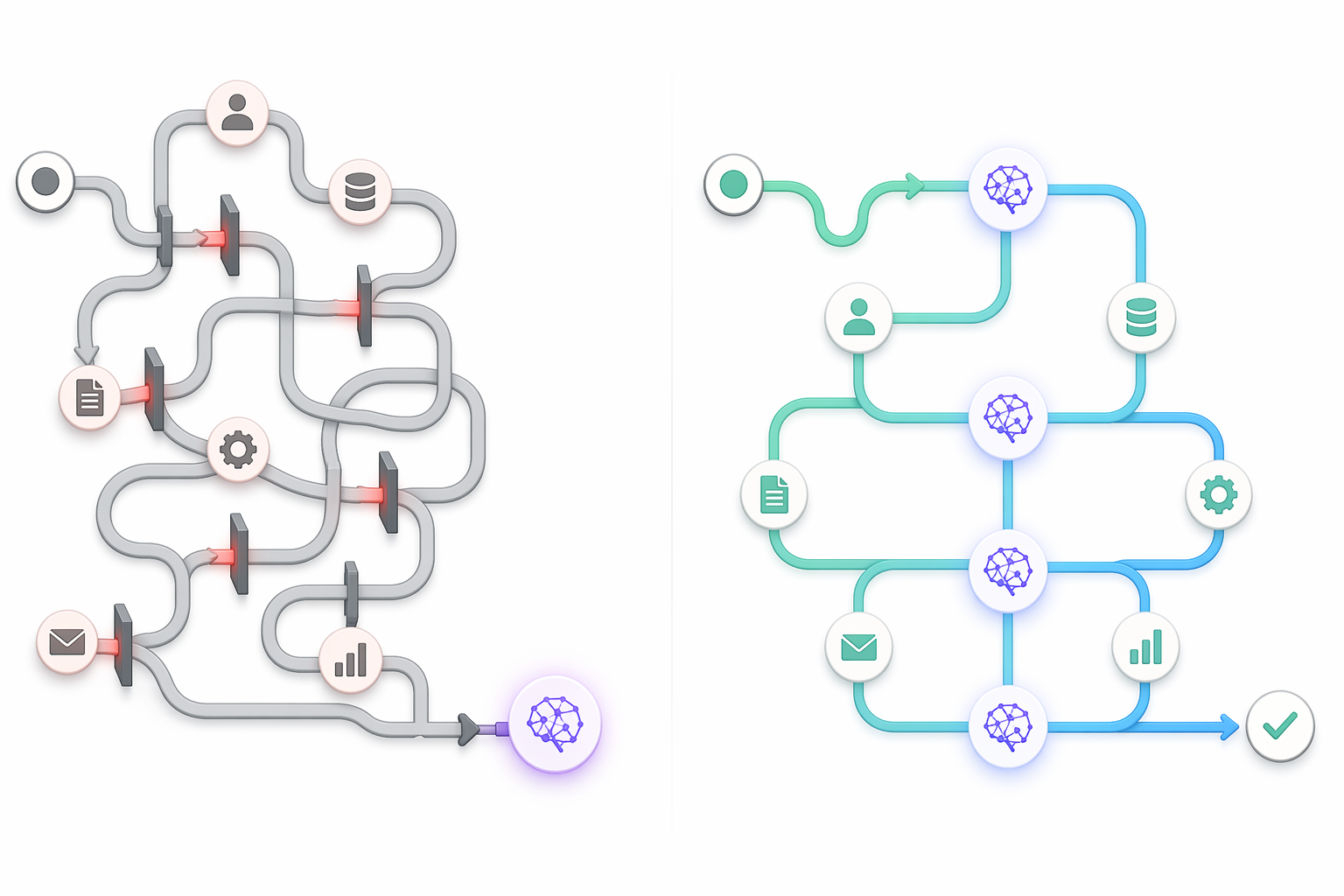
McKinsey's 2025 State of AI survey makes the implementation point hard to miss: high performers are 3x more likely to have redesigned workflows [3]. Microsoft's 2026 Work Trend Index adds a second layer to that idea, saying organizational factors such as culture, manager support, and talent practices account for 2x the AI impact of individual effort alone; it also says only 16% of AI users qualify as Frontier Professionals, the people who routinely redesign workflows and build multi-agent systems [8]. The message is not that individual experimentation does not matter. It is that the organization captures most of the value only when the work itself changes.
Task-level gains are real, but they are not universal
The strongest case for AI productivity tools comes from task-level studies, and those need careful handling. Anthropic's analysis of Claude conversations found task completion time dropping by about 80% in the sampled work [6]. A controlled MIT writing study found writing was 40% faster and quality improved by 18% [7]. Microsoft also reported about 25% less email time in its work trend analysis [8]. These are meaningful numbers, but they describe specific contexts, not a guarantee that every department, role, or process will see the same return.
What to measure before the license becomes a line item
A practical ROI case starts with the workflow, not the vendor demo. Before expanding a rollout, it helps to answer five questions: what task is being changed, what business outcome should improve, what the baseline effort or quality looks like today, which handoffs or review points are being removed or shortened, and how the tool's cost compares with the measured gain.
- Identify one workflow with visible drag, not a vague department-wide promise.
- Choose the outcome that matters in budget terms: hours saved, rework reduced, throughput increased, quality improved, or decision cycle shortened.
- Measure the current state before introducing AI, even if the baseline is rough.
- Redesign the handoffs, approvals, and review points instead of leaving them untouched.
- Compare the ongoing subscription and implementation cost with the value of the change, not just with user enthusiasm.
When the question shifts from understanding ROI to choosing a product, the ranked AI productivity tools comparison is the better next step. If the use case is narrower, the same logic applies in domain-specific buildouts such as sales workflow automation ROI statistics or document workflow automation ROI business case.
So the answer in 2026 is not that AI productivity tools are overhyped or automatically transformative. They can pay off, and the productivity numbers are strong enough to justify serious use. But the return belongs to organizations that redesign how work moves. If the tool only helps people move faster inside the old process, the company may celebrate a productivity lift while still missing the financial result.
References
- US AI Pulse Survey — EY
- AI Productivity Tools Market Size, Trends Report, 2026-2033 — Grand View Research
- The State of AI: Global Survey 2025 — McKinsey
- Frequent Use of AI in the Workplace Continued to Rise in Q4 — Gallup
- AI Use at U.S. Businesses — U.S. Census Bureau
- Claude task completion time reduction analysis — Anthropic
- Writing productivity study — MIT
- 2026 Work Trend Index: Agents, Human Agency, and the Opportunity for Every Organization — Microsoft
Comments
Join the discussion with an anonymous comment.