
The familiar bargain sounds rational at 10:45 p.m.: finish the deck, clear the inbox, take the late call, then catch up on sleep later. A five-hour night becomes proof of discipline. A nine-hour weekend sleep becomes repayment. The problem is that the brain does not appear to treat sleep as a simple bank account.
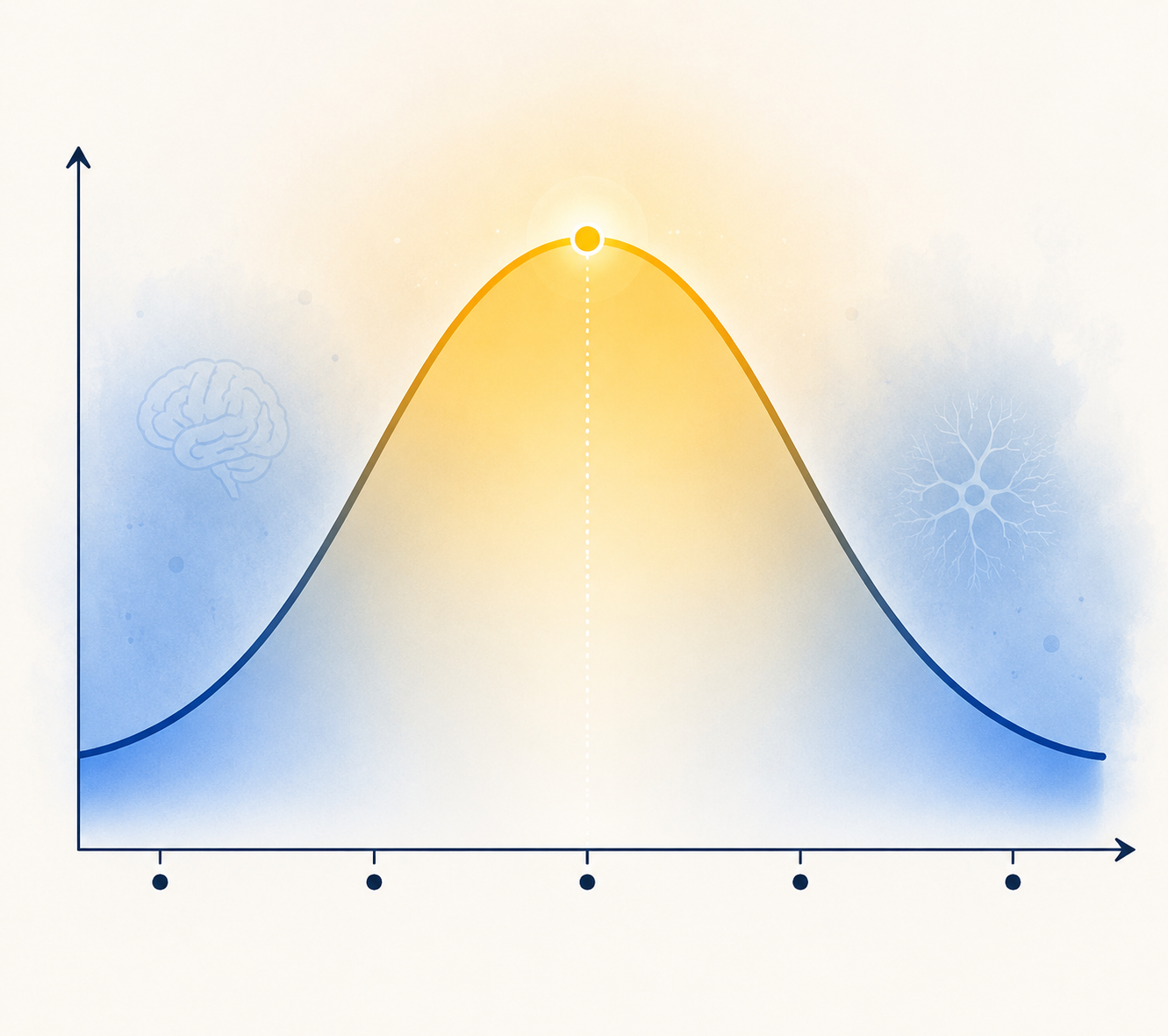
For productivity and long-term brain health, the best-supported target is narrower than the usual advice to “get more sleep.” In the largest data set we have connecting sleep duration, cognition, and brain structure, about 7 hours per night sat at the top of the curve. Cognitive performance was highest there, and grey matter volumes were largest across 46 brain regions, including areas tied to memory and executive function. Both short sleep and long sleep looked worse in the data.[1]
That does not mean every adult must force exactly 7 hours every night, or that one rough week has doomed anyone’s brain. It does mean that the common knowledge-worker pattern—routinely cutting sleep short, then trying to compensate with irregular long sleeps—is a weak strategy for focus. The concern is concrete: sleep length affects daily cognition, deep sleep helps clear proteins such as tau, and disrupted sleep patterns may sit on the path toward later cognitive decline.
Why the 7-Hour Number Deserves Attention
The strongest practical reason to take 7 hours seriously comes from the UK Biobank analysis by Tai and colleagues, published in 2022. The study included 479,420 participants and examined sleep duration alongside cognitive testing, mental health measures, genetics, and brain imaging. Sleep duration was self-reported in one-hour blocks, so this is not the same as a lab-measured sleep study. Still, its scale makes it hard to dismiss.[1]
The pattern was U-shaped. People reporting around 7 hours of sleep had the strongest cognitive performance. Those reporting short sleep, including 5 hours or less, and those reporting long sleep, including 9 hours or more, showed worse outcomes. Brain imaging told a similar story: grey matter volume was largest around the 7-hour point across 46 regions, including the hippocampus and orbitofrontal cortex.[1]
For someone paid to think clearly, those regions matter. The hippocampus is central to memory. The orbitofrontal cortex helps with judgment, reward evaluation, and flexible decision-making. You do not have to be worried about dementia to care about a sleep pattern associated with worse performance in systems you use every working day.
The caveats are real. UK Biobank participants skew older and predominantly white British, and self-reported sleep can misestimate what actually happened overnight. The study also shows association, not a clean proof that changing from 6 to 7 hours will directly enlarge grey matter or improve every task. But when a large brain-imaging data set, cognitive testing, and a biologically plausible sleep-cleaning mechanism point in the same direction, “I function fine on five hours” becomes a claim worth retesting.
The Overnight Cleaning Job You Cannot Move to Friday
The brain is not merely offline during sleep. During deep non-REM, slow-wave sleep, synchronized waves of neural activity help move cerebrospinal fluid through brain tissue. This waste-clearing pathway is often called the glymphatic system. Researchers at the University of Rochester Medical Center describe this slow-wave activity as helping drive fluid through the brain to flush metabolic waste, including tau and amyloid-beta.[2]
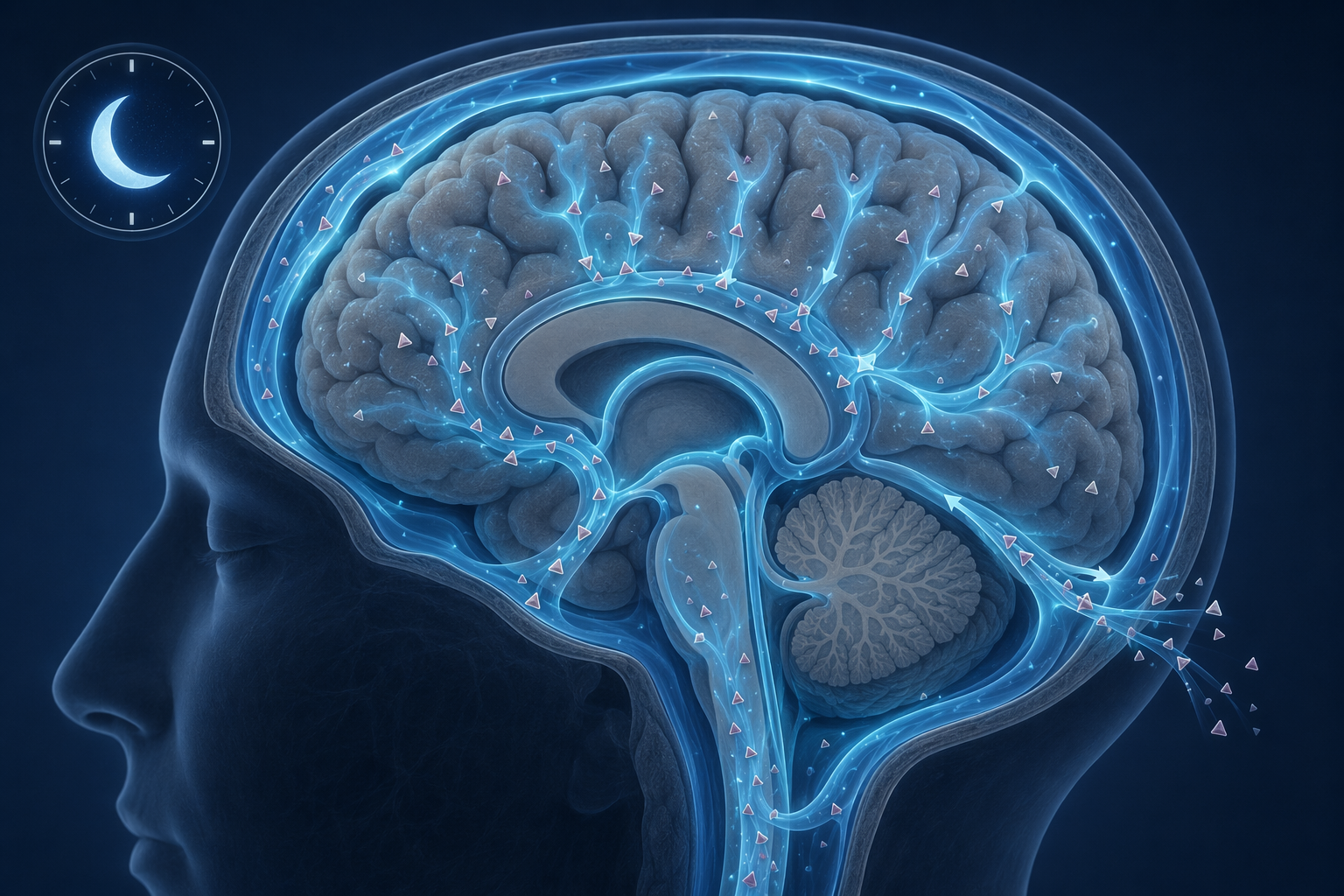
Tau is not automatically bad. In healthy amounts and proper locations, it helps stabilize structures inside neurons. The trouble begins when tau becomes abnormal, mislocalized, or accumulates in ways associated with neurodegenerative disease. Amyloid-beta is another protein associated with Alzheimer’s pathology. Sleep is one of the few routine behaviors that appears to influence the brain environment in which these proteins are handled.
This is where “I’ll catch up later” runs into biology. Deep sleep is not just a low-power mode; it is a timed maintenance window. If work, screens, stress, alcohol, caregiving, or late-night revenge scrolling repeatedly shrink that window, the cost may not be limited to feeling slow the next morning. The maintenance work itself may be interrupted.
The Sleepless-Night Tau Signal
A Washington University School of Medicine study made the short-term signal unusually concrete. In the human part of the study, one sleepless night raised tau protein in cerebrospinal fluid by about 50%. The human sample was small, so this should not be inflated into a population-wide prediction. But the finding is still hard to shrug off: a single night without sleep changed a biomarker directly connected to Alzheimer’s disease biology.[3]
The same research program also used animal models to examine how sleep deprivation could accelerate tau spread. Animal evidence cannot be treated as a direct forecast for a 42-year-old project manager, but it strengthens the mechanism: wakefulness and disrupted sleep appear to affect the release, clearance, and movement of tau in the brain.[3]
That distinction matters. The evidence does not say that one all-nighter causes Alzheimer’s. It says that sleep loss is not an abstract lifestyle flaw. It can alter tau biology in a direction researchers are watching closely. For a person who routinely compresses sleep to protect output, that is a productivity risk with a longer shadow.
Why Five-Hour Nights Are a Bad Productivity Trade
Short sleep has an obvious next-day cost: slower attention, weaker working memory, worse emotional control, and more friction around decisions. The UK Biobank results put structure around that experience by showing lower cognitive performance in short sleepers, not just worse self-reported tiredness.[1]
The more dangerous part is that many capable workers can still perform visibly well while degraded. They answer messages, attend meetings, push through shallow tasks, and mistake motion for cognition. What tends to suffer first is the work that is harder to measure in the moment: inhibition, prioritization, error detection, strategic patience, and the ability to stop polishing the wrong thing.
Broad workplace data fits that lived pattern without being the center of the case. In 2025, the National Sleep Foundation reported that 58% of workers said insufficient sleep negatively affected their productivity, and it cited fatigue as costing U.S. employers $136.4 billion annually.[4] Those figures are useful context. The stronger argument is more personal: if the next day requires judgment, negotiation, writing, coding, analysis, teaching, or caregiving, a short night borrows from the exact systems you need most.
Long Sleep Is a Warning Light, Not a Simple Villain
The U-shaped curve is the part people often misuse. If short sleep is bad and 7 hours looks best, it is tempting to treat 9 or 10 hours as “too much sleep” in the same simple way. The evidence is more complicated.
A 2026 UT Health San Antonio study using Framingham Heart Study data examined 2,410 participants and found that long sleep, in the 8.5- to 9-plus-hour range, was associated with higher blood levels of p-tau181, an Alzheimer’s-related phosphorylated tau marker. Levels rose most sharply beyond 10 hours. But the study was cross-sectional, meaning sleep duration and biomarker levels were observed at the same time. Long sleep may contribute to risk, but it may also be an early sign that something else is already changing in the brain or body.[5]
That is the practical reading: persistent long sleep deserves attention, especially if it is new, unexplained, or paired with cognitive changes. It does not mean a sick person, a new parent, a shift worker recovering from a brutal week, or someone healing from burnout should artificially cut sleep to hit a number. In those cases, long sleep may be a response to load, illness, mood, medication, or recovery.
Depression is one of the reasons to be careful. A Framingham analysis published in 2025 found that sleeping 9 hours or more was associated with cognitive performance equivalent to 6.5 years of brain aging, but the relationship was much stronger among participants with depressive symptoms. The effect was reported as 3 to 4 times stronger in that group, and 44% of long sleepers had depressive symptoms compared with 23% of average sleepers.[6]
So the long-sleep signal should not be converted into sleep restriction advice. It should be treated as a prompt to look at pattern and context. Are you sleeping long because you finally had the chance after chronic restriction? Because your schedule is chaotic? Because mood, pain, medication, alcohol, or illness has changed? Because you wake unrefreshed despite enough hours? Those situations call for different decisions.
A Useful Target Is a 7-Hour Opportunity, Not a Stopwatch Obsession
The most useful interpretation for working adults is not “sleep exactly 7 hours or fail.” It is: protect a consistent sleep opportunity that makes 7 hours of actual sleep realistic. For many people, that means being in bed longer than 7 hours, because sleep latency and awakenings count against actual sleep time.
| Pattern | What it usually means for work | What to do with the signal |
|---|---|---|
| Regularly 5-6 hours | You are likely borrowing from attention, inhibition, memory, and emotional control. | Move the constraint earlier: reduce late work, set a shutdown point, and protect a realistic sleep window. |
| Around 7 hours, consistent | This is the best-supported zone for cognition and brain structure in the large observational data. | Defend the routine before optimizing smaller productivity tactics. |
| Regularly 9+ hours | This may reflect recovery, illness, mood, medication, poor sleep quality, or early biological change. | Do not panic or self-restrict; look for context, change over time, and whether you wake restored. |
| Short weekdays, long weekends | The average may look acceptable while the brain gets an irregular maintenance schedule. | Stabilize timing before assuming catch-up sleep solves the problem. |
The boring operational move is also the one most people avoid: decide what time sleep starts before the day goes sideways. A calendar that protects every meeting but leaves bedtime negotiable is not neutral. It has already chosen the work that happens late over the work your brain performs overnight.
Generic sleep hygiene advice is only useful if it protects that window. A darker room, a cooler room, less alcohol, earlier caffeine cutoff, and a wind-down routine all matter insofar as they help you reach stable, deep sleep more often. The goal is not to decorate the night with rituals. The goal is to stop treating deep sleep as optional cleanup after the “real” work is done.
What This Means for Tau, Memory, and Focus
Tau deserves a more careful reputation than “Alzheimer’s protein.” Healthy tau has useful jobs inside neurons, and its role in cognition is more nuanced than a risk label suggests. For the companion side of this topic, How Tau Protein Improves Memory Formation for Productivity explains how tau can support memory when it is functioning normally.
This article is the other half of the story: sleep helps keep the system from drifting toward harmful accumulation. Deep sleep appears to support the fluid movement that clears waste products, including tau and amyloid-beta. Sleep deprivation can raise tau in cerebrospinal fluid. Large observational data place cognitive performance and brain structure near their best at about 7 hours. The pieces are not perfect proof, but they are aligned enough to change how a serious worker should budget the night.[1][2][3]
For most knowledge workers, the practical judgment is straightforward: a consistent 7-hour sleep window is a smarter productivity decision than squeezing the night and hoping to repay the debt with long, irregular recovery sleeps. The work you save by staying up late may be less valuable than the focus you lose tomorrow and the maintenance your brain misses overnight.
References
- Brain structure and genetic mechanisms underlying the nonlinear association between sleep duration, cognition and mental health, Communications Biology, 2022
- Not All Sleep Is Equal When It Comes to Cleaning the Brain, University of Rochester Medical Center
- Sleep Deprivation Accelerates Alzheimer’s Brain Damage, WashU Medicine
- Sleep and Productivity, National Sleep Foundation, 2025
- UT Health San Antonio study links sleeping long hours with higher levels of an Alzheimer’s-related protein, UT Health San Antonio, 2026
- Long sleep duration and cognitive aging: The moderating role of depressive symptoms, Alzheimer’s & Dementia, 2025
Comments
Join the discussion with an anonymous comment.