
The most familiar memory failure at work is not total forgetting. It is worse because it feels so close to success: you remember that you read the report, attended the briefing, highlighted the useful section, maybe even summarized it into a tidy note. Then, a week later, someone asks for the argument behind the recommendation, and all you can retrieve is the location of the file.
That gap is where tau protein becomes relevant to memory formation and productivity. The useful question is not whether tau protein gives knowledge workers a new biological lever to pull. It does not, at least not from the evidence available now. The better question is why two encounters with similar information can have such different futures: one becomes usable knowledge, while the other becomes a vague feeling of familiarity.
A July 2026 Nature Communications paper gives that question a sharper biological outline. In mice, Kosonen and colleagues found that tau phosphorylation at T205 modulated which neurons were recruited into memory engrams and affected remote memory access. The striking part for anyone who works with information all day is this: tau-deficient mice could form immediate memories, but later failed to access those memories through natural cues. The memory was not simply absent; it had become poorly retrievable in ordinary use.[1]
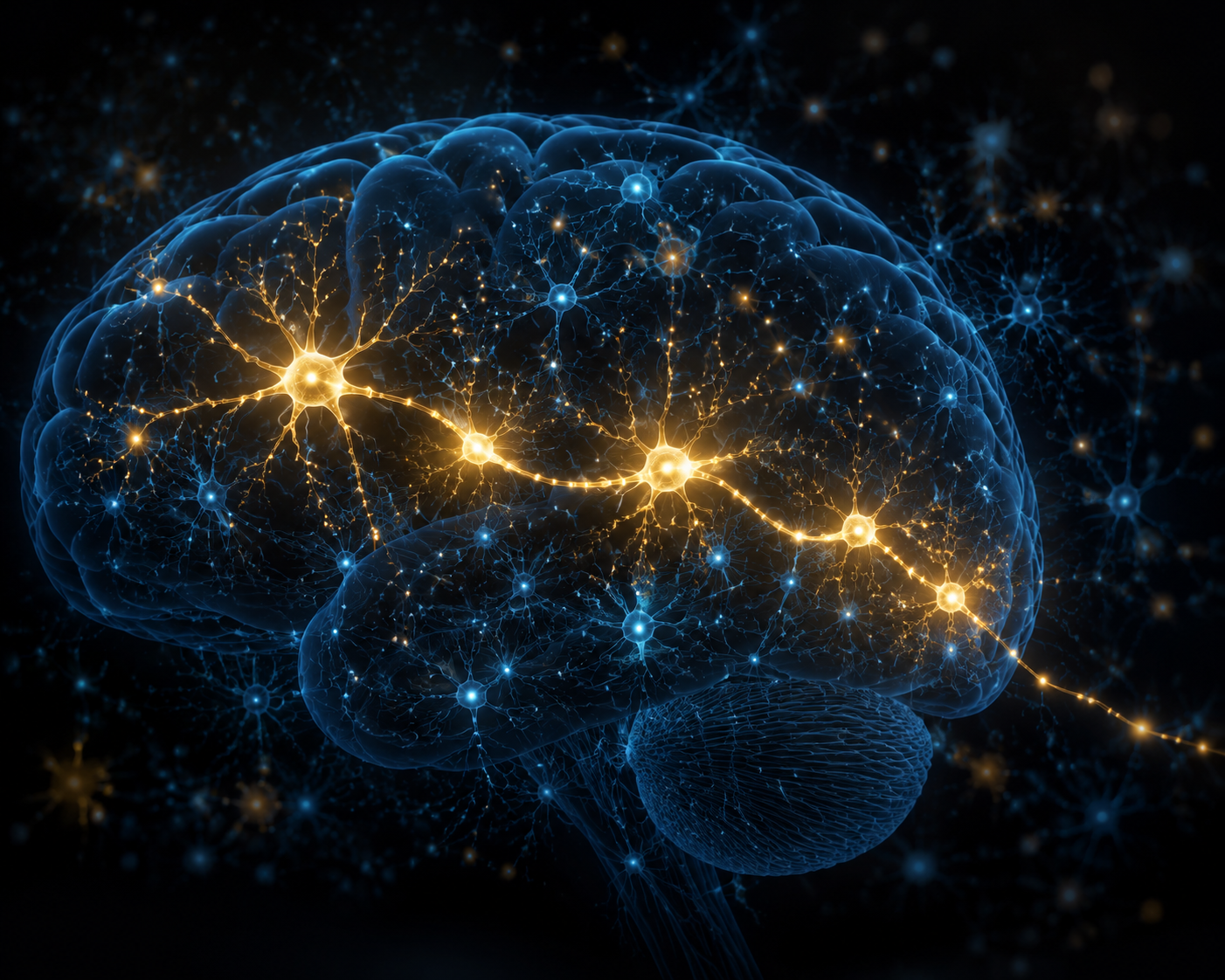
That does not prove that closing Slack, taking better notes, exercising, or sleeping well changes tau T205 phosphorylation in humans. The study was conducted in mice, and its human implications need translation. But it does put pressure on a lazy productivity assumption: that learning fails mainly because we did not store enough. The brain is not a passive inbox. At the moment of learning, it appears to be selecting, suppressing, recruiting, and filtering.
Captured Is Not the Same as Encoded
Most knowledge-work systems are excellent at proving that an encounter happened. A meeting note proves you were present. A saved deck proves the document entered your workspace. A highlight proves that a sentence looked important at the time. None of those artifacts proves that the idea was encoded in a form you can use later without reopening the source.
This distinction matters because retrieval is usually when productivity gets tested. The analyst has to explain the assumption behind a model. The manager has to remember why a tradeoff was rejected. The designer has to apply a research finding to a new screen. The consultant has to notice that a sentence in one client interview contradicts a pattern from three weeks earlier. In those moments, a beautiful archive helps only after you already know where to look.
The tau study is interesting because it separates immediate memory from later cue-based access. In the experiment, the issue was not that tau-deficient mice could not form a memory right away. The problem appeared later, when natural cues no longer accessed the memory reliably.[1] That is uncomfortably close to the way weakly learned work material behaves. It is not gone in a simple sense. It is familiar, searchable, perhaps recognizable when rediscovered. It just does not answer when called.
What Tau Appears to Do During Memory Formation
Tau is often discussed in the context of neurodegenerative disease, especially because abnormal tau is associated with Alzheimer’s pathology. That history makes the July 2026 finding feel surprising: the same protein family long associated with memory failure also appears to have a normal role in making memories last. The Nature Communications paper identified tau T205 phosphorylation as a modulator of engram cell recruitment and remote memory in mice.[1] Science coverage of the work described this role as a kind of biological “noise filter,” a useful phrase as long as it is not mistaken for a complete mechanism.[2]
An engram is not a label in a note-taking app. It is a population of cells whose activity helps store and later reactivate a memory. The study’s key contribution is that tau was not merely sitting in the background while memory happened. Its T205 phosphorylation influenced which cells were recruited into the memory trace and helped suppress off-target neural activity during encoding.[1]
That last part is the bridge to learning. Memory formation is not just about turning up signal. It is also about keeping irrelevant activity from joining the trace. If too many unrelated cells are recruited, or if the wrong activity is allowed to mingle with the learning event, the future cue has a harder job. It has to reactivate a pattern that was noisy at birth.
The everyday version is easy to recognize. You read a strategy memo while answering chat messages, checking a calendar reminder, and half-listening for your next call. The memo is technically in front of you. Your eyes move over the argument. You may even copy the strongest paragraph into a note. But the learning episode is contaminated by other tasks, other cues, other unfinished intentions. Later, when a natural cue appears — a decision meeting, a client question, a related problem — the memo’s point does not come cleanly with it.
This is not a claim that workplace distraction has been shown to alter tau phosphorylation in humans. It is a narrower and more useful claim: the mouse study reinforces the idea that encoding quality depends on biological selection and filtering, not just exposure. If the brain has to select the right neural pattern while suppressing irrelevant activity, then the conditions surrounding first contact with important material deserve more respect than they usually get.
The First Pass Is Where Many Notes Already Fail
The first serious pass through material is not clerical. It is not merely the stage where information moves from a PDF into a note. It is the moment when the brain begins deciding what belongs together, what can be ignored, what cues should later bring the idea back, and what the new information means in relation to what you already know.
That is why a distracted first pass is so expensive. You can clean up the note afterward. You can rename it, tag it, backlink it, summarize it, and place it in a dashboard. Those improvements may make the information easier to find. They do not fully repair the fact that the original encounter may have been encoded with weak context and too much competing activity.

This also explains why “I’ll just capture it now and learn it later” is a risky bargain. Sometimes it is necessary; not every meeting deserves deep attention. But when the material will matter later, treating the first pass as low-value administration can create the exact problem the system is supposed to solve. The file survives. The usable memory does not.
How to Design a Lower-Noise Learning Session
The practical lesson is not to worship focus for its own sake. Focus is one memory condition among several. Retrieval practice, spaced repetition, elaborative encoding, sleep, and physical activity still matter. The tau finding simply makes the encoding window harder to dismiss. If something must be remembered later, the first encounter should not be treated like a background task.
For important material, the setup should change before the note-taking app opens:
- Protect the first pass. Read the report, watch the lesson, or review the meeting recap in a dedicated block rather than inside a stream of messages.
- Single-task during encoding. Do not make the brain bind the new idea to a rotating set of tabs, alerts, and half-finished replies.
- Turn notes into cues, not storage bins. Write the question the note should answer later, the decision it affects, or the situation where it should come back.
- Retrieve soon after learning. Close the source and explain the point from memory before polishing the note.
- Space the next encounter. Revisit the idea after time has passed, not only while it still feels fresh.
Mayo Clinic’s memory guidance aligns with several of these practices: staying mentally active, organizing information, avoiding distraction while learning, repeating information, and using spaced review are all presented as practical ways to support memory.[3] None of that depends on turning tau into a productivity supplement. It is enough to notice that established memory advice and the tau mechanism both point away from passive capture and toward better encoding conditions.
A Better Note Is Often a Better Cue
A note that merely preserves a sentence asks your future self to repeat the learning work. A note that records the cue gives memory something to grab. The difference is small in format and large in consequence.
| Weak capture | Stronger encoding cue |
|---|---|
| “Q3 churn analysis: enterprise accounts at risk.” | “When forecasting expansion revenue, check whether the churn risk came from onboarding delay or missing executive sponsor.” |
| “Interesting framework from course.” | “Use this framework when a project has many tasks but no clear owner for the next decision.” |
| “Customer quote about dashboard confusion.” | “This quote supports the hypothesis that users cannot tell status from priority in the dashboard.” |
The examples are hypothetical, but the principle is practical. Retrieval works better when the note preserves the future situation in which the idea should be used. Tags and folders help locate material. Cues help reactivate it.
Tools Should Support Encoding, Not Substitute for It
A good personal knowledge management system still matters. Search matters. Links matter. Summaries matter. Spaced-repetition tools can be useful when the material deserves deliberate review. The mistake is expecting the archive to compensate for a learning session that was never given enough attention to form a clean trace.
A more honest setup pairs tools with attention design. The tool captures what matters after attention has done its first job. The calendar protects the encoding block. The notification settings reduce competing cues. The note template asks for the future use case, not just the source title. The review system forces retrieval before rereading.
For a report that will shape a decision, this might mean reading once without highlighting, then closing the document and writing three claims from memory. Only after that does the note get organized. For a meeting recap, it might mean writing the decision, the rejected alternative, and the condition that would change the decision later. For a course module, it might mean creating a small number of retrieval prompts instead of a large number of copied bullets.
The common feature is not minimalism. It is that the system respects the sequence: attend, encode, retrieve, then archive.
Focus Is Not the Whole Memory System
It would be convenient, and wrong, to turn this into a single-command rule: focus harder. Memory is not built by attention alone. Retrieval practice strengthens access. Spacing changes the difficulty and timing of review. Elaborative encoding connects new material to what is already known. Sleep supports consolidation. Exercise may also play a role in next-day cognitive performance.
A 2024 study led by Bloomberg and colleagues found that 30 or more minutes of moderate-to-vigorous physical activity was associated with improved episodic memory for up to 24 hours, and that deep sleep had an independent benefit.[4] That does not mean exercise directly modifies tau T205 phosphorylation in humans. It means the daily conditions around learning are worth taking seriously rather than treating memory as something that happens only inside the note app.
The useful hierarchy is simple enough: protect attention when first learning important material, test retrieval soon afterward, space later review, and maintain the basic body conditions that make cognition less fragile. None of those practices is new. The tau study makes one part of the picture more concrete: the brain may need a cleaner encoding environment because memory formation itself involves selection and noise suppression.
What This Does Not Prove
The boundary is important. The Nature Communications study was conducted in mice, not in office workers reading quarterly planning documents. It does not show that deep work changes tau phosphorylation in people. It does not show that any app, supplement, focus routine, or lifestyle habit can tune tau as a productivity intervention. It also does not mean tau is the only important mechanism in memory formation.[1]
What it does show is still valuable. In mice, tau T205 phosphorylation influenced engram recruitment and remote memory access. When tau was deficient, immediate memory could appear intact while later natural cue-based access failed.[1] For knowledge work, that is a disciplined analogy, not a clinical prescription. It gives biological shape to a familiar failure: information can be present in some sense and still unavailable when the situation calls for it.
Protect the Moment the Memory Is Made
The practical conclusion is modest, which is why it is useful. The tau discovery does not hand knowledge workers a biomarker to optimize. It does not turn productivity into molecular self-tracking. It does, however, strengthen the case for a rule many capable people ignore because their tools are so good: if something must be remembered later, protect the encoding environment now.
A clean archive is valuable. A retrievable memory is better. The difference often begins before the note exists.
References
- Tau T205 phosphorylation modulates engram cell recruitment and remote memory in mice, Nature Communications, July 2026.
- Scientists Discover Alzheimer’s-Linked Protein’s Surprising Role in Making Memories Last, SciTechDaily.
- Memory loss: 7 tips to improve your memory, Mayo Clinic.
- Device-measured physical activity, sedentary behaviour and sleep, and next day cognitive performance in older adults: a compositional data analysis, International Journal of Behavioral Nutrition and Physical Activity, 2024.
Comments
Join the discussion with an anonymous comment.