
Pricing and feature notes in this comparison were last verified on June 26, 2026. If you are choosing a marketing automation workflow tool for a small business, the useful question is usually not “Which platform has the most features?” It is “What will this cost once my list grows, and will I actually be able to build the workflow without creating another system I have to babysit?”
That matters because the work this software is supposed to remove is already piling up. Kissflow reports that 68% of employees say they have too much work to handle, and 94% of companies still perform repetitive manual tasks.[1] For an owner-operated business, that often shows up as missed lead follow-ups, abandoned carts nobody has time to recover, a newsletter list that is technically growing but never segmented, or a spreadsheet that quietly becomes the real CRM.
The short version: ActiveCampaign is the best first look for service-based businesses that need real automation depth at a low entry price; Brevo is the safest budget pick when sending volume is modest; Omnisend is the easiest eCommerce starting point if abandoned-cart and post-purchase workflows matter more than advanced predictive analytics.
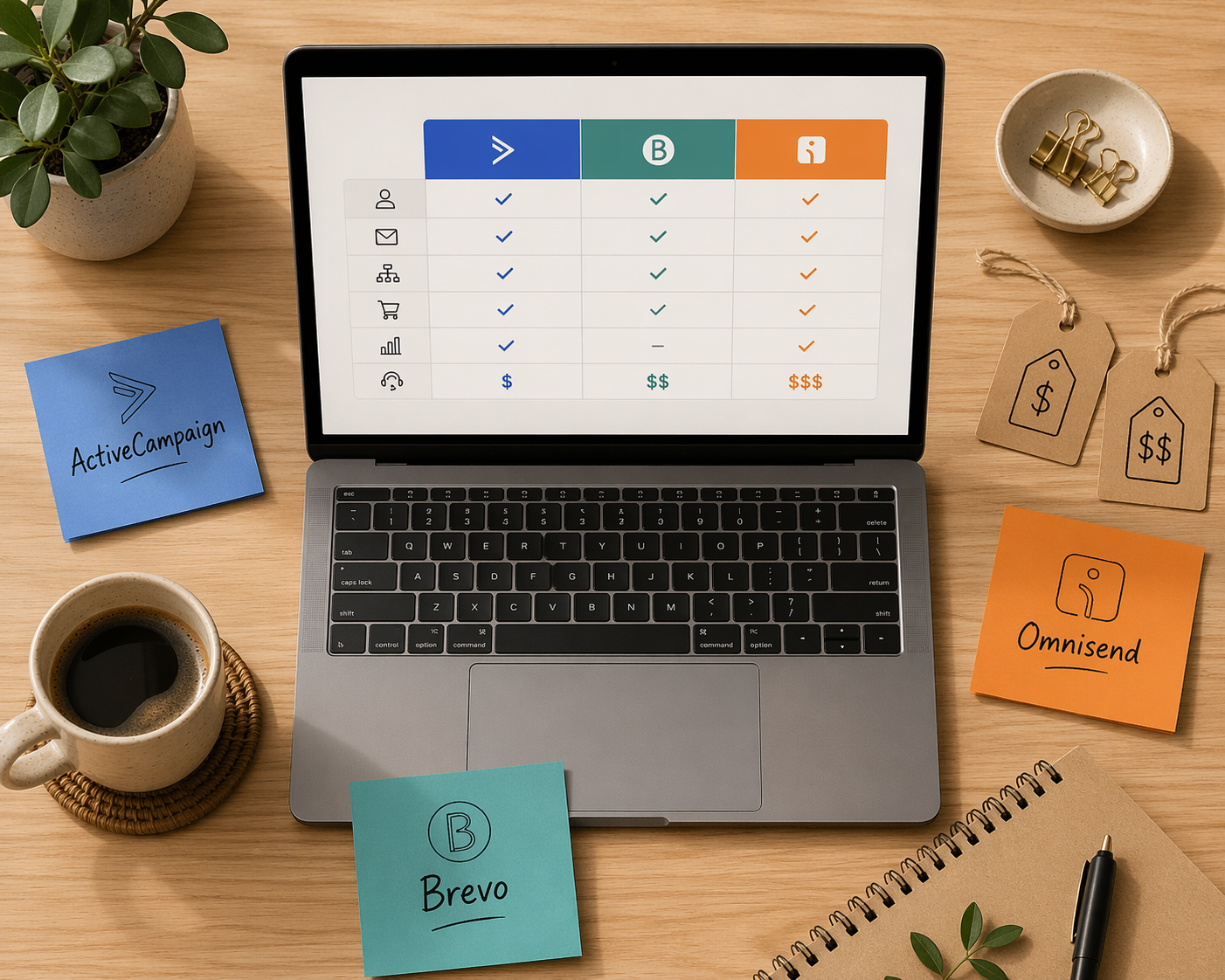
2026 small-business pricing snapshot
The table below is deliberately price-first. Feature lists are easy to skim past; contact tiers are where a cheap tool starts becoming a monthly line item. The exact vendor checkout page should still be checked before paying, because marketing automation pricing changes often and plan packaging shifts.
| Tool | 500 contacts | 1K contacts | 2.5K contacts | 5K contacts | What to watch before paying |
|---|---|---|---|---|---|
| ActiveCampaign | Pricing varies by plan and contact tier; verify current checkout pricing | Starter plan listed at $19/mo for 1K contacts | Verify current contact-tier jump | Verify current contact-tier jump | Strong automation depth for the price, but CRM can require a $50/mo add-on |
| Brevo | Free plan available; pricing is more constrained by email volume than contact count | Free plan can still apply if daily sending needs fit | Free plan uses unlimited contacts, but daily sending cap can become the blocker | Free plan uses unlimited contacts, but daily sending cap can become the blocker | 300-emails-per-day cap on free plan; advanced triggers and branching are more limited than deeper automation tools |
| Omnisend | Standard plan starts at $16/mo | Standard plan starts at $16/mo, subject to list and sending limits | Verify current contact-tier jump | Verify current contact-tier jump | Excellent eCommerce templates for beginners; analytics are shallower than Klaviyo |
| Mailchimp | Free plan covers basics | Verify current contact-tier pricing | Verify current contact-tier pricing | Verify current contact-tier pricing | Data-retention caps can weaken long-term segmentation |
| Kit | Free tier is strongest for creator broadcasts and landing pages | $49/mo for 1K subscribers | Verify current subscriber-tier jump | Verify current subscriber-tier jump | Creator-friendly, but automation logic is limited compared with general-purpose workflow builders |
| Klaviyo | Verify current contact-tier pricing | $45/mo starting point cited in the comparison sources | Verify current contact-tier jump | Verify current contact-tier jump | Better predictive analytics for eCommerce, but a higher starting cost than Omnisend |
ActiveCampaign’s Starter plan is listed at $19/month for 1K contacts, and its visual conditional branching and lead scoring are called out as available at a price level where Mailchimp and Brevo do not match the same automation depth.[2][3] That is the main reason it earns the strongest recommendation for service businesses rather than merely being another email platform with automation attached.
Brevo deserves its budget reputation, but the free plan is not magic. The important detail is that Brevo allows unlimited contacts on the free plan while limiting sending to 300 emails per day.[2] For a small list, that can be generous. For a 2,000-contact list where you want to send one campaign to everyone on the same morning, it is a queue.
Omnisend starts at $16/month and is positioned as the cheapest dedicated eCommerce workflow tool in the comparison material, with direct Shopify and WooCommerce integrations.[2] The attractive part is not just the price; it is that beginner eCommerce stores get abandoned-cart and post-purchase workflows without having to design revenue recovery from a blank canvas.
The best pick depends on the business model
A freelance consultant, a Shopify starter, a creator, and a local retail shop can all say they need a marketing automation workflow. They do not need the same workflow. One is trying to stop losing inquiries after a sales call. One needs cart recovery. One needs reliable audience broadcasts. One needs simple promotions and reminders without turning the store owner into a part-time systems administrator.

Service businesses: start with ActiveCampaign
For consultants, agencies, coaches, home-service companies, and other lead-driven businesses, ActiveCampaign is the most convincing low-cost option in this set. The reason is workflow logic. A service business often needs a lead to move differently depending on form answers, email engagement, appointment status, quote stage, or sales readiness. ActiveCampaign’s visual conditional branching and lead scoring at the $19/month 1K-contact Starter level give it more room to handle those paths than simpler newsletter-first platforms.[2][3]
A practical example: a website inquiry can receive an immediate confirmation, wait for a calendar booking, get a reminder if no booking happens, and be scored differently if the person clicks a pricing link. That kind of workflow is where a tool starts saving actual follow-up time instead of merely sending prettier email.
The catch is CRM cost. ActiveCampaign’s CRM add-on is cited at $50/month, and that can change the real monthly number for a business that wants pipeline management inside the same system.[2] If you already use another CRM, that may not matter. If you assumed the low marketing plan included a full sales pipeline, it matters immediately.
Tight budgets: Brevo is the least painful place to begin
Brevo is the tool to consider when the business has more patience than budget and the first workflows are simple: welcome emails, basic follow-ups, birthday or date-based messages, and small campaigns. The free plan’s unlimited-contact structure is unusually friendly if the list is growing but sending volume remains modest.[2]
The daily send limit is the line to draw in red. A 300-emails-per-day cap is workable for a small drip sequence or a local business sending a few small batches, but it gets awkward when one campaign needs to reach the full list at once.[2] Brevo is a good budget answer; it is not automatically the right answer for a business that expects frequent list-wide campaigns.
Beginner eCommerce: Omnisend beats general-purpose tools on setup speed
For a small Shopify or WooCommerce store, Omnisend’s advantage is that it starts from the store owner’s actual problem: customers browse, abandon carts, buy once, and then need a reason to come back. Its direct Shopify and WooCommerce integrations, plus pre-built abandoned-cart and post-purchase workflows, make it more immediately useful than a general tool that asks the owner to assemble those flows from scratch.[2]
The Klaviyo comparison is where the trade-off becomes clear. Klaviyo starts at $45/month in the cited comparisons, compared with Omnisend’s $16/month starting point, and offers stronger predictive analytics such as customer lifetime value, churn risk, and next-order timing.[2] A beginner store may not need those predictions on day one. A store with enough repeat-purchase data to act on them may eventually care a lot.
If eCommerce is the main decision path, the deeper comparison of Klaviyo vs. Omnisend vs. ActiveCampaign is worth reading before committing to a platform.
Creators: Kit is a fit, not a universal SMB pick
Kit, formerly ConvertKit, makes the most sense when the business is built around an audience: newsletter, course, coaching content, podcast, membership, or digital product. Gumloop’s 2026 list cites Kit at $49/month for 1K subscribers and reports landing page conversion rates of about 30% to 50%.[4] That conversion claim should be treated as creator-context evidence, not as a promise for every type of small business.
Kit’s weakness is automation logic. It can support a creator’s email funnel well enough, especially when the main job is capturing subscribers and sending broadcasts, but it is not the tool to choose if the business needs deep conditional routing, sales-stage logic, or complex multi-path follow-up.
Local retail and simple email marketing: Mailchimp is fine until history matters
Mailchimp remains a reasonable choice for basic newsletters, promotions, and simple automations. The frustration starts when a business wants to use older behavior to make smarter segments. Digital Applied’s 2026 comparison cites a 30-day data-retention limit on Mailchimp’s free plan and an 18-month cap on premium, which can prevent long-term historical segmentation.[3]
That limitation is easy to ignore during setup because nothing looks broken. The account can still send email. The problem appears later, when the owner wants to target customers who bought last year, subscribers who used to click but went quiet, or seasonal shoppers from a prior cycle. If historical segmentation is part of the plan, Mailchimp’s retention limits deserve attention before the list grows around it.
The hidden costs that change the decision
Small businesses do not only pay in subscription fees. They pay in setup time, surprise upgrades, cleanup work, and awkward workarounds. These are the details to check before a “free” or “starter” plan becomes the center of the customer system.
| Hidden cost or limit | Tool most affected | Why it matters |
|---|---|---|
| Daily sending cap | Brevo | The free plan’s 300-emails-per-day cap can block full-list sends even when contact storage is generous. |
| CRM add-on | ActiveCampaign | A low-cost marketing plan may not include the sales pipeline features a service business expects. |
| Historical data retention | Mailchimp | Segmentation gets weaker if older behavioral data is unavailable. |
| Limited automation logic | Kit | Good creator workflows do not equal deep multi-branch business automation. |
| Analytics depth | Omnisend | Lower eCommerce starting cost comes with shallower predictive analytics than Klaviyo. |
| Contact-tier jumps | All tools | A plan that looks cheap at 500 or 1K contacts can change quickly as the list grows. |
Brevo’s free plan is contact-friendly, not send-unlimited
Brevo’s free plan can be a very good starting point if the business sends modestly and values contact storage. The 300-emails-per-day cap is the practical constraint.[2] A local service provider sending a five-email welcome sequence to a handful of new leads each day may never feel boxed in. A shop with 1,500 subscribers and a weekend sale will feel it immediately.
ActiveCampaign’s automation value is real, but price the CRM honestly
ActiveCampaign deserves credit for giving small businesses access to automation features that are often pushed into higher tiers elsewhere. Conditional branching and lead scoring at the cited Starter price are meaningful for lead follow-up.[2][3] But if the business also needs built-in CRM functionality, the $50/month add-on belongs in the budget from the start.[2]
This is the kind of cost that causes buyer’s remorse because it is not a shiny feature; it is plumbing. If the team’s sales process lives in pipeline stages, tasks, deal owners, and follow-up reminders, leaving CRM out of the first-month estimate makes the platform look cheaper than the working system will be.
Mailchimp’s data limits can punish patient businesses
Mailchimp’s 30-day data retention on the free plan and 18-month cap on premium are not setup problems; they are later-stage segmentation problems.[3] That distinction matters. A new account can feel perfectly adequate for months. Then the business wants to build better segments from older engagement or purchase behavior and discovers the system was not keeping enough history for that plan.
Omnisend saves setup time, while Klaviyo saves more analytical headroom
Omnisend is appealing because it gives a beginner eCommerce business the workflows it probably meant to build anyway. Abandoned-cart and post-purchase automation are not exotic; they are table stakes for a store that wants to recover more revenue without manually chasing shoppers. Omnisend’s lower starting price makes that accessible.[2]
Klaviyo’s advantage is not beginner simplicity. It is stronger predictive analytics, including customer lifetime value, churn, and next-order timing, according to the comparison material.[2] That is a real capability gap. The small-store question is whether those predictions are useful now, or whether the business first needs reliable core flows that actually get launched.
Kit should not be stretched beyond creator work
Kit is at its best when the workflow begins with a creator asset: landing page, lead magnet, newsletter, sequence, offer. For that path, its free-tier broadcasts and creator orientation can be enough to get moving. For a local service business trying to manage lead status, or a store trying to build cart and purchase logic, Kit’s limited automation depth becomes the wrong compromise.
A faster shortlist
If you want the broader category map before choosing, start with the full marketing automation workflow by use case guide. If you are already choosing from this set, the shortlist is simpler:
- Choose ActiveCampaign if you run a service-based business and need lead follow-up, branching, scoring, and more serious workflow logic at a low entry price. Add the CRM cost to your estimate if pipeline management matters.
- Choose Brevo if the budget is tight, the workflows are simple, and the 300-emails-per-day free-plan cap will not disrupt normal campaigns.
- Choose Omnisend if you run a beginner eCommerce store and want abandoned-cart and post-purchase automation ready quickly, especially on Shopify or WooCommerce.
- Choose Mailchimp only if basic email marketing is enough and long-term behavioral segmentation is not central to the plan.
- Choose Kit if you are primarily a creator and the main job is growing an audience, sending broadcasts, and running simple subscriber sequences.
- Consider Klaviyo instead of Omnisend if eCommerce predictive analytics are worth the higher starting cost.
Before paying, verify six things on the vendor site: the contact tier you will actually use, the automation logic included on that tier, daily or monthly sending limits, data-retention rules, CRM requirements, and the depth of your eCommerce integration. If you are ready to implement rather than compare, the small-business process automation setup guide is the better next stop.
References
- Workflow Automation Statistics and Trends, Kissflow.
- Marketing Automation Software, Venture Harbour.
- Marketing Automation Platform Comparison 2026, Digital Applied.
- Best Marketing Automation Platforms, Gumloop.