
Last verified: Aug. 26, 2026.
A 3 minute sprint workout for focus and productivity can be real, but the label is doing a little too much work. The three minutes are the sprinting minutes: six all-out 30-second efforts. The workday intervention is longer, sweatier, and more conditional. If you count warm-up, long recoveries, breathing time, and the narrow window when the cognitive tests actually improved, you are usually looking at a 15–30 minute block, not a calendar crumb between two meetings.
The honest verdict is narrower and more useful: six 30-second all-out sprints can sharpen some forms of attention and executive-function speed shortly afterward, especially around the 10–20 minute post-exercise window. That makes the protocol plausible as an occasional pre-deep-work tool. It does not make sprint intervals a harmless tab-switching reset, a universal productivity trick, or a good default for sedentary workers.
The real session is not three minutes
The version people usually mean is sprint interval training: go all out, recover for several minutes, repeat. In the acute cognition study that best matches the “six 30-second sprints” claim, the sprint session used six 30-second maximal efforts with recovery between them, and cognitive tests were assessed 20 minutes after exercise in 36 young, physically active men [1].
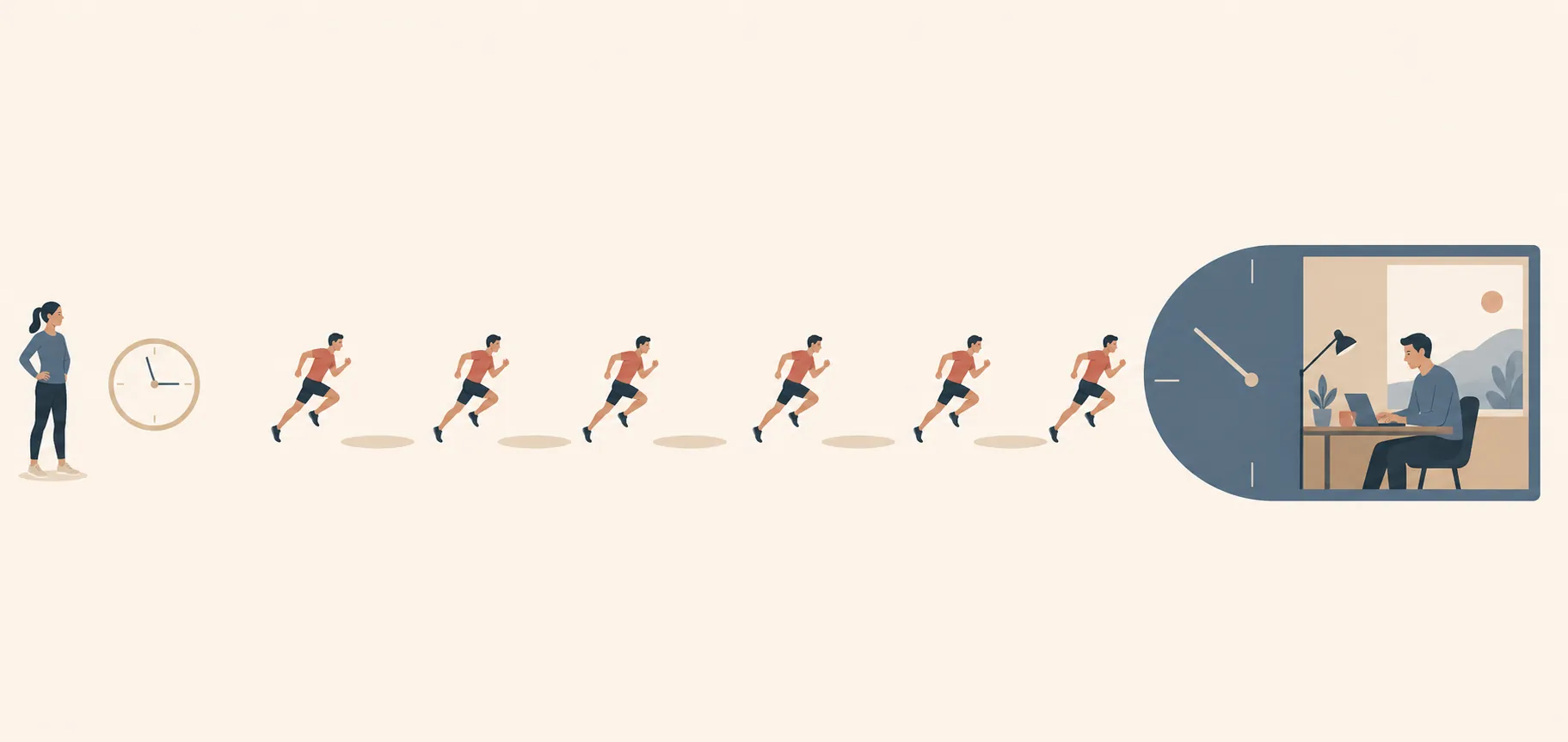
For a workday, the practical version looks more like this:
| Phase | What happens | Why it matters for work |
|---|---|---|
| Warm-up | 3–5 minutes of easy movement before hard efforts | Reduces the shock of going straight from chair to sprint |
| Sprint work | Six 30-second all-out efforts | This is the “3-minute” part |
| Recovery | Long easy recoveries between efforts, roughly a 1:8 work-to-rest feel in the classic protocol | Makes the later sprints possible; cutting rest turns the session into a different stimulus |
| Breathing and transition | A few minutes to stop sweating hard, hydrate, and sit down without carrying panic-breathing into the task | Prevents the first minutes of deep work from being consumed by recovery |
| Focus window | Start the protected task roughly 10–20 minutes after the session | This is when the relevant acute cognition studies measured benefits |
That timing detail is not decorative. If the work you care about starts 45 minutes later because you had to shower, answer messages, or calm down, the evidence no longer cleanly maps onto your day. The protocol belongs before a writing block, coding block, analysis session, or exam-style review period that is ready to begin soon after the exercise—not before a loose afternoon of meetings.
What actually improved: attention precision and speed, not “productivity”
The cleanest desk-worker question is not whether sprinting is “good for the brain.” It is whether the task right after sprinting gets easier in a measurable way. Two small acute-exercise studies are the useful anchors here.
First, Herold et al. tested a reduced-exertion sprint variant: a 3-minute warm-up followed by six 6-second all-out sprints with 60 seconds of recovery. In 19 adults aged 20–28, the session improved attention precision on the d2 test, seen as a lower error rate, at 10 minutes post-exercise. Digit Span performance, a working-memory measure, did not change. Participants still rated the effort at about 16 on the rating of perceived exertion scale, which is hard work, not a breezy office stretch [2].
That distinction is useful because it keeps the promise small enough to be believable. The result points toward cleaner attention under time pressure—fewer misses or false alarms on a paper-and-pencil attention task. It does not prove that a person will draft better strategy memos, make wiser hiring decisions, or stop procrastinating after sprinting.
Second, Kujach et al. used acute sprint interval exercise and found shorter response times on the Stroop test and Trail Making Tests A and B at 20 minutes post-exercise, alongside elevated BDNF, IGF-1, and VEGF. The sample was 36 young, physically active men [1]. Stroop and Trail Making are closer to executive speed than to “being productive” in the workplace: they involve inhibition, switching, visual scanning, and quick accurate responding.
For a knowledge worker, the plausible translation is modest but interesting. The post-sprint window may be a good time for work that punishes sloppy attention: editing, reviewing code, sorting evidence, checking a model, outlining an argument, or doing a first pass through a difficult problem. It is less clearly a tool for memory-heavy studying, creative looseness, or emotionally delicate work.
The reduced-exertion version matters more than it sounds
The six-30-second version gets attention because “three minutes” is memorable. But the reduced-exertion Herold protocol is arguably more relevant for real workdays: six 6-second sprints, 60-second recoveries, and a 10-minute post-exercise attention test [2]. It asks less from the calendar and from the legs, while still producing an attention-precision signal.
Less total sprinting does not mean easy. An RPE around 16 is still vigorous, and all-out efforts still carry the usual hazards of sudden acceleration, poor warm-up, awkward surfaces, and overconfident pacing [2]. But it does suggest a practical fork: if the goal is an acute focus window rather than a training plan, the smallest effective hard stimulus may be more sensible than copying the most dramatic interval format.
That is where many productivity writeups get sloppy. They treat intensity as a virtue by itself. For focus, the question is whether the dose leaves you sharper for the next task. If the workout makes you sweaty, breathless, slightly nauseated, or late to the block you were trying to protect, the workday math has failed even if the interval session was “only” three minutes of sprinting.
Where the Rockefeller result fits—and where it does not
The newest attention-grabbing item is a Rockefeller University study reported by ScienceDaily on Aug. 21, 2026. The release said three minutes of sprinting altered nearly 25% of measured blood proteins and more than 200 metabolites, compared with less than 0.25% of proteins after 90 minutes of moderate cycling. It also reported that, among 33 blood proteins linked to lower metabolic-disease risk in UK Biobank data from more than 53,000 participants, 32 were altered by sprinting versus 3 by moderate exercise [3].
Those numbers are striking, and they should be treated as press-release figures unless checked against the primary paper. They are not, by themselves, proof that a sprint break improves your afternoon focus. The report is useful as biological plausibility: very short maximal exercise can produce a broad acute molecular response. But the focus claim still needs human cognitive outcomes, measured after exercise, on tasks that resemble attention or executive control. That is why the Herold and Kujach findings carry more weight for this article than the Rockefeller release, even though the Rockefeller figures are newer and louder.
Three things not to blur
Sprint work time is not session time
“Three minutes” means accumulated sprinting. It does not include the warm-up, the recoveries, or the transition back to useful concentration. If you have exactly three minutes before a meeting, this is not the tool. A short walk, a few mobility drills, or standing away from the screen would be a more honest use of that slot.
Acute focus is not general productivity
The supported claim is about a short post-exercise window and specific test outcomes: d2 attention precision at 10 minutes, and faster Stroop and Trail Making performance at 20 minutes [1][2]. Productivity is a larger bundle: priorities, sleep, task design, deadlines, emotional load, interruptions, and whether the work even needed high-intensity arousal in the first place.
If you want the broader evidence style this site uses for focus interventions, the same caution shows up in audits of brain-training apps for focus and productivity and yoga, stress, and focus: the intervention has to be matched to the outcome, not praised because it sounds brain-adjacent.
Young active samples are not ordinary desk workers
The two cognition studies here are small, and their samples are young. Kujach’s study involved 36 young, physically active men; Herold’s involved 19 adults aged 20–28 [1][2]. Applying those findings to a 47-year-old sedentary project manager, a sleep-restricted parent, or someone returning from a calf injury is a judgment call, not a direct source finding.

There is also a simple inverted-U problem: more intensity is not automatically more useful for cognition. A maximal sprint can wake the system up; it can also overshoot the state you need for calm, precise work. For most desk workers on most days, the better bargain is probably lower friction movement that you can repeat without risk, dread, or a wardrobe change.
Not for you if
This section is not fine print. It decides whether the advice is responsible.
- You are a beginner or currently sedentary. Sprint interval training is demanding and is generally framed for people with a baseline level of fitness, not as a first step off the couch [4].
- You have a lower-body injury, recurring tendon pain, or a surface problem. All-out sprinting magnifies small issues quickly.
- You have a medical condition that has not been cleared for high-intensity exercise. Healthline’s sprint interval training guide flags medical clearance and suitability boundaries for this kind of work [4].
- You cannot warm up. Starting maximal sprints cold because the calendar is tight is the wrong interpretation of the evidence.
- You need to be composed immediately. If the next task is a client call, conflict conversation, presentation, or anything requiring calm social control, the post-sprint state may be a liability.
- You only have three minutes total. The supported protocol is not a three-minute total break.
- You are using it to rescue a chaotic day. Sprinting can create a short physiological opening; it cannot compensate for a broken task list, too little sleep, or a deep-work block that keeps getting interrupted.
When it is worth using
Use the six-sprint session only when the surrounding conditions are already right: you are fit enough for hard intervals, you can warm up, you have 15–30 minutes available, you can recover safely, and the work you care about begins soon afterward. The best fit is a protected block that rewards fast, accurate attention: editing, analytical reading, debugging, exam-style practice, structured planning, or decision review.
A practical workday sequence would be: clear the next work block first, change shoes if needed, warm up, complete the intervals without shortening the recoveries into ego work, spend a few minutes returning to normal breathing, then start the task while the 10–20 minute window is still relevant. If the transition requires a commute, shower, meeting, snack hunt, and Slack cleanup, the protocol is no longer aimed at the thing you wanted to improve.
For daily use, a lighter movement break is usually the more durable choice. Save the sprint protocol for the occasional block where the cost is acceptable and the payoff—briefly sharper attention and faster executive responding—is actually the thing you need.
References
- Acute Sprint Interval Exercise Increases Both Cognitive Functions and Peripheral Neurotrophic Factors in Humans: The Possible Involvement of Lactate, Frontiers in Neuroscience, 2020.
- Herold et al. 2022 full-text article, International Journal of Environmental Research and Public Health, 2022.
- 3 minutes of sprinting can change your body at a molecular level, ScienceDaily, Aug. 21, 2026.
- Sprint Interval Training: How to Burn Fat and Increase Speed, Healthline.