

The Stat That Changes Everything: 19.7% → 45% Agent Adoption in Two Years
In 2024, the idea of an AI agent autonomously routing leads, building segments, and generating content variants was still a pilot project for most marketing teams. By mid-2026, that picture has inverted. According to G2 grid survey data compiled by DigitalApplied, 45% of marketing teams now report using at least one agentic AI system for automation tasks, up from an estimated 15% in 2024. Among enterprise organizations, that figure jumps to 67%.
This is not a gradual feature rollout. It is the steepest adoption curve of any automation trend on record in this space. A separate survey from Flowlyn found that 19.7% of marketers had explicitly planned to deploy AI agents in 2025 to automate complex decision-making — a number that now looks conservative given the actual 2026 penetration rate. The jump from planned deployment to active use in roughly 18 months signals that the technology has crossed a reliability and usability threshold that earlier AI features never reached.
For senior marketing ops and RevOps leaders, the implication is immediate: the competitive baseline has moved. Teams still building workflows exclusively with traditional 'if X then Y' rules are not just missing an efficiency gain — they are operating on a fundamentally different automation model than the 45% of peers who have introduced agentic systems. The rest of this article unpacks what that model looks like, which platforms are enabling it, and how to build a migration plan that avoids the pitfalls that have caused 42% to 54% of AI initiatives to be scrapped.
What Agentic AI Means for Marketing Workflows (vs. Traditional Automation)
The term 'agentic AI' gets thrown around loosely, so it is worth being precise about what changes when a workflow moves from traditional automation to an agent-based model.
Traditional marketing automation executes predefined rules. A lead scores above 50 points → assign to sales. A cart is abandoned for 4 hours → send a reminder email. The logic is deterministic, transparent, and brittle. If the rule does not account for an edge case — a lead who scored 50 but visited the pricing page 12 times without converting — the workflow either misfires or does nothing.
Agentic AI systems operate differently. Instead of executing a fixed rule, an agent receives a goal — 'qualify this inbound lead and route it appropriately' — and reasons through the steps required to achieve it. The agent might pull firmographic data from a CRM, analyze behavioral signals from the website, check the lead's email engagement history, score the lead against a learned model, draft a personalized follow-up, and then decide whether to route to SDR, add to a nurture sequence, or flag for manual review. It does not follow a single path; it adapts based on what it discovers.
| Dimension | Traditional Automation | Agentic Automation |
|---|---|---|
| Decision logic | Fixed if-then rules | Goal-driven reasoning with context awareness |
| Error handling | Fails on unhandled edge cases | Adapts or escalates when conditions change |
| Human oversight | Requires manual rule updates | Supervisor reviews agent decisions and exceptions |
| Data usage | Uses predefined fields and triggers | Pulls from multiple sources dynamically |
| Output variability | Single deterministic output | Multiple context-dependent outputs |
| Scalability | Linear — more rules = more maintenance | Sub-linear — agent learns from new patterns |
This distinction matters for platform selection because agent capability is not a toggle that vendors can flip overnight. It requires underlying data infrastructure, model training, and integration surfaces that most traditional workflow builders were not designed to support. For a deeper look at how agents actually make decisions and where they still fail, see our explainer on AI agents and their autonomous decision-making capabilities.
The 5 Most Common Agent Workloads in 2026
Agent adoption is not evenly distributed across all marketing tasks. The G2 grid survey data reveals a clear hierarchy of workloads that teams are delegating to agents first — starting with the highest-volume, most rule-intensive processes and expanding into more creative and analytical functions.
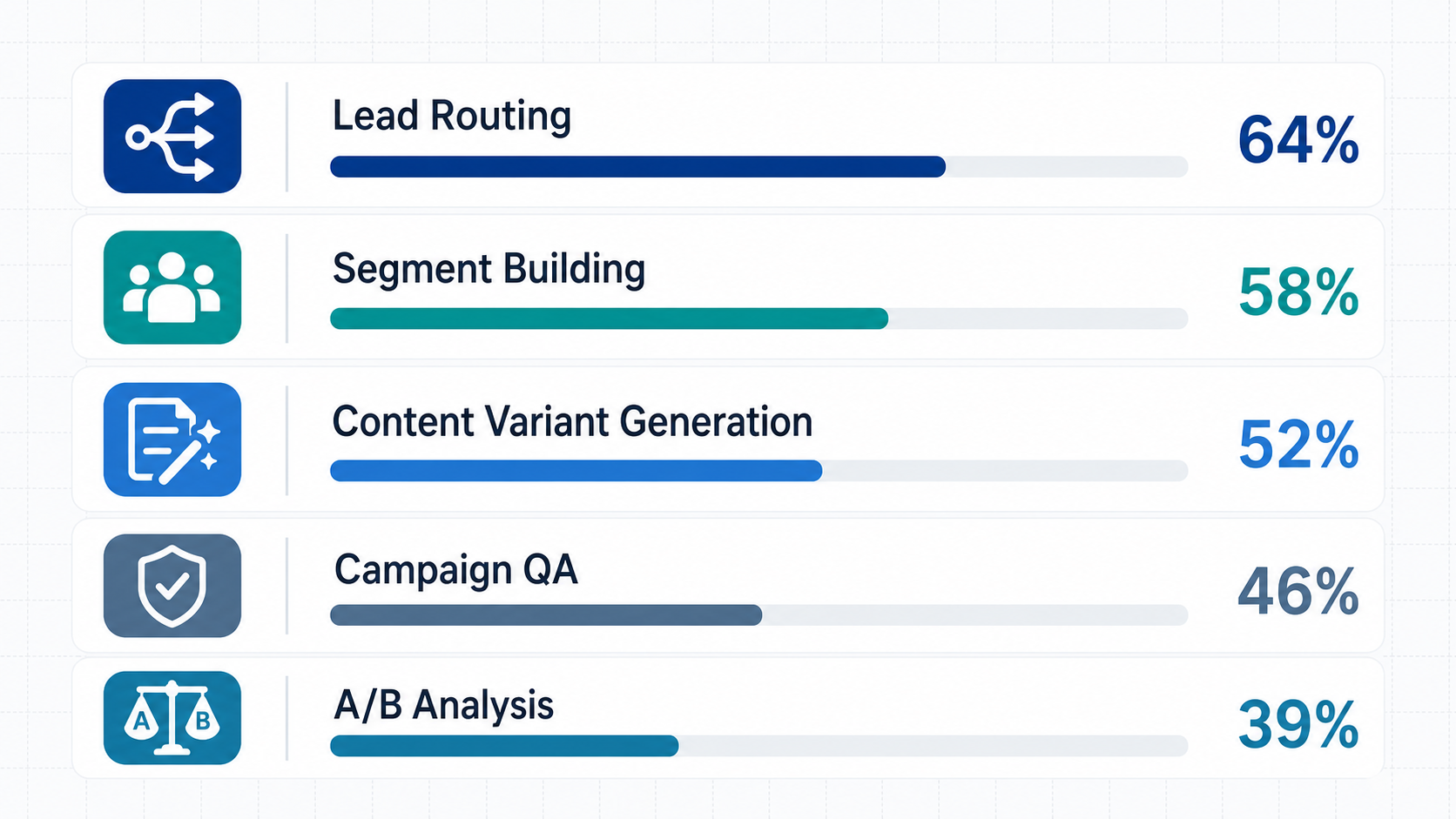
1. Lead Routing (64% adoption)
Lead routing is the most popular agent workload by a wide margin, and for good reason. Traditional lead routing rules are notoriously brittle — they assign based on a single criterion (geography, company size, source) and miss the behavioral signals that actually predict conversion. An agentic routing system evaluates multiple signals simultaneously: firmographic fit, engagement depth, content consumption patterns, and historical conversion data for similar profiles. The result is not just faster routing but better routing — leads reach the right rep or sequence on the first attempt, reducing the 30–50% of leads that typically fall through routing cracks.
2. Segment Building (58% adoption)
Segment building has historically been a manual, SQL-heavy process that marketing ops teams spend hours maintaining. Agents can analyze behavioral and demographic data to suggest or automatically create segments based on patterns humans might miss — for example, identifying a micro-segment of users who visit the pricing page, read case studies, and have not opened an email in 60 days, then building a re-engagement flow for that specific cohort. Teams using agents for segment building report being able to maintain 3–5x more active segments with the same headcount.
3. Content Variant Generation (52% adoption)
Content variant generation is where agents move from analytical work into creative production. An agent tasked with 'generate 5 subject line variants for this email, optimized for open rate' does not just swap words — it considers the segment's past engagement patterns, the time of day, the device type, and the email's position in the customer lifecycle. The output is not a single draft but a set of tested variants that can be deployed in an A/B test automatically. This is the workload that most directly compresses the timeline from strategy to execution.
4. Campaign QA (46% adoption)
Campaign QA is an ideal agent workload because it is repetitive, rule-intensive, and high-stakes. An agent can check every link in an email, verify that personalization tags resolve correctly, confirm that suppression lists are applied, validate that the send time aligns with the recipient's time zone, and flag any rendering issues across email clients — all before a human reviewer touches the campaign. Teams using agent-based QA report catching 3–4x more errors than manual review alone, and reducing the QA cycle from hours to minutes.
5. A/B Test Analysis (39% adoption)
A/B test analysis is the least adopted of the top five workloads, but it may have the highest long-term strategic value. An agent does not just report which variant won — it analyzes why it won, identifies which segments drove the result, and recommends follow-up tests. Over time, the agent builds a model of what creative approaches, offers, and timing work best for each segment, effectively creating a continuously learning optimization engine that operates without manual intervention.
Measurable Impact: Faster Campaigns, Lower Costs, Better Engagement
The adoption numbers are interesting, but the question every ops leader asks is: what does this actually deliver? The early data from teams using agent workflows points to three measurable improvements.
- 27% faster campaign build times. This is the most commonly cited benefit. Agents compress the timeline from brief to launch by automating the intermediate steps — segment definition, content variant generation, QA, and deployment configuration — that traditionally require handoffs between strategists, analysts, and operators.
- 19% lower cost per qualified lead. Better routing and more precise segmentation mean that budget is not wasted on unqualified prospects or poorly targeted campaigns. The cost reduction compounds as agents learn from each campaign and improve targeting over time.
- 22% lower unsubscribe rates. This is the most interesting metric because it reflects a qualitative improvement in relevance. Agents that personalize content, timing, and frequency at the individual level reduce the fatigue that drives unsubscribes — a problem that batch-and-blast approaches have never solved.
These figures should be read in context. The broader marketing automation ROI picture remains strong — businesses see an average return of $5.44 for every $1 spent on marketing automation, according to Flowlyn's 2026 report. But the same report notes that 42% to 54% of organizations scrapped AI initiatives in 2025 due to integration failures and data issues. Agentic automation is not a plug-and-play upgrade; it requires a data foundation that most organizations do not yet have.
Vendor Landscape: How the Top Platforms Are Shipping Native Agent Surfaces
The most concrete signal that agentic automation is not a passing trend is the speed at which major platforms have shipped native agent surfaces. According to DigitalApplied's vendor landscape analysis, 6 out of the 10 top marketing automation platforms launched native agent capabilities in 2026. This is not a bolt-on feature — it represents a fundamental rearchitecture of how these platforms handle workflow logic.
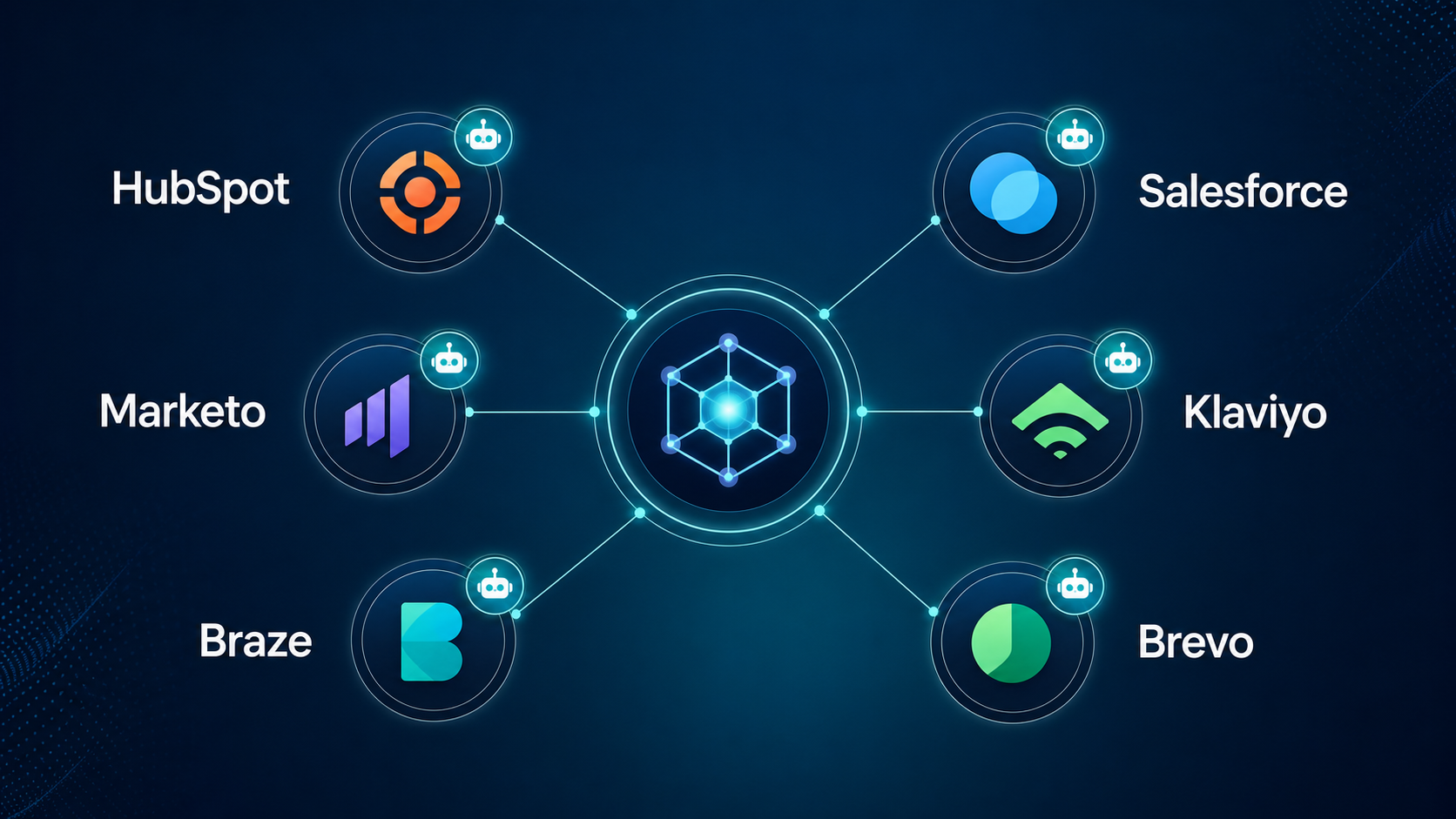
| Platform | Agent Product | Key Agent Capabilities | Availability |
|---|---|---|---|
| HubSpot | Breeze | Lead routing, content generation, campaign QA, segment building | GA (Q1 2026) |
| Salesforce | Agentforce | Lead scoring, opportunity routing, email personalization, workflow optimization | GA (Q1 2026) |
| Marketo | Marketo Agent Layer | Segment building, A/B test analysis, content variant generation | Beta (Q2 2026) |
| Klaviyo | K:AI | Flow optimization, content variant generation, predictive segment building | GA (Q1 2026) |
| Braze | BrazeAI Agents | Campaign QA, send time optimization, content personalization | GA (Q2 2026) |
| Brevo | Brevo AI Agent | Lead routing, email content generation, basic campaign QA | GA (Q1 2026) |
Each platform's approach to agents reflects its existing strengths. HubSpot Breeze is tightly integrated with the CRM and content tools, making it a strong choice for teams that want agents to work across the full customer lifecycle. Salesforce Agentforce leverages the depth of the Sales Cloud data model for sophisticated lead and opportunity routing. Klaviyo's K:AI is purpose-built for ecommerce flows — abandoned cart, welcome series, post-purchase — and excels at content variant generation for email and SMS.
For a full evaluation of these platforms including pricing, workflow builder quality, and use-case fit, see our broader marketing automation workflow tools comparison. The table above focuses specifically on agent capabilities, which is now a distinct evaluation dimension.
What This Means for Platform Selection: Agent Capability as a Top-3 Criterion
The most telling data point in the DigitalApplied survey is this: 73% of marketing automation buyers now cite AI agent capability as a top-three evaluation criterion, up from 18% in 2024. In two years, agent capability went from a niche consideration to a deal-breaker for nearly three-quarters of buyers.
This shift has practical implications for how teams should evaluate platforms in 2026. The traditional evaluation framework — workflow builder quality, integration ecosystem, pricing, deliverability — is still relevant, but agent capability now sits alongside them as a primary dimension. Here is a practical checklist for evaluating agent capabilities during platform selection.
- What specific agent workloads does the platform support natively? Not all agent surfaces are equal. Some platforms offer agents for lead routing only; others cover the full range of workloads. Map the platform's agent capabilities against your highest-volume workflows.
- How does the agent handle exceptions and escalations? A good agent knows when to ask for human help. Evaluate whether the platform allows you to set confidence thresholds, escalation paths, and manual review checkpoints.
- What data sources does the agent pull from? An agent is only as good as its data inputs. Check whether the agent can access CRM data, website analytics, email engagement history, and third-party enrichment sources — and whether it can reconcile conflicts between them.
- Can the agent be trained on your historical data? Pre-trained agents use generic models. The most valuable agents are those that can be fine-tuned on your campaign history, customer segments, and conversion patterns.
- What governance and audit trails exist? For regulated industries or teams with strict compliance requirements, the ability to review, approve, and roll back agent decisions is non-negotiable.
Projected 2027–2028 Trends: 62% Adoption, 34% of Workflows Composed by Agents
The current adoption curve shows no signs of plateauing. DigitalApplied projects that 62% of marketing teams will use AI agents by the end of 2027, and that 34% of all marketing workflows will be composed primarily by agents — rather than by humans — by 2028. If the current trajectory holds, agent-composed workflows will shift from a minority to a near-majority within two years.
These projections have significant implications for team structure and hiring. The traditional marketing operations team includes distinct roles: the operator who builds and maintains workflows, the analyst who interprets performance data, and the strategist who decides what to do next. Agentic automation compresses these three roles into a single 'agent supervisor' function — someone who defines goals, reviews agent decisions, handles exceptions, and continuously improves the agent's training data.
- The operator role shrinks. Fewer workflows need to be built and maintained manually. The agent handles the construction; the supervisor handles the oversight.
- The analyst role shifts upstream. Instead of spending time pulling reports, analysts focus on defining the metrics that agents should optimize for and validating that agent decisions align with business goals.
- The strategist role becomes more technical. Strategy is no longer a document — it is a set of goals, constraints, and training data that the agent executes against. Strategists need to understand how to translate business objectives into agent parameters.
For broader context on how natural language workflows and AI agents are reshaping the entire business workflow software landscape, see our business workflow software trends analysis for 2026.
Practical Action Plan: Audit, Identify, Pilot, Scale
The shift to agentic automation is inevitable, but the path is not risk-free. The 42% to 54% AI initiative failure rate cited by Flowlyn is a reminder that poor execution — not poor technology — is the primary cause of failure. Here is a five-step action plan for senior marketing ops leaders who want to move deliberately.
- Audit your current workflows. Map every active workflow in your marketing automation platform. Categorize them by volume, complexity, and error rate. The workflows that are high-volume, rule-based, and multi-step are the best candidates for agentic automation. Low-volume, highly creative, or heavily regulated workflows should stay human-led for now.
- Evaluate your current platform's agent capabilities. If you are on one of the six platforms that shipped native agent surfaces in 2026, start by exploring what your existing vendor offers. If your platform does not have agent capabilities, assess whether the gap justifies a migration or whether a point solution can fill it.
- Pilot in low-risk flows. Start with a workflow where failure is contained — lead routing or A/B test analysis are good candidates because errors are detectable and reversible. Run the agent in parallel with your existing workflow for at least two full campaign cycles before trusting it to operate independently.
- Establish governance and oversight processes. Define who reviews agent decisions, how often, and what constitutes an acceptable error rate. Set up audit trails and rollback procedures before you scale. The most successful agent deployments are those where the human supervisor role is clearly defined from day one.
- Scale based on measured results. Do not scale every workflow at once. Use the metrics from your pilot — campaign build time, cost per lead, unsubscribe rate — to build a business case for expanding agent usage. Scale to the next workflow only when the pilot has demonstrated clear, measurable improvement over the traditional approach.