

What Is Blue Prism and Who Is It For?
Blue Prism is a British enterprise robotic process automation (RPA) platform that essentially coined the term "Robotic Process Automation" in 2012. Founded in 2001 by Alastair Bathgate and David Moss, the company launched its first commercial product, Automate, in 2003 and went public on the London Stock Exchange AIM in March 2016 with a market cap of £48.5 million. In March 2022, SS&C Technologies acquired Blue Prism for approximately $1.6 billion, folding it into a broader financial services technology portfolio.
This review is written for RPA developers, automation engineers, and team leads who are evaluating Blue Prism from a day-to-day usability and developer experience standpoint. If you are trying to decide whether Blue Prism is the right platform for your automation team — not just whether it checks enterprise compliance boxes — this analysis of features, user ratings, strengths, and weaknesses will help you make that call.
Core Features: What Blue Prism Offers in 2026
Blue Prism's architecture is built around several distinct components that together form a complete enterprise automation platform. Understanding how these pieces fit together is essential for evaluating the developer experience.
Process Studio and Object Studio
Process Studio is the primary development environment where automation developers build workflows using a drag-and-drop, flowchart-style interface. Object Studio handles the creation of reusable "objects" that encapsulate application interactions — think of these as modular building blocks for screen scraping, API calls, and UI automation. This separation of process logic from application-specific code is one of Blue Prism's architectural strengths, enabling better reusability across different automation projects.
Control Room and Work Queues
The Control Room is the centralized management console for scheduling, monitoring, and managing automated processes across the enterprise. It provides real-time visibility into bot performance, queue status, and exception handling. Work Queues are Blue Prism's mechanism for managing workload distribution — they allow developers to define queues of work items that bots process in parallel, with built-in prioritization, retry logic, and reporting.
Decipher IDP, AI Gateway, and Chorus BPM
Decipher IDP is Blue Prism's intelligent document processing module, designed to extract data from structured and semi-structured documents like invoices, purchase orders, and forms. AI Gateway is the platform's bridge to machine learning models — it allows developers to integrate third-party AI/ML services (from providers like Google, AWS, and Azure) into automation workflows without writing custom integration code. Chorus BPM is the business process management layer that enables human-in-the-loop workflows, case management, and end-to-end process orchestration.
Blue Prism User Ratings: What the Numbers Say
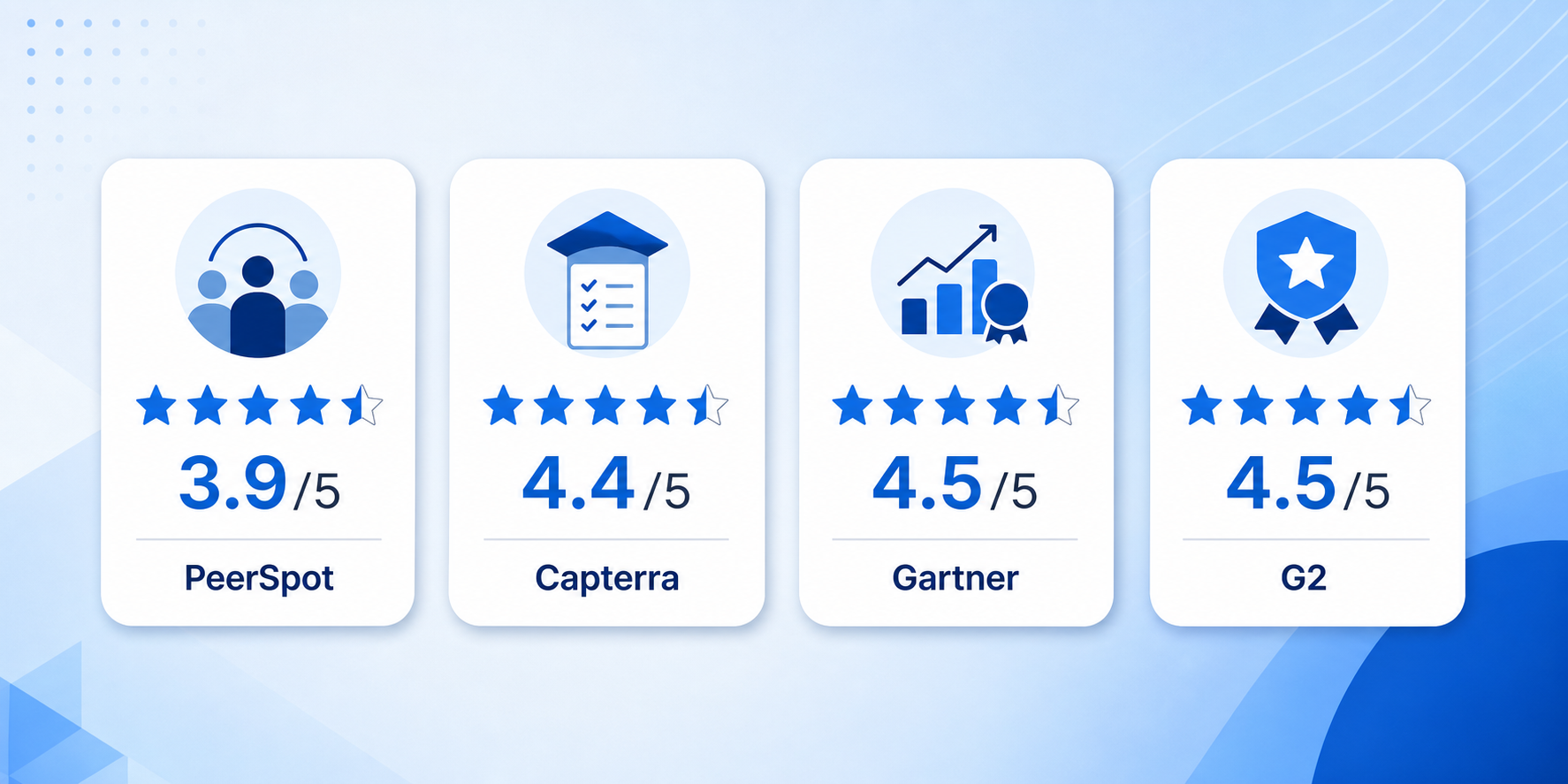
To get a balanced view of Blue Prism's real-world performance, we synthesized ratings from four major review platforms. The numbers tell a story of a platform that satisfies its core enterprise users but has a narrower appeal than some competitors.
| Platform | Rating | Number of Reviews | Key Demographic |
|---|---|---|---|
| PeerSpot | 3.9 / 5 (7.8 / 10) | 93 reviews | 59% large enterprise; 19% financial services |
| Capterra | 4.4 / 5 | 27 reviews | 67% enterprise companies |
| Gartner Peer Insights | 4.5 / 5 | Data available via Gartner | Enterprise IT decision-makers |
| G2 | 4.5 / 5 | Data from secondary sources | Mixed enterprise and mid-market |