
Workflow Orchestration Tools in 2026: A Four-Tier Comparison for Operations Leads and IT Managers
This guide helps operations leads, IT managers, and knowledge workers navigate the 2026 workflow orchestration market by organizing tools into four distinct tiers — no-code automation, data pipeline orchestration, enterprise BPM, and microservice orchestration — with a structured comparison table, deep dives on 8–10 tools, and a quick-pick guide by persona.
Get this template ↗ (opens external source in new tab)- workflow-automation
- no-code
- enterprise
- teams
- comparison
Introduction: Why the Right Orchestration Tier Matters More Than the Right Tool
If you are evaluating workflow orchestration tools in mid-2026, you have likely already discovered that the market is crowded and noisy. The real challenge is not choosing between Zapier and Make, or between Airflow and Prefect — it is identifying which category of tool your organization actually needs. The workflow orchestration market has fractured into four distinct tiers, each serving a fundamentally different technical audience and operational requirement. Selecting a tool from the wrong tier means either paying for complexity you will never use or hitting a scalability ceiling six months into deployment.
Before diving into the tiers, a quick diagnostic: orchestration is not automation. Automation executes a single task — sending an email, updating a row in a spreadsheet. Orchestration coordinates multiple automated tasks, human decisions, and external systems into a coherent end-to-end process. If your workflow involves conditional branching, error handling, human-in-the-loop approvals, or dependencies across systems, you need orchestration, not just automation. For a deeper breakdown of this distinction, see our guide on workflow orchestration vs. automation.
The four-tier framework described below provides a structured way to cut through the noise. Each tier has a distinct technical complexity level, governance depth, pricing model, and typical use case. By the end of this article, you should be able to identify your tier, shortlist the relevant tools, and understand the trade-offs between them.
The Four Tiers of Workflow Orchestration in 2026
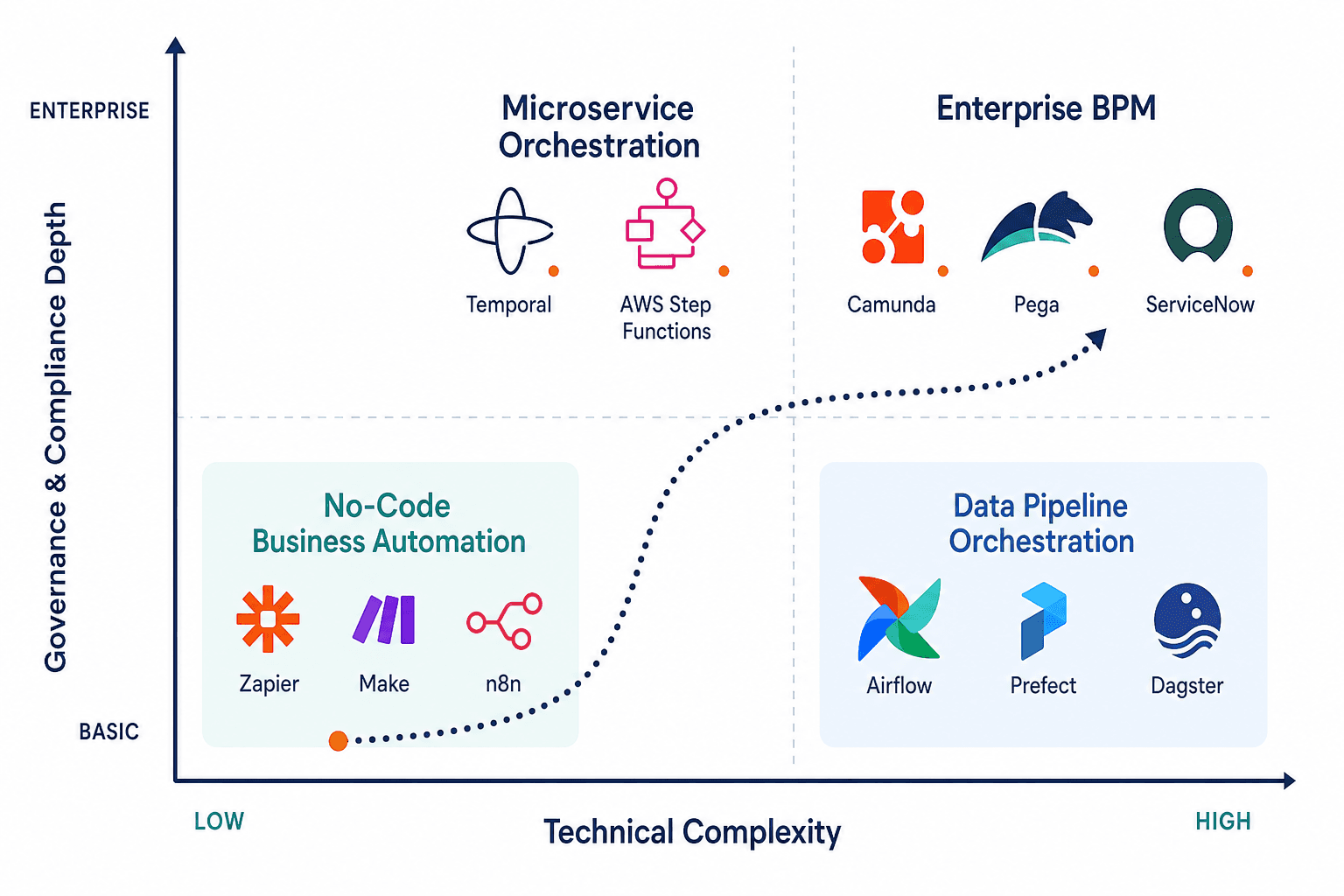
The 2026 orchestration market can be organized along two axes: technical complexity (how much engineering skill is required to operate the tool) and governance depth (how much auditability, compliance, and role-based control the tool provides). Plotting tools along these axes produces four clear tiers.
| Tier | Tool Examples | Best For | Pricing Range | Difficulty Level | Key Integrations |
|---|---|---|---|---|---|
| No-Code Business Automation | Zapier, Make, n8n | Operations teams, small businesses, departmental workflows | Free to $800/month (n8n Cloud) | Low | 9,000+ apps (Zapier), 1,000+ (Make), 400+ (n8n) |
| Data Pipeline Orchestration | Apache Airflow, Prefect, Dagster | Data engineers, ETL/ELT pipelines, machine learning workflows | Free (self-hosted) to $500+/month (Dagster Cloud) | Medium to High | Databases, cloud storage, data warehouses, ML frameworks |
| Enterprise BPM | Camunda, Pega, ServiceNow, Appian | Large enterprises, regulated industries, end-to-end process management | $50K+/year (Camunda Enterprise); custom pricing (Pega, ServiceNow) | High | ERP, CRM, legacy systems, identity providers |
| Microservice Orchestration | Temporal, AWS Step Functions | Engineering teams, distributed systems, long-running workflows | Free (self-hosted) to pay-per-execution (AWS Step Functions) | High | Containers, serverless functions, message queues, databases |
Comments
Join the discussion with an anonymous comment.