
On a bad smoke day, the strange part is not that work becomes impossible. It is that work remains technically possible while the lock-in disappears. The laptop opens. The calendar still says Tuesday. The task list is not outrageous. Yet the paragraph that should take twenty minutes takes forty, the spreadsheet feels noisier than it is, and every tab looks slightly more tempting than the one that matters.
That is the practical center of the wildfire smoke impact on productivity: not a cinematic collapse, but a measurable thinning of attention. In a study using Lumosity cognitive-game data from more than 10,000 adults, researchers found that high-PM2.5 wildfire-smoke days were associated with an average 3.7% decline in attention scores. The effect appeared within three hours of exposure, and western U.S. users lost an average of 887 points across the cognitive games studied.[1]
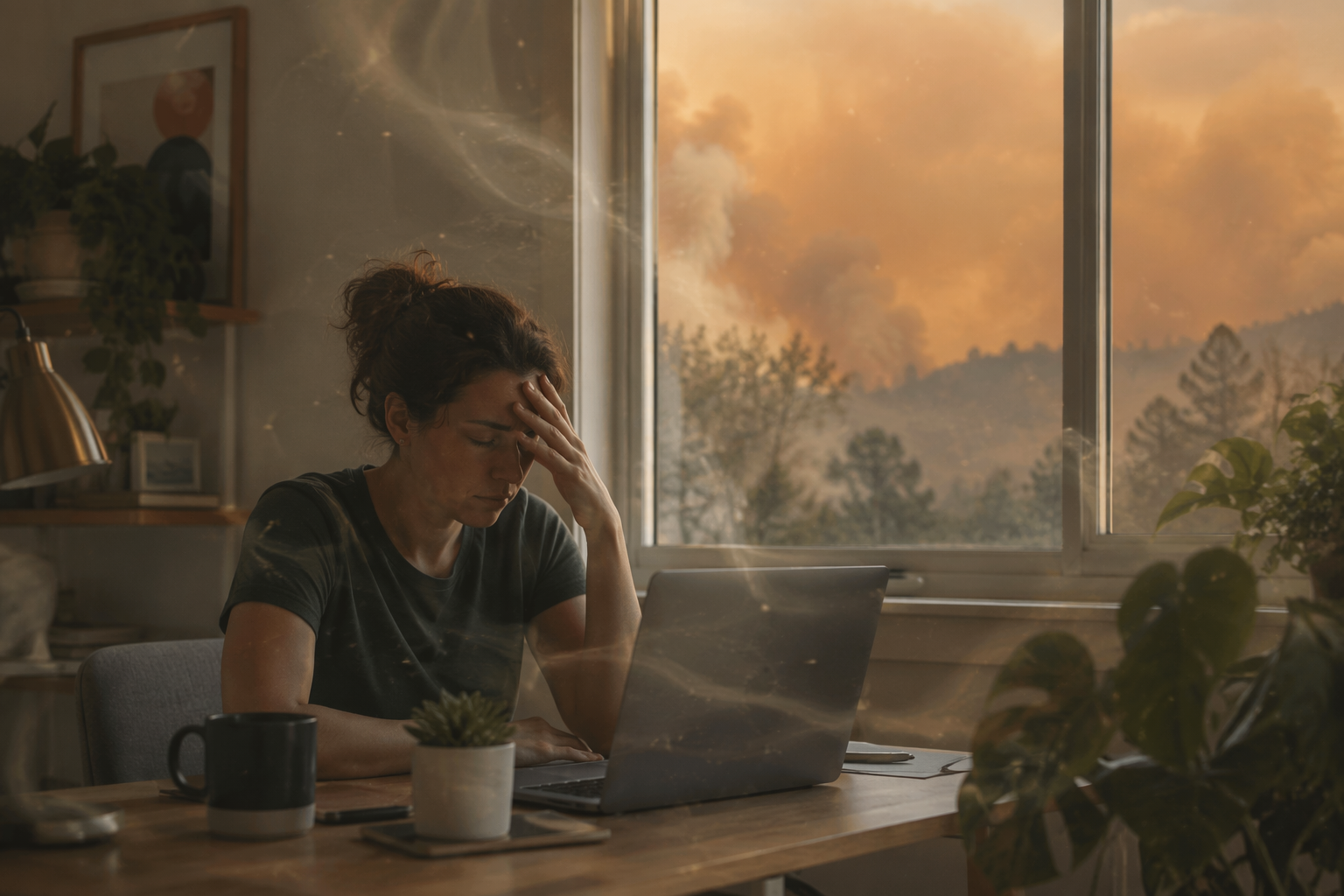
A 3.7% attention decline will not sound dramatic if you are expecting disaster statistics. It is more useful as an explanation for the kind of day knowledge workers actually report: slower reading, weaker task switching, more rereading, more staring at the same sentence. The study does not prove that every delayed email, weak draft, or messy meeting is caused by smoke. It measured attention through one Lumosity task, “Lost in Migration,” which is not the full map of creative judgment, strategy, memory, or collaboration. But it does make one point hard to dismiss: attention can decline on the same day the smoke arrives.[1]
“Smoke Brain” Is Not Just a Mood
It is tempting to describe this as distraction. The sky looks wrong, the news is grim, the body is tired, and the mind follows. Those things can be true. Smoke events often arrive with heat, poor sleep, anxiety, childcare disruptions, and constant checking of maps and air-quality numbers. The cognitive studies are observational, so the evidence does not let anyone cleanly subtract all of those surrounding conditions from the particles themselves.
Still, the particle pathway matters because it keeps the conversation from sliding into personality critique. The U.S. Environmental Protection Agency describes wildfire smoke as a mixture that includes fine particulate matter, especially PM2.5, small enough to be inhaled deeply. The EPA also points to evidence that ultrafine particles can cross the blood-brain barrier and that particulate exposure can trigger inflammation pathways relevant to brain function.[2]
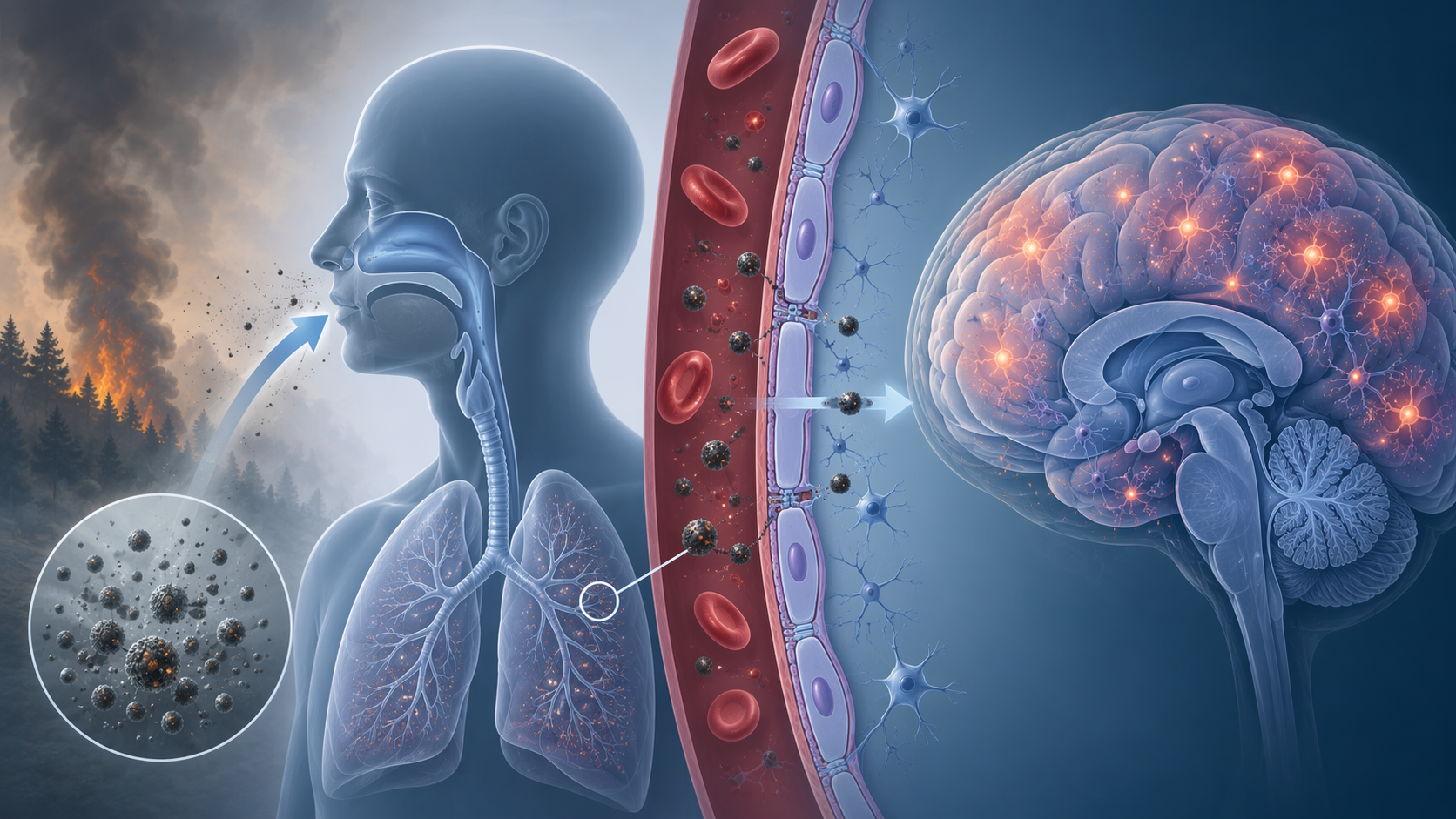
That mechanism does not mean every smoky afternoon produces the same cognitive effect in every person. It does mean “smoke brain” should not be treated as a cute metaphor for laziness. If particles can enter the body, contribute to inflammatory responses, and affect brain function, then focus is partly an exposure problem. The room is part of the workstation.
Why Productivity Tools Hit a Wall During Smoke Events
Most productivity advice assumes the worker’s environment is basically neutral. If attention drops, the usual fixes appear: a timer, a cleaner task manager, fewer notifications, a stricter morning routine, a new note-taking workflow. Those can help on ordinary days. They are less convincing when the air itself is changing the operating conditions for attention.
A timer can create a container for work, but it cannot filter PM2.5. A task app can reduce decision friction, but it cannot make a smoky room physiologically easier to think in. During wildfire smoke, the first productivity question is not “Which system will make me more disciplined?” It is “How much exposure am I working through, and can I lower it before I ask my brain for high-precision output?”
The Lumosity result is useful here because it lands on the scale of a normal work block. Attention declined within three hours of exposure, and the observed effects persisted up to two days after smoke cleared.[1] That time frame is exactly where remote workers and freelancers are often left alone with the consequences. The office may have a facilities team, upgraded HVAC, or a decision-maker who can cancel in-person work. The home worker has a window, a weather app, maybe a portable filter, and a deadline that did not move.
The Economic Signal Employers Should Not Ignore
The individual experience matters on its own, but the labor-market evidence makes it harder to dismiss as private discomfort. In a study of wildfire smoke and the labor market covering 2007–2019, Mark Borgschulte, David Molitor, and Eric Zou found that a single smoke day reduced quarterly per capita earnings by 0.10%. They estimate that wildfire smoke reduces total U.S. labor earnings by about $125 billion per year.[3]
Those figures do not say that every worker loses the same amount of productivity, or that cognitive work is the only channel. Smoke can affect outdoor labor, health, commuting, school closures, business operations, and local demand. The study period also ends in 2019, before several recent severe smoke seasons. But for employers, the conclusion is still blunt: wildfire smoke is not merely a wellness inconvenience. It is a labor condition with measurable earnings effects.[3]
That distinction matters for remote-work policy. If an organization treats smoke days as normal workdays with a weird sky, it quietly transfers the burden to individual employees. The person with a good filter, a tight apartment, and flexible meetings gets one version of the day. The person in a leaky rental, a hot room, or a shared space gets another. Both may be measured against the same output expectations.
From Outdoor Smoke to Indoor Focus Loss
Closing windows is the obvious first move, and it is usually the right one. It is not the whole plan. Wildfire smoke does not need an open window to matter indoors. It can enter through gaps, ventilation systems, doors, old frames, range-hood backdrafts, and the ordinary movement of people in and out of a building. Once inside, it becomes part of the working environment, not just something happening outside the glass.
For a knowledge worker, that chain is the part worth making visible:
- Outdoor wildfire smoke raises local PM2.5 levels.
- Some portion of that polluted air reaches the indoor workspace.
- Fine and ultrafine particles can affect the body through respiratory, inflammatory, and brain-related pathways.
- Attention-demanding work becomes slower, more error-prone, or harder to sustain.
- The worker often reads the result as a motivation problem, because the smoke exposure is invisible once the laptop fills the field of view.
This is why indoor air quality belongs in the same mental category as sleep, lighting, ergonomics, and meeting load. It is not a decorative wellness layer. It changes the conditions under which attention is being produced.
Build the Cleanest Work Zone You Can
The useful response is not to buy one device and declare the problem solved. Indoor air depends on room size, building leakage, filter capacity, HVAC settings, door movement, outdoor concentration, and how long the smoke event lasts. A portable HEPA filter can be a serious productivity intervention, but only if it is treated as part of a small system.
| Decision | What it means on a smoke day |
|---|---|
| Choose the work room | Use the room that is easiest to close off, has the fewest obvious leaks, and can hold filtered air. |
| Reduce entry points | Keep windows closed, limit unnecessary door opening, and seal obvious gaps where practical. |
| Filter the air | Run a portable HEPA unit or an appropriate HVAC filtration setup sized for the space and conditions. |
| Watch the timing | Check local PM2.5 or AQI before scheduling deep work, calls, or cognitively expensive tasks. |
| Move the workload | Shift demanding writing, analysis, coding, or decision work away from the worst smoke windows when possible. |
The room choice comes first because filtration works better when the target is smaller and more controlled. A whole apartment or house may be too much to clean quickly with one portable unit. A bedroom or office with a closing door is more realistic. If the cleanest room is not the prettiest room, the air wins.
Filtration should run before the hardest work begins, not only after the headache or fog shows up. If you know smoke is building overnight, the useful move is to protect the room where morning thinking will happen. If smoke is forecast to worsen in the afternoon, treat the morning as the scarce cognitive window and avoid spending it on low-stakes admin.
Monitoring does not need to become a second job. Local PM2.5 or AQI readings are most useful when they change scheduling decisions: whether to open a window, whether to run filtration continuously, whether to move a meeting, whether to save deep work for later, or whether to stop blaming yourself for a sluggish block. The point is not to refresh a map all day. The point is to stop treating the air as unknowable.
Adjust the Work, Not Just the Attitude
Once smoke is in the forecast, the workday should become less evenly distributed. Some tasks are more vulnerable to attention drag than others. Drafting, editing, coding, financial review, strategy writing, and complex problem-solving punish small lapses. Inbox triage, file cleanup, meeting notes, formatting, and routine follow-up may be more forgiving.
A practical smoke-day workload might look like this:
- Use the cleanest-air window for the task that would be most expensive to redo.
- Move precision work earlier if afternoon smoke is expected to worsen.
- Break review work into shorter passes, because missed errors are more likely when attention is thin.
- Delay major decisions when the evidence can wait and the air is poor.
- Tell collaborators what is happening in operational terms: smoke is affecting focus, so timelines or meeting loads may need adjustment.
That last point is not an excuse note. It is a better description of the production environment. A manager who would understand a power outage, a heat emergency, or a broken internet connection should also understand a smoke event severe enough to affect indoor air and attention. The economic evidence already treats smoke as a labor-market factor; workplace norms should catch up.[3]
What the Evidence Does and Does Not Say
The strongest claim is also the narrowest useful one: wildfire smoke exposure is associated with measurable same-day attention declines, and there are biologically plausible pathways by which particulate matter can affect brain function.[1][2] That is enough to change how knowledge workers plan smoke days.
It is not enough to claim that wildfire smoke explains every form of bad work during fire season. The Lumosity study used app-based cognitive tasks, not a full workday simulation. The labor-market study estimates earnings effects across broad worker populations, not only remote knowledge workers. Stress, heat, disrupted sleep, caregiving pressure, and the emotional weight of nearby fires can all move through the same day.
Those caveats should make the response more serious, not less. If several smoke-adjacent conditions can converge on the same worker, then the answer is not another lecture about discipline. It is a better operating plan: cleaner air where possible, more realistic scheduling, fewer unnecessary cognitive demands during the worst windows, and less moral drama around a brain working under degraded conditions.
Treat Air Quality as Part of the Productivity System
During wildfire smoke events, focus is not only a matter of willpower, workflow, or software. It is partly a matter of exposure. If attention can drop within hours and effects can persist for up to two days, then the rational response is to lower the dose where you can and stop pretending a normal calendar means normal working conditions.[1]
Protect the cleanest work zone available. Run filtration as a work support, not a lifestyle accessory. Watch the air well enough to move demanding tasks out of the worst smoke windows when possible. Then judge the day by the conditions it actually gave you, not by the conditions your task list assumed.
References
- Could an app help scientists understand wildfire smoke’s impact on cognition? — UNC Gillings School of Global Public Health.
- Fighting Haze: Effects of Wildfire Smoke and Particulate Matter on Brain Function — U.S. Environmental Protection Agency.
- Air Pollution and the Labor Market: Evidence from Wildfire Smoke — The Review of Economics and Statistics, MIT Press, 2024.
Comments
Join the discussion with an anonymous comment.