
The most embarrassing moment in a personal knowledge management system is not when it breaks. It is when it keeps existing.
The app is still installed. The database still opens. The folders are still named with care. Somewhere inside are quotes, meeting notes, article highlights, half-formed ideas, screenshots, book excerpts, and a few ambitious templates from the week everything felt possible. The system did not explode. It just stopped being trusted.
That private failure is common enough to deserve a structural explanation. A Forte Labs survey, cited secondhand in a Glasp guide, reported that 68% of people abandoned their personal knowledge management systems within a year; because the original methodology is not independently available here, the figure should be treated as a directional warning rather than a courtroom-grade statistic.[1] Still, it names something many professionals already recognize: PKM systems often collapse after the initial enthusiasm, and the collapse is usually misdiagnosed as weak discipline.

The better diagnosis is architectural. Most PKM advice asks the user to become more consistent: tag better, review weekly, process the inbox, maintain links, refine templates, prune old notes. A durable personal knowledge management system asks a different question: how many moments of discipline must happen before the system produces value?
If the answer is “many,” the system is already fragile.
The system usually fails before the notes become useful
A PKM system does not fail only at the dramatic point where someone rage-quits an app. It fails earlier, in smaller decisions: a thought is not captured because the phone is locked; a highlight is saved but never seen again; an inbox item waits for processing; a tag means one thing in February and another thing in June; a note might be useful someday, but not today.
The cost of this failure is not merely aesthetic clutter. McKinsey Global Institute’s 2012 research on social technologies estimated that knowledge workers spent 9.3 hours per week, or 19% of the workweek, searching for and gathering information.[2] That number is old enough that it should not be waved around as a precise 2026 measurement. But as a baseline for the cost of broken retrieval, it remains useful: professionals lose real working time when previously encountered information cannot be found at the moment it matters.
A PKM system is supposed to reduce that waste. Too often, it relocates the waste into a nicer interface.
Four architectural flaws that turn PKM into unpaid maintenance
The failure pattern is not random. Recent critiques of PKM systems, including Ultrathink’s “PKM Is Broken” and guidance from Atlas Workspace, converge around four recurring design problems: capture friction, organization designed around filing rather than retrieval, unbudgeted maintenance, and delayed value feedback.[3][4]
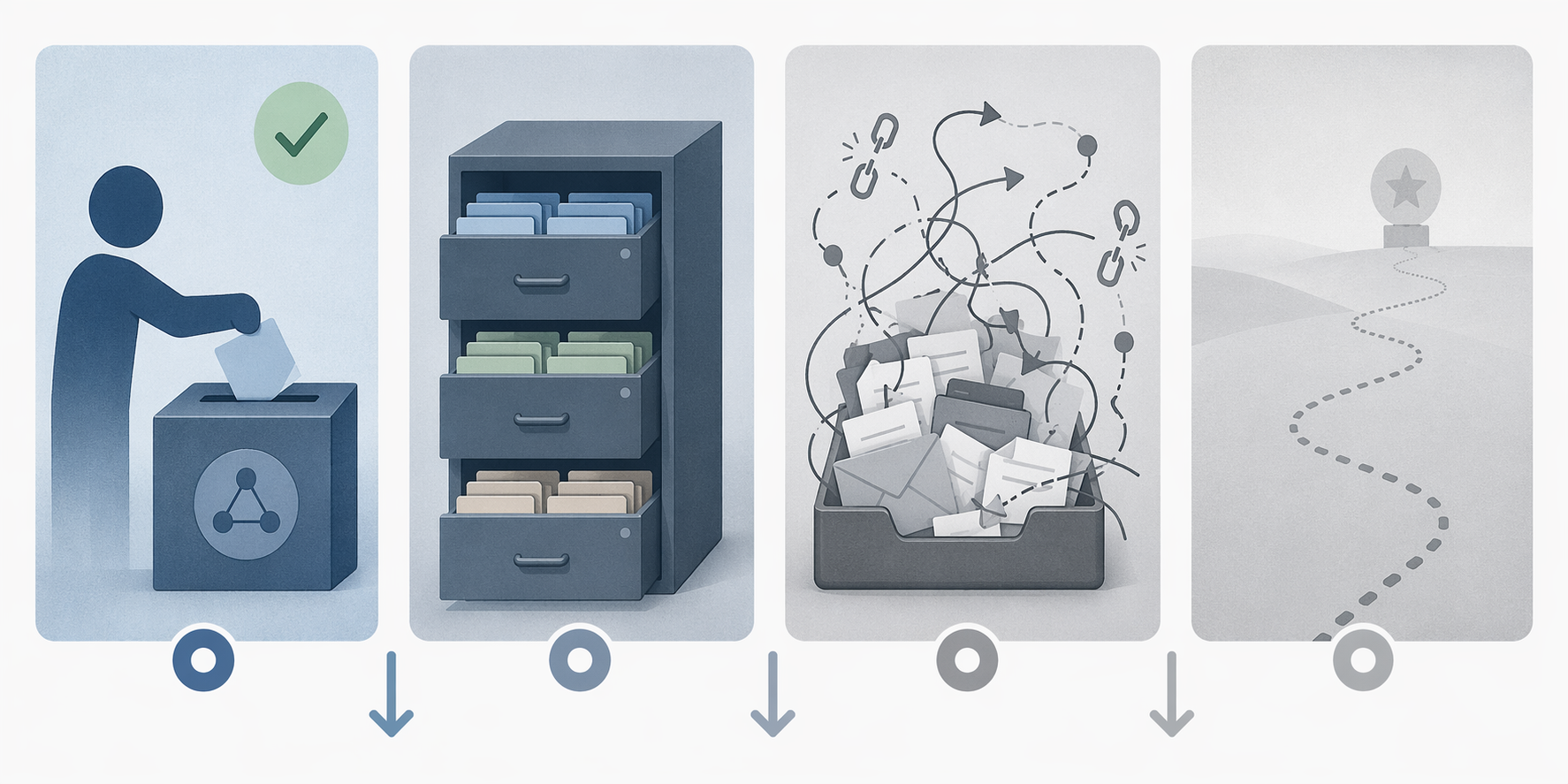
First, capture takes too long
Capture is where the system meets real life. Real life is not a quiet desk, a full battery, and twenty minutes to choose the correct template. It is a hallway conversation, a useful paragraph on a phone, a thought during a commute, a client call that ends with three follow-ups, or a sentence that arrives while making coffee.
Once capture takes more than roughly ten seconds, it starts competing with the task that produced the thought in the first place. Opening the right app, choosing the right database, naming the note, selecting a folder, adding tags, and deciding whether it belongs in “Projects,” “Areas,” “Resources,” or “Ideas” may feel orderly during setup. On a tired Thursday afternoon, those decisions are just enough friction for the thought to be left behind.
This is why beautiful systems can have terrible capture rates. The user is not failing to respect knowledge. The system is asking for too much context at the moment of lowest available attention.
Then, the notes that do get captured are filed for the wrong moment
Most organization schemes are designed around the filing moment. They ask, “Where should this go?” That feels responsible. It also creates a trap, because the future retrieval moment rarely uses the same mental map.
A note captured while reading about onboarding might later be needed while writing a hiring plan, designing a client handoff, preparing a manager training session, or explaining why a project failed. The correct folder at capture time may not match the question that arrives later. Tags help only if they are applied consistently and remembered under pressure. Links help only if someone maintains them and understands why they were created.
This is the quiet flaw in many “second brain” setups: they optimize the visible architecture of storage before proving the retrieval path. A system can look coherent from the top down and still be useless from the search bar.
After that, maintenance becomes a second job
The inbox is where PKM optimism goes to accrue interest.
At first, the inbox is humane. It lets the user capture now and decide later. Then “later” becomes a backlog. The backlog becomes a weekly review. The weekly review becomes a skipped appointment with guilt attached. Meanwhile, tags drift, project names change, old links point to stale notes, and templates need adjustment because the work itself has changed.
This maintenance tax is often invisible in PKM tutorials. The finished screenshot shows the dashboard, not the hours required to keep it from becoming decorative. A system that depends on constant human grooming can work for a while, especially during a calmer season. It is less likely to survive travel, deadlines, caregiving, illness, role changes, or the ordinary fatigue of a full week.
Finally, value arrives too late
A habit survives when the reward is close enough to reinforce the behavior. Many PKM systems delay the reward for weeks or months. Capture now, process later, connect later, review later, synthesize later, use someday.
That is too long for trust to build. If a professional saves twenty useful things and none of them reappear during actual work, the system has trained them to stop saving. The next time a useful idea appears, the brain makes a rational calculation: why feed a system that never feeds back?
| Failure mode | What it feels like | What is actually broken |
|---|---|---|
| Capture friction | “I’ll save this later.” | The system requires too many decisions before capture. |
| Filing over retrieval | “I know I saved this somewhere.” | Storage categories do not match future questions. |
| Maintenance tax | “My inbox is a mess.” | The system assumes unpaid review, tagging, linking, and cleanup. |
| Delayed value feedback | “This never helps when I need it.” | The payoff arrives too late to reinforce continued use. |
Use the PKM Stack as a diagnostic, not a decoration
The PKM Stack framework from The Sweet Setup is useful here because it separates a knowledge system into layers: Information, Ideas, Actions, and Philosophy.[5] That distinction prevents a common mistake: trying to fix every PKM problem by changing apps or adding a new template.
If the Information layer is broken, useful material is not being captured or retrieved. If the Ideas layer is broken, captured material is not being connected or developed. If the Actions layer is broken, notes are not influencing projects, decisions, or deliverables. If the Philosophy layer is broken, the system has no clear standard for what deserves attention in the first place.
That diagnostic is more useful than asking whether Notion, Obsidian, Logseq, Tana, or another app is “best.” Tool choice matters, but only after the architecture is honest about where work happens. A heavy linking system will not rescue someone whose real failure is capture. A prettier dashboard will not rescue someone whose notes never affect actions. A new taxonomy will not rescue someone who needs retrieval before filing.
For readers who want a broader tool comparison, an app-by-app guide such as “Best PKM Apps in 2026 Compared: Notion, Obsidian, Logseq, Tana, and More” belongs after this diagnosis, not before it. Otherwise, switching tools becomes a way to postpone the architecture problem.
The fix starts with capture that asks almost nothing
A lasting personal knowledge management system should treat capture as a reflex, not a filing session. The first design goal is simple: get the material into the system before the user has to classify it.
That usually means a few low-friction entry points:
- Voice capture for thoughts that appear while walking, commuting, or moving between tasks.
- Share-sheet capture from mobile reading, podcasts, documents, and messages.
- A browser extension for articles, webpages, PDFs, and research fragments.
- A single default inbox that does not ask the user to choose a folder before saving.
The important point is not the specific tool. It is the absence of a decision tree. If the user must decide whether a note is a project note, a permanent note, a literature note, a resource, or an idea before saving it, capture is already carrying organizational work. That work should move downstream, and as much of it as possible should be automated.
This is also where many template-heavy onboarding paths need restraint. A structured beginner path can help someone understand the territory, and a resource such as “Start Your Personal Knowledge Management System in 30 Days Using Pre-Built Templates” may be useful for that. But templates should reduce decisions, not multiply them. If every capture requires filling out a small form, the template is not infrastructure. It is paperwork.
Retrieval has to be designed before filing
A retrieval-first system starts with the situations where knowledge will be needed. Writing a proposal. Preparing for a one-on-one. Making a hiring decision. Revisiting a technical choice. Drafting a strategy memo. Explaining a repeated problem to a team.
Those situations should shape the system more than the urge to make the archive tidy. A note does not need one perfect home if it can reliably surface in the right working context. Search, backlinks, AI retrieval, saved queries, project hubs, and lightweight source metadata can all help, but the standard is practical: can the system return useful material when the user remembers the problem but not the filename?
A hypothetical example makes the distinction clear. Suppose someone saves five notes about customer onboarding: one from a sales call, one from a product analytics review, one from a support ticket, one from an article, and one from a team retrospective. Filing-first organization asks which folder each note belongs in. Retrieval-first organization asks which future questions should find them: “Why do new users churn?”, “What should go into the onboarding redesign?”, “What objections keep appearing before activation?”
The second set of questions is closer to work. A PKM system that cannot travel from saved material to live questions will eventually become an archive of good intentions.
AI-assisted synthesis changes the maintenance equation, with caveats
This is where AI becomes genuinely interesting for PKM—not as a novelty layer on top of a fragile archive, but as a way to remove a category of maintenance humans were never very likely to perform consistently.
The emerging LLM Wiki pattern, associated with Andrej Karpathy and documented by Mono Software in 2026, describes an agent that continuously synthesizes a user’s captured knowledge into maintained wiki-like pages.[6] Instead of asking the user to manually transform scattered notes into polished topic pages, the system updates living summaries, draws connections, and keeps related material accessible.
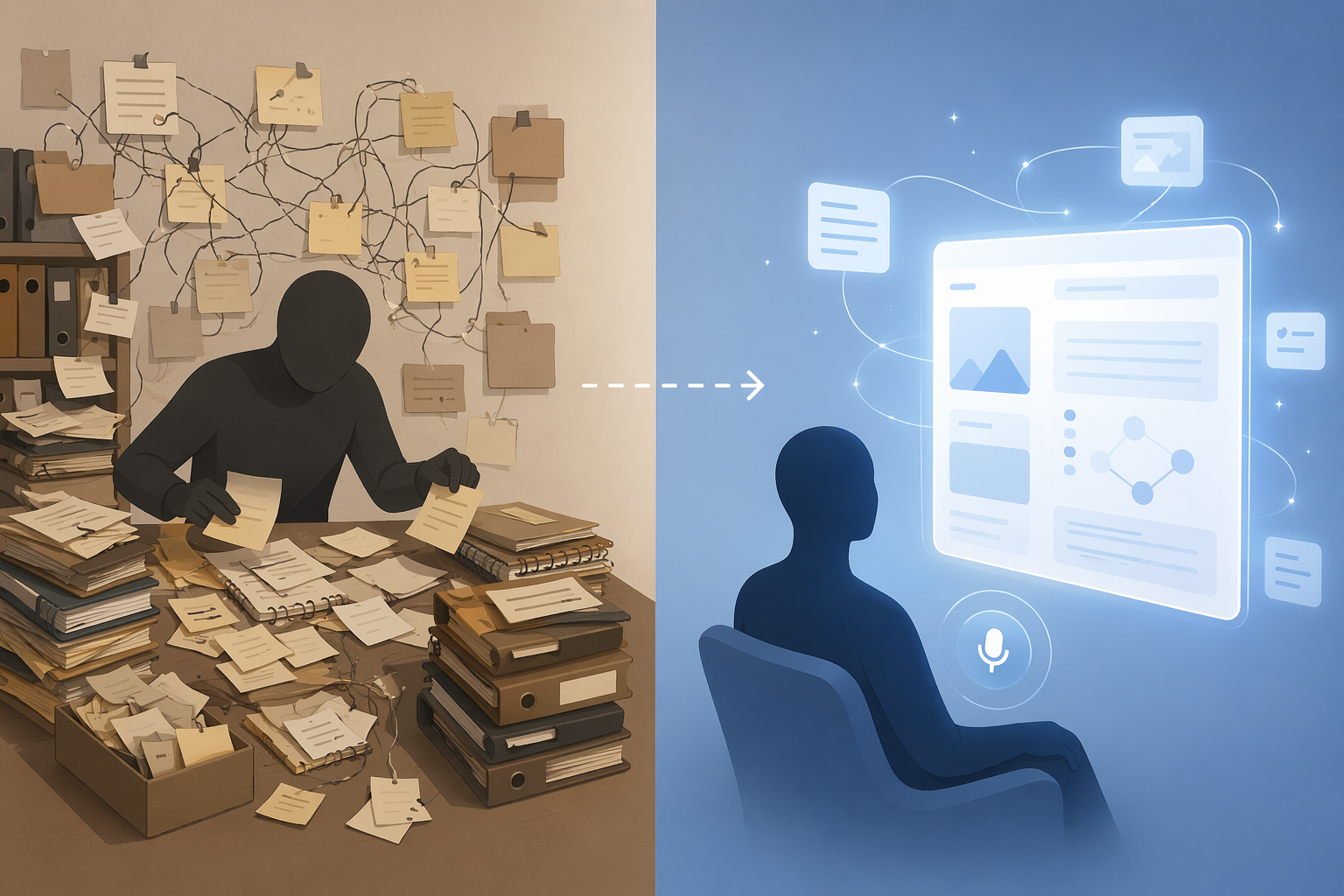
That pattern directly addresses two of the major failure modes: maintenance tax and delayed feedback. If captured fragments can be synthesized into useful pages without a weekly human cleanup ritual, the system no longer depends on the user behaving like a part-time librarian. If those synthesized pages become useful during current work, the payoff arrives sooner.
The caveat matters. In 2026, this is still an emerging pattern, not a settled best practice with long-term evidence across many kinds of workers. AI retrieval can hallucinate, over-compress, miss context, or create a false sense of order. Sensitive material raises privacy and governance questions. A generated synthesis still needs enough source transparency for the user to inspect where an idea came from.
Even with those limits, the direction is important. Traditional PKM often assumes humans will repeatedly convert raw capture into durable knowledge objects. Many will not. A better architecture assumes raw capture will be messy and then builds a retrieval and synthesis layer that can tolerate the mess.
What a lower-maintenance PKM architecture looks like
The durable version is usually less impressive in screenshots. It has fewer ornamental dashboards, fewer required fields, and fewer ceremonies. It is designed around a short path from noticing to capturing, and a short path from searching to using.
| Old design assumption | More durable replacement |
|---|---|
| The user will tag consistently. | The system should work even when tags are incomplete. |
| The inbox will be processed every week. | Capture should be usable before perfect processing. |
| Folders define knowledge. | Questions, projects, and retrieval patterns define usefulness. |
| The user will manually synthesize later. | AI-assisted summaries and wiki pages should reduce synthesis labor. |
| The payoff can arrive someday. | The system should return value during current work. |
This does not mean abandoning structure. It means putting structure where it produces leverage. A small number of project spaces may be useful. Source metadata may be useful. A few stable topic pages may be useful. A lightweight review may still help. The difference is that the system should degrade gracefully when the user misses a week, changes priorities, or captures something without classifying it.
For people who recognize more behavioral anti-patterns in themselves—overcollecting, perfectionism, tool-hopping, review avoidance—pieces like “Why Most Personal Knowledge Management Systems Fail: The 5 Traps That Sabotage Your Second Brain” and “12 Common PKM Mistakes That Kill Your System (and How to Fix Each One)” are useful companions. But behavior is only half the story. If the architecture requires ideal behavior, the system is borrowing against a future version of the user who may not show up.
The test is whether ordinary behavior is enough
A personal knowledge management system does not need to feel magical. It needs to keep working when attention is partial, energy is low, and work is moving faster than the filing system.
That gives a more useful standard than “try harder” or “switch apps.” Capture should be nearly instant. Retrieval should be designed before filing. Maintenance should be minimized, automated, or made optional wherever possible. Value should return quickly enough that the user keeps trusting the system.
The systems that last are rarely the most elegant ones. They are the ones that forgive inconsistency and still make yesterday’s thinking available when today’s work needs it.
References
- Glasp guide citing Forte Labs 2021 PKM abandonment survey — Glasp.
- The social economy: Unlocking value and productivity through social technologies — McKinsey Global Institute, 2012.
- PKM Is Broken — Ultrathink.
- Atlas Workspace guide on PKM failure modes — Atlas Workspace.
- The PKM Stack — The Sweet Setup, 2026.
- LLM Wiki pattern documentation — Mono Software, 2026.
Comments
Join the discussion with an anonymous comment.