
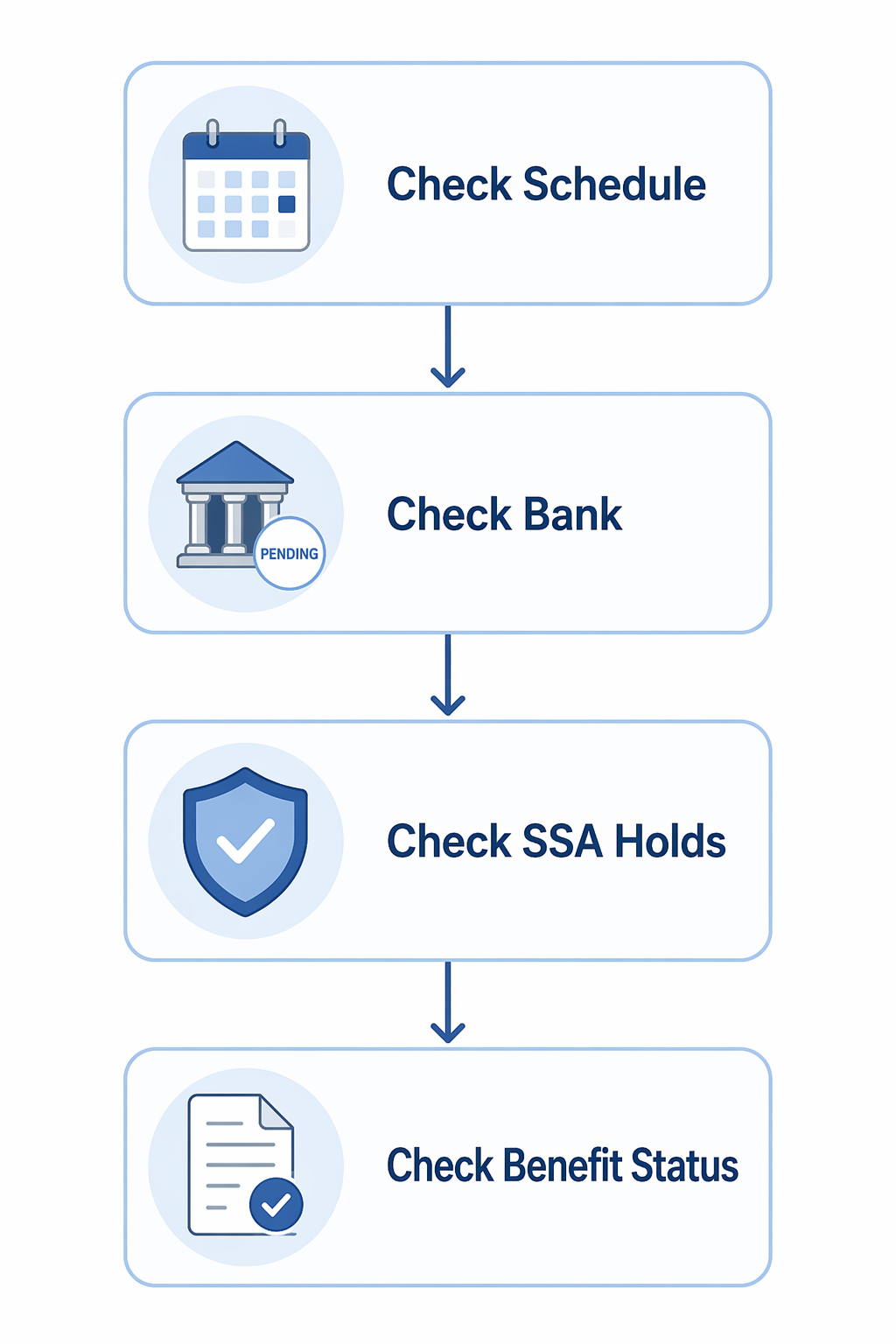
A missing disability payment feels urgent because rent, medication, and groceries do not care about bureaucracy. The fastest way to answer why your Social Security disability payment is delayed is not to start with a phone call; it is to rule out the four places where delays usually come from: the payment schedule, the bank, SSA holds, or a change in benefit status.
Start by checking whether the payment is actually late
A lot of missing-payment scares disappear once the calendar is checked carefully. In 2026, SSI is normally paid on the 1st of the month, while SSDI is paid on the 2nd, 3rd, or 4th Wednesday depending on your birth date; weekend and holiday shifts can change the deposit date and make a normal payment look late [1][2].
| Benefit | Normal 2026 timing | What to notice |
|---|---|---|
| SSI | Usually the 1st of the month | A weekend or holiday can shift the actual deposit |
| SSDI | 2nd, 3rd, or 4th Wednesday of the month | The Wednesday depends on your birth date |
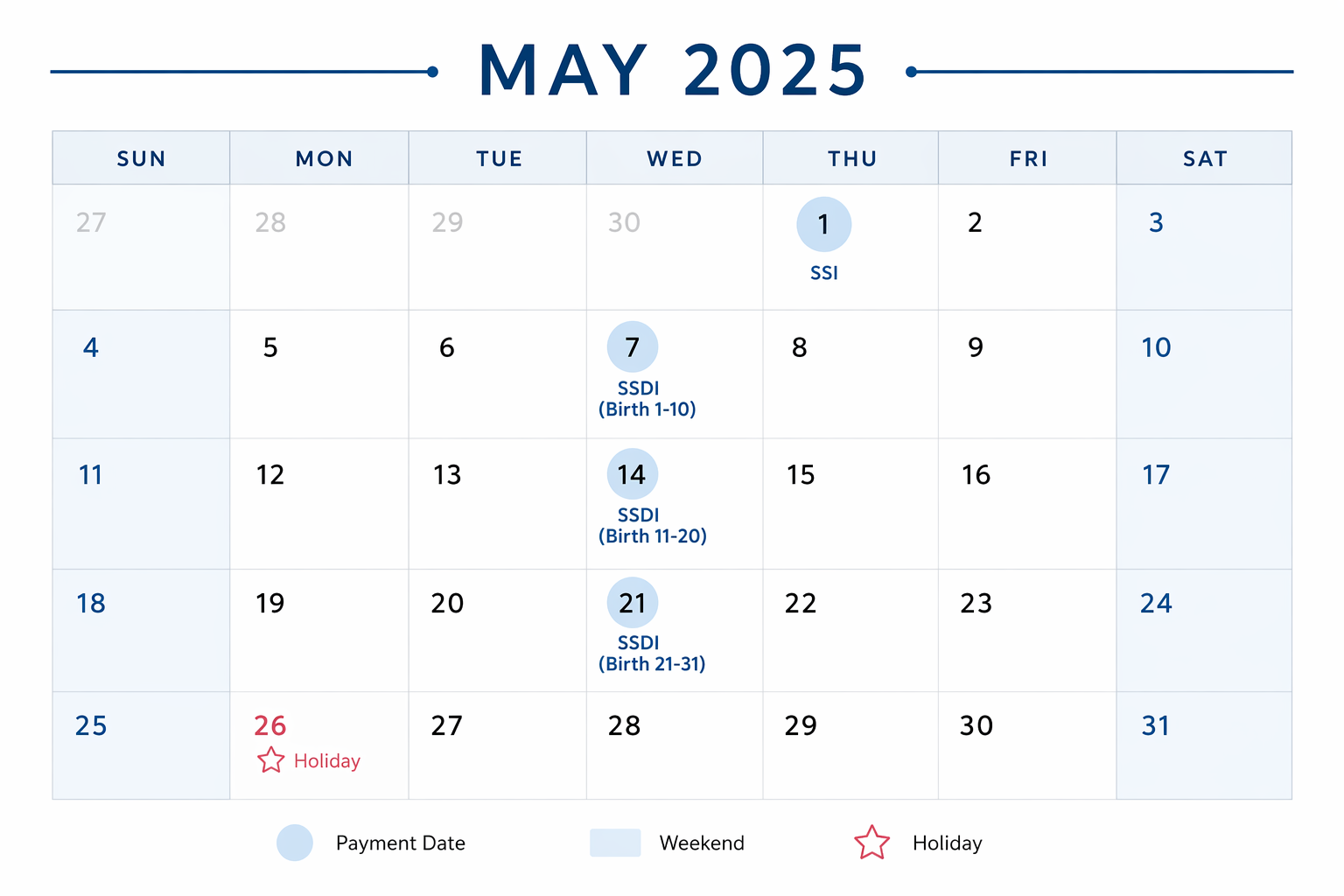
That is why the first useful question is not "Where is my money?" It is "Is today actually past my normal payment date after weekend or holiday shifts?" If the answer is no, the payment is probably not delayed at all. If the answer is yes, the next question is whether the bank has the money but has not posted it yet.
If the calendar fits, look at the bank side next
Before you blame SSA, check whether the deposit is pending, parked, or sent to the wrong place. A payment can show up as a pending deposit before it posts, and that usually means the money is in transit rather than lost; many pending deposits clear the next business day. If the account was closed, the routing number changed, or the deposit went to an old bank relationship, the fix may take much longer than a normal posting delay [3].
- Look for a pending deposit in the bank app before assuming the payment never arrived.
- Confirm that the account is still open and that the deposit details match the account you expect.
- If you recently switched banks, check whether the old account is still active and whether SSA has the new direct-deposit information.
- If the bank says the deposit went to a closed or incorrect account, ask what they can see on their side before you assume the money is gone.
One 2026 complication deserves special attention: a direct-deposit change can trigger a fraud-protection hold that delays the new bank instructions for about 30 days [5]. That matters most when someone changed banks to fix a previous problem and then got a second problem instead.
If the deposit really was sent to the wrong or closed account, a formal payment trace can take 45 to 90 days to work through [3]. That is not a reason to panic; it is a reason to document the dates, the old and new account details, and the bank's explanation so the trace starts with facts instead of a vague missing-payment complaint.
Use my Social Security before you call
The my Social Security account is the quickest free check that many people skip when they are worried. It lets you review payment history, confirm deposit information, and read electronic notices without waiting on hold [4].
- Payment history: confirms whether SSA shows the payment as sent.
- Deposit information: helps catch a routing-number or account mismatch.
- Notices: shows whether SSA has already sent a letter about a hold, review, overpayment, or other status change.
If the account shows a notice you have not read yet, that notice usually matters more than the missing deposit itself. A delay caused by an administrative hold, identity check, or banking verification problem is easier to handle when you can name the notice and the date you saw it.
When the delay comes from SSA's side
Sometimes the problem is not the calendar and not the bank. SSA can place an administrative hold while it verifies identity or banking details, or while it processes another issue tied to the record. If you recently changed direct deposit information, the fraud-protection hold discussed earlier may be the reason the money has not moved yet [5].
Benefit status can also change if SSA is handling an overpayment, a review, or another file-level issue. Earnings can matter too: in 2026, the substantial gainful activity limit is $1,690 a month for non-blind SSDI beneficiaries, and income above SSA's rules can interrupt a payment because the benefit status changed, not because the deposit is merely late [1].
Calling SSA is not automatically a bad move, and in 2026 the national numbers are better than many people expect. In May 2026, SSA reported that the national 800 number averaged a 5-minute wait with an 89% answer rate, field office appointments averaged a 6-minute wait, and the initial-claims backlog had fallen to 831,000 [6]. Those are national averages, not a guarantee for your local office, but they do mean escalation is sometimes more feasible than people assume.
The 3-business-day rule is the escalation boundary
The practical line is this: verify the schedule, then the bank, then my Social Security, then any notices. If the payment is still missing after 3 business days, report it to SSA [3]. That wait is long enough to rule out the common false alarms without dragging things out so long that the delay becomes harder to fix.
- The exact date your payment should have arrived.
- Whether the bank shows a pending, posted, rejected, or closed-account deposit.
- Any recent bank change, address change, name change, or direct-deposit change.
- Any SSA notice, letter, or electronic message tied to the account.
If you call after the 3-business-day window, you are not calling with a vague complaint. You are calling with a timeline, a bank status, and a record of what you already checked.
Keep next month from starting the same way
- Put the SSA payment calendar on your phone calendar at the start of the year.
- Avoid casual bank changes close to a payment date unless you have a clear reason and a written record.
- Check my Social Security once a month, even when nothing seems wrong.
- Keep deposit information current and save screenshots of confirmations when anything changes.
- Keep a short troubleshooting log with the date, what you checked, and what each source showed so the next delay starts with evidence instead of panic.
References
- “2026 Social Security Disability Payment Calendar” — Trajector Disability — link
- “Social Security Payment Dates 2026” — Chase — link
- “What to Do If Your SSDI or SSI Direct Deposit Is Late or Missing” — WithPurple — link
- “my Social Security” — Social Security Administration — link
- “Direct Deposit Changes Can Delay Social Security Payments Due to New Fraud Protocols” — Louis Law Group — March 2026 — link
- “SSA Performance” — Social Security Administration — May 2026 — link
Comments
Join the discussion with an anonymous comment.