
“How mental health screening boosts workplace productivity” sounds like a settled question until the word screening is separated from everything that is supposed to happen after it. A questionnaire can identify distress. It can make an invisible problem visible to an employer in aggregate. It can give an employee language for what they are experiencing. But the best available evidence does not support the idea that screening, followed by advice or a passive referral, measurably improves productivity.
The distinction is not academic. In a WHO-commissioned systematic review published in BMJ Occupational & Environmental Medicine in 2023, researchers screened 12,328 records and included 8 independent trials covering 2,940 employees. Across 3 controlled trials, screening followed by advice or referral alone produced no detectable effect on work-related outcomes, with a pooled effect size of d=-0.07 and a 95% confidence interval from -0.29 to 0.15. Across 4 trials where screening was paired with facilitated access to treatment, the pooled effect was small but positive, d=-0.22 with a 95% confidence interval from -0.42 to -0.02.[1]
That is the useful answer for employers: mental health screening can boost workplace productivity when it functions as the front door to facilitated, confidential, evidence-based treatment. When it ends with awareness, advice, or a link employees must navigate alone, the expected productivity gain disappears.
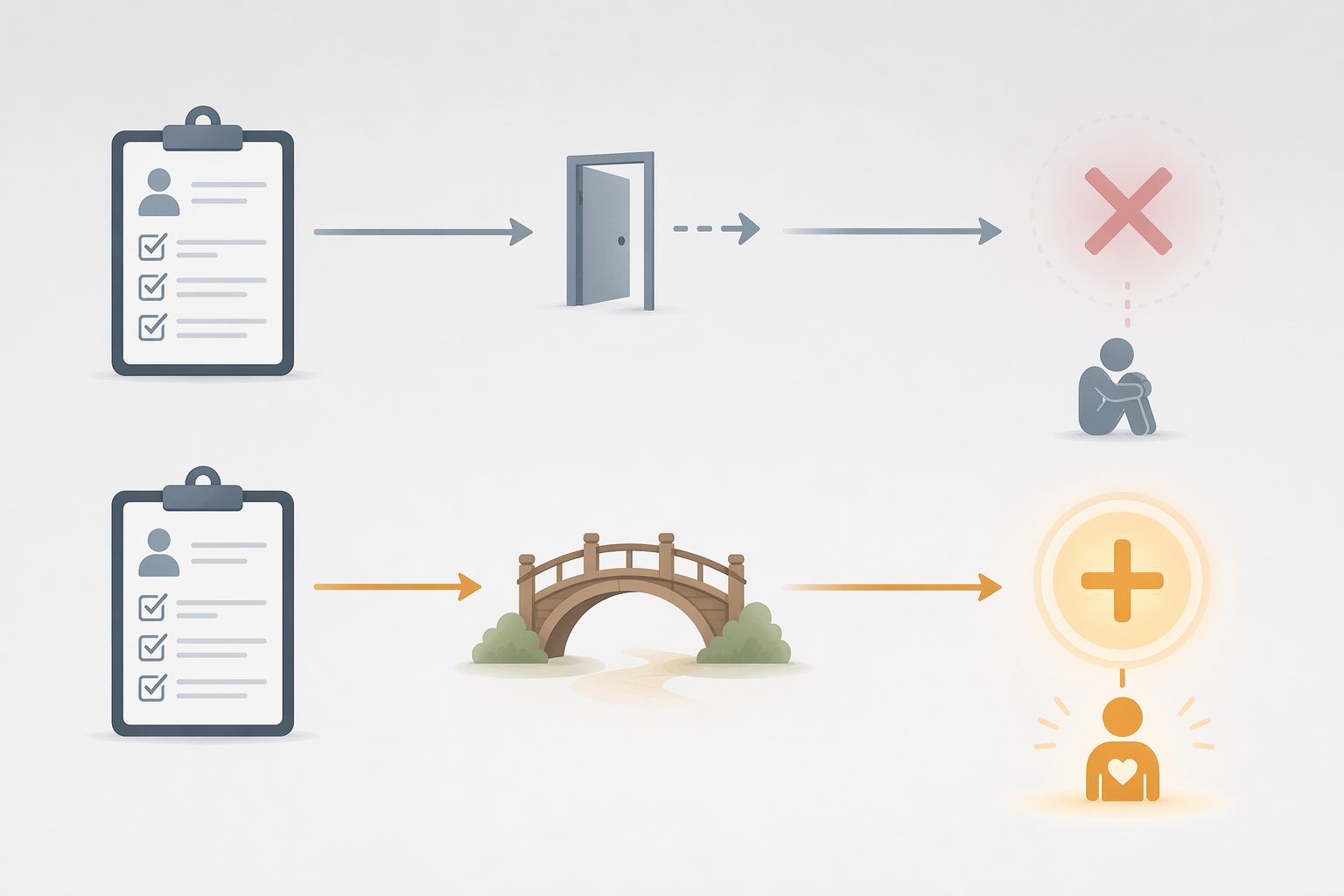
The Evidence Turns On The Follow-Up, Not The Form
The 2023 review matters because it did not simply ask whether workplace mental health programs feel worthwhile. It separated interventions by what employees actually received after screening. That is where many employer programs become weaker than their launch materials suggest.
| Program Design | Evidence In The Review | Productivity-Relevant Interpretation |
|---|---|---|
| Screening followed by advice or passive referral | No detectable pooled effect across 3 controlled trials: d=-0.07, 95% CI -0.29 to 0.15 | Identifying need did not translate into measurable work improvement |
| Screening paired with facilitated treatment access | Small positive pooled effect across 4 trials: d=-0.22, 95% CI -0.42 to -0.02 | The employee had a more reachable path from distress to care |
| Direct sickness absence outcome | One trial found a significant reduction at 12 months: d=-0.38, 95% CI -0.71 to -0.04; the effect faded by 5-year follow-up | The signal is promising, but not strong enough to support sweeping long-term claims |
The review’s certainty ratings also matter. The authors rated the evidence as low to very low certainty under GRADE criteria because there were few trials and most had high risk of bias.[1] That does not make the findings useless. It means the responsible conclusion is narrower: the best available evidence favors screening-plus-facilitated-care over screening-plus-advice, but employers should not treat the effect size as a guaranteed return.
This is where a dashboard can become misleading. A program may report how many people completed a screening, how many screened positive, and how many referral resources were displayed. Those are activity measures. Productivity changes depend on the harder sequence: whether the employee trusts the process, accepts support, reaches a clinician or structured intervention, stays with it long enough for symptoms to improve, and can work differently as a result.
The Drop-Off Is The Program
The most uncomfortable numbers in the review are not the pooled effect sizes. They are the follow-through numbers. In one trial, only 1 in 6 participants who screened positive followed through on referrals. In another, 151 employees screened positive, 51 saw an occupational physician, and only 18 received actual advice.[1]
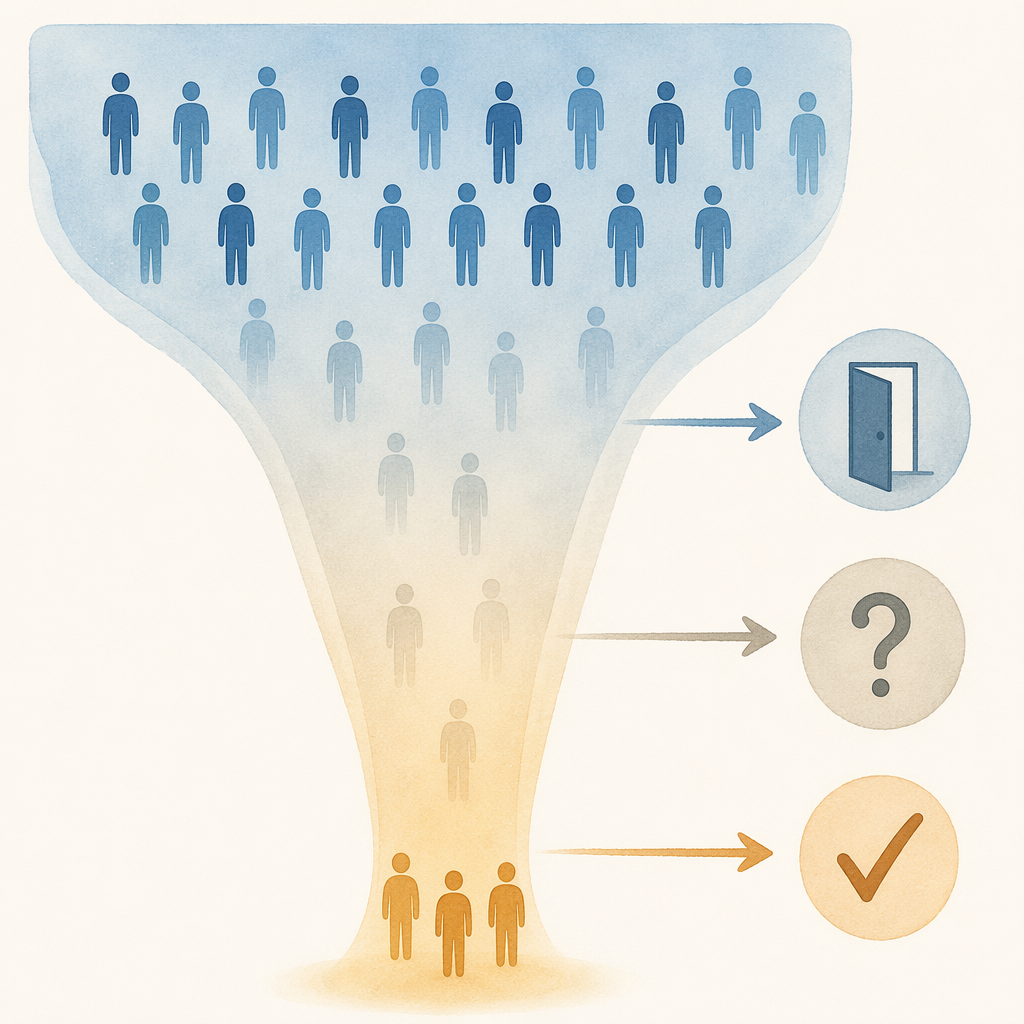
That is not a minor implementation detail. It is the mechanism. If an employee screens positive and then has to decide whether the referral is trustworthy, find time, understand coverage, explain an absence, wait for an appointment, and manage the fear that the employer might somehow find out, many will stop before treatment begins. The program may still count them as “referred.” Their workday has not changed.
The contrast between follow-up models makes this visible. Online self-help uptake was 5% in one reviewed intervention. Occupational physician consultation uptake was 34%. Telephone-based care management, in the Wang et al. trial included in the review, reached 90% adherence.[1] The questionnaire did not explain that difference. The service pathway did.
A passive self-help link assumes that motivation, privacy, comprehension, and time are already available. An occupational physician route may be more concrete, but it can create a different obstacle: employees may see it as close to the employer. In one trial, 50% of participants had known their occupational physician for more than 5 years, a relationship that likely suppressed honest self-reporting and uptake for some workers.[1]
Confidentiality is therefore not a line in an FAQ. It is part of the intervention. If employees believe a disclosure could affect reputation, promotion, workload, or a manager’s view of reliability, the screening form becomes a performance risk. A formally available program can still fail because the safest choice for the employee is silence.
What Facilitated Access Has To Do
Facilitated access is not a warmer name for a referral page. It means the program removes enough friction that a person who has screened positive can plausibly get into care. In practice, that may mean proactive outreach, appointment navigation, care management, covered treatment options, protected privacy, and a clear explanation of what the employer will and will not see.
The treatment itself also matters. Across the reviewed trials, cognitive-behavioral therapy interventions produced the strongest effects.[1] That finding should make program buyers more demanding. A vendor’s screening instrument may be polished, but the productivity-relevant question is what evidence-based care sits behind it and how many employees actually reach it.
- The screening tool identifies employees who may need support, but it does not deliver the support.
- The referral process must reduce practical barriers rather than transfer them to the employee.
- Confidentiality must be believable before employees will answer honestly or accept help.
- The treatment offer should be evidence-based, with CBT-supported options treated as especially important.
- Program reporting should track movement from positive screen to care engagement, not just completion of the initial questionnaire.
A simple hypothetical example shows the difference. In one company, an employee completes a screening, receives an automated message saying they may benefit from support, and is shown a list of providers. In another, the employee receives a confidential offer to schedule a covered session, can speak with a care manager, and is told exactly what information is shared with the employer in aggregate only. Both companies can say they screened. Only the second has changed the route from distress to treatment.
Why Employers Care, And Why Cost Figures Are Not Proof
The business concern is real. Deloitte UK estimated that presenteeism related to poor mental health costs employers £28 billion, compared with £6 billion for absenteeism.[2] Gallup estimated that poor employee mental health accounts for $47.6 billion in annual lost productivity in the United States, and reported that workers with fair or poor mental health miss 12 unplanned workdays per year compared with 2.5 days for all other workers.[3]
Retention is part of the same practical picture. Modern Health, citing Forrester research, reported that 79% of employees are more likely to stay at companies that offer high-quality mental health resources.[4] For a wellbeing manager trying to protect both employee health and organizational capacity, these figures explain why mental health cannot be treated as a side benefit.
But broad cost estimates do not prove that a screening program will pay for itself. Presenteeism totals, missed-day comparisons, and retention surveys describe the size of the problem and the perceived value of support. They do not show that a questionnaire followed by a referral link changes symptoms, absence, performance, or turnover. The same caution applies to popular return-on-investment claims borrowed from general treatment evidence. A return from treating depression and anxiety is not the same as a return from screening employees and hoping they find care.
The Decision Framework For A Productivity-Relevant Screening Program
A workplace mental health screening program should be judged by the path it creates after a positive result. The practical test is not whether the organization can identify need. It is whether the organization has designed a credible route from need to care.
| Design Question | Weak Answer | Stronger Answer |
|---|---|---|
| What happens after a positive screen? | The employee receives advice or a resource link | The employee is offered facilitated access to confidential care |
| Who carries the next step? | The employee must navigate providers, scheduling, and coverage alone | A care manager, clinician, or structured service helps the employee enter treatment |
| What does the employer measure? | Screening completion and referral counts | Engagement with care, adherence, symptom change where appropriate, and work-related outcomes |
| How is privacy explained? | A generic confidentiality statement | Clear boundaries on what managers, HR, vendors, and aggregate reports can see |
| What care is available? | Broad wellness content or self-guided resources only | Evidence-based treatment options, with CBT-supported pathways available |
The first column is where procurement conversations often become too vague. A vendor may have a validated screener, a polished portal, and a clean reporting dashboard. Those features are useful, but they do not answer the operational question. If 100 employees screen positive, how many will be contacted, how quickly, by whom, through what confidential channel, and with what treatment options actually available?
For knowledge-work settings, the productivity outcomes may not appear only as fewer sick days. They may show up as reduced presenteeism, fewer stalled projects, better concentration, fewer avoidable conflicts, or improved retention. Those outcomes are harder to measure cleanly than absence, which is why the program design has to be disciplined. If the pathway to care is weak, the measurement problem becomes a convenient place for wishful thinking to hide.
Screening Belongs Inside A Larger Workplace Mental Health System
WHO’s workplace mental health guidance places screening inside a broader approach that includes organizational interventions, manager training, and direct treatment access.[5] That framing is important because screening can identify distress created or worsened by work conditions, but it cannot redesign workload, role clarity, psychological safety, or manager behavior by itself.
This does not mean every employer must build a clinical system. It does mean screening should not become the visible substitute for harder changes. If managers are rewarded for chronic overwork, if employees fear disclosure, or if benefits are too difficult to use, a screening campaign may simply document the damage more efficiently.
The defensible threshold is clear enough: workplace mental health screening can boost productivity when it is the front door to facilitated, confidential, evidence-based treatment and sits within a broader mental health strategy. When screening ends with advice, awareness, or a passive referral link, the best available evidence says not to expect measurable productivity gains.
References
- Workplace interventions for common mental disorders: a systematic review and meta-analysis. Occupational & Environmental Medicine. 2023.
- Mental health and employers: The case for investment. Deloitte UK.
- The Economic Cost of Poor Employee Mental Health. Gallup.
- Employee Retention and Mental Health Benefits. Modern Health.
- Mental health at work. World Health Organization.
Comments
Join the discussion with an anonymous comment.