
The Old Reality: Why Traditional OCR Failed on Handwriting
For decades, converting handwritten notes to text meant accepting a high error rate. The core problem wasn't a lack of effort — it was architectural. Traditional OCR engines like Tesseract were designed for printed text, where characters are neatly separated, fonts are consistent, and the background is clean. Handwriting violates every one of those assumptions.
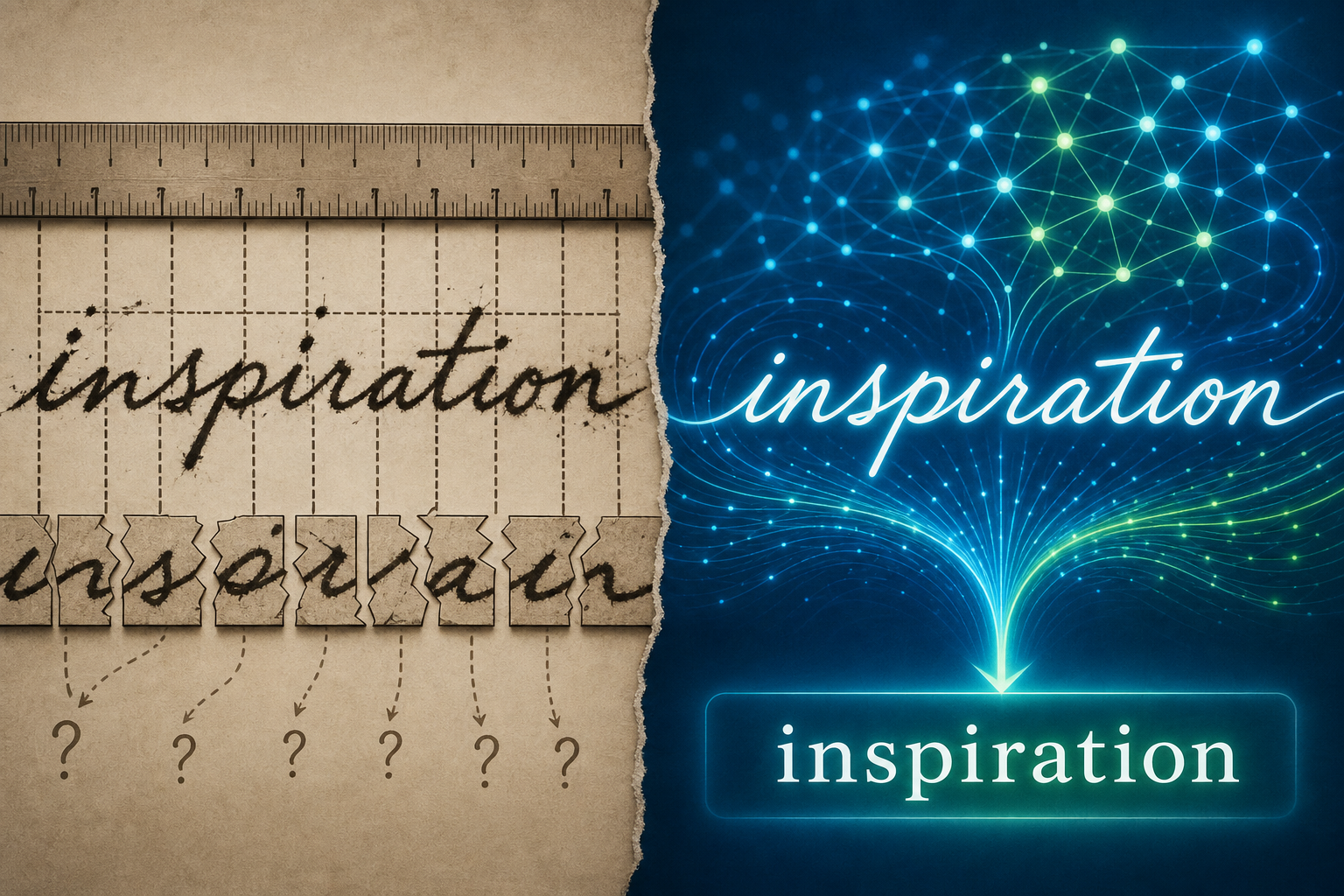
The fundamental limitation is character segmentation. A traditional OCR pipeline first isolates individual characters, then classifies each one. This works when there's a clear space between letters. But in cursive handwriting, letters connect. A single stroke can represent multiple characters, and the same shape can mean different things depending on the writer. When Tesseract 5 tries to parse cursive, it doesn't know where one character ends and the next begins. The result, as the IAM benchmark confirms, is a 12.5% Character Error Rate (CER) — roughly one error every eight characters. Word Error Rate (WER) climbs to approximately 35%, meaning more than a third of words are misread.
Writer variability compounds the problem. Every person forms letters differently — slant, pressure, spacing, and stroke order all vary. Traditional OCR models are trained on a limited set of fonts or handwriting samples. When faced with a new writer, they have no mechanism to adapt. The engine doesn't understand that a looped 'e' and an open 'e' are the same letter, or that a rushed 'r' might look like a 'v'. It simply fails to match the shape to its stored templates.
Contextual understanding — or the lack of it — was the third missing piece. When a human reads messy handwriting, they use surrounding words, sentence structure, and topic knowledge to resolve ambiguity. Traditional OCR has no such mechanism. It processes each character in isolation. If a scribbled word could be 'meeting' or 'melting,' the engine has no way to prefer the one that makes sense in context. This is why even the best traditional systems averaged around 64% accuracy on handwriting, as noted across multiple 2026 benchmarks.
The 2026 Revolution: How VLMs Changed the Game
Vision-Language Models (VLMs) approach handwriting recognition from a completely different starting point. Instead of segmenting characters and classifying them one by one, a VLM treats the entire line of text as a visual sequence and generates the corresponding text sequence directly. This sequence-to-sequence architecture is the key innovation.
Here is what changed in practice:
- Contextual disambiguation: When GPT-5 or Claude Opus 4.7 encounters an ambiguous character, it uses the surrounding words and sentence structure to resolve it. The model doesn't just see shapes — it reads language. This is why VLMs can handle messy cursive that would stump a traditional engine.
- Multi-writer generalization: Frontier VLMs have been trained on vast datasets encompassing thousands of handwriting styles. They don't need to be retrained for each new writer. The same model that reads your neat print can also parse a colleague's rushed scrawl with minimal accuracy drop.
- End-to-end learning: There is no separate segmentation step. The model learns directly from image pixels to text characters. This eliminates the cascading error problem where a segmentation mistake guarantees a classification mistake.
- Attention mechanisms: VLMs use attention layers to focus on relevant parts of the image when generating each character. This allows them to handle variable spacing, overlapping strokes, and unusual letter formations that would break a fixed-grid approach.
The result is not a marginal improvement. According to the CodeSOTA April 2026 benchmark on the IAM Handwriting Database — the standard evaluation dataset with 13,353 text lines from 657 writers — frontier VLMs now hold the top positions. GPT-5 leads at approximately 1.22% CER, followed by Claude Opus 4.7 at 1.31% and Gemini 3 at 1.44%. These are not incremental gains. They represent a step-change in what is possible.
Benchmark Comparison: IAM Handwriting Database Results
The IAM Handwriting Database is the most widely cited benchmark for handwriting recognition. It contains handwritten English text from 657 writers, covering a broad range of styles from neat print to loose cursive. The following table compiles the latest published results from CodeSOTA's April 2026 ranking, which is the most comprehensive independent comparison available as of Q2 2026.
| Model / Service | CER (%) | WER (%) | Cost per 1K Pages (USD) | Type |
|---|---|---|---|---|
| GPT-5 (OpenAI) | ~1.22 | ~2.8 | ~$12 | Frontier VLM |
| Claude Opus 4.7 (Anthropic) | ~1.31 | ~2.9 | ~$15 | Frontier VLM |
| Gemini 3 (Google) | ~1.44 | ~3.1 | ~$8 | Frontier VLM |
| GPT-5-mini (OpenAI) | ~1.52 | N/A | ~$2 | Lightweight VLM |
| Azure Document Intelligence v4.0 | ~1.8 | N/A | ~$15 | Enterprise OCR |
| DTrOCR (WACV 2024) | 2.38 | N/A | Open-source | Specialized HTR |
| TrOCR-Large (Microsoft) | 2.89 | N/A | Open-source | Specialized HTR |
| Transkribus | 2.95 | N/A | ~$8 | Historical HTR |
| Tesseract 5 | 12.5 | ~35 | Free | Traditional OCR |
Comments
Join the discussion with an anonymous comment.