
Using video games as inspiration for summer book report writing does not require turning every chapter into XP or promising a prize for finishing. The useful part of game design is structural: the player knows the objective, can see progress, makes meaningful choices, gathers what will be needed later, and gets a chance to improve before the final result counts.
Set up that structure before the book is opened. The assignment and rubric become the main quest. Book choice supplies an early decision that belongs to the student. Character cards, setting notes, and an evidence log collect material during reading. The first complete report is the boss-battle draft, while the level-up pass handles revision, editing, and submission. GoodNotes, Notability, Notion, or Obsidian can all serve as the container; there is no need to turn a summer assignment into an app-selection project.
The complete quest log at a glance
| Quest-log area | What goes there | What the student does | Evidence checkpoint |
|---|---|---|---|
| Main Quest | Exact assignment, due date, rubric, required format, and submission instructions | Chooses how to organize the work without changing the teacher’s requirements | Mark every rubric item that requires a quotation, example, or page reference |
| Choose the Book | Teacher-approved options or the family’s eligible reading pool | Chooses the book when the assignment permits it and records why it is a workable choice | Confirm the edition so page references remain consistent |
| Evidence Log | Quotations, page or location references, paraphrases, observations, and unanswered questions | Decides which passages appear important while keeping exact wording separate from interpretation | No quotation enters a card or draft without a retrievable location |
| Character and Setting Notes | Motives, conflicts, changes, relationships, setting details, and linked supporting passages | Builds only the cards and maps that help answer the assignment | Each interpretive claim points back to the Evidence Log |
| Boss-Battle Draft | A complete beginning-to-end report, even if some sentences are rough | Chooses the order of claims and evidence | Every body paragraph contains or links to relevant textual support |
| Level-Up Pass | Rubric review, substantive revision, editing, evidence verification, and final copy | Chooses how to solve weaknesses identified during review | Reopen the book and verify wording, context, names, and page references |
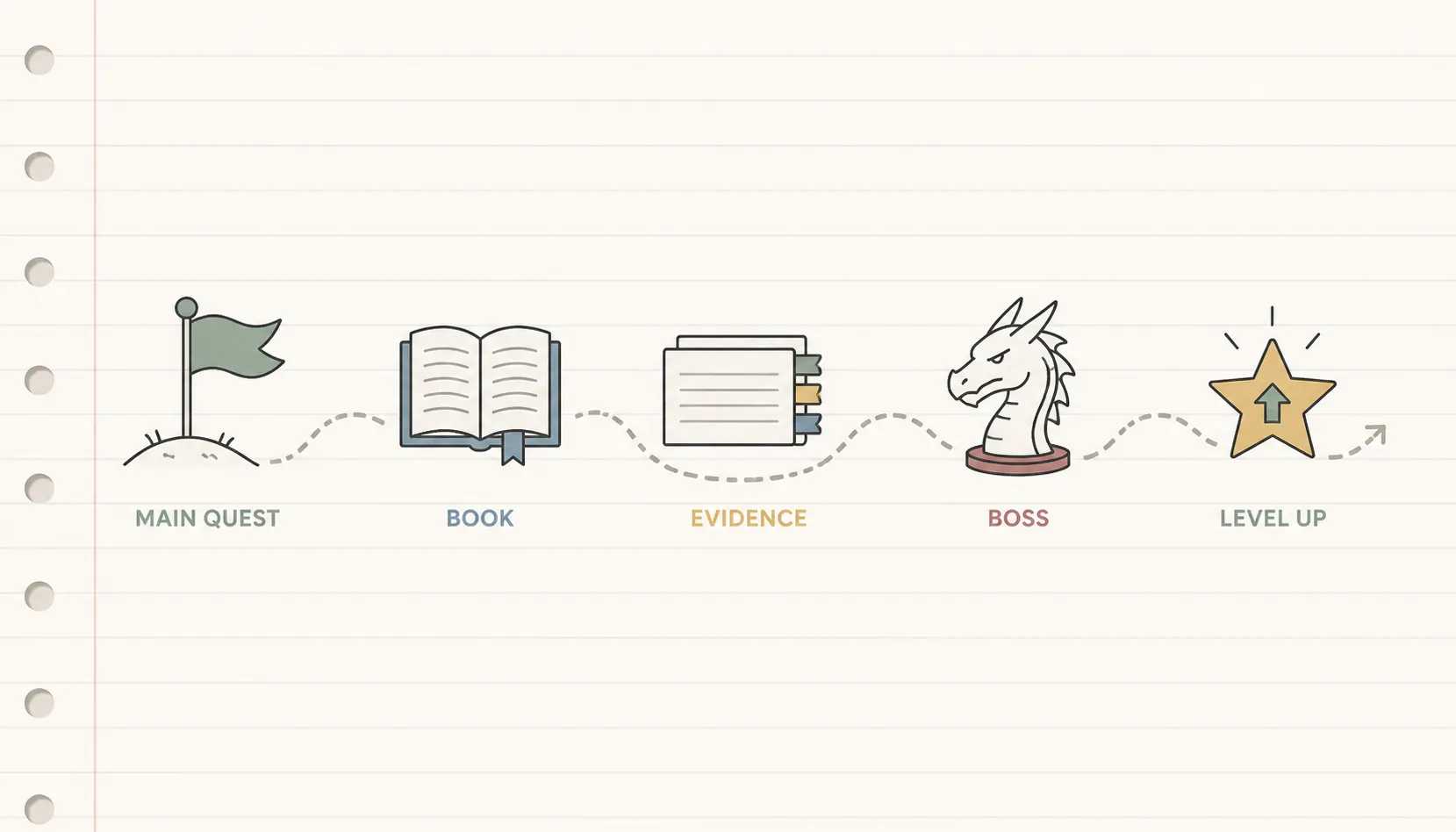
Keep this overview visible on the quest-log home page. Progress should describe the state of the work rather than award points for activity. A small set of labels such as “not started,” “collecting evidence,” “ready to draft,” “needs revision,” and “verified” tells the student what can happen next. A streak counter merely records that the app was opened.
This setup is deliberately interface-neutral. Translate “page” into a note, document, canvas, or notebook section supported by the app already in use. App menus and features vary by version, so this guide does not provide menu paths, click counts, or cross-version compatibility claims.
Build the home page around the real assignment
Place the teacher’s prompt at the top of the home page without translating it into game language. Immediately below it, place the complete rubric or a link that opens the rubric in one action. The due date, expected length, required topics, format, and submission method belong in the same area. If a requirement is unclear, flag it for clarification rather than quietly inventing a rule.
Read the rubric together before reading begins. Teacher Joanne Miller’s collection of creative book-report formats emphasizes that alternative reports still need textual evidence, that students should see the rubric before starting, and that choice can support motivation and engagement.[1] A playful workspace cannot compensate for hiding the standard until the draft is finished.
Turn each rubric requirement into a plain-language checkpoint, but retain the teacher’s original wording beside it. “Explains how the main character changes,” for example, might become a checkpoint asking for the character’s initial state, the pressure that produces change, the later state, and passages supporting that account. This is a planning aid, not permission to rewrite the grading criteria.
- Teacher controls: eligible books, required topics, length, citation expectations, format, due date, and grading criteria.
- Student controls: book choice when allowed, note style, which useful characters receive cards, the order of supporting points, visual organization, and the wording of the final argument.
- Parent role: make the next action visible, help interpret requirements, and ask the student to locate support. Do not fill the workspace with adult-written conclusions.
Book choice should happen early enough to feel consequential. If the teacher supplied a list, display that list rather than opening an unlimited catalog. If the student may choose freely, agree on practical boundaries such as reading level, availability, assignment fit, and whether the selected edition supports stable page or location references. The student can then choose within those boundaries.
Make evidence capture easier than reconstruction
The Evidence Log is the hinge of the system. Without it, character cards become fan profiles and the boss battle becomes an ordinary blank document waiting for the student to reread half the book. The log should accept quick entries during or immediately after reading, while preserving enough context to find each passage again.
For each useful passage, record the exact quotation or a clearly labeled paraphrase, the page or location, the speaker or point-of-view character when relevant, what is happening in the scene, and the assignment question the passage might support. Keep “what the book says” separate from “what I think it shows.” That separation makes later fact-checking much less painful.
| Entry part | Purpose |
|---|---|
| Passage or paraphrase | Preserves the source material; quotation marks identify copied wording |
| Page or location | Makes the passage retrievable in the student’s edition |
| Scene context | Prevents a striking line from being used outside the situation that gives it meaning |
| Student interpretation | Records the possible significance without presenting interpretation as the author’s exact words |
| Possible use | Connects the entry to character, setting, theme, conflict, or a specific rubric requirement |
| Verification status | Shows whether the passage has been reopened and checked before submission |
A handwritten note can use the same structure without becoming a tiny form. Put the page number in the margin, copy or paraphrase the passage, and add a short tag such as “motive,” “setting pressure,” or “change.” In a keyboard-based workspace, links or tags may help navigation, but they are optional. A modest evidence log that the student actually maintains is better than an elaborate database abandoned after the opening chapters.
Bound the digital session. Reading can remain on paper or an e-reader while evidence is first marked with a sticky note, bookmark, or brief handwritten cue. The student can transfer selected passages during a scheduled note session instead of leaving the note app open throughout the entire reading period. The quest log should reduce lost work, not quietly convert the book into more device time.
Character cards should answer report questions
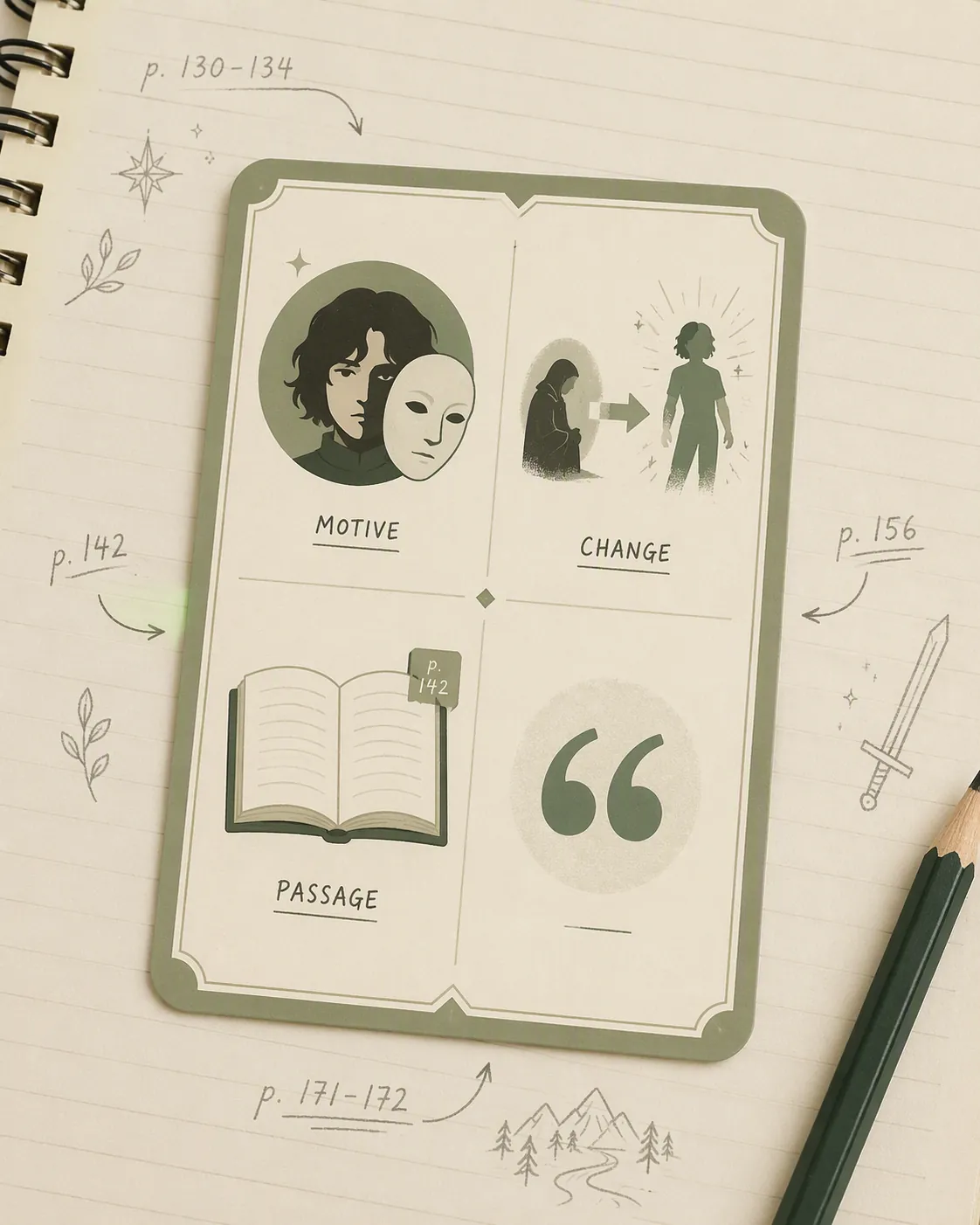
Create a character card only when that character matters to the assignment. A card for the protagonist will usually earn its space; cards for every named person usually create clerical work. The test is simple: will this note help the student make or support a claim in the report?
A useful card follows movement through the story. Record what the character wants, what obstructs that goal, the decisions the character makes, important relationships, what changes, and what remains unresolved. Under each substantial observation, link or copy the relevant Evidence Log entry. A statement such as “she becomes braver” is a draft idea; the card is ready only when the student can identify the scene or passages that justify it.
Setting notes deserve the same discipline. Record details of place, period, social conditions, or atmosphere only when they affect conflict, choices, or meaning. If the teacher asks for a setting description, the student can collect sensory details and quotations. If setting is not part of the required analysis and does not influence the argument, an ornate map is decoration rather than preparation.
At the end of a reading segment, ask the student to choose the next useful action: add a passage, update an existing card, make a new note because the story has introduced a genuinely important element, or stop because nothing needs capturing. Choosing “nothing to add” is legitimate. Requiring an entry after every chapter encourages filler and makes reading feel like data entry.
Move from cards to the boss-battle draft
Do not open a blank draft and tell the student to start writing. First, place the rubric checkpoints beside the available cards and evidence. Sort the material by the questions the report must answer, then identify gaps. If the assignment asks how a conflict changes the protagonist and the workspace contains only personality descriptions, the missing work is now visible before paragraph writing begins.
Build a lightweight paragraph plan from claims and support. For each body paragraph, the student needs a point that answers the assignment, evidence from the book, and an explanation of how that evidence supports the point. The order can remain the student’s choice: chronological development may suit a report about character change, while grouped ideas may suit a theme-based assignment.
| Draft element | Material pulled from the quest log | Check before writing onward |
|---|---|---|
| Opening | Book identification, assignment focus, and the student’s central claim | The claim answers the prompt rather than merely announcing the title |
| Body paragraph | A card observation plus one or more Evidence Log entries | The evidence actually supports this paragraph’s point |
| Explanation | The student’s interpretation and relevant scene context | The paragraph explains significance instead of dropping in a quotation |
| Transition | Relationship between the current point and the next one | The order reflects an argument, development, or comparison |
| Conclusion | The implications of the report’s established points | No new unsupported claim appears at the finish |
The “boss battle” label earns its place only because this is the first complete attempt to combine several kinds of work: understanding the prompt, selecting evidence, organizing claims, and writing connected paragraphs. It should not imply one high-pressure sitting. The draft can be written in bounded sessions, with a visible return point such as “continue paragraph two: explain the second quotation.”
When a paragraph stalls, return to the evidence rather than adding another game mechanic. The student may need to reread a scene, replace a weak quotation, clarify the claim, or split two competing ideas. Those are writing decisions. A badge cannot make the relationship between a passage and an interpretation clearer.
Use the level-up pass for real revision

Reading Rockets presents classroom writing as a process with four general stages: prewriting, drafting, revising and editing, and publishing.[2] The quest-log labels can sit on top of that established process without replacing it. Evidence logs and cards support prewriting; the boss battle is drafting; the level-up pass contains substantive revision and sentence-level editing; submission is publishing.
Begin the level-up pass with the rubric, not spelling. Compare the draft with each requirement and mark where the reader can actually find the answer. A requirement that appears only in the student’s head is not yet present in the report. Add missing reasoning, reorganize paragraphs, remove material that does not serve the assignment, and strengthen weak evidence before polishing sentences.
- Revise the ideas and structure: Does the central claim answer the prompt? Does each paragraph have one intelligible job? Are important relationships explained?
- Verify the evidence: Reopen every quoted or paraphrased passage. Check wording, context, speaker, character names, and page or location references.
- Edit the language: Correct sentences, punctuation, spelling, capitalization, and the citation format required by the teacher.
- Prepare the final copy: Confirm length, title and identification requirements, file format, legibility, and submission instructions.
Keep evidence verification distinct from proofreading. A perfectly punctuated quotation can still be miscopied or pulled from a scene that does not support the surrounding claim. If the student cannot retrieve a passage, either locate it again or remove the unsupported reference. Do not convert a guess into an authoritative-looking page number.
Why this structure may help
The scale of writing disengagement warrants attention, although population data cannot diagnose an individual student. In the National Literacy Trust’s 2026 Annual Literacy Survey, based on 125,375 responses from children and young people ages 5–18 across 479 UK schools, 28.7% of 8–18-year-olds said they enjoyed writing in their free time and 11.9% said they wrote daily in their free time. Daily writing was 15.1 percentage points lower than in 2010, representing 56% fewer daily writers, and enjoyment was lowest among ages 11–16.[3] These are UK findings, so they are directional rather than estimates of US students’ behavior.
A separate National Literacy Trust analysis of 55,075 open-ended responses describes engagement in terms including identity, autonomy, relevance, authentic audience, cognitive manageability, emotional response, and whether a young person sees writing as something for people like them.[4] Those are the report’s analytic constructs, not universal rules. Still, they help explain why a bounded choice, a visible next action, and a manageable evidence trail may improve the experience of a required report.
The connection to game design is similarly modest. In Octalysis, framework creator Yu-kai Chou argues that gamification should address underlying motivational drives rather than merely attach points, badges, and leaderboards. His own framework distinguishes “White Hat” drives associated with meaning, accomplishment, creativity, and ownership from “Black Hat” drives involving pressure such as loss, scarcity, and unpredictability.[5] This is the creator’s description of his framework, not independent proof that a quest-log template improves book reports.
The practical overlap is enough: the assignment has a meaningful objective, progress is legible, the student owns consequential choices, and feedback leads to revision. None of that establishes that playing video games improves writing, nor does it require such a claim. The workspace borrows navigational conventions from games; it does not treat gaming as an academic intervention.
Keep the game layer within firm limits
Do not add a family leaderboard, randomized rewards, expiring bonuses, artificial scarcity, loss threats, or penalties for breaking a streak. Those mechanics shift attention from understanding the book to managing the reward system. They can also turn a parent into the operator of an economy that must be negotiated whenever the assignment becomes difficult.
Visible progress should reflect completed work: the prompt has been reviewed, evidence has been captured, the draft is complete, a rubric item has been addressed, or a quotation has been verified. Avoid awarding points for opening the app, changing an avatar, decorating a card, or remaining online. If customization helps the student feel ownership, set a short boundary for it and move on.
Share the rubric at the beginning and preserve choice inside it. The student may choose a book, a note style, an argument order, or which evidence best supports a claim; the student may not choose to omit a required element. Meaningful agency is different from weakening the assignment.
The quest log is finished when the report answers the prompt, meets the rubric, contains verified textual evidence, has been revised and edited, and is ready in the required submission format. At that point, close the workspace and submit the work. The scaffolding has completed its one useful quest.
References
- 50 Creative Book Report Ideas for Every Grade and Subject — WeAreTeachers
- Looking at Writing — Reading Rockets
- Children and young people's writing in 2026 — National Literacy Trust, 2026
- Why children and young people do or do not engage with writing in their free time — National Literacy Trust
- Octalysis: The Complete Gamification Framework — Yu-kai Chou, last updated July 2026
Comments
Join the discussion with an anonymous comment.