
The feed will not load. You refresh once, then again, then open a group chat to ask whether it is just you. Someone sends a screenshot from Downdetector. Someone else makes the first joke about touching grass. Meanwhile, the next ten minutes are sitting there, weirdly unclaimed.
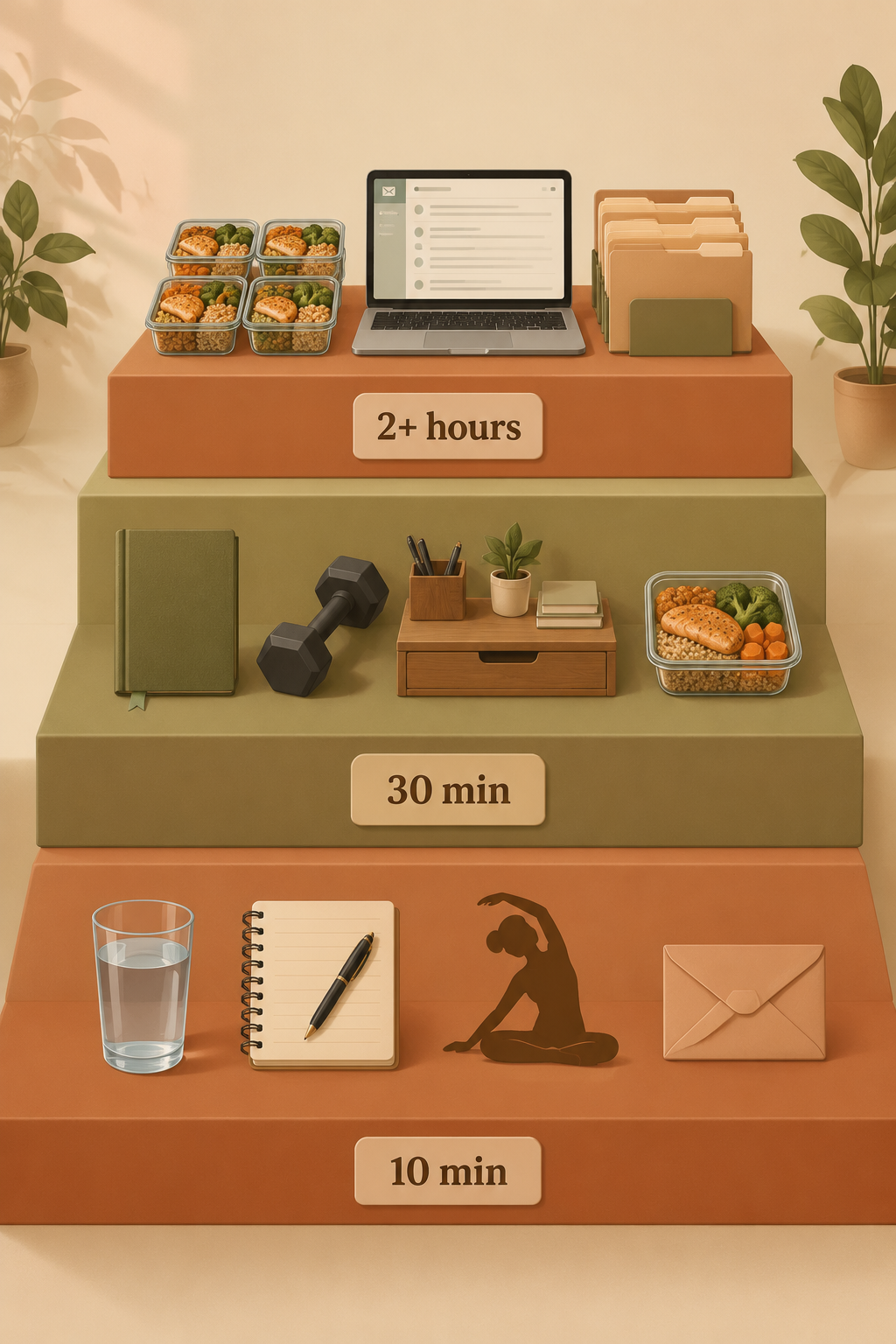
If you came here looking for how to stay productive during a social media outage, the useful answer is not “become a better person.” It is this: match the outage window to a task that is already obvious, bounded, and available without the broken app. Ten minutes gets a body reset or one small cleanup. Thirty minutes gets visible progress. Two hours or more can carry a real project block, but only if you do not spend the first half of it deciding what “productive” means.

The window is bigger than it feels. One widely cited 2025 roundup puts average daily social media use at 2 hours and 21 minutes, or 141 minutes a day. Treated as a benchmark rather than a personal diagnosis, that adds up to about 16.5 hours a week and roughly 35.7 full days a year spent inside social platforms.[1] Your own number may be much lower or much higher, but the point holds: even a partial outage can return enough attention to do something concrete.
And outages are not exotic once-in-a-decade events. Meta’s October 2021 outage took Facebook, Instagram, and WhatsApp offline for about six hours.[2] In March 2024, another Meta disruption peaked at more than 605,000 reports and lasted about two hours.[3] A June 2026 disruption produced tens of thousands of user reports, but its exact duration and scope are still better treated cautiously than turned into folklore. The safe lesson is smaller and more practical: this will probably happen again, and improvising from a twitchy refresh loop is a bad operating system.
First, Get Out of the Refresh Loop
There is a recognizable little emotional sequence in a platform outage: denial, irritation, group solidarity, mild desperation, then acceptance. Dynamik Apps describes this as the “five stages” of a social media shutdown; it is a useful mirror, not clinical science.[4] The mistake is waiting for acceptance to arrive on its own. By then, the outage may be half over.
Use a hard stop instead. Put the phone face down, close the platform tab, and pick from a menu by time available. Do not start by hunting for the perfect replacement activity. That just moves the scroll from one feed to another.
| If the outage gives you | Use it for | The standard |
|---|---|---|
| 10 minutes | A micro-win: movement, water, breathing, one note, one surface | You should feel a state change before the app comes back |
| 30 minutes | A focused dive: reading, workout, desk reset, meal-prep, one learning rep | You should be able to point to what changed |
| 2+ hours | A project block: batch cooking, file cleanup, inbox triage, calendar planning, offline skill practice | You should reduce future friction, not just fill time |
If You Have 10 Minutes
A ten-minute outage window is not a chance to reinvent your life. It is a chance to interrupt the nervous thumb. The best tasks are physical, visible, or simple enough that you can begin them before your brain starts bargaining.
- Stand up and stretch the parts that remote work quietly locks in place: neck, shoulders, wrists, hips.
- Drink a full glass of water, then take ten slow breaths before checking anything else.
- Write one sentence in a notebook: “The next useful thing is…” and finish it with an action you can do today.
- Clear one square foot of your desk, not the whole room.
- Do 50 jumping jacks, or a gentler equivalent if that is not right for your body.
- Call or voice-message one person you have been meaning to check on, if you can do it without opening a social app.
That last option matters. The point of an outage is not to pretend social contact is the enemy. If the platform outage exposes how much of your connection runs through one app, a direct text, call, or planned coffee is a sturdier substitute than staring at an error screen with other people.
For students, ten minutes can also mean resetting the study surface before the next assignment: charger plugged in, water nearby, the relevant document open, unrelated tabs closed. For remote workers, it can mean moving laundry, emptying the dishwasher, or taking the walk around the block that a “quick check” usually consumes. None of this is glamorous. That is why it works during the first restless minutes.
If You Have 30 Minutes
Thirty minutes is long enough to make visible progress and short enough that you should not open a planning system to plan the planning. Pick one lane: body, space, learning, food, or relationship.
Body
Do a guided workout you already have saved, take a brisk walk, or run through a simple mobility routine. The University of Arizona’s outage advice points people toward physical activity as one practical way to redistribute scrolling time, and this is where that advice is most immediately usable.[5] If the workout requires finding the perfect video, skip the search and walk instead.
Space
Set a timer and reset one area: desk, backpack, kitchen counter, bedside table, downloads folder. The win is not cleanliness as a personality trait. The win is that the next task has fewer obstacles. If you work from home, a cleaner work surface also gives the outage something rare: immediate proof that time passed in a useful direction.
Learning
Read one chapter of a physical book, review printed notes, or practice one small offline lesson. “Learn a new skill” is usually too vague for a surprise 30-minute block. “Read pages 40–55,” “review the next ten flashcards,” or “practice one phrase from a language notebook” is usable. The activity has to be ready before the outage, or the search for material becomes the new feed.
Food
Meal-prep one component: wash greens, cook rice, boil eggs, chop vegetables, portion snacks, make tomorrow’s lunch. Do not start the recipe that requires three missing ingredients. A good 30-minute outage task reduces one future decision.
Connection
Send the non-performative message: “I saw something that made me think of you,” “Can we catch up this week?” or “No need to reply fast, but I wanted to check in.” If social feeds are part of how you maintain weak ties, replacing them with one deliberate touchpoint is more realistic than pretending you suddenly do not need people.
If You Have 2 Hours or More
A longer outage can support deeper work, but only if the project is already defined. Otherwise, the first hour disappears into deciding whether you should clean the closet, learn Python, fix your budget, organize photos, or finally become the kind of person who owns matching food containers.
Choose a project that meets three tests: it can be done without social feeds, it has a clear finish line for this session, and it makes tomorrow easier. That filters out fantasy productivity and leaves the useful stuff.
- Batch-cook two or three simple components for the week: grain, protein, vegetable, sauce.
- Clean up a digital workspace that does not require social access: downloads, desktop files, notes app, project folders, local documents.
- Do inbox triage if email is working: archive old threads, flag only real follow-ups, write drafts that can be sent later.
- Plan next month’s calendar on paper or in a calendar app: deadlines, travel, appointments, bills, study blocks, recovery time.
- Practice from offline learning material: a downloaded course, a workbook, saved documentation, printed notes, a book chapter with exercises.
Digital cleanup is especially tempting during an outage, but keep the boundary clear. Organizing local files is productive. Opening a browser to see whether the outage is still trending is not. If a task requires the broken platform, park it on a paper list and move to something that does not.
For a freelancer, a two-hour block might become invoice cleanup, proposal drafting, portfolio file organization, or outlining a client deliverable. For a student, it might become reading, problem sets, citation cleanup, or building a study calendar before exams. For a remote employee, it might become documentation, expense reports, project notes, or the unglamorous admin that always loses to reactive work.
The best long-window tasks have a visible handoff at the end: meals stacked in the fridge, folders renamed, inbox reduced, calendar blocked, notes ready for the next work session. If the outage ends halfway through, you still have something to show for it.
Build the Menu Before the Next Outage
A social media outage is a terrible time to design your social media outage plan. Harvard Summer School’s digital detox guidance emphasizes planning ahead, recognizing triggers, and choosing alternative activities before disengaging.[6] That advice becomes much more useful when it is translated into a short menu you can reach while mildly annoyed.
Write the menu somewhere that does not depend on the platforms being available: a paper notebook, a sticky note, a notes app that works offline, or a text file on your desktop. Keep it boring. Boring is good. Boring survives outages.
| Menu slot | Preload it with |
|---|---|
| 10-minute body reset | A stretch sequence, walking route, breathing prompt, or no-equipment movement option |
| 10-minute environment reset | One surface, one drawer, one bag, or one file folder |
| 30-minute focus task | A book chapter, printed reading, saved workout, offline lesson, or meal-prep component |
| 2-hour project | A named project with a clear session finish line |
| Connection option | Three people you can text, call, or make plans with directly |
Trigger recognition is the part most people skip because it sounds therapeutic when it is actually logistical. Notice the moments when your hand reaches for the app: waiting for a file to upload, avoiding a hard paragraph, cooling down after a meeting, sitting between classes, eating alone. Those moments need replacements that fit the same size of gap. A five-minute trigger does not need a two-hour improvement project. It needs water, movement, a note, or one small next action.
The University of Arizona frames scrolling time as something that can be redirected toward movement, learning, or social connection.[5] That trio is a useful guardrail because it keeps the menu from becoming one more work-maximization scheme. During an outage, productivity can mean finishing a report. It can also mean walking, cooking, reading, calling your sibling, or making the next day less chaotic.
What to Avoid While the Platforms Are Down
The obvious trap is replacing one feed with another: outage trackers, live blogs, search results, group chats about the outage, short-form video on a platform that still works. There is nothing wrong with checking once to confirm the problem is not your account or internet connection. After that, repeated checking is just the old habit wearing a different jacket.
- Do not start a task that requires the broken platform to complete.
- Do not choose a task with a vague finish line, such as “get organized” or “learn marketing.”
- Do not turn a short outage into a full self-audit unless you genuinely have the time and energy.
- Do not use the outage to shame yourself for liking social media.
That last rule is not soft. Shame is inefficient. If social media gives you news, professional visibility, jokes, invitations, and low-friction contact with people you care about, then the goal is not to prove you never needed it. The goal is to stop a temporary outage from turning into an hour of anxious nothing.
When the Feeds Come Back
This is where many outage productivity plans end too early. The platforms return, everyone posts about the outage, and the attention dividend vanishes. Before reopening everything, take one minute to name what worked. Did a walk help? Did the clean desk reduce friction? Did a 30-minute reading block feel easier than expected? Keep that piece.
The evidence does not require a grand vow to quit. In a 2023 PLOS ONE study with 51 participants, reducing social media use from about 3.5 hours a day to about 0.5 hours a day reduced both positive and negative emotions, leaving overall wellbeing roughly neutral.[7] A Psychology Today discussion of quitting social media similarly notes that lower stress can come with a loneliness tradeoff, and recommends intentional offline connection as a mitigation.[8] Those are modest findings, not a universal commandment.
A better post-outage target is small enough to survive normal life: keep 15 to 30 minutes of the reclaimed time each day. Use it for offline work, movement, planning, reading, cooking, or direct contact with someone you would otherwise only observe through a feed. Put it on the calendar if that helps. Put it in a notebook if you trust paper more than app settings.
When the next outage hits, you will still refresh once. Most people will. Then you will have a menu, a timer, and a next move that does not depend on the feed coming back.
References
- Average Daily Time Spent on Social Media, BroadbandSearch,
- Facebook, Instagram and WhatsApp hit by global outage, The Guardian, October 4, 2021,
- Facebook and Instagram Are Back Online After Widespread Outage, Time, March 5, 2024,
- The Five Stages of a Social Media Shutdown, Dynamik Apps,
- Social Media Outage? Productive Ways to Redistribute Your Time, University of Arizona,
- Need a Break from Social Media? Here’s Why You Should — and How to Do It, Harvard Summer School,
- Social media abstinence and emotional wellbeing: An experience sampling study, PLOS ONE, 2023,
- Can Quitting Social Media Make You Lonely?, Psychology Today, February 2025,
Comments
Join the discussion with an anonymous comment.