
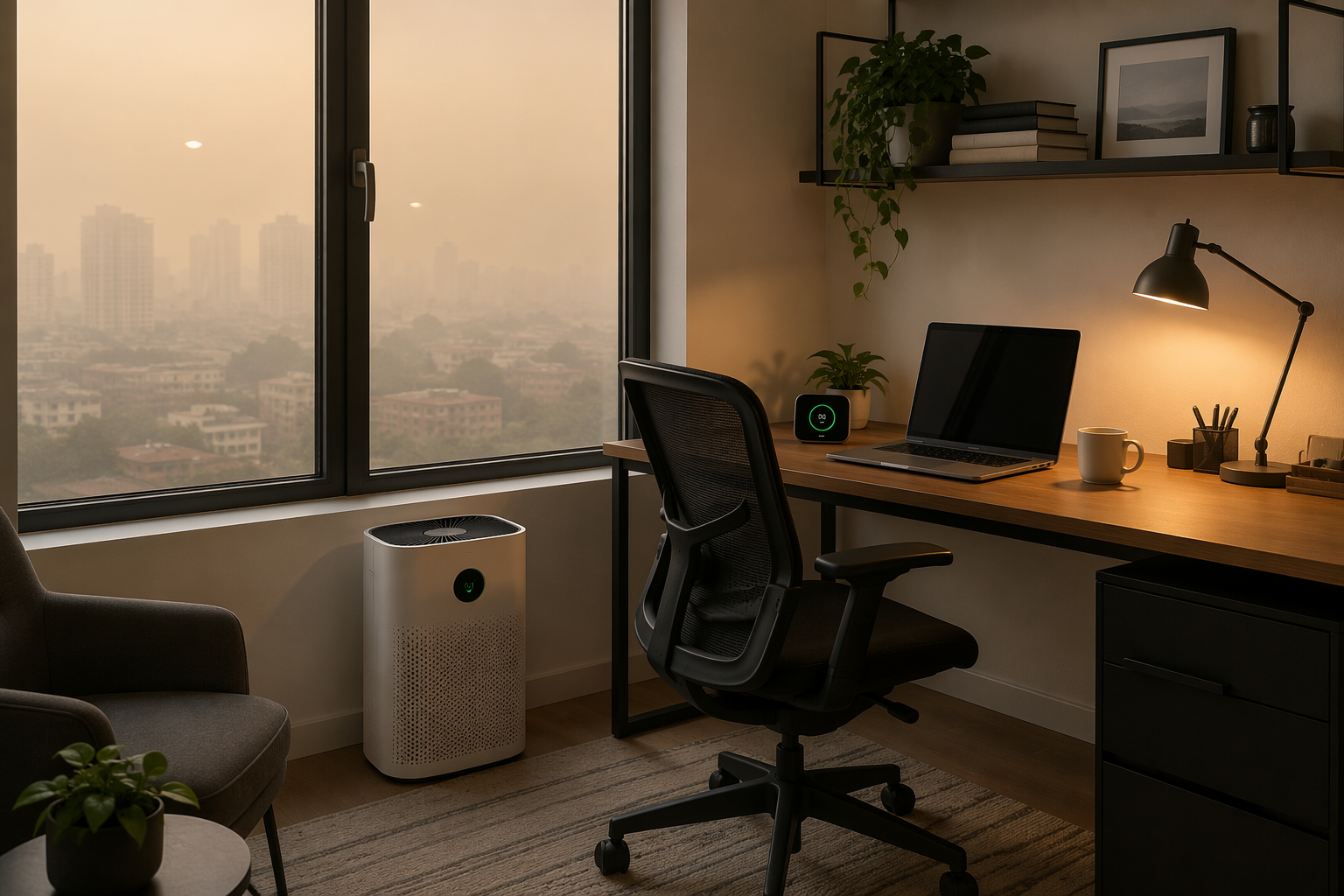
The first productive move on an air quality alert day happens before the laptop opens: close the windows, shut the door to the room you will work in, start the HEPA purifier, and remove the small indoor pollution sources that normally feel harmless. The alert may be outside, but the workday is inside a room that can either protect your attention or quietly grind it down.
That is the practical answer to how to stay productive during air quality alert conditions: treat the room as part of the workday. A strong target is preserving 85–90% of a normal workday, but only if the basics are in place: a sealed workspace, filtration sized to the room, real-time readings for PM2.5 and CO₂, fewer self-inflicted pollutants, and a task plan that puts the hardest thinking into the cleanest window of the day.
The first 30 minutes matter more than the perfect plan
An alert-day morning should not begin with a debate about whether the room “feels fine.” During wildfire smoke or other outdoor pollution events, the EPA’s guidance is to keep outdoor air from entering, run filtration, and avoid opening windows for relief when the air outside is the problem.[1] The cracked window “just for a minute” is usually not a ventilation strategy; it is a way to import the exposure you are trying to avoid.
- Pick one work room, preferably with a door, and close windows and exterior doors.
- Run a HEPA purifier continuously, not only when the room smells stale.
- Keep candles, incense, frying, and vacuuming out of the alert-day schedule because they can worsen indoor air during smoke events.[2]
- Put an indoor air quality monitor where you work, not across the apartment.
- Move writing, coding, strategy, financial decisions, and difficult meetings earlier if the readings are better then.
The point is not to turn a desk into a cleanroom. It is to stop the preventable losses: smoke drifting in, a purifier running on low in a room too large for it, CO₂ climbing through the afternoon, and the hardest task landing exactly when the room is at its worst.
Build the workspace around readings, not vibes
The two numbers worth watching most closely are PM2.5 and CO₂. PM2.5 tells you whether fine particles are getting into the room. CO₂ is an imperfect but useful signal of how stale the occupied room has become. Workplace IAQ guidance commonly uses 1,000 ppm as a CO₂ ceiling and identifies PM2.5 below 15 µg/m³ as a practical target, while also tracking humidity, temperature, and VOCs.[3]
| Reading | What it changes during the workday |
|---|---|
| PM2.5 rising | Keep the room sealed, increase purifier speed, avoid cooking or cleaning that adds particles, and delay optional errands or outdoor breaks. |
| CO₂ approaching or above 1,000 ppm | Move demanding work sooner if possible, take a break outside the room only if the alternative space is cleaner, or briefly reset occupancy without opening to polluted outdoor air. |
| Temperature or humidity uncomfortable | Expect attention to degrade faster; use cooling, hydration, shade, and lighter work blocks rather than pretending discomfort is a discipline problem. |
| Readings stable and low | Use the window for deep work, consequential calls, analysis, writing, coding, or decisions that are expensive to redo. |
A monitor does not solve the air problem. It prevents the more common operational problem: making decisions from smell, mood, or habit. Smoke can be present before it smells dramatic. Stale air can slow a meeting before anyone feels sick. A number on the desk gives you permission to change the work plan without turning the whole day into guesswork.
HEPA filtration is the baseline, not the upgrade
Filtration matters because “indoors” is not automatically clean. In the 2026 HAFTRAP trial, HEPA filtration reduced indoor PM2.5 by 52% and improved executive function by 12% among adults aged 40 and older after 30 days of use.[4] That last condition matters: the cognitive improvement was not significant for younger participants, so the result should not be sold as a universal 12% brain boost for every remote worker. The cleaner air finding, however, is directly relevant to any alert-day workspace.
A purifier also has to be sized to the room. The spec to check is CADR, or clean air delivery rate. A small purifier in a large open-plan living room may still help, but it may not exchange enough air quickly enough to protect a full workday. On alert days, a smaller closed room with a properly sized purifier often beats a prettier, larger space with more leakage.
This is where small apartments and shared homes get difficult. The best room may also be the bedroom, the child’s nap space, or the only place with a tolerable temperature. If you cannot dedicate a full work room, create the smallest practical clean zone: close the nearest door, put the purifier between the likely leak source and your desk, keep the monitor near your breathing zone, and reserve the cleanest hours for tasks that cannot be done twice.
Why the hard work should move earlier
The reason to protect the morning is not motivational folklore. In Harvard’s COGfx research, cognitive scores dropped about 50% at 1,400 ppm CO₂ compared with 550 ppm, with a 15% decline appearing as early as 945 ppm. Strategic thinking and crisis response were among the areas hit hardest.[5] That is exactly the category of work people often schedule casually: the strategy memo after lunch, the architecture decision at 3 p.m., the client escalation when the room has been closed for hours.
Direct evidence for high-skill remote work during air quality alerts is still thinner than anyone would like. Some worker-productivity studies use call-center or data-entry settings, while COGfx used a strategic-management simulation. Still, the operational implication is strong enough to act on: when the room is cleanest and least stale, spend that time on work where judgment, planning, inhibition, and error correction matter.
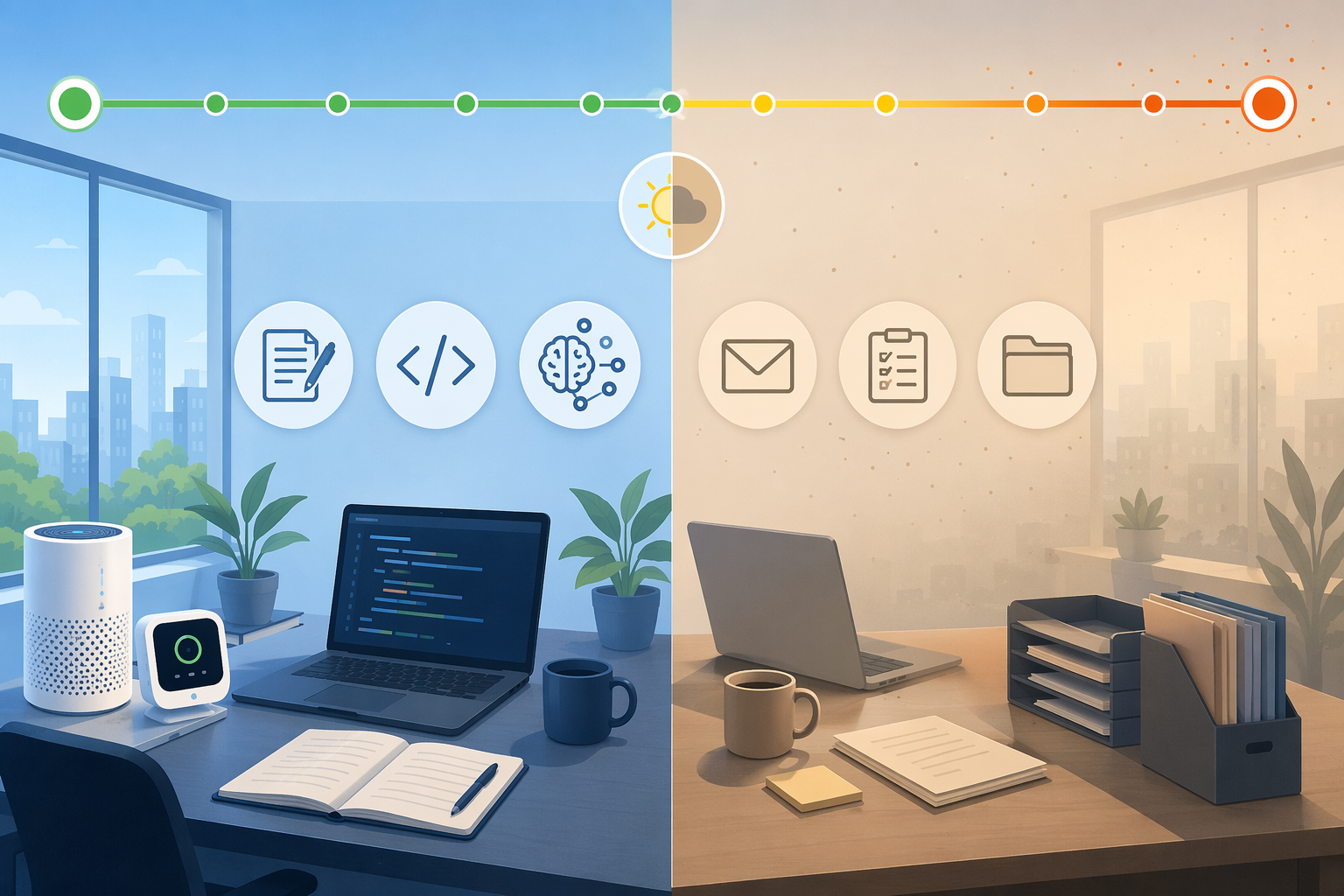
| If readings are favorable | Use the block for |
|---|---|
| PM2.5 low and CO₂ comfortably below 1,000 ppm | Deep writing, coding, modeling, strategy, legal review, financial decisions, interview loops, design critique, or high-stakes client calls. |
| PM2.5 controlled but CO₂ climbing | Shorter focus sprints, review work, structured drafting, prepared meetings, or tasks with clear checklists. |
| PM2.5 rising or the room is uncomfortable | Email triage, formatting, scheduling, file cleanup, expense reports, low-stakes edits, or asynchronous updates. |
| Readings are poor and symptoms appear | Pause, reduce exposure, follow health guidance, and move only essential work forward. |
This is not a productivity aesthetic. It is queue management. The day has a limited supply of clean, comfortable, low-CO₂ attention. Spend it on the work that would be most expensive to botch.
Do not sabotage the room from the inside
Many alert-day productivity failures are self-inflicted. A stale-smelling room invites candles. A closed apartment invites a “quick” fry-up. Dust on the floor makes vacuuming feel responsible. During smoke events, public guidance warns against burning candles, frying food, and vacuuming because these activities can add particles or stir them up indoors.[2]
The better routine is boring: cook earlier or choose low-particle meals, postpone vacuuming, wipe surfaces instead of stirring dust, and keep the purifier running through meetings. If the room smells stale, check CO₂ before opening a window. If the PM2.5 reading is rising, look for the leak or indoor source before blaming your focus.
Breaks should lower exposure, not just reset your mood
A normal productivity break often means stepping outside, opening a window, walking to get coffee, or changing rooms. On an alert day, those defaults need inspection. If outdoor smoke is the issue, an outdoor walk may be a health tradeoff, not a clever reset. If the kitchen has just been used for cooking, it may be worse than the desk. If the hallway leaks outdoor air, it may not be a better place to take calls.
- Take visual and movement breaks inside the cleanest zone when outdoor air is poor.
- Use low-cognition breaks after demanding blocks: stretch, hydrate, reset lighting, or step away from the screen.
- If another indoor space has better readings, use it for calls or admin, not for your hardest work.
- If symptoms show up, treat that as health information first and productivity information second.
Masks, commuting choices, and outdoor exposure still matter, but they are not the center of a remote-work plan unless you have to leave. The cleaner move is to reduce the number of times the workday forces you through bad air in the first place.
The economics change when alerts repeat
One bad-air day is annoying. Repeated alert days become an operations problem. IZA’s review notes that indoor PM2.5 during wildfire events can reach 70–100% of outdoor levels without filtration and that air pollution affects cognitive processing speed and selective attention.[6] The NBER summary of a study of about 5,000 call-center workers found that each 10-unit increase in the pollution index reduced productivity by 0.35%.[7] Those settings are not identical to high-skill remote work, but they make the accumulation visible: small losses repeated across many workdays are no longer small.
That is why a $150–300 HEPA purifier and an $80–200 IAQ monitor can be a rational work expense across a season of alerts. The broader indoor-air literature points in the same direction: Kaiterra’s summary of LBNL-linked data reports that employees in poor IAQ settings are 6–9% less productive and estimates a $22.8 billion annual U.S. loss from suboptimal indoor ventilation.[8] Joseph Allen’s Harvard work has also argued that the productivity benefit of improved indoor air quality is about $6,500 per person per year, while doubling ventilation costs under $40 per person per year.[9] The dollar figure is from older work and should not be treated as a current invoice amount, but the relationship is still useful: better air is not merely a wellness perk when thinking is the product.
A realistic alert-day operating standard
The goal is not heroic normalcy. Some days will still be worse. Heat, caregiving, shared rooms, fixed call schedules, older buildings, and limited budgets can all shrink the clean-air margin. A person in a small apartment may not be able to isolate a perfect workspace. A person on back-to-back calls may not be able to move strategy work into the morning. A person without cooling may face a real conflict between sealing the room and staying comfortable.
Still, the repeatable standard is clear enough: close the room, filter continuously, measure PM2.5 and CO₂, avoid adding particles indoors, protect the best air for the hardest work, and let lower-consequence tasks absorb the dirtier or staler parts of the day. That system will not make hazardous air harmless. It can keep a knowledge-work day from being quietly wasted by a room that was never set up to help you think.
References
- Wildfires and Indoor Air Quality (IAQ), EPA.
- What to do during air quality alert: Masks, air purifiers and more, CBS News.
- Office Indoor Air Quality, Skedda.
- HAFTRAP trial, Nature Scientific Reports, 2026.
- COGfx, Harvard Healthy Buildings.
- Air pollution and worker productivity, IZA World of Labour.
- The effect of pollution on worker productivity, NBER Digest.
- 22 Statistics that Prove Air Pollution Should be a Priority for Businesses, Kaiterra.
- Healthy Buildings, Harvard Healthy Buildings.
Comments
Join the discussion with an anonymous comment.