
A headline about the SORLA protein protecting the brain from tau tangles can feel distant from an ordinary workday. You are not trying to diagnose Alzheimer’s disease before breakfast. You are trying to remember the argument in yesterday’s document, switch from a planning call to a spreadsheet without mental drag, and learn one more unfamiliar tool while your calendar keeps filling.
That is why the July 2026 SORLA finding is worth more than a quick glance. In a mouse study, animals engineered to produce extra SORLA showed less tau accumulation, less brain atrophy, and preserved synaptic plasticity and function compared with controls.[1] The practical question is not whether this proves a new productivity supplement. It does not. The better question is whether the SORLA protein, tau tangles, brain health, and productivity all meet at a biological layer that knowledge workers usually ignore: the synapse.

Why tau belongs in a productivity conversation
Most productivity advice starts at the visible surface: calendar blocks, task managers, inbox rules, note templates. Those tools matter, but they assume the underlying cognitive machinery is ready to cooperate. On a good day, it does. Your brain holds a thread, suppresses distractions, retrieves a relevant memory, and updates a plan when new information arrives. On a bad day, the same workflow becomes strangely heavy.
Tau is relevant because it is not merely a scary word from late-life neurology. In Alzheimer’s research, neurofibrillary tangles made of tau track more closely with the degree of cognitive impairment than amyloid plaque burden does.[2] That does not mean every distracted morning is tau pathology. It means the disease headline points toward a more general truth: when synaptic signaling degrades, the losses show up as problems with processing speed, working memory, learning, and cognitive flexibility.
Synapses are the practical unit here. They are where neurons communicate, where repeated use can strengthen a pathway, and where a memory or skill becomes easier to call up next time. If tau damage disrupts synaptic function, the consequence is not abstract. It is the kind of friction that makes a person reread the same paragraph, lose the point of a meeting while taking notes, or need more recovery time after a cognitively dense task.
What the July 2026 SORLA study actually showed
SORLA is interesting because it appears to act less like a stimulant and more like a maintenance system. In the July 2026 mouse study, extra SORLA was associated with reduced tau accumulation, reduced brain atrophy, and preserved synaptic plasticity and function.[1] Plasticity is the brain’s ability to adapt its connections. Function is the part that matters when a signal needs to move cleanly enough for thinking to happen.
The careful reading is important. This was a genetically modified mouse model, not a trial in people who work long days and eat more salmon. It does not show that increasing SORLA in humans will improve focus, memory, or task-switching. It does show a plausible protective pathway at the level where cognitive performance is built and lost: synapses under stress from tau.
| What the evidence supports | What it does not yet prove |
|---|---|
| Extra SORLA protected mouse brains against tau-linked damage in the reported model.[1] | That people can deliberately raise brain SORLA enough to improve daily performance. |
| The protected outcomes included synaptic plasticity and function.[1] | That a measurable focus or memory benefit will appear in healthy knowledge workers. |
| Tau burden is closely tied to cognitive impairment in Alzheimer’s research.[2] | That everyday mental fatigue should be interpreted as tau pathology. |
That narrower claim is still useful. A person does not need a guaranteed performance gain to care about preserving the systems that make good work possible. The mistake would be to treat SORLA as a shortcut. The equally lazy mistake would be to dismiss it because it is not yet a human productivity metric.
The DHA connection is the practical hinge, with limits
The reason DHA enters this story is specific, not generic omega-3 enthusiasm. In a 2007 Journal of Neuroscience study, DHA increased SORLA/LR11 protein levels in primary rat neurons, aged mice, and DHA-depleted models.[3] In the available evidence, that is the direct published bridge from a dietary component to SORLA expression.
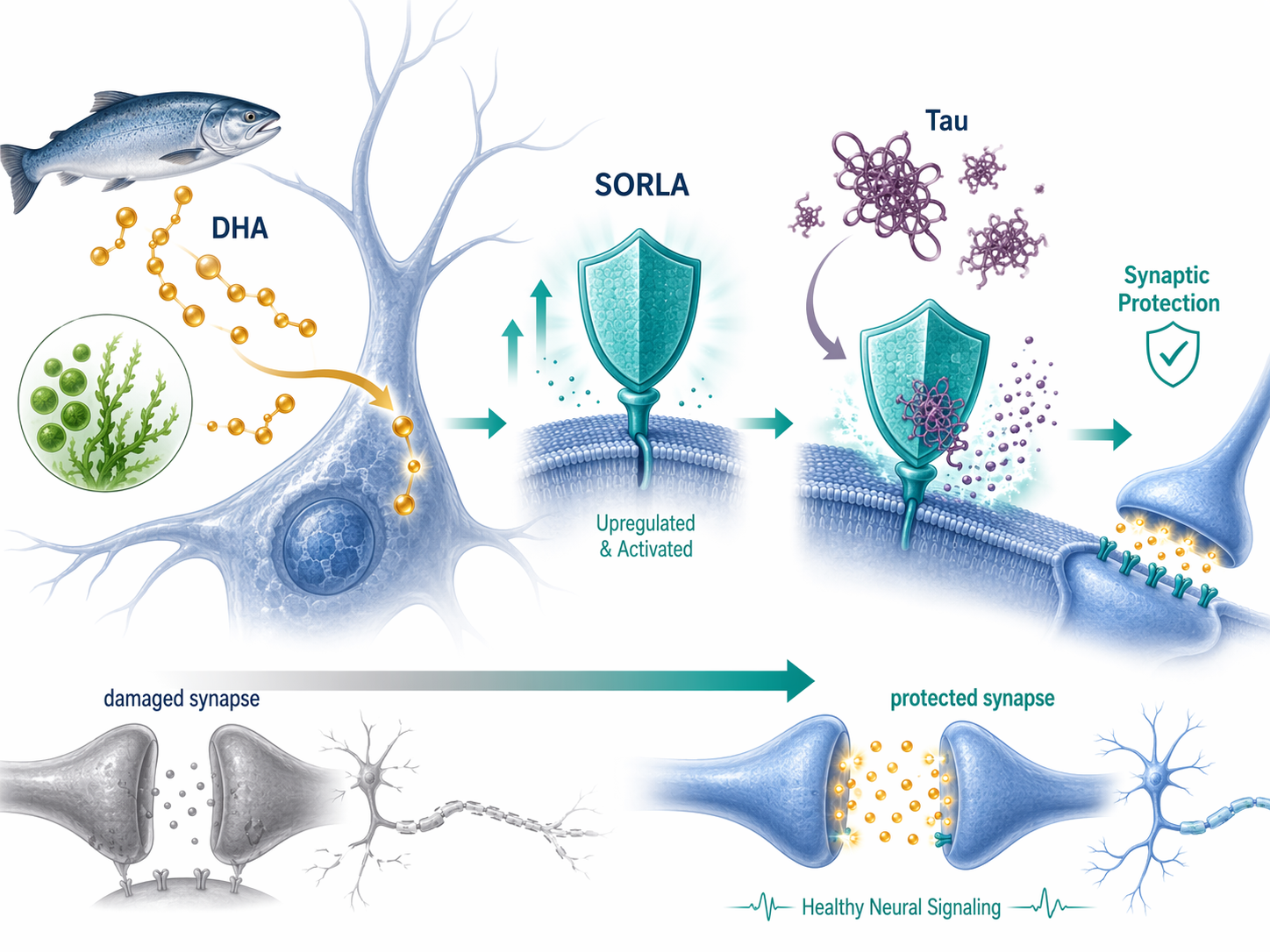
It is tempting to turn that into a simple claim: take DHA, raise SORLA, protect your focus. The evidence is not there. The DHA-SORLA study used rodent and cell models, and no human trial has yet shown that dietary DHA raises SORLA levels in the human brain or improves knowledge-work performance through this pathway.[3]
Still, the finding changes the quality of the recommendation. DHA-rich eating or algae oil supplementation is not being smuggled in as a vague “brain food” habit. It has a published mechanistic link to the same protective protein that, in the later mouse study, helped defend synapses against tau-linked damage.[1][3] That is a modest reason to act, not a license to overpromise.
What a sensible DHA move looks like
For a knowledge worker, the practical move is to make DHA intake boring and repeatable. That usually means building meals around DHA-rich fish if that fits your diet, or considering algae oil if you avoid fish. The point is not to chase an acute focus effect before a deadline. It is to support a biological environment in which the brain’s protective systems are less likely to be neglected.
- Prefer food-first DHA sources when they fit your diet and medical situation.
- Use algae oil as the non-fish option if you want DHA without fish.
- Treat supplements as a consistency tool, not as a cognitive rescue plan.
- If you take medications, are pregnant, have a bleeding disorder, or manage a medical condition, check with a clinician before changing supplementation.
None of this requires pretending that DHA is the only nutrient that matters or that SORLA is the only protective pathway in the brain. It simply gives DHA a clearer role in a productivity context: not as a stimulant, but as one plausible input into synaptic resilience.
Work itself can push against the same systems you are trying to protect
The SORLA story also lands differently when you remember what modern work asks of attention. A 2024 systematic review of 64 studies reported consistent detrimental effects of shift work, occupational stress, and prolonged working hours on attention, working memory, and executive functions.[4] Those are the exact capacities that make a calendar, task list, or note system useful in the first place.
This does not mean stress and long hours cause tau tangles in the way the SORLA mouse model studied tau. It means the practical burden on cognition is already visible in occupational research. If work patterns are repeatedly eroding attention and executive control, then a brain-health stack has to include workload design, sleep, and recovery alongside nutrition.
A useful stack is less glamorous than a new app. It asks whether your day gives the brain any chance to keep its maintenance systems online.
- Sleep: protect enough regular sleep that memory consolidation and recovery are not treated as optional.
- Exercise: keep movement in the week as a baseline brain-health behavior, not as a guilt project.
- Stress management: reduce chronic overload where possible instead of only adding coping tactics after the damage is done.
- Workload design: put the heaviest cognitive work where your attention is most reliable, and stop using late-day fog as a planning failure.
- DHA intake: make it consistent enough to be a background support, not an experiment you remember only when you feel mentally flat.
Prevention is the right frame
The broader dementia-prevention literature already supports the idea that lifestyle and environment matter across the lifespan. The 2024 Lancet Commission estimated that 45% of dementia cases could be prevented or delayed by addressing 14 modifiable risk factors.[5] SORLA does not replace that frame. It adds a sharper mechanism to one part of it.
For someone who is healthy, working, and decades away from the age range usually associated with dementia screening, “prevention” can sound too remote to change behavior. But the same capacities at stake later in life are the ones you borrow every day for analysis, design, writing, planning, coding, negotiation, and learning. Protecting them is not a retirement project.
The right level of confidence is somewhere between hype and paralysis. SORLA is a plausible protective pathway. Tau matters because synapses matter. DHA is the current dietary lever with direct published evidence of raising SORLA in neurons and animal models. Human clinical trials still need to clarify whether that pathway can be deliberately strengthened in people and whether doing so changes meaningful cognitive outcomes.
Until then, DHA-rich eating or algae oil supplementation belongs in the same category as sleep, exercise, stress management, and sane workload design: a preventive support for the brain that has to keep showing up. Not a promise of sharper focus tomorrow. Not a cure. A low-drama choice that fits the biology better than waiting for certainty while treating cognition as if it were only a scheduling problem.
References
- “Extra SORLA protein shields brain from damage linked to Alzheimer’s,” ScienceDaily, July 18, 2026.
- “Rethinking Alzheimer’s: Tau protein,” Stanford Medicine, 2025.
- “Docosahexaenoic Acid Increases LR11, an ApoE Receptor That Blocks Amyloid-β Peptide Generation,” Journal of Neuroscience, 2007.
- “The impact of shift work, occupational stress and prolonged working hours on cognitive functions: a systematic review,” Frontiers in Psychology, 2024.
- “Dementia prevention, intervention, and care,” The Lancet Commission, 2024.
Comments
Join the discussion with an anonymous comment.