
The first thing to fix during a heat wave is not your attitude. It is the calendar.
A standard 9-to-5 workday assumes that attention is mostly available in a steady line: start, focus, meet, answer, decide, finish. During a multi-day heat event, that assumption fails early. By midday, the same task takes longer, small decisions feel expensive, and the person who made a messy choice at 2 p.m. may be creating 9 a.m. repair work for someone else tomorrow.
That is not a private weakness dressed up as weather. An OECD working paper covering 23 advanced economies found that high-temperature days and heat waves reduce labor productivity, with longer heat waves and high humidity worsening the effect.[1] The San Francisco Fed has also examined U.S. labor productivity losses from extreme heat, placing the problem at an economic scale rather than a mood scale.[2]
So the useful question is not simply how to stay cool and productive during a heat wave. It is how to stop assigning your highest-friction work to the least forgiving hours of the day.

The Workday Needs a Thermal Map
A thermal workflow treats temperature as a scheduling constraint, the same way you already treat a client deadline, a school pickup, or a team meeting. The goal is not to do less by default. It is to stop spending your best attention during the hours when your body is already working harder to regulate itself.
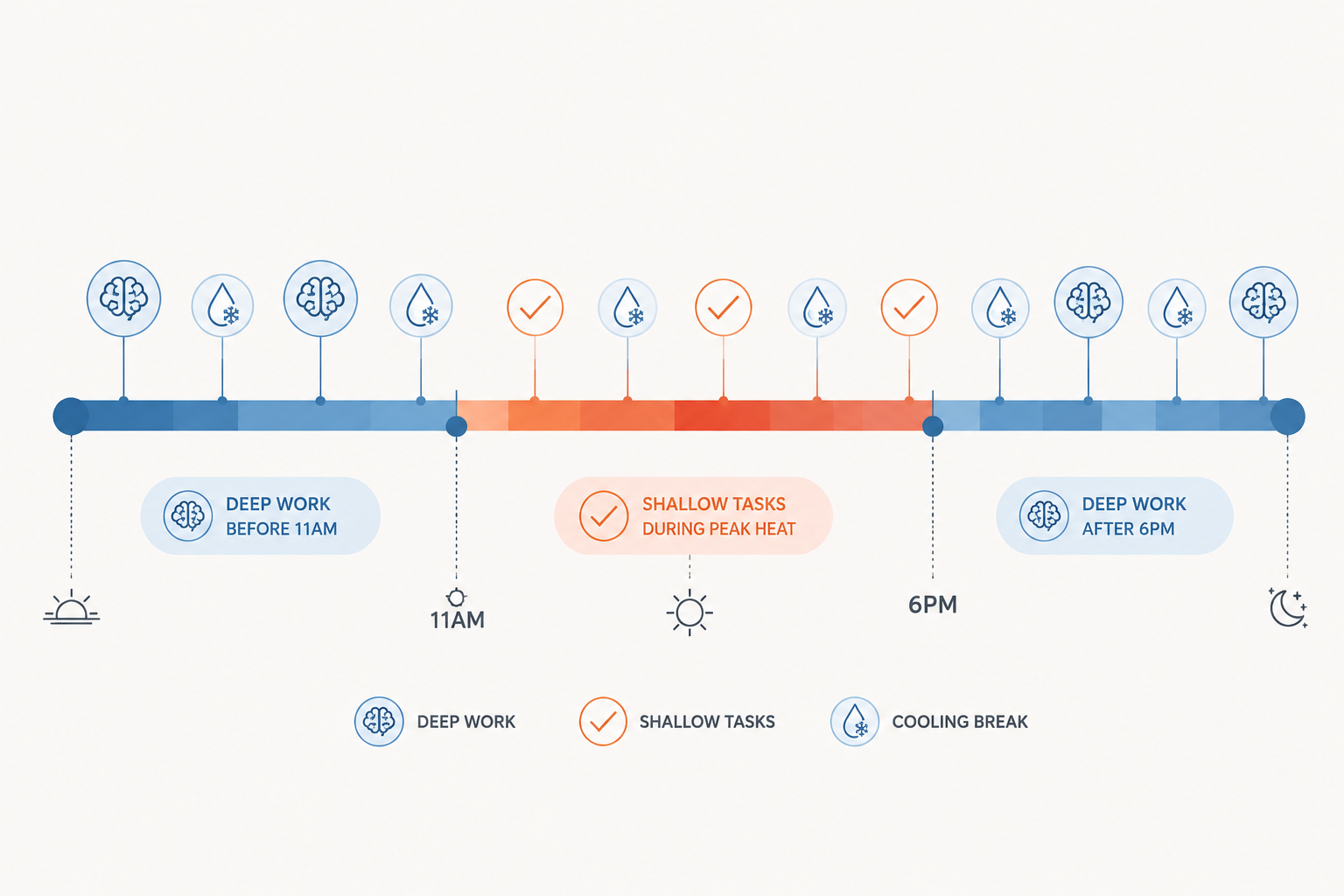
The operating principle is simple: put complex work in cooler, better-recovered windows; put routine work in the hottest window; insert cooling breaks before quality drops far enough that the next block becomes cleanup.
| Time window | Best use | What to avoid |
|---|---|---|
| Before 11 a.m. | Writing, analysis, planning, strategic decisions, hard reviews | Burning the cool window on status meetings and inbox clearing |
| 11 a.m. to 4 p.m. | Email, admin, formatting, routine coordination, low-stakes review | Starting high-consequence work that will need careful rechecking |
| 4 p.m. to 6 p.m. | Recovery, handoffs, light planning, cooling reset | Pretending the late-afternoon slump is a character flaw |
| After 6 p.m. | A second deep-work window if your life and team norms allow it | Making evening work invisible to collaborators |
Why Complex Work Belongs in the Coolest Hours
Heat does not affect every task equally. A messy inbox, a template update, and a strategic pricing decision do not draw from the same mental budget. That distinction matters because one of the strongest explanations for heat-related performance decline is not that people suddenly stop caring. It is that thermoregulation and task performance compete for limited cognitive resources.
Hancock and Warm’s maximal adaptability model, discussed in a 2024 Frontiers in Psychology review, describes heat stress as a demand that consumes limited-capacity cognitive resources. Under that model, complex tasks suffer more than simple ones because they require more of the same scarce resource.[3]
This is the reason deep work should move before 11 a.m. during a heat wave when possible. Draft the proposal while the room is still tolerable. Run the analysis before the laptop, the apartment, and your patience have all warmed up. Make the decision that other people will act on before you are tempted to accept the first answer that gets the task off your screen.
The midday block is not useless. It is just the wrong place for work that punishes small errors. Use it for tasks where momentum matters more than judgment: replying to straightforward messages, updating project boards, formatting slides, processing invoices, scheduling, renaming files, checking routine dashboards, or doing a first-pass review that will not be treated as final.
A Practical Morning Block
Start the day by protecting one or two high-value blocks before the heat accumulates. If you normally begin with email, reverse the order. Check only what can change the morning’s priorities, then close the inbox and work on the task that would be most expensive to redo.
- Use the first cool block for original thinking: writing, modeling, planning, coding, editing, design review, or decision preparation.
- Use the second cool block for work that requires judgment but benefits from the first block’s progress.
- Move status checks, recurring updates, and low-stakes approvals out of the morning unless they are blocking someone else.
- Name the handoff point before you stop, so midday work has a clear track instead of becoming a vague continuation.
If your team uses scheduling or task tools, the useful feature is not novelty. It is whether the tool lets you time-block, move tasks quickly, and make changed availability visible. If you are comparing options, a use-case-based guide to AI productivity apps can help separate reminder tools from planning tools.
Midday Is for Lower-Stakes Throughput
The hottest part of the day is where a lot of heat-wave workdays go wrong. People keep the same meeting load, the same decision load, and the same expected response speed, then wonder why the afternoon produces thin thinking and avoidable revisions.
A better midday plan is deliberately less heroic. It keeps the operation moving without pretending this is the right time for the hardest calls.
- Batch straightforward email replies instead of leaving the inbox open all day.
- Handle administrative work that has clear rules and low ambiguity.
- Format documents, clean up notes, update trackers, and prepare materials for a later review.
- Move routine coordination into this window when it does not require hard negotiation or judgment.
- Mark any midday decision that has real consequences for a cooler-hour recheck.
The last item is the one that protects the remedial worker. If a choice affects budget, client expectations, staffing, legal exposure, product direction, or another person’s workload, do not let the overheated version of yourself be the only reviewer. A quick flag such as “draft decision, confirm after 6” is not fussiness. It is quality control.
Cooling Breaks Are Part of the Work, Not a Reward After It
During a heat wave, breaks need a job. The job is not vague relaxation; it is reducing thermal and attentional load before the next work block starts.
The HEAT-SHIELD project at Loughborough University found in a controlled cycling study that work output per cycle declined over a full shift even in cool conditions, while heat added an additional 5% to 16% decline.[4] That does not mean a desk worker loses exactly the same percentage while writing a report. It does mean the shape of the problem is familiar: output can decay across a shift, and heat adds strain on top of ordinary fatigue.
A Pomodoro-style rhythm can help, but only if the break is actually thermal. Twenty-five minutes of work followed by five minutes of scrolling in the same hot chair is barely a reset. For heat-wave work, build a cooling step into the break.
| Work block | Cooling break | Purpose |
|---|---|---|
| 25 to 40 minutes of focused work | 5 to 10 minutes away from the workstation | Stop heat and attention from compounding unnoticed |
| Two or three cycles | Longer cooling reset if the room is warming or mistakes are increasing | Prevent a low-quality final block that creates rework |
| Midday shallow-work batch | Short reset between batches | Keep routine throughput from becoming irritable, sloppy work |
A useful cooling break might mean moving to the coolest room, rinsing hands or face with cool water, closing heat-facing blinds, refilling water, swapping a hot laptop off your lap, or standing near a fan. UK Health Security Agency guidance for hot weather includes keeping out of the sun at the hottest time of day, closing curtains in rooms that face the sun, drinking fluids, and cooling skin with water when needed.[5]
The important part is to treat the break as maintenance, not permission. If the next block requires judgment, the break is doing work for that judgment.
Workspace Heat Counts Too
The room is not the only heat source. Devices add their own small insult: laptops running hot, chargers warming the desk, external monitors radiating into a small workspace. Professional organizer Julie Bestry recommends practical steps such as improving airflow around devices, avoiding laptop use on soft surfaces that trap heat, shutting down unneeded electronics, and organizing the workstation so you are not adding extra friction to an already uncomfortable day.[6]
These details will not rescue a badly designed schedule, but they can keep a difficult midday block from becoming worse than it has to be.
The Evening Block Is Useful Only If It Is Visible
After 6 p.m., many homes and offices begin to cool, and attention may return. That can be a strong second deep-work window for people who have the autonomy and life structure to use it. It is a poor plan when it silently turns into extra work after a full day.
If you shift serious work into the evening, trade it for something earlier. Do not simply add it. A heat-wave schedule might mean 7:30 to 10:30 a.m. for deep work, 11 a.m. to 3 p.m. for shallow work and meetings, a late-afternoon recovery window, and 6:30 to 8 p.m. for a final drafting or review block. That is a redistributed day, not a longer one.
Flexibility has evidence behind it, though the source matters. A cited Owl Labs survey reports that 62% of remote workers say flexible schedules increase their productivity and focus.[7] Because Owl Labs sells into the remote-work market, that figure should not be treated as neutral proof that flexibility solves everything. It does support a more modest and useful point: many remote workers experience schedule control as a real productivity lever.
A Bad Hot Night Changes Tomorrow’s Plan
Heat-wave productivity is not reset cleanly at midnight. If the night stays hot, the next day starts with a smaller margin.
Ashley Ward of Duke University’s Heat Policy Innovation Hub, cited by PBS, notes that overnight temperatures above 75°F, or 24°C, can prevent the body from recovering, compounding the next day’s risks.[8] People vary in heat tolerance, health status, housing, and acclimatization, so the threshold is not a personal diagnostic tool. It is a planning signal.
After a hot, broken night, make the morning narrower, not more ambitious. Pick the one piece of complex work that most needs your best attention. Move optional decisions. Shorten meetings where you can. Build in more recheck points. The mistake is to schedule the next day as if recovery happened just because the calendar moved forward.
When You Do Not Control the Whole Day
Not everyone can move work before 11 a.m. and after 6 p.m. Client coverage, fixed syncs, caregiving, shift rules, and manager expectations can pin large parts of the day in place. Partial adoption still helps because the thermal workflow is not all-or-nothing. It is a way to protect the most error-prone work from the worst conditions available to you.
| Constraint | Partial adaptation |
|---|---|
| Fixed midday meetings | Move preparation and decision review to a cooler window; use the meeting for information exchange where possible |
| Client-facing hours | Batch client responses by complexity; save sensitive or ambiguous replies for a cooler recheck |
| Team sync cannot move | Shorten the agenda, defer hard decisions, and assign written follow-up for cooler-hour review |
| No evening availability | Protect the earliest possible morning block and lower the consequence level of afternoon tasks |
| Shared household or limited cooling | Use cooling breaks as location changes when possible, even if the work schedule itself cannot fully move |
The communication has to be legible. “It’s too hot, so I may be slow” is true but operationally weak. A better note tells people what will happen, when they can expect you, and which work is being protected.
Heat-wave schedule note: I’m shifting deep work earlier this week because the afternoon heat is affecting focus. I’ll be fully available for urgent items from 11 a.m. to 3 p.m., handling routine replies then, and doing final review/decision work before 10:30 a.m. or after 6 p.m. If something needs same-day judgment, please flag it by 10 a.m. so I can review it in the cooler block.For a manager, the same idea can become a team norm: move decision-heavy meetings earlier, make midday meetings shorter and more procedural, allow async updates during peak heat, and mark which deliverables require cooler-hour review. This is especially important on distributed teams, where one person’s afternoon heat wave may be invisible to someone working in a cooled office or a different climate.
The Heat-Wave Work Protocol
A usable protocol should fit on tomorrow’s calendar. It does not need a new identity, a perfect home office, or a manager who has read the same studies. It needs task matching, cooling breaks, and visible availability.
- Before the day starts, identify the work that would be most expensive to redo.
- Schedule that work before 11 a.m. if possible, or in the coolest available window.
- Reserve the hottest middle hours for routine, reversible, or lower-stakes tasks.
- Add cooling breaks between work cycles, not only after you already feel depleted.
- Use an evening deep-work block only if it replaces earlier work and is visible to collaborators.
- After a hot night, reduce the number of hard decisions and add recheck points.
- Tell your team what is shifting, when you are reachable, and which work needs cooler-hour review.
Hydration, light clothing, fans, shade, closed blinds, and cooler showers all matter. They are just not the whole plan. Productivity in a heat wave is preserved by redistributing cognitive load, not by forcing the body to comply with a calendar built for milder conditions.
References
- The Heat is On: Heat Stress, Productivity and Adaptation Among Firms, OECD, 2024
- Impact of U.S. Labor Productivity Losses from Extreme Heat, San Francisco Fed, 2024
- The effects of heat stress on cognitive performance: implications for the workplace, Frontiers in Psychology, 2024
- New study demonstrates impact of heat on worker productivity, Loughborough University, 2022
- How to keep cool and stay well during hot weather, UK Health Security Agency, 2026
- How to Stay Productive When It’s Too Darn Hot, Julie Bestry, 2025
- 5 Ways to Stay Productive During the Summer Heat, Engage for Success
- How to stay cool and safe in a heat wave — even without air conditioning, PBS, 2026
Comments
Join the discussion with an anonymous comment.