
The smoke-day work problem usually starts before the first meeting: you check the AQI, look out at a brown-orange sky, and realize the plan you made yesterday assumed normal air. That assumption has a cost. Stanford SIEPR research estimated that wildfire smoke reduced U.S. annual earnings by about $125 billion from 2007 through 2019, and that one smoke day cut quarterly per-capita earnings by $5.20, or roughly 0.10%.[1] That is not a dramatic number on one pay stub. It is useful because it turns vague drag into a measurable productivity loss.
To protect yourself from wildfire smoke while working, treat the day less like a motivation problem and more like an infrastructure problem. Build one room where the air is actively cleaned. Reduce the number and intensity of outdoor exposures. Then move your hardest cognitive work into the cleaner, lower-AQI parts of the day instead of pretending the calendar is unaffected.
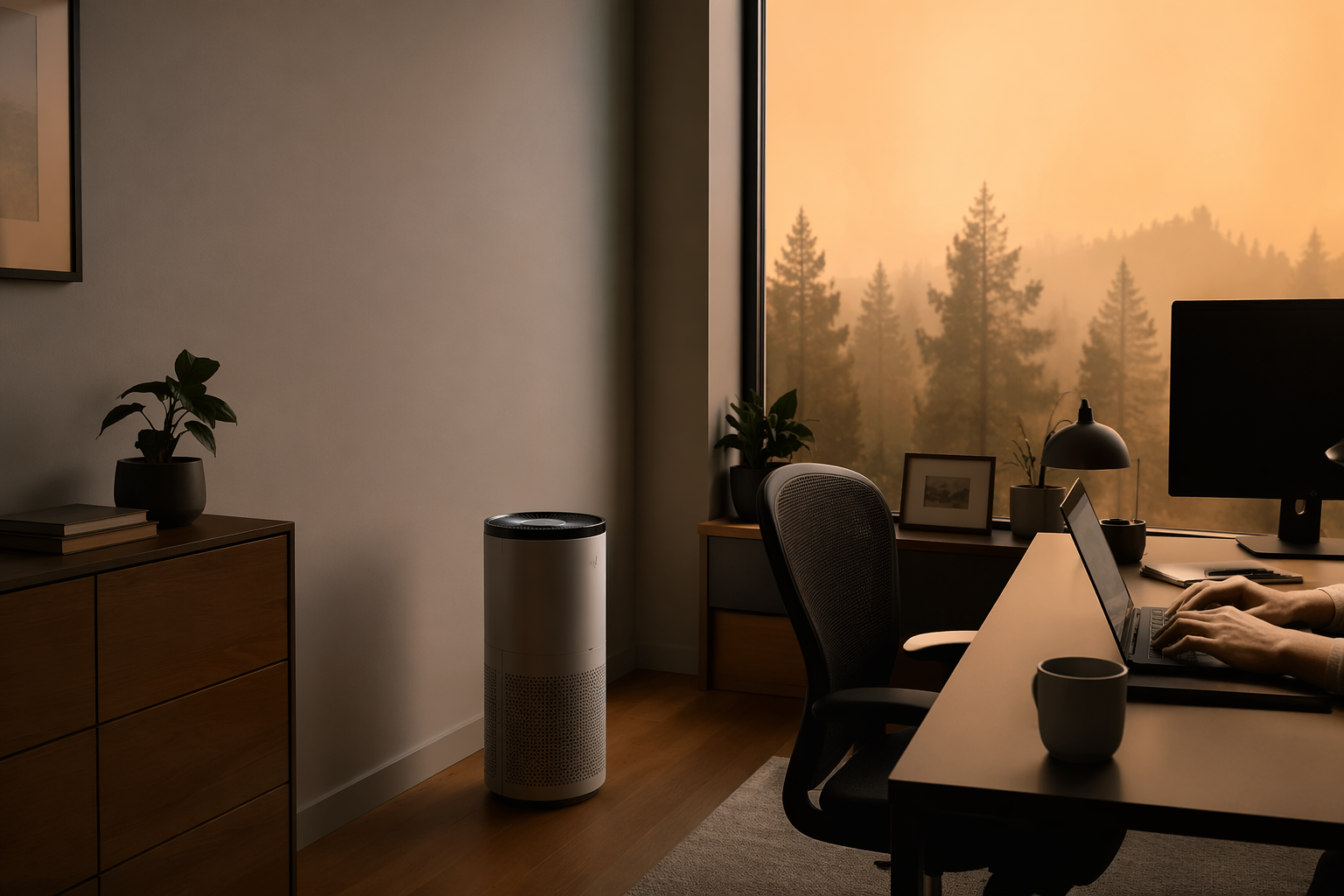
First, Stop Calling Indoors Safe by Default
“Stay indoors” is incomplete advice for someone trying to work an eight-hour day at home. The EPA warns that wildfire smoke can enter homes through open windows and doors, mechanical ventilation, and small leaks and cracks; without filtration, indoor fine-particle levels can rise during smoke events.[2] UBC’s Dr. Sarah Henderson makes the same practical point: indoor air can approach outdoor smoke levels if a building is leaky and unfiltered.[3]
That does not mean every apartment or house needs to become a sealed lab. It means your workday needs a controlled zone. If you are a freelancer, remote employee, grad student, teacher grading from home, or hybrid worker outside the reach of a facilities team, the useful question is not “Is my home smoky?” It is “Which room can I make clean enough to work in for the next several hours?”
Build the Clean Room Before You Optimize the Routine
Pick one room as the smoke-day office, preferably the room where you can close a door, work comfortably, and avoid obvious leakage. Smaller is usually easier to clean than larger. A bedroom that can hold a desk may beat a beautiful open-plan living room because air cleaning depends on volume, airflow, and time, not vibes.
- Close windows and exterior doors before smoke arrives if forecasts give you warning.
- Close the interior door to the clean room and reduce traffic in and out.
- Block obvious gaps, especially under the door, if smoke odor is entering from hallways or adjacent rooms.
- Avoid burning candles, frying food, vacuuming without a HEPA vacuum, or doing dusty chores in the room.
- Run the air cleaner continuously rather than waiting until the room smells smoky.
A cheap indoor particulate monitor is not required, but it can keep the day honest. It will not make the air cleaner. It will tell you whether the purifier, room choice, and door discipline are actually changing the condition you are working in.
Choose a purifier by smoke CADR and room size
For smoke, the label that matters most is not the word “HEPA” floating alone in a product description. Look for CADR, or Clean Air Delivery Rate, and specifically the smoke CADR when it is listed. CADR tells you how quickly a cleaner can deliver filtered air. A purifier that is excellent in a small bedroom can be underpowered in a large living room, even if both boxes say HEPA.
Wirecutter’s wildfire-smoke guidance emphasizes using an air purifier sized to the room and running it before, during, and after smoke intrusions.[4] In its 2026 purifier testing, Wirecutter names the Coway Airmega Mighty2 as a strong option for rooms up to 350 square feet and the Blueair Blue Pure 211i Max as a tested example for larger spaces.[5] Those are not magic purchases; they are examples of the kind of matching you should do: room size first, smoke CADR second, price and noise third.
| Decision | What To Check | Why It Matters During Work |
|---|---|---|
| Room selection | Can the door close, and is the room small enough for the purifier? | A clean room protects the hours when you need to think, write, code, teach, or meet. |
| Purifier sizing | Smoke CADR and recommended room area | Undersized units may run loudly without cleaning the air fast enough. |
| Noise tolerance | Fan setting you can tolerate on calls and deep-work blocks | The purifier you turn off because it is annoying is not part of the system. |
| Filter supply | Replacement filter availability before smoke season | Filters and popular units can become harder to find once smoke arrives. |
Upgrade central HVAC filtration if you can
If your home has forced-air heating or cooling, check whether the system can safely use a higher-efficiency filter such as MERV 13. Do not force a dense filter into equipment that cannot handle it; restricted airflow can create its own problems. But when the system supports it, better filtration helps the whole home, while the portable purifier concentrates protection where you work.
If you rent, the practical version may be less elegant: ask what filter is installed, replace the filter you are allowed to replace, and build your clean-room plan around a portable unit you control. The point is not to win a building-science contest. It is to keep one work zone from becoming just another smoky room.
Use a DIY cleaner only as a supervised bridge
A box fan with a MERV 13 filter can be a useful stopgap when commercial purifiers are sold out or out of budget. EPA research describes DIY air cleaners as a cost-effective way to reduce indoor particles from wildfire smoke.[6] The important word is interim. This setup is not as tidy, durable, or foolproof as a tested purifier, and the CDC warns not to leave a DIY box-fan air cleaner unattended.[7]
If you use one, place it where it will not tip, keep cords out of walkways, inspect the filter, and turn it off when no one is around. It can save a workday. It should not become an unsupervised appliance humming in a closed room while you run errands.
Make Outdoor Exposure Short, Deliberate, and Boring
The clean room handles the hours. A respirator handles the unavoidable minutes: taking out trash, moving a car, walking a dog, collecting a delivery, checking on someone nearby. Those trips should be planned like interruptions with a cost, not sprinkled through the day.
The mask hierarchy is simple enough to keep by the door. Harvard Healthy Buildings recommends a NIOSH-approved N95 as the minimum practical respiratory protection for wildfire smoke, with P100 respirators offering stronger filtration when properly fitted.[8] KN95s are not NIOSH-certified, and Washington State L&I is blunt that bandanas, towels, scarves, and most cloth face coverings do not provide adequate protection from wildfire smoke particles.[9]
- Keep NIOSH-approved N95s near the door, not buried in a drawer.
- Use a P100 respirator when smoke is heavy, exposure is unavoidable, and you can get a proper seal.
- Check the fit before stepping outside; facial hair, gaps, and loose straps reduce protection.
- Batch outdoor tasks into one short trip instead of five small ones.
- Do not count cloth masks, bandanas, or a pulled-up shirt as smoke protection.
This is where productivity advice needs to stop romanticizing movement breaks. On a clean-air day, a walk may reset your attention. On a smoke day, that same walk may increase the dose of fine particles you inhale. Dr. Henderson notes that an average resting adult breathes about 6 liters of air per minute, while intense exercise can raise that to about 60 liters per minute.[3] During smoke, effort changes exposure.
So the smoke-day version of a break may be less cinematic: stretch indoors, refill water, stand near the purifier, do a quiet reset away from the screen. Save the outdoor walk for a lower-AQI window or skip it. That is not laziness. It is dose management.
Use AQI as a Scheduling Input, Not Just a Weather Widget
AQI should change the work plan before the day starts. Cal/OSHA requires certain worker protections when wildfire smoke exposure reaches AQI 151 or higher for PM2.5, including engineering controls where feasible and making respirators available; Washington State L&I also treats wildfire smoke as an occupational hazard with employer obligations.[10][9] Those rules are written for employers and workers, especially outdoor work. They are not personal legal requirements for your home office. They are still useful benchmarks because they show where regulators stop treating smoke as a minor inconvenience.
| AQI Window | Home-Office Decision | Work Planning Move |
|---|---|---|
| Good to Moderate | Ventilate only if outdoor air is genuinely better than indoor air. | Use this window for errands, dog walks, and any task that requires leaving the clean room. |
| 101–150 | Keep windows shut if smoke is present; run filtration continuously. | Move demanding work earlier or later if the forecast shows a cleaner window. |
| 151+ | Treat outdoor exposure as something to avoid or protect with a proper respirator. | Protect deep work inside the clean room; shift errands, chores, and nonessential travel. |
| Rapidly changing or visibly smoky | Trust the more conservative signal: smell, visibility, local alerts, and indoor monitor readings. | Shorten meetings, reduce context switching, and avoid planning around best-case air. |
The useful shift is to sort the task list by cognitive load and exposure risk. Deep-focus work belongs in the lowest-AQI part of the day you can reasonably use: writing, analysis, coding, strategy, financial review, research synthesis, hard grading, client calls where you need judgment. Higher-AQI hours can absorb lower-stakes tasks: inbox cleanup, file naming, receipt sorting, scheduling, template updates, reading that does not require sharp synthesis, and meetings where your role is mostly listening.
That does not require a heroic calendar rebuild. If the air is forecast to worsen in the afternoon, move the proposal draft into the morning and push inbox cleanup later. If the smoke is expected to lift after a wind shift, use the earlier block for admin and hold the hardest work until the cleaner window. If your employer expects normal output, the most useful message is specific: “I’m moving the analysis block to 8–10 because AQI is forecast to deteriorate after noon; I’ll use the afternoon for review and follow-ups.”
A smoke-day work map
- Check the AQI forecast before opening the calendar, not after the day is already overbooked.
- Start the purifier in the clean room and give it time to work before the first deep-focus block.
- Put the hardest task in the best-air window, even if that means doing admin later than usual.
- Batch outdoor exposure into one protected trip with an N95 or P100 if going out is unavoidable.
- Use worse-air hours for shallow work, asynchronous updates, low-stakes meetings, or rest.
- Recheck conditions before opening windows, exercising, or moving work to another room.
Protect Cognitive Work Without Overclaiming the Science
It is reasonable to plan as if smoke can make thinking harder. It is not reasonable to pretend every unanswered research question has been settled. The strongest labor-market evidence shows earnings and productivity losses associated with wildfire smoke exposure across a large time window.[1] Direct evidence on wildfire smoke and cognition is still developing, and smoke is not the same exposure in every place, building, or job.
For a working day, that uncertainty does not argue for doing nothing. It argues for building a margin. If you have one task that cannot tolerate errors, do it when the room is cleanest and the day is least physically demanding. If you have a meeting that requires persuasion or delicate judgment, avoid placing it immediately after an outdoor errand in bad smoke. If your work is paid by project rather than salary, treat smoke planning as income protection, not self-care decoration.
The Stanford estimate is also based on 2007–2019 data.[1] By 2026, many workers are dealing with more frequent smoke intrusions, more remote-work days, and more homes that now double as offices. The exact loss in your own week will not be visible as a neat line item. The interrupted draft, the postponed call, the headache that turns a two-hour task into four, and the afternoon spent refreshing AQI maps are how the cost usually shows up.
What To Set Up Before the Next Smoke Alert
The worst time to buy a purifier is the week everyone else in the region is trying to buy the same purifier. The same goes for replacement filters and respirators. Product availability can tighten during smoke events, and the delay matters if your work depends on the room being usable.
- Choose the clean room and measure or estimate its square footage.
- Buy a purifier matched to that room’s size and smoke CADR, plus at least one replacement filter if budget allows.
- Check whether your HVAC system can use a MERV 13 filter, and keep the correct size on hand.
- Store NIOSH-approved N95s or a properly fitted P100 where you will actually use them.
- Create a smoke-day task label in your planner: deep focus, shallow work, outdoor, postpone.
- Decide in advance which meetings can move, shorten, or become asynchronous when AQI spikes.
If money is tight, prioritize the control point that protects the most work hours: one clean room with effective filtration. A respirator is essential for unavoidable outdoor exposure, but it will not clean the air around your desk. Window sealing helps, but it does not replace filtration. A scheduling system helps, but it cannot make smoky indoor air harmless.
Run the Day Like Conditions Have Changed
A productive smoke day is usually less graceful than a normal one. The purifier may be louder than you like. The best work block may move earlier than your usual rhythm. The outdoor break may become an indoor stretch. The errand may wait. That is still a functioning system.
Smoke days are not normal days, but they do not have to become lost days. Treat air quality the way you already treat bandwidth, power, or noise: an environmental constraint that needs a setup, a backup, and a schedule. The result you want is concrete: a room where the air is being cleaned, a respirator ready for unavoidable trips outside, a task list sorted by cognitive load, and a workday that is adjusted rather than abandoned.
References
- Wildfire Smoke and the Labor Market — Stanford SIEPR, 2022.
- Wildfires and Indoor Air Quality — EPA.
- 10 tips for coping with wildfire smoke — UBC.
- How Can I Clear My Home of Wildfire Smoke? — Wirecutter.
- Best Air Purifiers of 2026 — Wirecutter, 2026.
- Research on DIY Air Cleaners to Reduce Wildfire Smoke Indoors — EPA.
- Safety Guidelines: Wildfires and Wildfire Smoke — CDC.
- Choosing the right respirator after a wildfire — Harvard Healthy Buildings.
- Wildfire Smoke — Washington State L&I.
- Protecting Outdoor Workers — Cal/OSHA.
Comments
Join the discussion with an anonymous comment.