
The farm stand starts selling out before anyone unfolds a table. It starts in the hour when the wash line is either moving or clogging, when the person packing greens either knows the case count or has to keep re-counting, when the signs are either already in the box or someone is writing “carrots” on damp paper with a failing marker.
One version of market morning burns time at every handoff. Dirty produce comes into the same space where clean cases are waiting. Lettuce is packed differently from last week. The market lead asks how many bunches are in each tote and gets three answers. The truck is half loaded before someone remembers the price signs. By the time the stand opens, the crew has already spent its judgment on avoidable decisions.
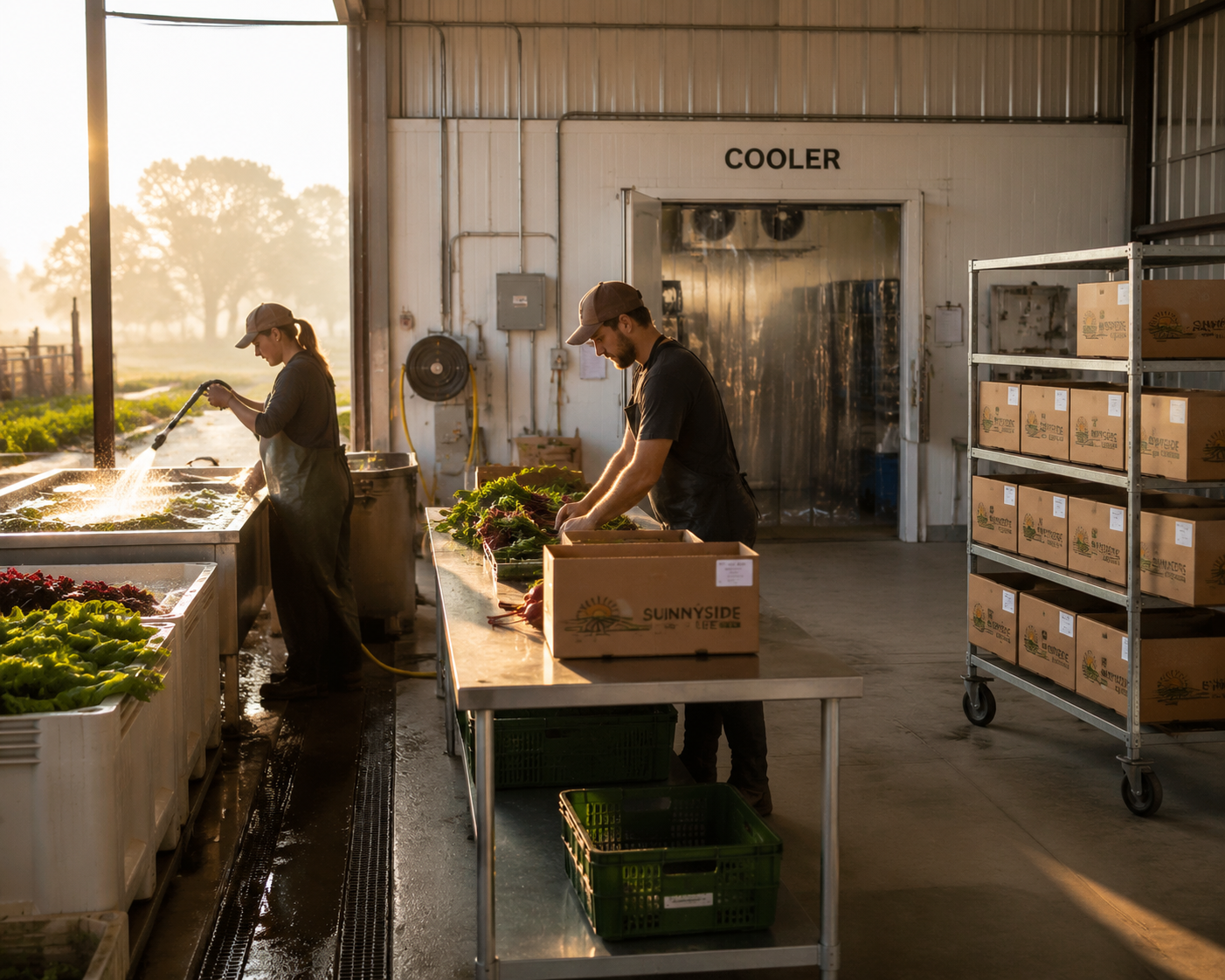
The better version is less dramatic. Dirty produce enters one side of the shed. Washed produce moves forward, not backward. Finished cases land on rolling shelves where they can be counted at a glance. Labels sit in the same corner. The market kit is already stocked. The truck is packed in a practiced order, because market-day efficiency is not a mood; it is a workflow.
Sellout Planning Starts With Last Week’s Numbers
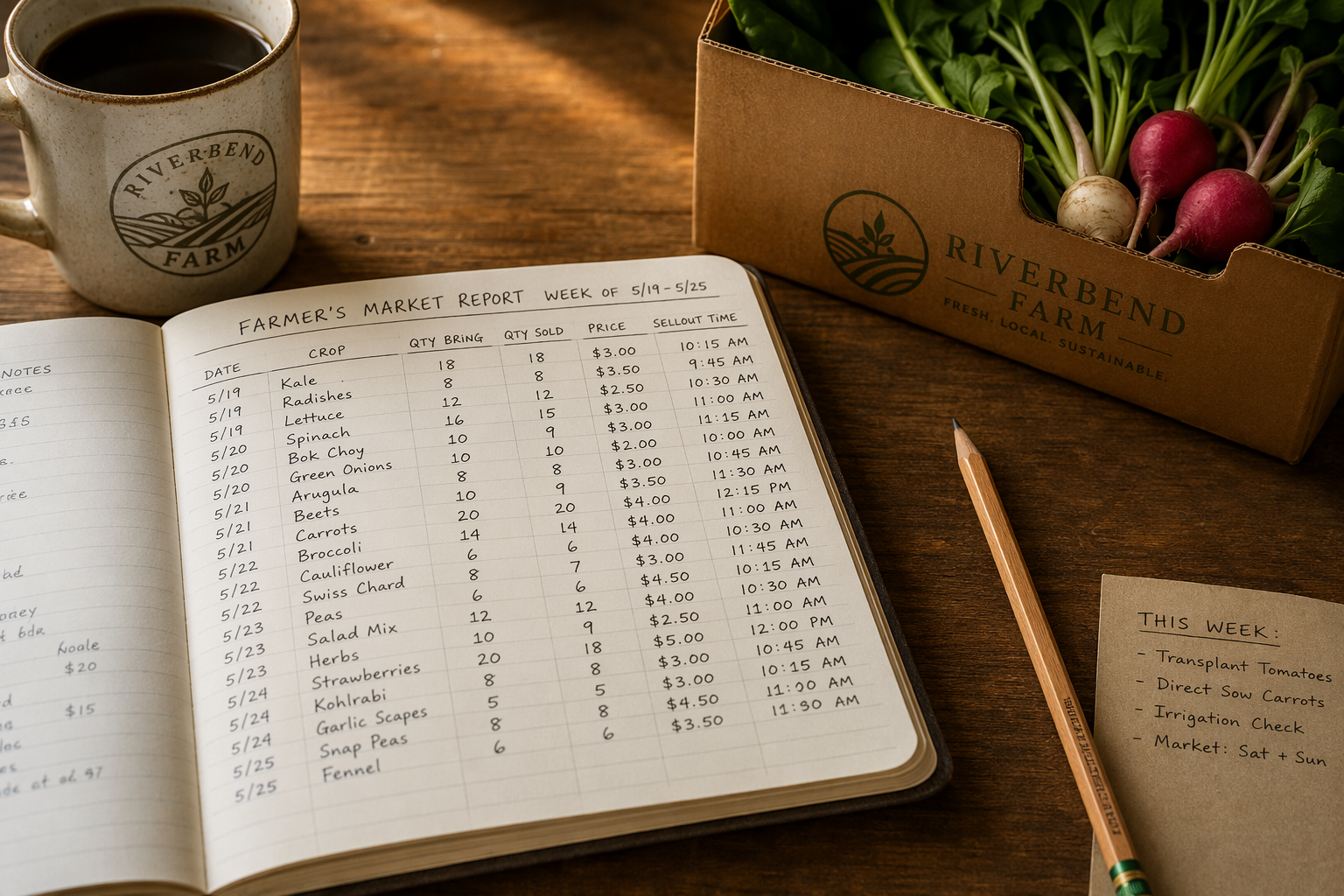
The most useful farm stand record is not a pretty annual report. It is a weekly market report that says what was brought, what price it sold for, and when it sold out. Nina Planck described this habit in Rodale Institute’s farm stand guidance: her family recorded the quantities brought to market, the prices, and the sellout timing, then used those records for future production planning year after year.[1]
That is the loop that turns “we sold out of carrots” into an actual decision. Did the carrots sell out before the morning rush was over, or only near closing? Did the farm bring too few, or did the display sit empty because the backup tote was buried in the truck? Did the price change, or did the crop size change? Without the report, those questions become memory, and memory is a poor planning tool after a long market day.
Planck’s family farm also reported reaching $350,000 in annual revenue from farmers markets alone in the early 2000s.[1] That number is worth noticing, but not copying onto a whiteboard as a promise. It is one farm, in one market context, from a different cost and customer-density environment. The practical lesson is smaller and sturdier: the farm treated market results as production information, not just sales history.
A usable market report does not need to be elaborate. It needs to survive tired hands and be easy enough to complete after the truck comes home.
| Column | Why it matters |
|---|---|
| Date and market | Separates a strong Saturday from a weak location or weather-affected week |
| Crop or product | Lets the farm compare the same item over time |
| Quantity brought | Connects harvest and packing decisions to actual demand |
| Price | Shows whether sellout timing changed with price |
| Quantity sold or returned | Prevents guessing from an empty-looking or messy table |
| Sellout time | Distinguishes a good sellout from an underpacked one |
| Restock notes | Records whether the problem was demand, display, or access to backup inventory |
The sellout time is the column many farms are tempted to skip, and it is the one that keeps the farm honest. Selling out of salad mix at 9:30 a.m. is not the same as selling out at 12:45 p.m. One may mean the harvest target was too low. The other may mean the farm brought the right amount and avoided hauling wilted product home. A simple time note gives next week’s harvest list a better starting point than a vague “bring more.”
Turn the Report Into a Pack List, Not a Memory Test
The report only helps if it changes what happens before the next market. If last week’s basil sold out early, the next step is not merely telling someone to “remember more basil.” The harvest sheet, packing targets, case counts, and truck load should all reflect that decision before market morning starts.
That means translating the market report into a pack list with fixed units. “More lettuce” leaves room for improvisation. “Four cases of little gem, 24 heads per case” gives the crew something visible to complete. Growing for Market describes this kind of standardized packing: fixed counts per container, such as 24 little gem lettuces per case or 30 bunches of carrots per tote, with labels placed in the top-right corner so inventory and restocking can be read quickly.[2]
The top-right label sounds too minor until the cooler is full, the truck is waiting, and someone needs the next tote of carrots. Consistent label placement removes a small search from a morning already full of small searches. It also lets a newer crew member help without knowing every crop by leaf shape, rubber-band color, or the preferences of whoever packed last week.
Standard case counts do the same thing for quantity. A stack of six identical carrot totes is instantly meaningful if everyone knows each tote holds 30 bunches. The market lead can see what is on the rolling shelf, what is in the truck, and what is missing without opening every container. That matters more than any clever booth tweak because it protects the stand from arriving understocked, overstocked, or unready to restock.
Make the Pack Shed Move in One Direction
A pack shed that sells well is not necessarily fancy. It is legible. Dirty crops come in. Washing happens. Sorting and packing happen. Finished cases move to cooler staging. The flow should make it harder to backtrack than to keep moving.
Growing for Market highlights one-direction wash and pack setups where dirty produce enters on one side and clean product moves toward the cooler on the other, using tools such as bubbler wash systems, high-pressure spray guns, stainless work surfaces, and rolling metal shelving to reduce pack-shed time.[2] The important part is not the exact equipment list. It is the direction of travel.
Backtracking creates handling, and handling creates delay. A tote set down in the wrong zone gets moved twice. A washed crop staged beside unwashed bins needs extra attention. A finished case without a label becomes someone else’s problem at load-in. These are not cosmetic failures; they are places where the market plan leaks time.
A Practical Pack-Shed Sequence
- Bring dirty produce into a defined receiving area, not into the packing lane.
- Wash and rinse in the order the crop needs, keeping clean and dirty zones visually separate.
- Move product to a packing table where case counts are already known.
- Pack into standardized totes, crates, or cases with the same count each time.
- Place labels in the same location, preferably where they remain visible when cases are stacked.
- Stage finished cases on rolling shelving or a marked cooler area in the order they will load.
The goal is not to make the shed look tidy for a photograph. The goal is to make the next action obvious to a tired person. If the pack list calls for five cases of greens, the crew should be able to see when the fifth case is done. If the market lead asks whether all the peppers are loaded, someone should be able to answer without excavating a mixed pallet.
This is also where a farm protects product quality without adding a lecture at the stand. Clean produce that moves quickly to the cooler gives the market crew a better starting point. A display can be charming, but it cannot undo a morning of warm greens, bruised tomatoes, or cases packed so inconsistently that the best product never makes it to the table.
Build Restocking Into the Case, Not the Conversation
At a busy stand, restocking should not require a conference. The person at the table should know what container to grab, what is inside it, and roughly how much it adds to the display. If that person has to keep asking, the packing system is pushing its unfinished work into public view.
Fixed case counts make restocking a visual inventory system. Three full totes of carrots are 90 bunches if the farm uses 30-bunch totes. Two cases of lettuce are 48 heads if the farm uses 24-head cases. Those numbers can then be compared against the market report. If carrots sold out before midmorning two weeks in a row, adding one tote is a clear adjustment, not a guess.
The same system helps prevent overcorrection. A sellout is not always a signal to bring much more. If an item sold out ten minutes before closing and the crew was able to keep the display stocked until then, the farm may have hit the right amount. The report, the case count, and the restock notes need to be read together.
Keep the Market Kit Boring and Complete
Once produce leaves the shed, the best systems are the ones nobody has to think about. A market kit should not be a crate of miscellaneous supplies that gets rebuilt from memory every week. It should be a repeatable box that works at every market: signs, blank paper, markers, tape, scissors, clips, price materials, and change where the market lead expects them.
Rodale’s farm stand guidance describes a sign box organized by product category, including a “PEPPERS file,” along with pre-made laminated signs and basic supplies.[1] The Maine Federation of Farmers’ Markets likewise advises vendors to bring practical market setup materials such as signs, price information, table coverings, change, bags, weights if needed, and other supplies that prevent last-minute scrambling.[3]
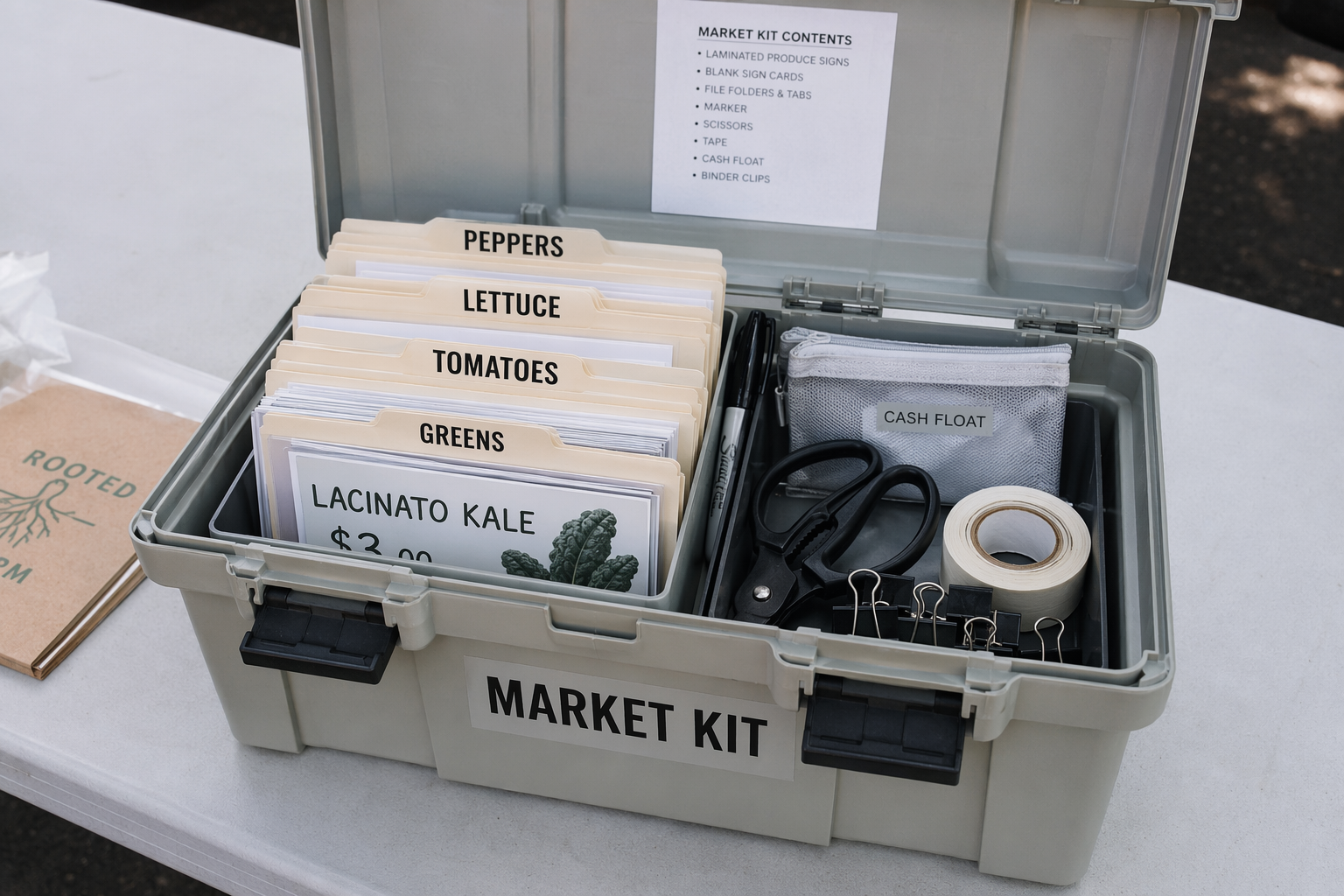
A “PEPPERS file” is the kind of detail that saves a morning. It means the person setting up the stand does not have to invent signage while customers are already walking past. It also means the farm can hand the kit to someone new and expect a reasonable result. That is the standard: not whether the kit feels clever, but whether it removes decisions from people who are already carrying produce, answering questions, and watching cash.
A useful market kit also has a closing routine. Wet signs get dried or replaced. Missing tape gets added to the refill list. Change goes back where it belongs. If the kit only works because one person secretly repairs it every Friday night, it is not really a system yet.
Practice the Load-In Before the Parking Lot Is Full
The truck is part of the workflow. If the backup greens are loaded behind the tent weights, or the first table comes out after the last produce tote, the farm will pay for that mistake during the narrowest part of the morning. Market load-in is usually short, crowded, and unforgiving. It is a poor time to discover that the vehicle was packed like a storage closet.
The Maine Federation of Farmers’ Markets recommends practicing how the vehicle is packed and making sure the vendor has the necessary setup equipment for market.[3] Growing for Market also points to modular display equipment, including collapsible roller tables, as part of efficient farmers market setup.[2] The shared lesson is simple: load for the order of use, not for the convenience of the last person standing by the truck.
| Load zone | What belongs there |
|---|---|
| First out | Tent, weights, tables, table covers, and core display pieces |
| Second out | Market kit, signs, cash materials, bags, clips, and small setup tools |
| Protected and accessible | Fragile or temperature-sensitive produce that should not be crushed or trapped |
| Restock path | Backup cases arranged so the market lead can reach high-turn items first |
| Last in, easy out if needed | Items needed immediately at arrival, even if they were packed late |
The exact order will vary by vehicle and market rules. What should not vary is the presence of an order. A practiced load-in lets the crew set the physical stand before customers arrive, then bring produce forward in a controlled way instead of stacking everything in a panic and fixing it in public.
Use Display Maintenance as the Last Step, Not the Whole Strategy
There is a place for display habits. A stand that looks picked over will slow down late buyers. Rodale’s guidance and Growing for Market both describe moving remaining produce into progressively smaller containers so the table keeps a sense of abundance instead of showing the dregs.[1][2]
That smallest-container rule is useful, but it is not magic. It works after the farm has brought the right range of product, packed it cleanly, made restocking easy, and arrived with signs and equipment ready. Shrinking a basket cannot repair an underpacked truck. It cannot create a price sign that stayed behind in the shed. It cannot tell the crew whether last week’s tomatoes sold out too early or merely looked scarce because the restock tote was hard to reach.
Customer service, pricing, and display all matter. Colorado State University Extension and Modern Farmer both include market presentation, pricing, and customer interaction among their farmers market sales advice.[4][5] But for a farm that is losing sales to late arrivals, chaotic setup, inconsistent packing, or poor restocking, those booth-level tactics sit downstream from the real constraint.
What This Kind of Efficiency Can and Cannot Prove
The evidence for these routines is mostly trade-publication, extension, and farm-case guidance. The Rodale example is a single-farm account. The Growing for Market pack-shed examples are also practical farm examples, not broad industry benchmarks.[1][2] No peer-reviewed sellout-rate standard says a labeled tote raises farm stand sellout odds by a clean percentage.
Small farms rarely get perfect data before they need better routines. The useful question is narrower: does the system reduce counting, searching, rewriting, rehandling, and guessing before the market opens? If it does, the stand arrives with more of its attention available for customers and less of it spent repairing preventable disorder.
Selling out quickly is not produced by one trick at the table. It is built through a chain of repeatable decisions: last week’s numbers become this week’s pack list; the pack list becomes standardized cases; the cases move cleanly through the shed; the market kit is ready; the truck unloads in order; the display is maintained from a stock position the crew can actually understand. Empty tables usually begin long before the first customer arrives.
References
- So You Want to Run a Farm Stand, Rodale Institute
- Twelve Tips for Pack Shed Setups and Farmers Market Displays, Growing For Market
- Quick Tips for Selling at Market, Maine Federation of Farmers' Markets
- 8 Ways to Make More Money at a Farmers Market, Colorado State University Extension
- Success at the Farmers Market: 7 Vendor Tips, Modern Farmer, July 2025
Comments
Join the discussion with an anonymous comment.