
You open the hard thing. The thesis chapter, the client report, the messy strategy memo, the course module you are somehow both behind on and avoiding. For about ninety seconds, you are the sort of person who will calmly choose long-term productivity over instant gratification. Then the document looks back at you with all its blank little accusations, and suddenly checking one message feels not only reasonable but practically administrative.
This is usually where productivity advice starts scolding. Delay gratification. Build discipline. Think about your future self. Fine advice, in the way “be taller” is fine advice to someone trying to reach a high shelf.
The more useful question is how to overcome instant gratification for long term productivity when you are still a normal person with a normal appetite for relief. The answer is not to pretend short-term pleasure has no pull. It is to stop letting that pleasure float around unattached. If the reward arrives before the work, instead of because of the work, it trains the wrong sequence.
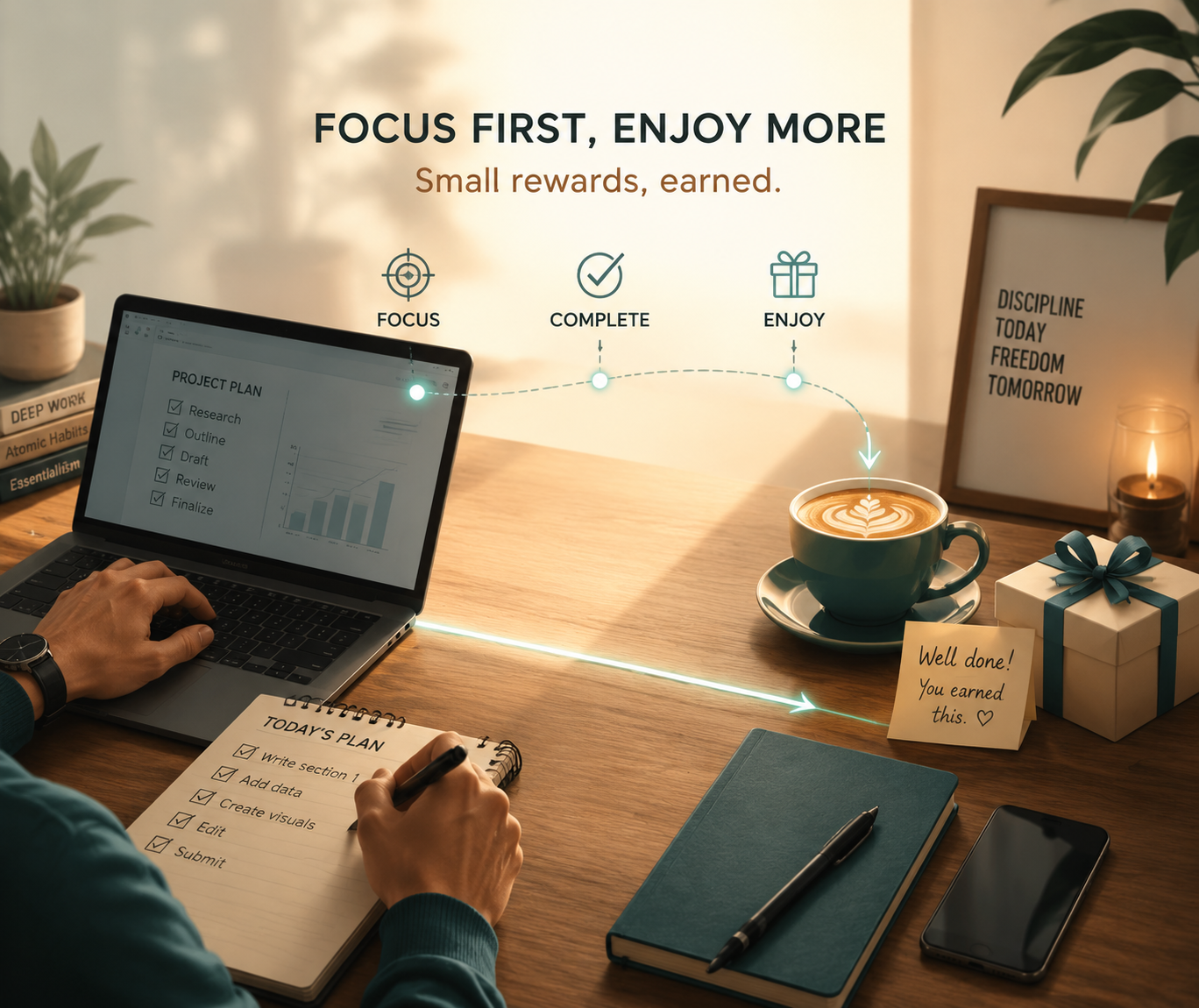
The problem is not pleasure. It is untethered pleasure.
A small reward after a real work interval is not the same behavior as wandering into a snack, scroll, or shopping tab because the task became unpleasant. One reinforces persistence. The other rescues you from discomfort before persistence has a chance to become visible.
That distinction matters because research on immediate rewards is more generous than the usual sermon. In studies described by Cornell Chronicle, Kaitlin Woolley and Ayelet Fishbach found that immediate bonuses increased task persistence by almost 20% compared with delayed bonuses of the same value. In a reading task, immediate rewards increased persistence by 35%, while larger rewards increased persistence by 19%.[1]
That is the useful part: the reward did not have to be huge. It had to arrive close enough to the work for the brain to connect the two. A distant prize may look more impressive in a planner, but impressive is not the same as repeatable on a Wednesday afternoon.
Woolley and Fishbach also argued that immediate rewards can create a kind of “perceptual fusion” between an activity and its goal, making the activity feel more intrinsically motivating.[1] Put less elegantly: when the good feeling is attached to doing the thing, the thing stops feeling like pure deprivation.
Why distant rewards often fail lonely work
Long, unstructured projects are especially hostile to distant rewards. A student finishing a thesis, a freelancer rebuilding a portfolio, or an analyst cleaning up a sprawling report may have a perfectly good reason to care about the outcome. The problem is not ignorance. The problem is that the reward lives far away, while the resistance is sitting right there in the chair.
A future promotion, degree, invoice, or clean reputation can matter deeply and still fail to move today’s cursor. Delayed rewards ask you to make a long emotional loan to yourself. Some people can do that reliably. Many people can do it on Monday and then become mysteriously unavailable by Thursday.
The New Year’s resolution evidence points in the same direction. In a 2016 analysis, Woolley and Fishbach found that immediate rewards predicted persistence at New Year’s resolutions better than delayed rewards did.[2] That does not prove every resolution can be solved with a treat. It does suggest that when people keep going, the experience of doing the behavior now matters more than we like to admit.
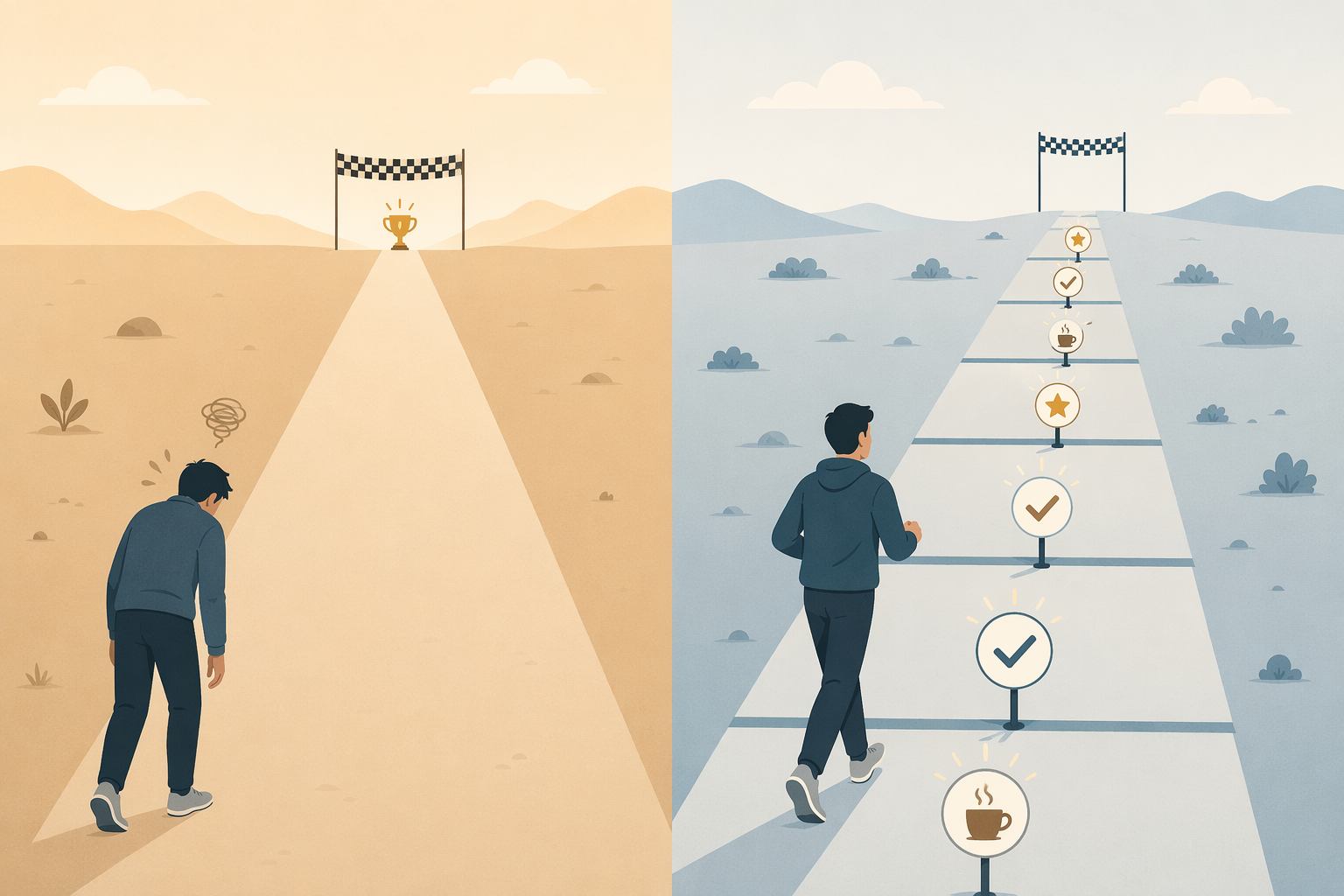
This is where many productivity systems accidentally become too noble to survive. They reserve all satisfaction for the final submission, the finished draft, the launched project, the tidy dashboard. Meanwhile, the work itself is full of ambiguity, false starts, and invisible effort. If nothing satisfying happens until the end, quitting gets to offer the only immediate relief.
Build rewards into the sequence, not around it
A reward system for long-term productivity should answer one plain question: what exactly must happen before the reward is allowed to arrive? If the answer is vague, the reward will drift. “I’ll have coffee while I work” can be lovely, but it may not reinforce anything. “I’ll make coffee after I outline the next three sections” has a behavioral hinge.
The reward does not need to be childish or extravagant. In fact, the more dramatic the reward, the more it tends to become its own project. The best immediate rewards are small enough to repeat, pleasant enough to matter, and boring enough not to hijack the afternoon.
| Weak reward setup | Better reward setup | Why it works better |
|---|---|---|
| Scroll when the task feels bad | Scroll for five minutes after sending the draft section | The relief follows progress instead of replacing it |
| Buy something after a stressful day | Save a small purchase for completing a defined milestone | The reward is earned by a behavior, not by general suffering |
| Promise a vacation after the whole project | Pair each deep-work block with a small enjoyable ritual | The project gains frequent reinforcement before the final payoff |
| Work with no pleasant elements until everything is done | Add music, a favorite location, or a good drink to the work block | Some enjoyment is embedded in the task itself |
The table is not a menu of cute hacks. It is a way to see the sequence. Productive action first, immediate reward second. If that order flips, you are no longer using instant gratification for productivity. You are just taking a break from the thing you said mattered.
Use frequent small bonuses instead of one heroic prize
A heroic prize sounds adult. Finish the whole course, then take a weekend trip. Submit the proposal, then buy the nice thing. Complete the manuscript, then celebrate. There is nothing wrong with that, except that the reward is useless during the many sessions when you are tired, under-praised, and still nowhere near finished.
For difficult knowledge work, smaller reward checkpoints usually have more practical value. They give the project a pulse. The work no longer asks for ten clean hours of virtue; it asks for the next completed unit.
- After a 25-minute focused work block, stand up, refill your drink, and read one saved article paragraph.
- After drafting a rough section, take a short walk before editing it.
- After clearing one defined batch of admin work, answer the low-stakes message you actually want to answer.
- After reviewing one data set or source packet, switch to a more pleasant subtask for the next block.
Notice the size. These are not rewards that create a second recovery problem. A reward that leaves you foggier, poorer, or more avoidant is not infrastructure. It is a little trap with nicer branding.
If you already use a planning system, put the reward checkpoint directly beside the work block instead of keeping it as a private afterthought. A daily planning workflow can make those checkpoints visible, especially when your workday has too many competing priorities. If you need a structure for that, a comparison of daily planning apps for knowledge workers can help you decide where those checkpoints belong.
Attach rewards to behaviors you can actually control
Do not reward yourself only for outcomes that depend on other people, clean insight, or luck. “Reward after client approval” may be too distant. “Reward after sending the revised draft” is cleaner. “Reward after I feel confident” is a mess. “Reward after I spend 40 focused minutes identifying the next decision” is usable.
This matters because long projects are full of days when the output looks unimpressive from the outside. You can spend an hour untangling a paragraph, rejecting bad ideas, or discovering that your first plan will not work. That may be real progress, but if your reward system only recognizes polished completion, it will punish exactly the kind of work complex projects require.
Choose rewardable behaviors that are visible and hard to fake: opening the source file and annotating it, drafting a bad first version, making the decision list, sending the email, reconciling the spreadsheet, reducing the open loops from twelve to six. If the behavior is too mushy to observe, it is too mushy to reward.
For people juggling many tasks, deciding what deserves reinforcement can be as important as the reward itself. Rewarding every tiny action turns the system into confetti. Rewarding only the work that moves a priority forward keeps it useful. If prioritization is the weak point, an AI task manager prioritization approach can help separate genuinely important work from noisy urgency.
Put some pleasure inside the work
Not every reward has to wait until the task is complete. Some immediate rewards work because they make the task itself less bleak. This is different from distracting yourself while pretending to work. The question is whether the pleasant element supports the work block or competes with it.
A favorite playlist may help with repetitive formatting and ruin careful writing. A coffee shop may make a reading session feel bearable and make confidential work impossible. A coworking call may help a freelancer begin and make deep analysis too performative. The reward is not universally good or bad. It has to fit the cognitive demand of the task.
This is the least glamorous part of making instant gratification useful: you have to notice what actually helps. If the pleasant add-on causes task-switching, makes the work sloppy, or becomes the main event, remove it. If it gets you to sit down and stay with the work longer, keep it.
Keep the reward immediate, but not infinite
Immediate does not mean endless. A five-minute reward can support another work block. A forty-five-minute reward can quietly become the rest of the day, especially when it involves feeds designed to make stopping feel rude to your own nervous system.
The safest rewards have edges. A walk around the block has a natural end. A cup of tea has a natural end. One chapter, one episode segment, one short call, one saved article, one stretch routine: these can be bounded. Open-ended rewards need a timer or a very honest person in charge, and many of us have already met that person at 11:47 p.m. and found them unreliable.
Team workflows need the same caution. If a group’s reward for finishing one stage is a flood of celebratory chat, the reward may create more interruption than momentum. Automation can help here by reducing friction without adding noise. For example, a simple status update or workflow nudge can be handled through Slackbot automation so the reward is completion, not another coordination tax.
Will rewards ruin your motivation?
A common fear is that if you reward yourself for work, you will become dependent on treats and lose whatever intrinsic motivation you had left. That fear is not ridiculous. Some incentives can distort behavior, especially when they are controlling, badly matched, or used to replace meaning altogether.
But the evidence does not support panic about every temporary incentive. In research discussed by Chicago Booth Review, Oleg Urminsky and Indranil Goswami found that temporary incentives led to only a brief, small post-reward dip lasting three choices, after which behavior returned to baseline or above. The studies included about 1,100 participants and used tasks such as choosing math problems versus watching videos.[3]
That last sentence is doing important work. Math-problem and video-watching choices are not the same as writing a dissertation, managing a difficult client, or building a complex product plan. The result is reassuring, not magical. It suggests that temporary rewards do not automatically poison motivation, but it does not mean every reward system will help every kind of work.
The practical takeaway is modest and useful: do not be so afraid of “ruining motivation” that you leave yourself with no reinforcement at all. Use temporary rewards as scaffolding. If the task becomes more fluent over time, you may need fewer of them. If the task remains difficult but important, there is no moral prize for making it unnecessarily joyless.
Where delayed gratification still belongs
None of this means every impulse should be cleverly converted into a productivity tool. Delayed gratification still matters, especially around addictive behaviors, financial decisions, and choices where the immediate reward has consequences that compound badly. There is a difference between using a pleasant ritual after a writing block and using a harmful behavior as payment for being responsible.
The reward has to be smaller than the goal it serves. If the reward drains money you are trying to save, damages sleep you need for work, or strengthens the exact avoidance loop you are trying to escape, it is not a reward architecture. It is sabotage with a receipt.
This boundary also protects the system from becoming absurd. You do not need a prize after every email. You do not need to gamify brushing your teeth unless brushing your teeth is genuinely the hard part right now. Save rewards for behaviors that are important, resistible, and repeatable.
A simple setup to test this week
Pick one project you keep avoiding. Not your whole life. One project. Then choose one behavior that would count as real progress if repeated several times this week. Make it concrete enough that a tired version of you can tell whether it happened.
- Define the work unit: one draft section, one source review, one analysis pass, one outreach batch, or one focused block.
- Choose a small immediate reward that has a clear ending.
- Write the sequence as “After I finish X, I get Y.”
- Keep the reward close to the work in time, preferably right after the work unit.
- Track whether the sequence makes you more likely to start again, not whether it makes you feel like an optimized citizen.
A hypothetical setup might look like this: after drafting 300 rough words of a report, you make the good coffee and sit somewhere nicer for ten minutes. Or after completing one review pass on a data table, you take a walk before opening messages. The exact reward matters less than the attachment. Work first. Reward immediately after. Repeat without making the system theatrical.
If your productivity system already feels crowded with apps, automations, templates, and dashboards, keep this test deliberately plain. Tools can help, but they can also become another place to hide from the project. A lean AI productivity tool stack is useful only if it reduces friction around the behavior you are trying to repeat.
The aim is not to abolish instant gratification. That project has a poor completion rate and a terrible user experience. The aim is to make gratification earned, immediate, small, and tied to the work you want to persist through.
References
- It’s about time: Immediate rewards boost motivation, Cornell Chronicle, 2018.
- Immediate Rewards Predict Adherence to Long-Term Goals, PubMed, 2016.
- Short-Term Rewards Don’t Sap Long-Term Motivation, Chicago Booth Review.
Comments
Join the discussion with an anonymous comment.