
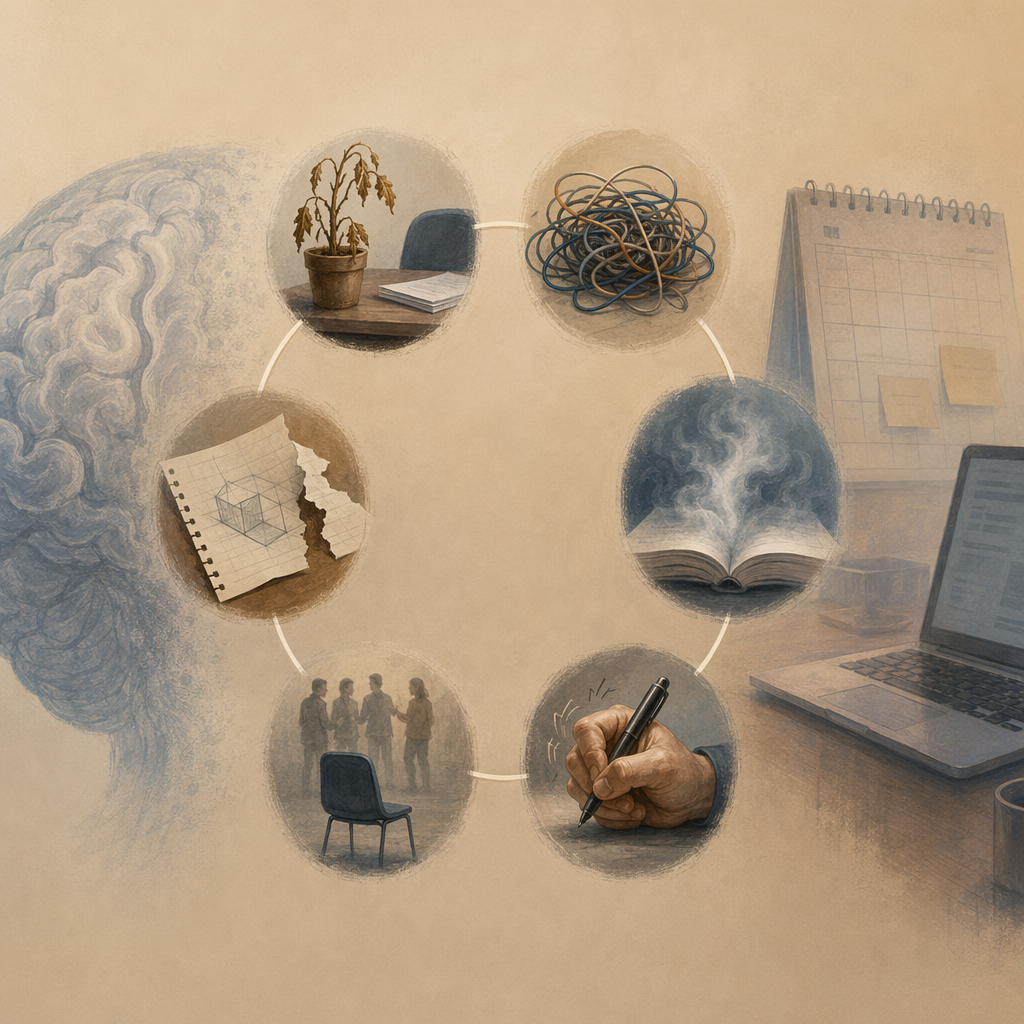
The workday does not always announce trouble as sadness. Sometimes it starts with rereading the same paragraph four times, then postponing a decision that used to take ten minutes. A draft looks worse each time it is opened. A message from a colleague sits unanswered because the exchange may be awkward. By evening, the tasks are technically done, but there is no small private signal of completion: no satisfaction, no confidence, no evidence that tomorrow will be easier.

That is the practical reason midlife depression, dementia risk, and productivity belong in the same careful conversation. The immediate problem is not an abstract future diagnosis. It is the way particular depressive symptoms take apart the working day: confidence before judgment, coping when complexity rises, concentration during hard thinking, steadiness before conflict, warmth in collaboration, and the sense that finishing something counted.
A 2025 Lancet Psychiatry analysis of 5,800 Whitehall II participants followed over 23 years found that specific depressive symptoms in midlife were associated with later dementia risk. Loss of self-confidence and difficulty coping with problems were each linked to about a 50% higher dementia risk, and the broader association was driven by six symptoms rather than depression treated as one vague category. Low mood and sleep disturbance, the symptoms people often expect to carry the story, did not drive the association in this analysis.[1]
The study does not prove that these symptoms cause dementia. Its Whitehall II sample was 72% male and 92% White, which limits how confidently the findings can be generalized to women and ethnic minority groups. Still, the finding is useful because it points to the same problems many midlife knowledge workers already recognize at their desks.[1]
The six symptoms that damage work before they become a health worry
The important move is to stop treating depression at work as only “feeling down.” Sadness matters, of course. So do fatigue and sleep. But this particular dementia-risk signal sat closer to the machinery of work: judgment, coping, attention, emotional steadiness, social connection, and task appraisal.[1]
1. Loss of self-confidence
Loss of self-confidence is not merely a mood label. At work, it changes the threshold for action. A person who once made a reasonable call after checking the evidence may now keep reopening the same files, asking for reassurance, or delaying a decision until someone else sets the direction.
That delay can look like perfectionism from the outside. From the inside, it often feels like the disappearance of a trusted internal gauge. The Whitehall II finding is notable because loss of confidence was one of the symptoms linked to about a 50% higher dementia risk, making it more than a soft complaint about morale.[1]
For productivity, the immediate damage is decision drag. Work does not simply take longer; it accumulates unresolved edges. Drafts stay open. Approvals wait. Other people cannot proceed because the person with the decision has lost confidence in the act of deciding.
2. Difficulty coping with problems
Difficulty coping with problems was the other symptom linked to about a 50% higher dementia risk in the Whitehall II analysis.[1] It is easy to underestimate because “coping” sounds like temperament. In practice, coping is a work function. It is what allows a person to absorb a changed deadline, an unclear assignment, a technical snag, or a tense conversation without the whole day collapsing around it.
When coping weakens, small obstacles become project-wide threats. The spreadsheet error is not just an error. The client revision is not just a revision. The brain has trouble shrinking the problem back down to the next manageable action.
This is one reason ordinary productivity advice can land badly during depression. “Break it down” is sound in theory, but the depressed brain may need the breakdown to be external, visible, and almost embarrassingly concrete. The person is not refusing to cope. The coping system is under strain.
3. Impaired concentration
Impaired concentration is the symptom most people recognize as a productivity problem, but it is still often moralized. The person is told to remove distractions, close tabs, or show more discipline. That may help at the margins, but depression itself can impair attention, memory, information processing, decision-making, cognitive flexibility, and executive function.[2]
Those are not minor inconveniences for knowledge work. They are the tools of the job. A lawyer tracking clauses, a product manager weighing tradeoffs, a teacher planning a unit, or an analyst comparing datasets all rely on working memory and flexible attention. When concentration frays, the person may still be sitting at the desk for the same number of hours, but the usable thinking inside those hours has narrowed.
The dementia-risk finding does not mean that every spell of poor concentration predicts decline. It does suggest that persistent midlife concentration trouble, especially when paired with other depressive symptoms, deserves more respect than the usual lecture about willpower.[1]
4. Persistent nervousness
Persistent nervousness changes the social geometry of work. A routine check-in becomes something to rehearse. A Slack message feels loaded. A manager’s neutral comment keeps replaying through the afternoon. The person may still attend the meeting, but part of their cognition is already spent before the agenda begins.
In the Whitehall II analysis, nervousness was one of the six depressive symptoms driving the association with later dementia risk.[1] At the desk, its cost is anticipatory load. The work is not only the task; it is the task plus the imagined reaction, the possible misunderstanding, and the effort to appear fine.
5. Reduced social warmth
Reduced social warmth can be mistaken for disengagement or irritation. It may show up as shorter replies, fewer informal check-ins, less visible enthusiasm, or a quiet retreat from the casual exchanges that keep collaboration human.
This matters because much knowledge work depends on small social repairs. People ask for clarification, soften disagreement, notice confusion, and make it easier for others to admit uncertainty. When warmth recedes, collaboration becomes more brittle. The person may not intend distance, but the team receives less relational signal.
The Whitehall II finding puts reduced social warmth among the six symptoms associated with later dementia risk.[1] That should not be used to police someone’s tone. It should be used to notice that withdrawal and emotional flatness can be part of a health pattern, not a character flaw.
6. Dissatisfaction with task execution
The last symptom is easy to miss because it can hide inside high standards. Dissatisfaction with task execution means the completed task does not register as adequately completed. The report is submitted, but it feels wrong. The meeting was handled, but the mind replays the awkward sentence. The inbox is cleared, but there is no sense of having done enough.
This symptom attacks one of productivity’s quiet rewards: the evidence of competence. A working system is not only a way to move tasks forward. It is also a way a person learns, repeatedly, “I can still do this.” Depression can corrupt that evidence. Finishing stops feeding confidence.
As one of the six symptoms linked to later dementia risk in the Whitehall II analysis, dissatisfaction with task execution deserves a more careful reading than “being too hard on yourself.”[1] It is a symptom that can keep a person working past the point of usefulness because no endpoint feels trustworthy.
What helps is not pushing harder, but lowering the load
If depression affects attention, memory, processing speed, decision-making, cognitive flexibility, and executive function, the response should not be to demand more invisible effort from the same impaired systems.[2] The practical answer is to move more of the work into structures that do not depend on mood, confidence, or perfect recall.
UBC’s Working With Depression materials group cognitive support into three useful categories: remediation, which directly practices cognitive skills; compensatory strategies, such as mnemonic devices and using stronger abilities to support weaker ones; and adaptive approaches, such as changing the environment with external memory aids, structured routines, and task batching.[3]
For a midlife worker trying to stay functional through depressive symptoms, the adaptive category is often the most humane place to begin. It does not ask the person to prove they can think their way out of the condition. It reduces the number of places where the condition can quietly sabotage the day.
| Symptom | Productivity failure point | Useful support |
|---|---|---|
| Loss of self-confidence | Decisions stall or require repeated reassurance | Predefined decision rules, smaller approval thresholds, written criteria |
| Difficulty coping with problems | Minor obstacles expand into project-wide overwhelm | Visible next-action lists, escalation rules, external memory aids |
| Impaired concentration | Reading, analysis, and planning lose usable depth | Single-task blocks, reduced inputs, notes that hold context |
| Persistent nervousness | Meetings and messages consume attention before they happen | Predictable routines, scripts for recurring conversations, buffered transitions |
| Reduced social warmth | Collaboration becomes thinner and more brittle | Low-pressure check-ins, paired work, explicit communication norms |
| Dissatisfaction with task execution | Finished work does not register as finished | Done criteria, review limits, end-of-task records |
Externalize memory before concentration fails
A depressed brain should not have to keep the whole project in mind while also doing the project. External memory aids are not cosmetic. They protect continuity when attention breaks.
- Keep one visible project note with the current goal, next action, waiting items, and unresolved questions.
- End each work session by writing the re-entry point: the file, the paragraph, the decision, and the next move.
- Use checklists for recurring work that should not depend on memory, especially reviews, submissions, handoffs, and meeting preparation.
- Put reminders where the work happens, not in a separate system that requires another act of recall.
This is not about becoming more organized for its own sake. It is about reducing the penalty for a predictable symptom. If concentration drops at 3 p.m., the system should still know where the work left off.
Narrow decisions when confidence is unreliable
Loss of confidence makes open-ended decisions expensive. A useful system narrows the decision before the person reaches it.
- Define what makes a decision “good enough” before reviewing options.
- Limit low-risk choices to two or three options instead of reopening the whole field.
- Separate reversible decisions from decisions that truly need consultation.
- Use a short written rationale so the decision does not have to be emotionally re-litigated later.
Managers can help here without turning mental health into a performance project. Clear authority, explicit review points, and fewer ambiguous approvals reduce the confidence burden. The goal is not to extract more from a distressed worker. It is to stop ambiguity from becoming another symptom amplifier.
Use routines to make nervousness less expensive
Persistent nervousness feeds on uncertainty. A routine cannot remove the underlying symptom, but it can reduce the number of social and managerial moments that arrive as surprises.
Recurring meetings should have predictable agendas. Difficult conversations should have a written opening line and a known place to park unresolved issues. Message templates can help with common friction points: asking for clarification, declining extra work, reporting a delay, or requesting a decision. These are not scripts for pretending to be well. They are handrails for moments when nervousness would otherwise consume the working memory needed for the actual exchange.
Batch tasks and simplify the environment
Task batching helps because switching tasks requires executive control, and executive function is one of the cognitive domains depression can impair.[2] The aim is not to build an elegant productivity ritual. It is to spend less cognitive effort on reorientation.
- Group shallow administrative tasks into one or two windows instead of letting them interrupt deeper work all day.
- Keep only the materials needed for the current task visible.
- Use the same start sequence for demanding work: open the project note, read the re-entry point, set the next action, begin.
- Stop a work block with a written handoff to your future self instead of relying on memory.
If these changes save forty minutes, the saved time does not automatically belong to more work. During depression, reclaimed effort may need to go to treatment appointments, sleep, a walk, a meal, exercise, or a conversation with someone safe. A system that only creates more capacity for work can become another way to lose the person inside the workload.
Keep social scaffolds small and real
Reduced warmth and withdrawal are hard to address because advice in this area can become sentimental quickly. The practical version is modest: lower the effort required to stay connected.
A standing ten-minute check-in with a trusted colleague may be more useful than an open invitation to “reach out anytime.” Pairing on the first fifteen minutes of a difficult task can reduce avoidance. A team norm that clarifying questions are welcome can prevent nervousness from becoming silent confusion. These supports work because they make connection scheduled, specific, and less dependent on a good mood.
Treat exercise as cognitive support, not a personality makeover
Exercise belongs in this discussion, but not as a scolding detour. UBC’s MoodFx materials recommend “rich activities” that combine aerobic and strength demands, such as hiking with a backpack, rock climbing, or swimming, for brain-boosting effects.[3] The useful point is the combination: movement, coordination, effort, and sometimes environment.
For someone with depression, the right version may be deliberately smaller than the ideal version. A short walk with hills, a beginner strength session, swimming laps, or carrying groceries home can still be treated as support for the brain and the workday. The purpose is not to become a fitness project. It is to build cognitive reserve while giving the nervous system a different kind of demand than another hour at the screen.
Medication may help mood before it fixes thinking
One caution matters for expectations. Harvard Health reported that cognitive problems can persist in depression, and noted that 95% of patients on common antidepressants showed no improvement on measures of cognitive impairment.[2] That does not mean treatment is futile, and it certainly does not mean people should make medication decisions without a clinician. It means a person may need direct cognitive supports even while mood treatment is underway.
This is where productivity tools can be useful without pretending to be treatment. A checklist will not treat depression. A project note will not resolve persistent nervousness. A routine will not diagnose cognitive decline. But these supports can reduce the daily damage while a person seeks appropriate care and while treatment takes effect.
Depression is one dementia risk among many, not the whole story
The Whitehall II findings are worth attention, but they should not be inflated into a single-cause story. A 2026 analysis in Alzheimer’s & Dementia estimated that midlife modifiable risk factors including obesity, lower education, diabetes, and depression contribute to 22.7% of dementia cases in the United States. In that model, a 15% reduction in those midlife risk factors could prevent about 176,000 cases annually.[4]
Within that same analysis, depression’s population-attributable fraction was 1.0%, compared with 8.1% for lower education and 7.7% for obesity.[4] That is a modest share, but not a meaningless one. It places depression where it belongs: among several modifiable midlife risks, not above all of them.
The 2024 Lancet Commission on dementia prevention also identifies midlife depression as a modifiable risk factor in its updated framework.[5] The responsible conclusion is not that treating depression guarantees dementia prevention. It is that persistent depressive symptoms in midlife are relevant to both present functioning and long-term brain health.
When to stop managing and get help
Productivity techniques are support tools, not substitutes for professional mental health care. If depressive symptoms persist, worsen, interfere with daily life, strain relationships, or make work feel unmanageable, it is time to speak with a qualified healthcare provider. If there are thoughts of self-harm or suicide, seek urgent help immediately through local emergency services or a crisis line.
For the work itself, the first move is observation rather than self-accusation. Notice whether the pattern is confidence, coping, concentration, nervousness, warmth, satisfaction, or several at once. Then reduce the load around that symptom: externalize memory, narrow decisions, make routines predictable, simplify the environment, keep social support specific, and protect time for care and recovery.
The six symptoms deserve attention because they cost people something now. They make capable workers doubt their competence, withdraw from useful connection, and lose the small confirming signals that a finished task should provide. The possible long-term brain-health signal makes that attention more urgent, but the humane reason to act is already present in the workday.
References
- Specific depressive symptoms in midlife linked to increased dementia risk, UCL News, Dec. 2025
- More than sad: Depression affects your ability to think, Harvard Health Publishing, May 6, 2016
- Cognitive Difficulties, Working With Depression / UBC MoodFx
- Midlife modifiable risk factors for dementia in the United States, Alzheimer’s & Dementia, Jan. 2026
- Dementia prevention, intervention, and care: 2024 report of the Lancet standing Commission, The Lancet Commission, 2024
Comments
Join the discussion with an anonymous comment.