
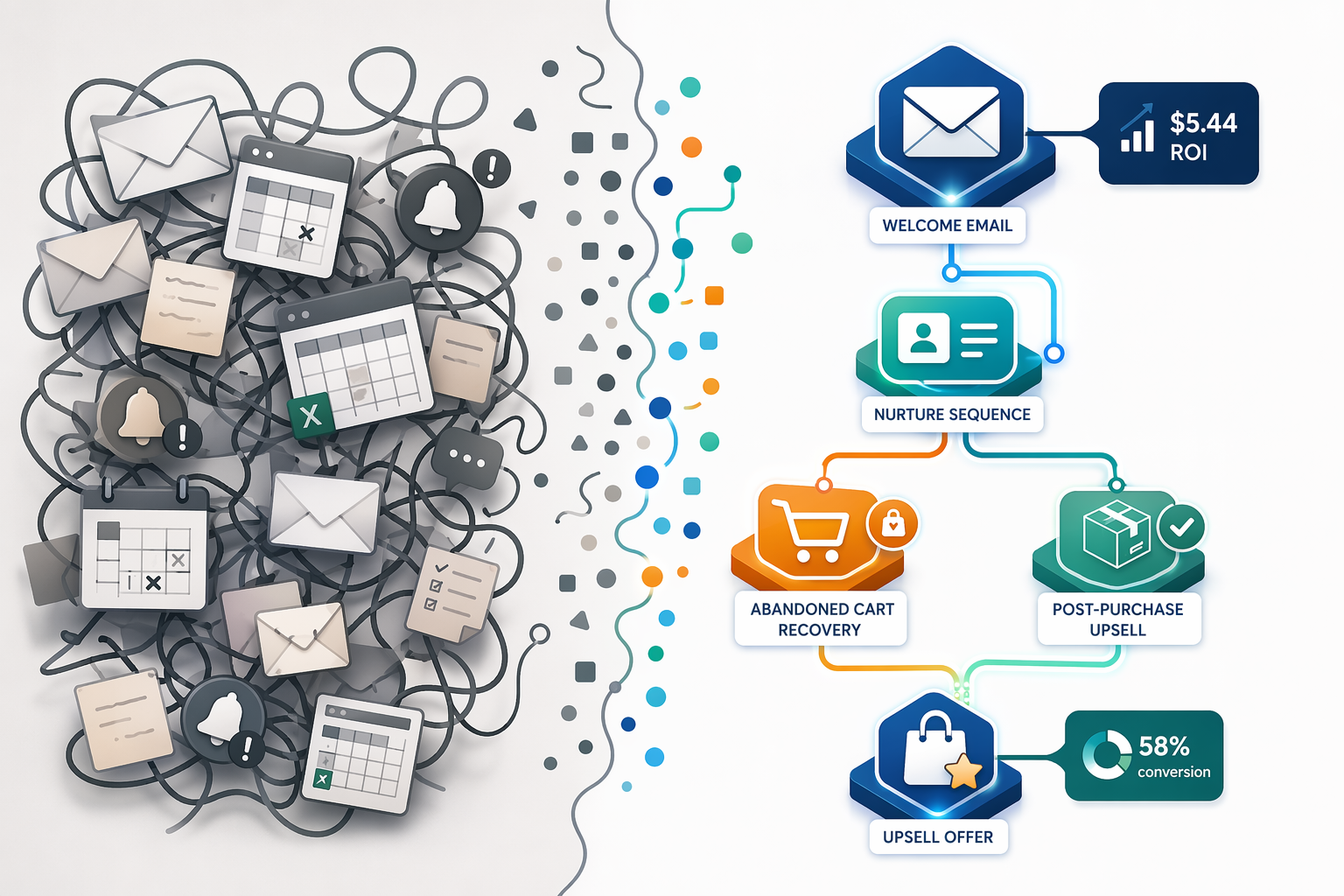
The $5.44 ROI Reality: Why Workflow Type Matters More Than Platform
Marketing automation programs return an average of $5.44 for every dollar spent, according to Forrester Wave benchmarking. That headline figure sounds impressive, but it masks a wide gulf in performance. Top-quartile programs achieve $8.71 per dollar, driven by tighter CRM integration, multi-touch attribution, and AI-assisted segmentation. Bottom-quartile programs — often running legacy batch-and-blast campaigns — manage only $1.92 per dollar.
The platform you choose matters, but it is not the primary determinant of that ROI gap. What separates the $8.71 programs from the $1.92 programs is which workflows you build and how deeply you integrate them with your data infrastructure. A well-configured welcome series on a mid-tier platform will outperform a poorly segmented multi-channel campaign on an enterprise suite every time.
This playbook profiles eight specific workflow types — welcome series, abandoned cart, lead nurture, post-purchase, re-engagement, price-drop alerts, upsell/cross-sell, and feedback collection — with per-workflow benchmark data, trigger structures, and the integration checklist that explains why some programs earn four times more than others. If you already have automation software and need to justify the investment or improve its output, these are the workflows to audit first.
8 Marketing Automation Workflow Profiles: Triggers, Structure, and Benchmarks
The eight workflows below are organized by their typical ROI impact, but every business should evaluate them against its own customer lifecycle. Each profile includes the trigger event, the conditions that activate it, an example sequence structure, and benchmark data drawn from Klaviyo's 2024 Benchmark Report and Omnisend's 2025 Report. Industry-specific variations are noted where the data supports them.
| Workflow Type | Trigger Event | Avg. Revenue Per Recipient | Top 10% Revenue Per Recipient | Click-to-Convert Rate |
|---|---|---|---|---|
| Welcome Series | New subscriber or account creation | $2.65 | $21.18 | 58.26% |
| Abandoned Cart | Cart abandonment with items remaining | $3.65 | $28.89 | 42.02% |
| Lead Nurture | Lead capture or score threshold | N/A (MQL-to-SQL lift) | N/A | 4.5% CTR (standard) |
| Post-Purchase | Purchase completion | N/A | N/A | 4.9% CTR |
| Re-engagement | Inactivity threshold | N/A | N/A | 5.2% CTR |
| Price-Drop / Inventory | Stock replenishment or price change | N/A | N/A | N/A |
| Upsell / Cross-Sell | Purchase completion + product affinity | N/A | N/A | N/A |
| Feedback Collection | Post-interaction timing | N/A | N/A | N/A |
Welcome Series: The Highest-Converting Workflow You're Probably Underinvesting In
The welcome series is the single highest-converting automation type by click-to-convert rate. Omnisend's 2025 Report puts that rate at 58.26% — meaning more than half of the people who click through a welcome email complete the desired action, whether that is a first purchase, a demo booking, or a content download. The average revenue per recipient is $2.65, but top-decile programs pull in $21.18 per recipient.
The trigger is straightforward: a new subscriber joins your list or a new account is created. The conditions that improve performance include source-based segmentation (did they sign up via a blog post, a landing page, or a checkout pop-up?) and timing (the first email should send within minutes of the trigger). A typical 3-to-5 email sequence might look like this:
- Email 1: Immediate confirmation of the subscription or account, set expectations for what the subscriber will receive, and deliver the promised lead magnet or discount.
- Email 2 (Day 1-2): Introduce your brand story, mission, or the problem you solve. Include a social proof element — testimonial, case study, or review snippet.
- Email 3 (Day 3-4): Highlight your most popular product or service with a clear CTA. Use behavioral data if available — show items similar to what they browsed before signing up.
- Email 4 (Day 5-7): Offer a time-limited incentive or a second content piece. This is the final push before the subscriber moves to a standard nurture track.
- Email 5 (Day 7-10): If no engagement, transition to a re-engagement or sunset workflow. If engaged, move to a post-purchase or upsell sequence.
Industry variation is significant. Sporting goods brands see a 57.63% open rate on welcome workflows, while food and beverage hits 55.52% and automotive reaches 55.1%. On the revenue side, automotive leads at $6.29 per recipient, followed by hardware and home at $5.70 and sporting goods at $4.47. If you operate in one of these verticals, the welcome series is likely your highest-ROI workflow.
| Industry | Welcome Workflow Open Rate | Revenue Per Recipient |
|---|---|---|
| Sporting Goods | 57.63% | $4.47 |
| Food & Beverage | 55.52% | N/A |
| Automotive | 55.10% | $6.29 |
| Hardware & Home | N/A | $5.70 |
Abandoned Cart: Where the Revenue Multiplier Lives
If the welcome series is the highest-converting workflow, abandoned cart is the highest-revenue workflow. The top 10% of programs generate $28.89 per recipient from abandoned cart emails, according to Klaviyo's 2024 Benchmark. The average is $3.65 per recipient — still higher than any other workflow type except the top-decile welcome series.
The trigger is a cart abandonment event: a user adds items to their cart but does not complete the purchase within a defined window (typically 15 minutes to 1 hour). Conditions that improve performance include item value thresholds (trigger only for carts above a minimum value to avoid low-value recovery costs), time-of-day send optimization, and inventory scarcity signals. A standard 2-to-3 email sequence looks like this:
- Email 1 (1 hour after abandonment): Friendly reminder with a clear image of the abandoned items, a direct link back to the cart, and a brief value proposition (free shipping, return policy).
- Email 2 (12-24 hours after abandonment): Add social proof — how many people have purchased this item recently, or a customer review. Consider a small incentive (10% off, free gift) if the cart value is high.
- Email 3 (48-72 hours after abandonment): Scarcity message — low stock warning or price-drop alert if applicable. If no response, move the contact to a browse abandonment or re-engagement workflow.
Industry variation is pronounced. Automotive leads abandoned cart revenue at $9.86 per recipient, followed by hardware and home at $9.63 and sporting goods at $6.73. The click-to-convert rate for abandoned cart workflows is 42.02%, making it the second-highest converting workflow type after welcome series.
Lead Nurture: The 38% MQL-to-SQL Lift That Scales With AI
Lead nurture workflows are the backbone of B2B marketing automation. Organizations running nurture sequences with lead scoring and behavioral triggers see MQL-to-SQL conversion rates 30 to 50 percent higher than teams using batch-and-blast email, with a median lift of 38%, per Marketo benchmark data. When AI intent signals are layered on top of standard lead scoring, that lift reaches 62%.
The trigger is typically a lead capture event (form submission, content download, webinar registration) or a lead score threshold crossing. Conditions include demographic fit (industry, company size, role) and behavioral signals (pages visited, time on site, email engagement). A standard B2B nurture sequence might include:
- Email 1 (immediate): Deliver the requested content and introduce a related resource. Set the expectation for the nurture cadence.
- Email 2 (Day 3): Case study or customer story relevant to the lead's industry or role. Include a clear next step — schedule a demo, read a comparison guide.
- Email 3 (Day 7): Educational content that addresses a common objection or pain point. Use personalization tokens for company name and role.
- Email 4 (Day 14): Direct sales offer — free consultation, trial extension, or personalized demo. This email should have a strong, single CTA.
- Email 5 (Day 21): Re-engagement or sunset. If the lead has not engaged after 4-5 touches, move to a lower-frequency nurture track or a re-engagement workflow.
The difference between triggered nurture sequences and batch-and-blast campaigns is stark. Triggered nurture sequences see a 28% open rate and 4.5% CTR, while batch-and-blast email baseline is 20% open rate and 2.6% CTR. That 40% improvement in CTR alone justifies the investment in automation infrastructure.
| Nurture Approach | Open Rate | CTR | MQL-to-SQL Lift |
|---|---|---|---|
| Batch-and-Blast Email | 20% | 2.6% | Baseline |
| Triggered Nurture (Standard) | 28% | 4.5% | 38% median |
| Triggered Nurture + AI Intent Scoring | N/A | N/A | 62% |
Post-Purchase, Re-engagement, Price-Drop, Upsell, and Feedback Workflows
The remaining five workflow types cover the post-conversion and retention stages of the customer lifecycle. Each serves a distinct purpose, and together they form the foundation of a mature automation program.
Post-Purchase Workflow
Triggered by a completed purchase, the post-purchase workflow confirms the order, sets delivery expectations, and begins the relationship-building process. Benchmark data shows a 29% open rate and 4.9% CTR. A strong post-purchase sequence reduces buyer's remorse, encourages repeat purchases, and collects reviews or referrals. Include order confirmation, shipping updates, usage tips, and a review request spaced over 7-14 days.
Re-engagement Workflow
Triggered by an inactivity threshold — typically 60 to 90 days without email open, site visit, or purchase. Re-engagement emails show a 31% open rate and 5.2% CTR, making them one of the most effective workflows for recovering dormant contacts. The sequence should start with a gentle reminder of the value you offer, escalate to an incentive, and end with a clear unsubscribe option for contacts who do not respond. This keeps your list healthy and your deliverability metrics accurate.
Price-Drop and Inventory Alert Workflow
Triggered by a stock replenishment event or a price change on a product the contact has viewed, added to a wishlist, or previously abandoned. This workflow is particularly effective in eCommerce verticals with high price sensitivity — electronics, fashion, and home goods. The email should be immediate and include a direct link to the product page. No benchmark data is available for this workflow type specifically, but it typically outperforms broadcast promotional emails because it is triggered by expressed interest.
Upsell and Cross-Sell Workflow
Triggered by a purchase completion combined with product affinity rules. If a customer buys a camera, the upsell workflow recommends a lens kit or a tripod. If they buy a SaaS starter plan, the cross-sell workflow introduces the professional tier or an add-on module. Timing matters — send the recommendation 3-7 days after the initial purchase, when the customer has had time to experience the core product but is still in an engagement window. Product affinity rules should be based on actual purchase data, not manual categorization.
Feedback and Zero-Party Data Collection Workflow
Triggered by a post-interaction timing window — after a purchase, after a support ticket is closed, or after a content download. This workflow collects reviews, Net Promoter Score (NPS) responses, and preference data. In 2026, zero-party data collection has become a defining competitive advantage in eCommerce automation, as third-party cookies continue to degrade and privacy regulations tighten. A well-designed feedback workflow asks for one piece of information per email, keeps the survey to 2-3 questions, and offers a small incentive for completion. The data collected feeds back into segmentation and personalization models, creating a virtuous cycle.
The Integration Checklist: What Separates $8.71 Programs From $1.92 Programs
The $6.79 gap between top-quartile and bottom-quartile ROI is not random. It correlates with three specific integration variables that determine whether a workflow program delivers compounding returns or diminishing results.
| Integration Variable | Bottom-Quartile Approach | Top-Quartile Approach | Impact on ROI |
|---|---|---|---|
| Segmentation Depth | Flat lists with basic demographic filters | Concentric layered segments combining behavioral, demographic, and predictive data | Top-quartile programs see 3-4x higher revenue per recipient |
| CRM Integration | Disconnected systems with manual data syncs or CSV uploads | Bidirectional real-time sync between marketing automation and CRM | Enables multi-touch attribution and closed-loop reporting |
| AI Intent Scoring | Static lead scoring based on demographic fields only | Predictive models analyzing behavioral signals, content engagement, and intent data | 62% MQL-to-SQL lift vs. 38% without AI |
Comments
Join the discussion with an anonymous comment.