
The first money argument after marriage often does not sound like a money argument. It sounds like, “Wait, I thought you paid that.” Or, “Why did this come out of my account?” Or, “Can you send me your half before the card autopay hits?” Two capable adults can love each other, earn enough to cover the bills, and still end up running their household like a group project with no owner, no checklist, and no deadline.
That is the practical answer to how to manage joint finances after marriage: stop treating shared money as a recurring conversation you are supposed to remember, and start treating it as a household workflow. The system needs three layers: an account structure that makes ownership visible, automated money movement that removes low-value coordination, and a monthly review ritual where judgment calls have a scheduled place to land.

The friction is common enough that it should not be treated as a character flaw. Mercury’s 2026 Modern Love report says 73% of couples experience some degree of financial misalignment with their partners.[1] An AICPA survey cited by Tiller found that 69% of married or cohabitating adults disagreed over financial decisions in the last year, and 26% said disagreements happen at least monthly.[2] Penny Hoarder’s 2026 Financial Anxiety Barometer found that 1 in 3 Americans say financial stress has led to arguments with their significant other.[3]
Those numbers do not prove that every couple needs the same setup. They do show why “we’ll just be better about talking” is a fragile control layer. A shared life creates repeated transactions, repeated decisions, and repeated exceptions. If the process lives only in one person’s memory, that person becomes the finance department by default.
Start with the account structure, not the app
Before choosing a budgeting app, decide what kind of financial operating model you are actually running. The account structure determines who sees what, where bills pull from, how savings goals are funded, and whether income differences are handled openly or quietly patched over every month.
There is some evidence in favor of pooling. A 2023 Journal of Consumer Research study, discussed by NPR, found that couples who pool all their money into joint accounts tend to be happier and stay together longer.[4] That is stronger evidence than a preference survey, but it is still not a universal command. Debt history, prior financial stress, family obligations, immigration logistics, business ownership, and income gaps can all make full pooling emotionally or operationally harder.
Most couples are not choosing between total merger and total separation anyway. Bankrate data cited by New York Life says only 27% of couples keep completely separate accounts, while 34% keep at least one separate account while sharing others.[5] In practice, many households are hybrids. The useful question is not “Are we doing marriage correctly?” It is “Can our setup answer the same routine questions the same way every month?”
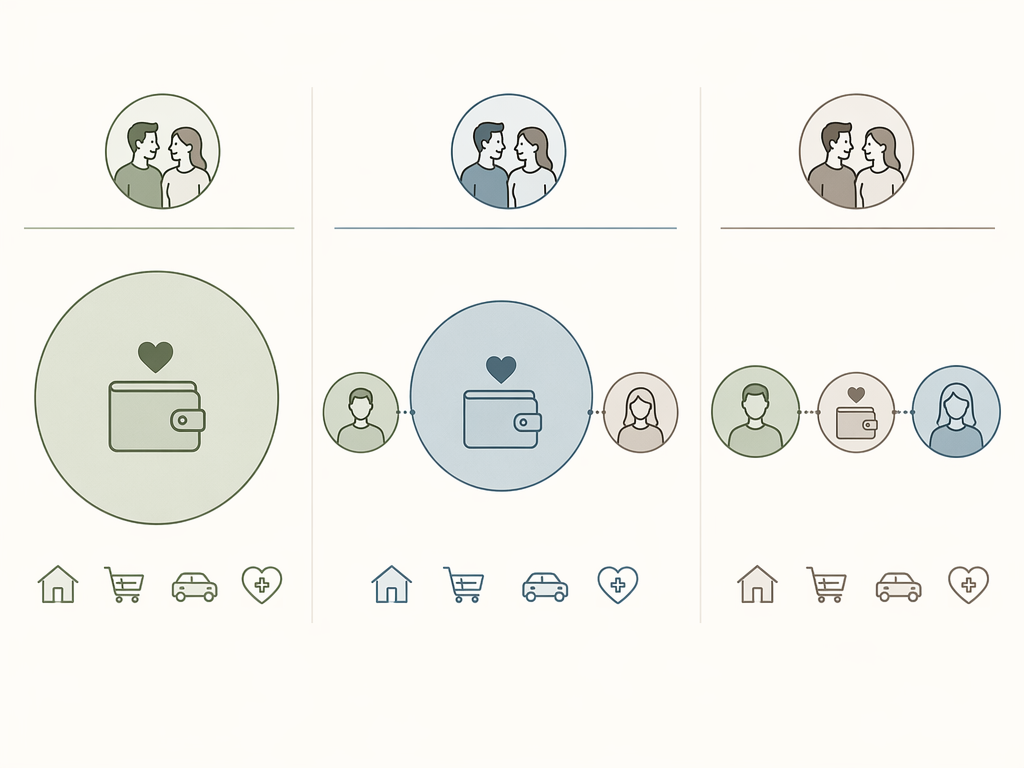
| Account model | How it works | Best fit | Watch for |
|---|---|---|---|
| Fully joint | Income flows into shared accounts; bills, savings, and spending are managed from the same pool. | Couples who want maximum transparency and are comfortable making most money decisions together. | Personal spending can feel over-scrutinized unless each person has agreed discretionary money. |
| Proportional hybrid | Each partner keeps an individual account and contributes to shared bills or savings by a percentage, often based on income. | Couples with income differences, existing obligations, or a desire for both shared responsibility and personal autonomy. | The contribution formula needs a review trigger when income, debt, rent, childcare, or benefits change. |
| Separate with shared budget | Partners keep mostly separate accounts but use a shared plan, tracker, or bill calendar to coordinate household costs. | Couples who need separation for practical or emotional reasons but still want a clear household operating plan. | Invisible labor can creep in if one person becomes the only reconciler, reminder-setter, and exception-handler. |
The fully joint model is the cleanest from a workflow perspective because there are fewer internal transfers to remember. Paychecks land, bills leave, savings transfers run, and both people can see the same reality. It can also surface every purchase, which may be helpful for planning and uncomfortable for privacy. A small personal allowance for each partner, even inside an otherwise joint system, often prevents the shared account from becoming a permission system.
The proportional hybrid model is usually better than a casual 50/50 split when incomes differ. The key is to define the rule before the bill is due. For example, a couple might decide that shared expenses are funded according to each partner’s share of household income. That example is hypothetical, and the exact formula matters less than the habit: write the rule down, automate the transfers, and revisit it when the underlying facts change.
Separate with a shared budget can work, but it needs more explicit process. Someone has to maintain the bill list. Someone has to know which account each bill pulls from. Someone has to check whether reimbursements happened. If that “someone” is always the same person, the system may look independent while still depending on one partner’s unpaid project management.
This is where a household finance setup starts to look like any other personal workflow system: capture the recurring obligations, process them into clear owners and dates, and automate what should not require a fresh decision.
Turn the structure into automatic money movement
Once the account model is clear, automation can do useful work. If the structure is vague, automation just makes confusion faster. A rent transfer that runs automatically from the wrong account still creates stress. A card autopay that one person cannot see still leaves room for the same “did you pay that?” conversation.
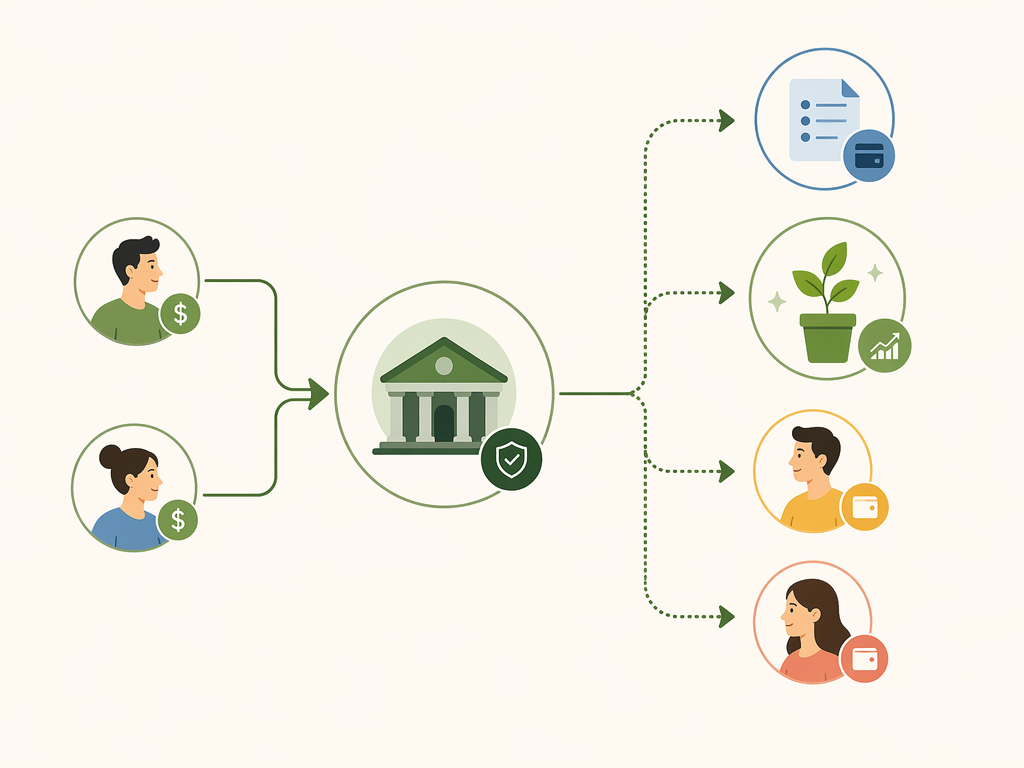
The automation layer should answer five recurring questions without a meeting:
- Where does income land first?
- Which account pays fixed bills?
- When do shared savings transfers happen?
- How does each person receive discretionary money?
- Who gets alerts when something fails, increases, or renews?
For a fully joint setup, the flow might be simple: paychecks go into the joint checking account, fixed bills autopay from that account, savings transfers run shortly after payday, and each partner gets a recurring personal spending transfer. For a proportional hybrid, paychecks may stay separate while each partner sends an automatic contribution to the shared bills account. For separate-with-shared-budget, the most important automation may be calendar reminders, shared tracker updates, and recurring reimbursements.
A Business Insider case study of a millennial couple who automated their money describes the practical win well: automation eliminated the routine “did you pay that?” friction and shifted conversations toward bigger decisions and dreams.[6] That is the point. Automation is not there to make a couple avoid money. It is there to stop wasting attention on transactions that should already have a path.
A useful build order looks like this:
- List every recurring bill, renewal, debt payment, subscription, insurance premium, and expected transfer.
- Assign one payment account to each item, even if both partners fund that account.
- Set autopay for stable bills where the due date and amount are predictable.
- Schedule transfers after income arrives, not before, so the system survives normal timing delays.
- Create alerts for low balances, failed payments, large transactions, annual renewals, and variable bills.
- Put exceptions into a shared task list instead of handling them through scattered texts.
The order matters. A shared card autopay should not be enabled until both people know which account funds it and what happens if the balance is short. A savings transfer should not be judged as a failure if it was scheduled before the second paycheck of the month arrives. A bill reminder should go to the person who can act on it, not merely to the person who historically worries first.
This is also a good place to keep the tool stack lean. One banking platform, one shared tracker, and one shared calendar or task manager may be enough. If you already tend to overbuild systems, a digital minimalism productivity setup is a useful constraint: add tools only when they remove a recurring decision or make ownership clearer.
What should be automated, and what should stay manual
| Automate | Keep visible |
|---|---|
| Fixed bills with predictable amounts | Variable bills that need a quick review before payment |
| Recurring transfers to shared savings | Large one-time purchases or withdrawals |
| Direct deposit splits or scheduled household contributions | Income changes, bonuses, job loss, or irregular cash flow |
| Low-balance and renewal reminders | Decisions about changing goals, pausing transfers, or taking on new debt |
Good automation lowers the number of times a couple has to coordinate. It should not lower visibility. Both partners should know which automations exist, where to find them, and what would happen if a paycheck is late or a bill jumps.
Choose tools after the workflow is already sketched
Budgeting tools are useful when they match the account model. They are frustrating when they force a couple into a structure they never agreed to. The app should reflect the operating model, not become the operating model.
Monarch Money, YNAB, Tiller, and Honeydue all show up often in couple-budgeting conversations, but they solve different workflow problems. Monarch Money is often positioned as a broad shared financial dashboard; Origin Financial’s 2026 guide lists Monarch at $14.99 per month or $99.99 per year, though current pricing should be checked because app pricing changes.[9] YNAB tends to fit couples who want an active zero-based budgeting process. Tiller is better for spreadsheet people; Tiller cites an Inc Magazine finding that 89% of people feel more in control of their money when tracking it with a spreadsheet versus other tools.[2] Honeydue is built around partner visibility and shared bill tracking.
| If your system needs... | Consider... |
|---|---|
| One shared dashboard across many accounts | Monarch Money or a similar aggregator |
| Active category planning and frequent budget decisions | YNAB or a similar envelope-style budgeting tool |
| Spreadsheet control, formulas, and custom reporting | Tiller or a shared spreadsheet workflow |
| Simple partner visibility for bills and balances | Honeydue or a lightweight shared finance app |
The selection test is practical: can both people understand the tool in five minutes, and will the person who currently does less finance admin actually use it? If the answer is no, the tool may be elegant but still increase the workload of the partner who already carries the system.
Couples with different planning styles should not force themselves into the most sophisticated option just because it has better reporting. A system that fits your actual behavior is usually more durable than one that flatters your ideal self. The same logic applies to broader productivity choices: the method has to match the people using it, not just the category it belongs to.
Use a monthly review to catch what automation cannot
Automation handles repetition. It does not handle meaning. A higher insurance premium, a new family obligation, a partner’s anxiety about debt, or a quiet feeling that spending has drifted needs a conversation with a beginning and an end.
The CFP Board’s February 2026 guide recommends quarterly financial check-ins using a five-step framework.[7] Quarterly may be enough for some established couples. Right after marriage or a move-in, monthly is usually more forgiving because the system is still revealing its weak spots. The Gottman Institute also frames structured financial conversations early in a relationship as linked with higher satisfaction over time, though its article presents that as a broad research-based claim rather than a single cited study.[8]
A 30-minute monthly money date does not need to become a budget summit. Put it on the calendar, keep the agenda stable, and stop when the decisions are captured.
- What changed? Income, bills, due dates, balances, benefits, debt, family requests, subscriptions, or upcoming travel.
- What surprised either of us? A charge, a feeling, a missed payment, a category that ran high, or a transfer that felt too aggressive.
- What needs a decision? A purchase, goal tradeoff, account change, debt priority, savings pause, or contribution adjustment.
- What should we adjust? Autopay dates, transfer amounts, alerts, owners, categories, or the next review date.
The review works best when it produces small system edits. If the electric bill rose, change the monthly transfer. If one partner keeps missing reimbursement requests, replace reimbursements with a scheduled contribution. If an annual subscription caused irritation, add a renewal alert one month before it hits. The goal is not to prove who was right; it is to remove the same failure from next month’s calendar.
Some conversations will not fit neatly inside a workflow. Debt from before the marriage, unequal earning power, financial secrecy, family pressure, and past instability can make shared money feel loaded before a spreadsheet ever opens. A tidy system can make responsibilities clearer, but it cannot manufacture trust by itself. If the review keeps circling the same unresolved fear, the next useful step may be a deeper conversation or professional support, not another automation rule.
A working rhythm for the first 90 days
For the first three months, treat the system as a pilot. Do not try to perfect every category or forecast every exception. Build enough structure that bills clear, savings has a path, both people can see what is happening, and changes have somewhere to go.
| When | What to do |
|---|---|
| Week 1 | Choose the account model, list recurring obligations, and decide which account pays each bill. |
| Week 2 | Set up direct deposit splits, recurring contributions, bill autopay, savings transfers, and core alerts. |
| Week 3 | Choose the lightest shared tracker that matches the model, then add only the accounts and categories you need. |
| End of Month 1 | Hold the first 30-minute review and fix timing problems, missing bills, unclear owners, or transfer amounts. |
| End of Month 2 | Review surprises and decide whether the account structure still fits real behavior. |
| End of Month 3 | Lock in the pieces that worked, remove tools nobody uses, and set the next three monthly review dates. |
The system is doing its job when fewer routine questions require a conversation, not when money never feels complicated. Bills still change. Priorities still compete. One month will be busier than expected. The difference is that the household no longer depends on one person noticing everything in time.
References
- How to Merge Finances, Mercury, 2026, https://mercury.com/blog/how-to-merge-finances
- Best Budget App for Couples, Tiller, https://tiller.com/best-budget-app-for-couples/
- Best Budgeting Apps for Couples, The Penny Hoarder, 2026, https://www.thepennyhoarder.com/budgeting/best-budgeting-apps-couples/
- How to combine finances with your partner, NPR, July 1, 2024, https://www.npr.org/2024/07/01/g-s1-7478/how-to-combine-finances-with-your-partner
- Everything about combining finances, New York Life, https://www.newyorklife.com/articles/everything-about-combining-finances
- Millennial couple benefits of automating money, Business Insider, December 2020, https://www.businessinsider.com/millennial-couple-benefits-of-automating-money-2020-12
- Financial Check-In for Couples, CFP Board, February 2026, https://www.letsmakeaplan.org/financial-topics/articles/planning-for-couples/financial-check-in-for-couples
- Combining Finances and Responsibilities: A Complete Guide for Couples, Gottman Institute, https://www.gottman.com/blog/combining-finances-and-responsibilities-a-complete-guide-for-couples/
- 10 Best Budgeting Apps for Couples in 2026, Origin Financial, 2026, https://useorigin.com/resources/blog/10-best-budgeting-apps-for-couples-in-2026
Comments
Join the discussion with an anonymous comment.