
A kids' farm stand looks like a cute summer activity from the sidewalk. From the parent's side of the table, it can also be a small, contained productivity project: choose a goal, define the work, prepare the materials, show up, handle feedback, count the result, and decide what to change next time.
That distinction matters. This is not a farm-business guide for children, and it should not be treated as one. Lemonade Day's youth entrepreneurship curriculum gives the cleaner frame: a four-week sequence of planning, preparing, launching, and reflecting, described as field-tested with thousands of children nationwide. It also places the startup cost for simple child-run business ideas in the $10 to $25 range, which keeps the project low-stakes enough to stay playful. [1]
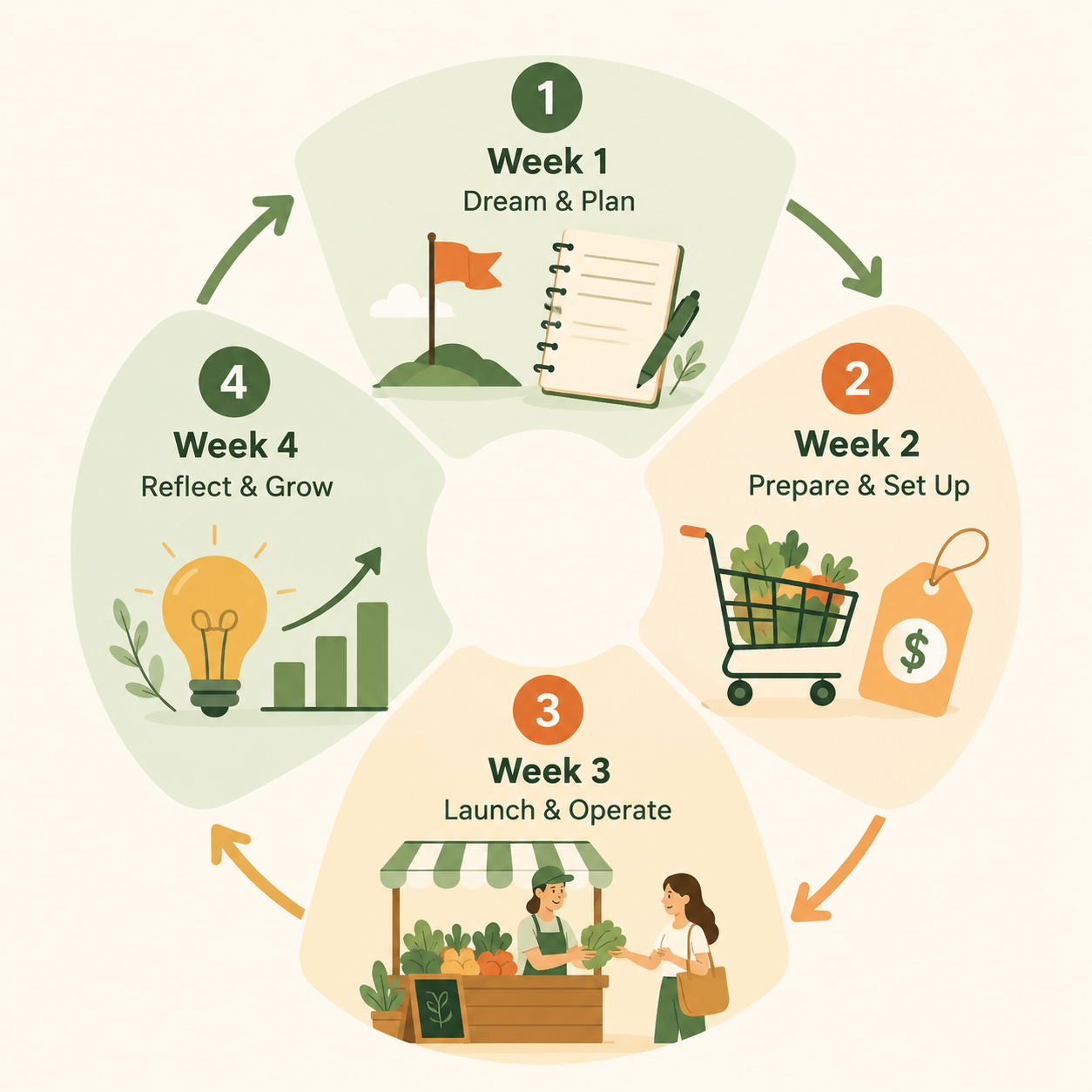
The productivity value comes from the loop, not the produce. A child who sells cucumbers for one Saturday has practiced more than selling cucumbers if they helped decide the goal, made a price sign, noticed a slow hour, answered a neighbor's question, counted back change, and said what they would do differently next time.
| Week | Child's Main Job | Parent's Background Job |
|---|---|---|
| Week 1: Dream & Plan | Pick one goal, choose what to sell, ask what people might buy, define what "done" means | Keep the scope small and help turn ideas into next actions |
| Week 2: Prepare & Set Up | Gather supplies, set prices, make signs, practice money and customer scripts | Check safety, math, permissions, and the cash setup |
| Week 3: Launch & Operate | Run the stand, talk to customers, restock, make change, track sales | Stay nearby without taking over |
| Week 4: Reflect & Grow | Count money, calculate costs, name lessons, choose one change | Help review the project without turning it into a grading session |
Week 1: Make the Goal Small Enough to Finish
The first week is where the project becomes productive instead of merely busy. Lemonade Day's planning stage starts with goal-setting and market research, which is exactly the right order for a child-sized stand: first decide what the project is for, then decide what work belongs inside it. [1]
A useful goal is concrete but not inflated. "Earn spending money" is fine, but it is easier to work with if the child chooses a visible target: sell ten bunches of herbs, save for one toy, donate part of the money, or run the stand for two hours without quitting early. The goal should fit on a single index card. If it needs a dashboard, it is probably an adult goal wearing a child's handwriting.
Then comes the smallest possible market research. A child can ask three neighbors, relatives, or family friends what they might buy from a backyard stand: tomatoes, cucumbers, flowers, lemonade, eggs, herbs, or a mixed basket. The point is not to produce statistically meaningful data. The point is to practice looking outward before making a plan.
- What are we selling?
- Who might buy it?
- What will it cost us to start?
- How will we know the stand is finished for the day?
- What will we do with the money?
That last question is more useful than it looks. A stand with no finish line can drift into parent-managed activity. A stand with a clear end condition teaches the shape of a project: it starts, it has constraints, it ends, and then someone reviews it.
KidsGardening's school farmers' market resource describes students planning, planting, calculating, designing, and promoting produce, with growth described socially, academically, and personally. Its specific skill examples include budgeting, pricing, making change, customer interaction, and product description. [2] Those are not abstract business outcomes. They are observable behaviors a parent can watch from a folding chair.
The parent job in Week 1 is mostly subtraction. Remove products that require too much handling, locations that need complicated permission, and goals that turn one sunny table into a family logistics department. If the child is young, the parent may write the plan while the child dictates. If the child is older, the parent can ask clarifying questions and resist the urge to make the plan prettier.
Define "done" before buying anything
A child-friendly definition of done might be: the sign is made, the table is ready, prices are written, change is in the cash box, and we will be open from 10 a.m. to noon on Saturday. This prevents the project from expanding every time someone has a new idea. Painted rocks, recipe cards, flower bundles, and homemade cookies may all be charming. They do not all need to be in the first launch.
Week 2: Prepare the Stand Without Taking It Over
Week 2 turns the goal into materials: table, sign, prices, product, bags or baskets, cash box, and a simple way to record sales. Lemonade Day places budgeting, pricing, and marketing in this preparation phase. [1] For a farm stand, that means the child sees that "open a stand" is not one task. It is a cluster of next actions.
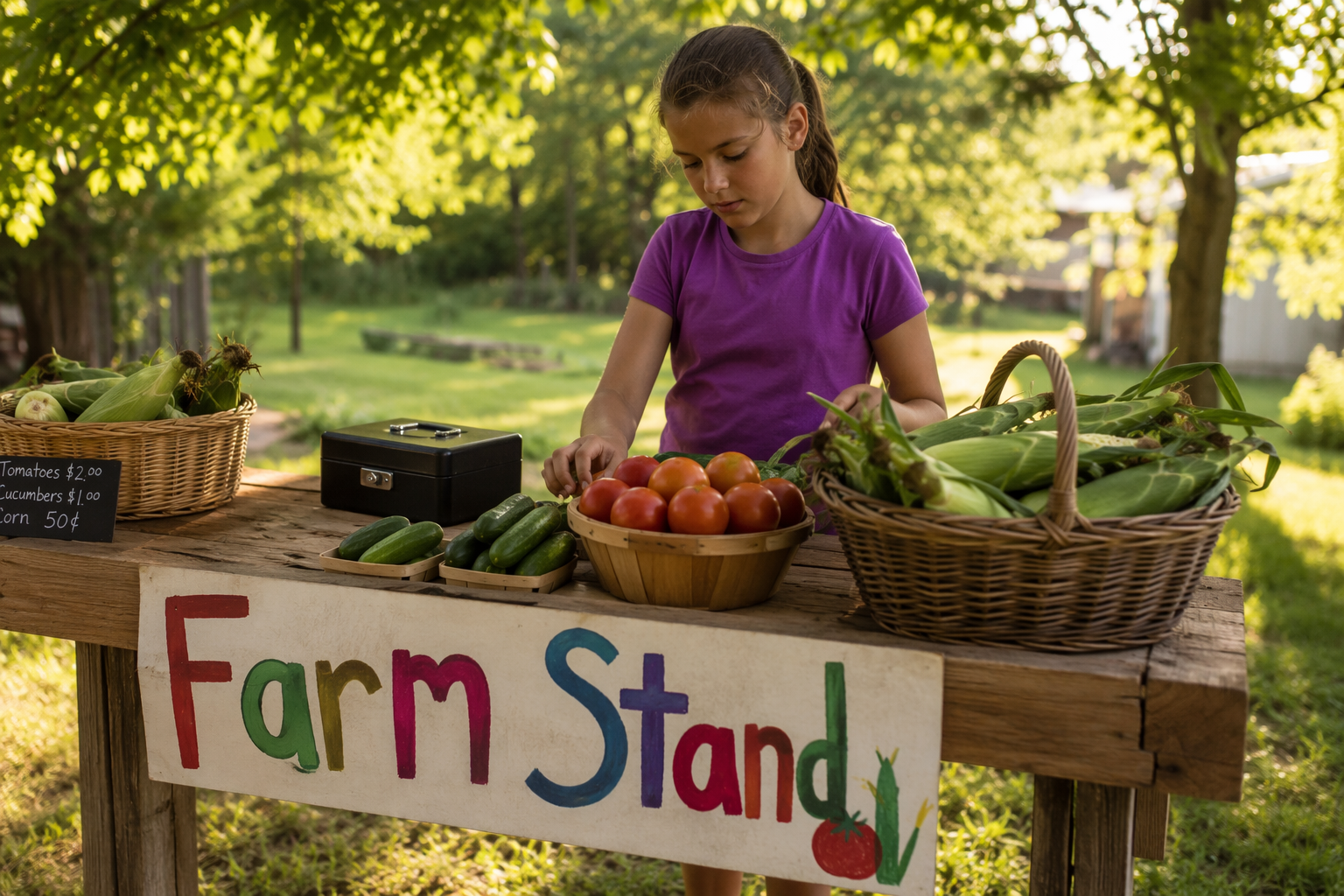
This is where the project can accidentally become a parent performance piece. The sign does not need adult lettering. The basket labels do not need to look like a boutique grocer. A wobbly "Cucumbers 50 cents" sign that the child can explain is better than a perfect sign the child watched someone else make.
Preparation should cover three practical areas.
- Money: choose simple prices, prepare small bills and coins, and practice counting back change.
- Display: decide what goes where, how much product to show at once, and what an empty-looking table should trigger.
- Words: practice a greeting, a product description, and one calm response if someone says no.
The display piece is easy to underestimate. In The Survival Mom's account of running a farmers market booth with her children over multiple summers, one of the lessons was noticing visual gaps in the display and filling them. The same account also describes children learning to identify a product and customer, talk professionally, qualify a sale, make change, manage inventory, do basic accounting, accept tips graciously, and handle upset customers. [3]
For a child's backyard version, "inventory management" may only mean noticing that the tomato basket is empty and bringing out five more tomatoes. That is enough. The skill is noticing the state of the system and taking the next appropriate action.
Rodale Institute's farm stand lessons, drawn from a vendor who started at age 9, also emphasize pricing strategy, visual merchandising, customer communication, and record-keeping. The article was originally published in 2004, so any old pricing examples should be treated as dated, but the operating principles still fit a child's stand well. [4]
Keep the budget visible
A $10 to $25 starting budget is useful because it creates real constraints without making the child responsible for meaningful household money. [1] Write the costs where the child can see them: poster board, marker, paper bags, change for the cash box, maybe a small basket or tablecloth if those are not already at home.
If the family already owns the table, baskets, and markers, still name them as borrowed supplies. Children do not need formal depreciation schedules. They do benefit from understanding that projects use resources, even when nobody swipes a card that morning.
Week 3: Launch, Then Let Reality Interrupt the Plan
Launch week is the part children usually imagine first: the table is outside, the sign is visible, and someone might actually stop. Lemonade Day's launch phase includes daily operations, sales, and customer interaction. [1] For a farm stand, the learning often arrives in small, slightly awkward moments.
A neighbor asks, "Are these from your garden?" The child has to answer. Someone wants two cucumbers but only has a larger bill. The child has to make change or ask for help. The display looks picked over after the first few sales. The child has to restock. Nobody comes for twenty minutes. The child has to wait without abandoning the stand.
This is also where the parent needs a job description. Be nearby for safety, money mistakes, food-handling judgment, and uncomfortable interactions. Do not become the salesperson unless the child asks for support or the situation requires it. A parent who answers every customer question has made the stand smoother and less useful.
The record-keeping can stay simple: one tally mark per item sold, a note for tips, and a quick mark for anything given away or spoiled. Rodale's emphasis on record-keeping is worth keeping at child scale here. [4] A seven-year-old may use pictures or hash marks. A teenager may track item, price, quantity, and total. The important part is that the sale does not disappear the moment the money enters the box.
| Moment at the Stand | Productivity Skill Practiced |
|---|---|
| A customer asks what tastes best | Describing the product clearly |
| The basket starts looking empty | Noticing status and restocking |
| A buyer changes their mind | Handling feedback without spiraling |
| Someone pays with a larger bill | Making change and slowing down to check |
| Sales are slower than expected | Staying with a time-boxed commitment |
Adult farm stand numbers can be tempting here, and they are mostly a distraction. SmartFarmPilot discusses farmers market profitability with a wide adult-operation range of $100 to $7,000 per day, while GrazeCart cites a $116,015 average from a NOFA 2022 survey. [5][6] Those figures are useful only as a reminder that farm stands can be real enterprises at adult scale. They are not a reasonable benchmark for a child's summer project.
For this project, a slow hour is not a failure if the child stays open, speaks politely, records what happened, and has something concrete to review. That is the difference between an activity that merely occupies time and one that teaches execution.
Week 4: Count the Money, Then Count the Learning
Reflection week is the part most likely to be skipped because the visible event is already over. It is also the part that helps the lesson carry over. Lemonade Day's final phase includes calculating profit and identifying lessons learned. [1] Without that review, the stand becomes a memory. With it, the child gets a reusable loop.
Start with the arithmetic. Count the cash. Subtract startup costs. Separate repayment, savings, spending, and giving if those were part of the original goal. If there were donated supplies, say so plainly. The goal is not to make the profit look impressive; it is to make the result legible.
This is where KidsGardening's math outcomes become very concrete: budgeting, pricing, and making change are not worksheet categories when the child is holding the cash box and checking whether the numbers match the tally marks. [2]
Then ask for observations before advice. Children often notice operational details if adults leave enough quiet for them to say them: the sign was hard to read from the street, the cherry tomatoes sold faster than the large tomatoes, people asked whether the produce was organic, the table looked better when the baskets were full, or the price list needed bigger writing.
- What went better than expected?
- What was harder than expected?
- Which product sold first?
- What question did customers ask more than once?
- What would we change if we opened again?
One change is enough. Add a clearer sign. Start earlier. Bundle herbs. Move the table closer to the driveway. Put the best-looking produce at the front. Practice one sentence about where the vegetables came from. The review should create a next action, not a lecture.
The Survival Mom's family case is useful here because it shows how many lessons appear only after real contact with customers: communicating value, closing the sale, negotiating unusual requests, accepting tips, and handling upset customers. [3] Those are hard to simulate at the kitchen table. A stand gives the child a mild version of public responsibility, with a parent close enough to keep it safe.
A review script that does not feel like school
The review can happen over lemonade, dinner, or while putting the table away. Keep it short enough that the child would be willing to do it again. A simple format works:
- We planned to...
- What actually happened was...
- We earned...
- We spent...
- Next time we would...
If the child wants to stop after one stand, the loop is still complete. If they want to run it again, Week 4 quietly becomes Week 1: choose the next goal, adjust the plan, and launch a better version.
What Parents Should Expect, and What They Should Not
Expect parent labor. Someone has to check local rules, supervise food safety, provide the table, help with money, and prevent a shy child from being overwhelmed. A farm stand is independent work for a child only inside a boundary an adult has made safe.
Expect uneven interest. A child may love making the sign and dislike waiting for customers. Another may enjoy talking but avoid the math. That unevenness is part of the diagnostic value. The project shows which parts of planning, executing, and reviewing feel natural and which parts need scaffolding.
Do not expect academic proof that one backyard stand produces lasting productivity skills. The best available materials here are curriculum frameworks, school garden resources, and lived case accounts, not controlled longitudinal studies. E-seedling frames youth entrepreneurship as a way to build lifelong skills, but that is still a broad entrepreneurship claim, not a guarantee about any one child or any one Saturday. [7]
The safer claim is also the more useful one: a four-week farm stand gives children repeated practice with behaviors that productivity-minded adults already recognize. They define an outcome. They break it into actions. They prepare materials. They operate under real conditions. They review evidence. Then they choose a next change.
That is why the success metric should not be revenue. It should be whether the child completed one honest cycle of choosing a goal, preparing the work, showing up, handling real feedback, and reviewing what happened. The tools are produce, a sign, a cash box, and a short summer deadline. The habit is the same one adults keep trying to practice with cleaner notebooks and more complicated apps.
References
- Business Ideas for Kids, Lemonade Day, https://lemonadeday.org/blog/business-ideas-for-kids
- Digging Deeper: School Farmers' Market, KidsGardening, https://kidsgardening.org/resources/digging-deeper-school-farmers-market/
- 13 Things My Kids Learned From Running a Farmer's Market Booth, The Survival Mom, https://thesurvivalmom.com/kids-learn-business/
- How to Run a Farm Stand: 22 Lessons from a Vendor Who Started at Age 9, Rodale Institute, https://rodaleinstitute.org/blog/how-to-run-a-farm-stand/
- Is Selling at Farmers Markets Profitable?, SmartFarmPilot, https://smartfarmpilot.com/blog/is-selling-farmers-market-profitable
- How Much Does a Farm Stand Make?, GrazeCart, https://grazecart.com/blog/how-much-does-a-farm-stand-make
- 7 Lifelong Skills Kids Learn Through Entrepreneurship, E-seedling, https://eseedling.com/7-lifelong-skills-kids-learn-through-entrepreneurship/
Comments
Join the discussion with an anonymous comment.