
If your focus falls apart in the afternoon, the usual suspects are easy to blame: sleep, coffee timing, motivation, lunch. Sometimes those are real. But if you are doing strategy work, writing, analysis, planning, or fast decision-making in a closed room, the room itself may be part of the problem.
The practical target is simple: keep indoor CO2 below 800 ppm when you want your best cognitive work. That is stricter than the old comfort-oriented idea that anything under 1,000 ppm is broadly acceptable, but it better matches the evidence on focus and complex task performance. A 2024 building-performance synthesis recommends below 800 ppm for optimal cognitive performance, while treating up to 1,000 ppm as acceptable when energy efficiency is prioritized.[1]
That distinction matters. A room can be acceptable for occupancy and still be a poor place to make decisions.

The threshold worth acting on
CO2 is not a productivity metaphor. It is a measurable condition in the room. Outdoor air is typically near the low end of the 400-800 ppm range, while occupied rooms climb as people exhale and ventilation fails to keep up. The useful question is not whether CO2 is “bad” in a general sense. It is when the level becomes high enough that knowledge work starts paying a cognitive tax.
| Indoor CO2 level | Practical reading for knowledge work |
|---|---|
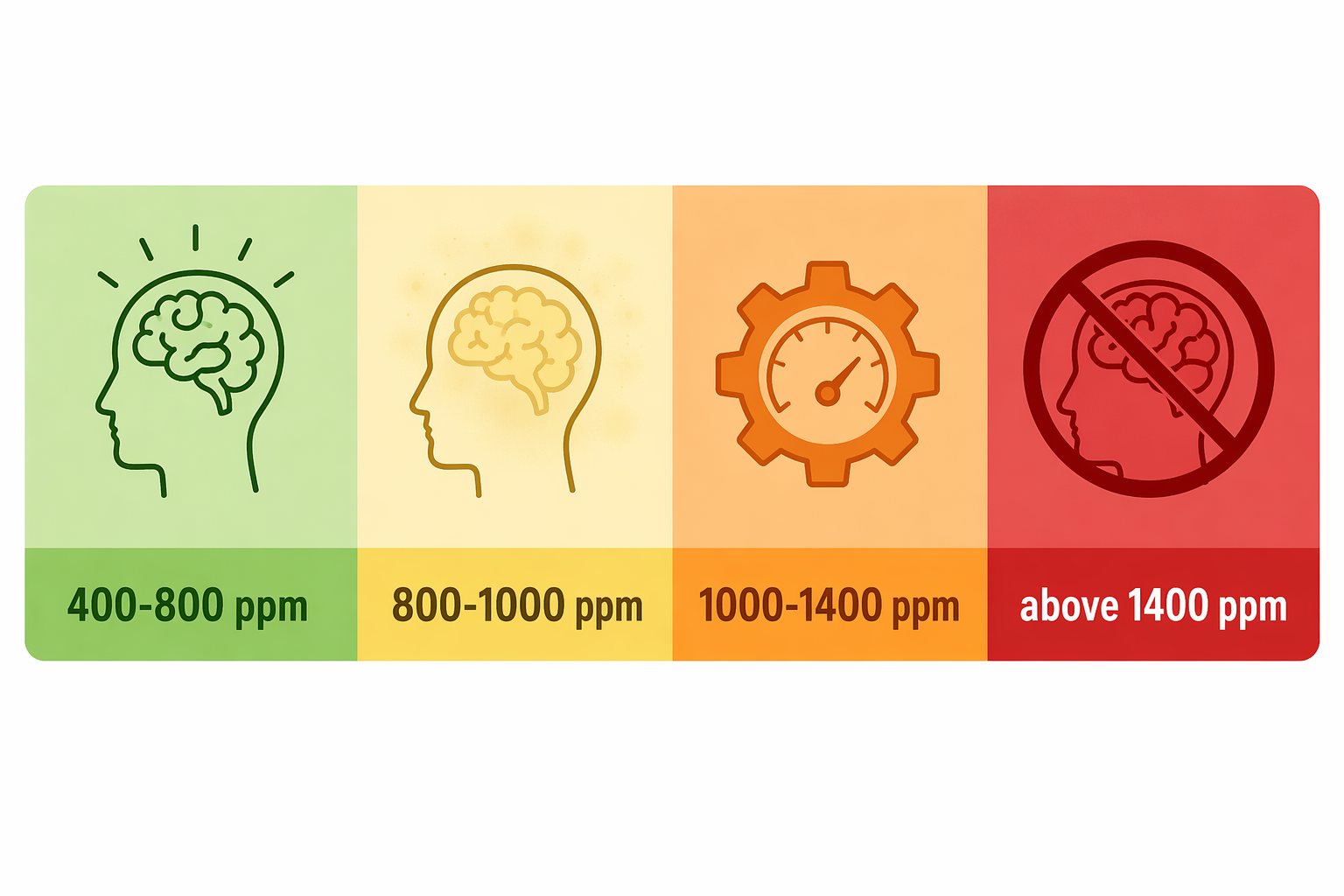
| 400-800 ppm | Best target range for focused work; typical outdoor baseline to low-impact indoor air. |
| 800-1,000 ppm | Marginal range; not an emergency, but no longer ideal for sustained complex work. |
| 1,000-1,400 ppm | Impaired range; evidence shows measurable decline in complex task performance. |
| >1,400 ppm | Significant concern; decision quality, strategic thinking, and throughput deserve stronger attention. |
The 800 ppm target is not a panic line. It is a protective line. Below it, you are giving attention and decision-making a better physical setting. Above it, especially once a room drifts past 1,000 ppm, CO2 becomes one of the variables you should check before assuming the problem is discipline.
What the strongest controlled study found
The clearest threshold evidence comes from Allen et al. 2016, a double-blinded study of 24 professionals exposed to different indoor environmental conditions. When CO2 was about 950 ppm, cognitive scores were 15% lower than at about 550 ppm. At about 1,400 ppm, scores were 50% lower. Across all cognitive domains, a 400 ppm increase corresponded to a 21% drop in performance.[2]
Those numbers are not about feeling slightly stuffy. They are about the mental work offices and home workspaces are built around: interpreting information, weighing options, responding to changing conditions, and choosing what to do next. A person can still answer email in a room at 1,200 ppm. The more important question is whether they are making the same quality of judgments they would make in better air.
This is why the 800-1,000 ppm range deserves a careful reading. It is not the range where the room becomes unsafe. It is the range where the margin starts narrowing. If a monitor shows 850 ppm during light administrative work, that is different from seeing 850 ppm at the start of a two-hour planning session that will probably climb higher as people remain in the room.
At 1,000-1,400 ppm, the judgment should be less relaxed. This is the range where the controlled evidence lines up with the everyday complaint: slower thinking, thinner working memory, more friction in decisions that require holding several variables in mind. The room may not feel dramatic. That is the problem. People often interpret the fog as a personal failure because the environmental signal is invisible.
The field evidence is quieter, but harder to dismiss
Small controlled studies are useful because they isolate conditions. They are also easy to wave away if you have ever tried to keep a real office behaving like a lab. The Harvard Global CogFx study helps because it followed 302 office workers across 6 countries in real buildings. For every 500 ppm increase in CO2, response times slowed by 1.4-1.8%, and throughput dropped by 2.1-2.4%. The study did not detect a lower threshold below which changes stopped mattering.[3]
Those percentages sound modest until you attach them to actual work. A slower response time is not just a slow click. It is the manager taking longer to triage a problem, the analyst needing more passes to compare options, the writer losing the thread between one paragraph and the next. Throughput is not a moral score. It is the amount of cognitively demanding work a person can move through before the room starts taking its share.
The Harvard study also matters because it used CO2 as a proxy for ventilation quality. That makes the result more realistic and less tidy. In real rooms, rising CO2 often travels with other indoor pollutants that also accumulate when ventilation is poor. So the practical conclusion is not that CO2 is always acting alone. It is that a rising CO2 reading is a useful warning that the room’s air exchange is not keeping pace with the work being asked of people.
Why 1,400 ppm deserves stronger language
Above 1,400 ppm, the conversation should change from optimization to intervention. Allen et al. found the largest drop at about 1,400 ppm, where cognitive scores were 50% lower than at about 550 ppm.[2] That is not a tiny productivity leak. It is the kind of condition that can make a competent person look scattered, slow, or oddly indecisive.
Satish et al. 2012 points in the same direction from a decision-making angle. In that Lawrence Berkeley National Laboratory study, decision-making was impaired at 1,000 ppm, and at 2,500 ppm, strategic thinking and initiative-taking were rated “dysfunctional.” The same source notes that meeting rooms can reach those higher levels within 60-90 minutes.[4]
The meeting-room detail is important because it describes a familiar failure mode. A group gathers to solve the hardest problem of the week. The door closes. Everyone exhales into the same air while the conversation gets more complex. By the time the discussion needs synthesis, tradeoffs, and a clean decision, the room may have become less suitable for exactly that kind of thinking.
A 2023 meta-analysis in Building and Environment gives the broader synthesis. Across 15 studies, complex task performance declined significantly at 1,000-1,500 ppm, with a standardized mean difference of -2.044. The authors recommended limiting cognitively demanding work to 120 minutes or less at elevated CO2 and proposed a stricter occupational limit below 1,000 ppm.[5]
What changes at each range
400-800 ppm: the range to protect
This is the range to aim for when the work is expensive to redo. Drafting a strategy document, reviewing financial assumptions, designing a research plan, resolving a thorny customer issue, or writing code all depend on working memory and judgment. If the room stays below 800 ppm, air quality is less likely to be the hidden drag.
That does not mean every person will feel brilliant at 700 ppm. Sleep, illness, workload, stress, and food still matter. It means the room is not adding an avoidable cognitive penalty on top of everything else.
800-1,000 ppm: not a crisis, not ideal
This is the gray zone. Many buildings treat it as acceptable, especially when energy efficiency is part of the calculation.[1] For short stretches of routine work, it may not matter much. For deep work, it is the point where a monitor reading should change how you manage the next hour.
The practical move is not to abandon the room. It is to stop pretending the number is irrelevant. If you are at 900 ppm early in a meeting, expect the level to rise. If you are at 950 ppm before starting a cognitively demanding task, improve ventilation before reaching for another productivity technique.
1,000-1,400 ppm: the room is now part of the workload
Once CO2 is above 1,000 ppm, the evidence is strong enough to treat the environment as a productivity variable. This is where the 2023 meta-analysis found significant declines in complex task performance across the 1,000-1,500 ppm range.[5] It is also where Satish et al. observed impaired decision-making at 1,000 ppm.[4]
The work type matters. Data entry, simple formatting, or routine inbox sorting may be less visibly affected. A hiring decision, quarterly plan, legal review, product prioritization meeting, or difficult piece of writing is different. These tasks punish small losses in clarity because one weak judgment can force rework later.
>1,400 ppm: fix the air before trusting the output
At this point, the language should be plain. Do not schedule your hardest thinking in that room if you have a choice. Open the space, increase outdoor air, change rooms, reduce occupancy, shorten the session, or move the demanding part of the work elsewhere. The point is not comfort. The point is whether the decisions made there deserve confidence.
The evidence is strong enough to use, but not perfectly neat
There are real caveats. CO2 may be partly a ventilation proxy rather than the lone cause of every observed effect. When researchers manipulate CO2 directly with pure CO2 rather than changing ventilation, the most consistent impairments appear in higher-level decision-making, while other cognitive domains are more mixed. That does not make CO2 irrelevant; it narrows the claim. A high reading tells you the room is not refreshing air well enough, and complex cognition is the work category most worth protecting.
Sample size also matters. Allen et al. and Satish et al. each used 24 participants.[2][4] That is one reason the Harvard field study and the 2023 meta-analysis are useful additions rather than decorations. The case for action does not rest on one dramatic number. It rests on a pattern: controlled experiments, field measurements, and research synthesis all point toward poorer complex performance as indoor CO2 rises into ranges common in occupied rooms.[2][3][5]
The claim should also stay tied to ordinary office and home-office work. Some submarine and military findings at very high CO2 do not map neatly onto desk workers because those populations can be specialized and acclimatized. The person trying to finish a client proposal in a spare bedroom should not use those edge cases to dismiss office-focused evidence.
Use CO2 readings to match the room to the work
A CO2 monitor is useful because it turns an invisible condition into a scheduling and room-choice signal. The reading does not have to become another obsession. It only has to answer a practical question: is this a good room for the work I am about to do?
- For writing, analysis, planning, strategy, design review, and difficult decisions, aim for below 800 ppm before you start.
- If the room is between 800 and 1,000 ppm, improve ventilation if the task is complex or the session will run long.
- If the room is above 1,000 ppm, treat the environment as a likely drag on complex performance.
- If the room is above 1,400 ppm, change the air or change the room before relying on high-stakes judgment.
This also reframes the familiar 3 PM slump. Coffee may help some days, and sleep still matters; how coffee affects focus is a separate question. But if a closed office, bedroom, or meeting room is sitting above 1,000 ppm, more caffeine is not the first variable to test. The broader indoor environment matters too, which is why CO2 fits naturally alongside indoor air quality and work productivity rather than only alongside habit tracking.
The operational judgment is straightforward: if your work depends on strategy, writing, analysis, planning, or fast decisions, keeping indoor CO2 below 800 ppm is an evidence-based way to protect focus. Once levels drift above 1,000 ppm, the room itself becomes a productivity variable worth fixing.
References
- Recommended CO2 Levels for Optimal Building Performance, See The Air, 2024.
- Associations of Cognitive Function Scores with Carbon Dioxide, Ventilation, and Volatile Organic Compound Exposures in Office Workers: A Controlled Exposure Study of Green and Conventional Office Environments, Environmental Health Perspectives, 2016.
- Office air quality may affect employees’ cognition, productivity, Harvard T.H. Chan School of Public Health.
- Elevated indoor carbon dioxide impairs decision-making performance, Lawrence Berkeley National Laboratory, 2012.
- Effects of carbon dioxide on human cognitive performance: A systematic review and meta-analysis, Building and Environment, 2023.
Comments
Join the discussion with an anonymous comment.