
The honest answer to how humanoid robots can improve classroom productivity is narrower than most demo decks make it sound. They do not save teachers time by “teaching” in the broad, human sense. They save time when they absorb a task that is repetitive, structured, and safe to run with limited judgment: vocabulary rehearsal, math fact practice, pronunciation turns, scripted social routines, or the same directions delivered for the tenth time without irritation.
That distinction matters because teacher time is not an inspirational phrase. It is an accounting problem. Someone prepares the activity, starts the device, watches the students, handles the child who disengages, troubleshoots the connection, and decides whether the work was worth doing. A humanoid robot becomes productive only when the time it removes from the classroom system is greater than the time it adds back in setup, supervision, training, and repair.
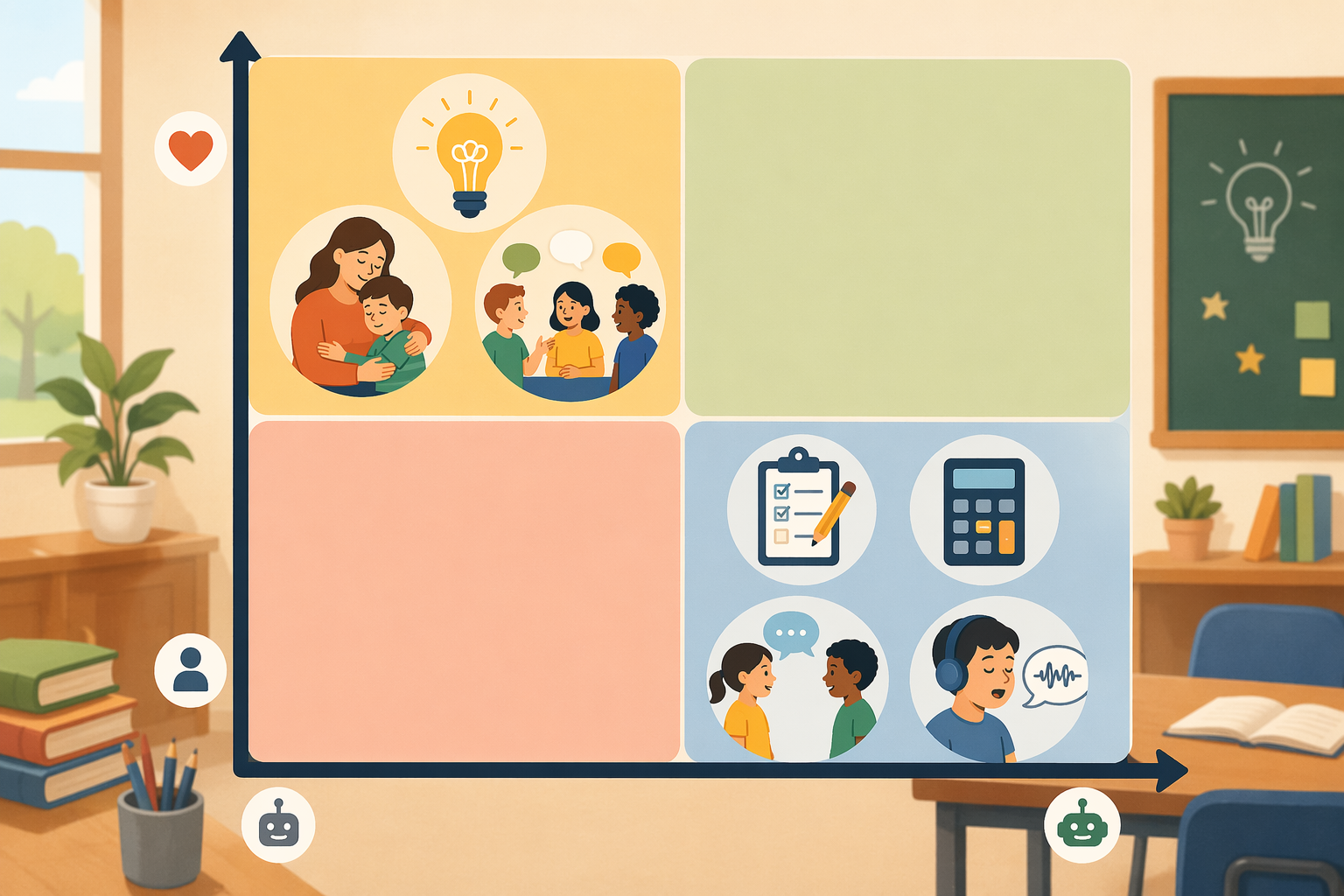
The Classroom Productivity Matrix
A useful classroom robot decision starts with two questions: how valuable is the teacher’s human judgment in this task, and how suitable is the task for a robot? Those are not the same question. A task can be important for learning and still be exhausting to repeat. A task can be engaging with a robot and still be a poor use of instructional time.
| Task Type | High Robot Suitability | Low Robot Suitability |
|---|---|---|
| High teacher value | Structured special education routines where consistency matters, such as turn-taking practice, joint attention prompts, or repeated social scripts under teacher supervision | Creative thinking, open-ended discussion, conflict repair, emotional support, writing conferences, and moments when the teacher must read context, tone, history, and student intent |
| Low teacher value | Vocabulary drills, math fact practice, pronunciation repetition, language exchanges, flashcard-style review, routine instructions, and predictable practice cycles | Tasks that are low-value but still messy: vague classroom management, unscripted tech support, loosely planned enrichment, or anything the robot cannot complete without frequent adult rescue |
The low-teacher-value, high-robot-suitability quadrant is the cleanest productivity case. If a teacher needs thirty students to rehearse the same vocabulary exchange, a robot can run that exchange without fatigue, embarrassment, or visible impatience. If students need repeated math fact practice, the robot can prompt, wait, respond, and move through the next item. The teacher is then free to listen for misconceptions, pull a small group, or watch which students are avoiding the work.
The high-teacher-value, low-robot-suitability quadrant is where many purchases get overconfident. Creative thinking, emotional support, and open-ended discussion are not inefficient just because they are hard to automate. They are high-judgment work. A teacher is not merely delivering turns in those moments; she is noticing hesitation, deciding whether silence means confusion or resistance, weighing classroom history, and choosing whether to press, wait, redirect, or protect a student from exposure.
The high-teacher-value, high-robot-suitability quadrant deserves more care than either the enthusiasts or the skeptics usually give it. Some special education routines are both high-value and robot-suitable because consistency is part of the intervention. A robot that repeats a turn-taking prompt the same way every time can be useful, especially when a teacher remains responsible for interpretation, adaptation, and safety. The robot is not replacing the adult relationship. It is carrying a narrow routine inside a larger human plan.
The low-teacher-value, low-robot-suitability quadrant is the trap. These are tasks no one much values, but the robot is not good at them either. A clumsy device that needs constant resetting during a loosely designed activity does not reduce workload. It converts teaching time into stage management.
What the Evidence Supports
The strongest evidence does not support a general claim that humanoid robots make classrooms more productive. It supports a narrower claim: when robots are placed inside a clear pedagogical routine, they can sustain practice and engagement in ways that may protect teacher attention for higher-value work.
The Australian 10-school study by Chalmers and colleagues is useful because it does not treat robot presence as the intervention. It found that constructivist inquiry approaches produced the strongest sustained engagement and skill transfer, while robot-as-gimmick approaches lost impact quickly. It also reported that teachers needed substantial professional development, with training requirements in the 8–20 hour range per teacher when paired with later analyses of implementation costs.[1][2]
That is exactly the kind of result that should slow down a purchase meeting. If the robot is dropped into a classroom as a novelty station, the first week may look busy and still create no durable productivity. If the teacher has to design every interaction from scratch, rehearse the robot behavior, recover from failures, and explain the point of the activity to students, the first weeks can easily be net negative.
Language learning is a more plausible fit. Reports on NAO-based vocabulary and English-language practice point to at least comparable learning outcomes with higher student enjoyment, especially where the robot can repeat short exchanges that a teacher cannot reasonably deliver one-on-one to every student.[2] The productivity gain is not that NAO becomes a better language teacher than a person. It is that a bounded exchange can run many more times without consuming the teacher’s entire period.
Special education use cases are also more credible when kept narrow. Secondary reviews describe QTrobot autism interventions associated with gains in attention, joint attention, and turn-taking.[2][3] Those are not blanket claims that a robot understands a child better than a teacher. They are claims about repeated, structured interactions where predictability can help some students participate.
Engagement Is Not the Same as Time Saved
Engagement matters. A student who will practice with a robot but not with a worksheet is giving the teacher something valuable. Still, engagement is not automatically productivity. The question is whether the engagement persists, whether it improves the target learning behavior, and whether the teacher gets usable attention back instead of another moving part to supervise.
The novelty-effect warning is not a footnote. Reviews summarized in 2026 reporting describe an initial engagement spike that often fades after 2–4 weeks unless the robot is deliberately integrated into instruction.[2] That makes the first month a poor time to declare victory. A crowded group of students around a blinking humanoid can look like success while the teacher is silently doing more work than before.
A better productivity measure is blunter: after the novelty period, which adult task happens less often? Fewer repeated directions? Fewer individual pronunciation drills by the teacher? More time for small-group correction? Less time prompting turn-taking? If no one can name the displaced task, the robot has not saved time. It has added an event.
Training and Total Cost Belong in the Productivity Calculation
Teacher training is not a side cost. It is part of the workload ledger. The 8–20 hours of professional development cited in implementation discussions means schools should expect the break-in period to cost time before it saves time.[1][3] That does not make the purchase irrational. It means the school needs a runway and a specific enough use case to earn the time back.
The money ledger is just as easy to undercount. RoboZaps’ 2026 cost analysis estimates that hardware accounts for only 50–60% of total cost, with software licenses commonly adding $500–$3,000 per year before maintenance and infrastructure are included.[2] A school that budgets only for the robot body is doing the same thing as a classroom that budgets only for the demo: pretending the unglamorous work will somehow disappear.
The Altus Schools Ameca pilot makes that reality visible, though it should not be stretched into a verdict on humanoid robots. In June 2026, the school bought two Ameca robots for $500,000, and early reporting from a journalist visit described mixed reactions: some students called the robot “creepy,” and the school’s own dean described the lesson as “clunky.” The pilot has no published outcome data, so it proves neither failure nor success.[4]
Its value is more practical than statistical. It shows the parts that procurement language tends to smooth over: the size of the investment, the awkwardness of early classroom use, the student who does not find the robot charming, and the adult who has to keep the lesson moving anyway.
The Same Robot Will Not Save the Same Time for Every Student
Classrooms do not receive technology evenly. A Norwegian Grade 6 study by Tilden and colleagues found that learning effects varied significantly by gender and prior experience.[5] That is a warning against designing one robot workflow and assuming it will produce the same productivity gain across the room.
For a teacher, variation means supervision does not go away. Some students may need less adult prompting when the robot runs a practice exchange. Others may need more framing, reassurance, or alternative access. A productive deployment leaves room for that difference instead of treating the robot station as a universal independent-learning machine.
A Robot Does Not Need a Fake Heart to Be Useful
One of the more refreshing findings comes from the Chicago Public Schools robot SEL study by Wright, Sebo, and colleagues. The study found that robots using honest, factual dialogue outperformed robots with fictional emotional personalities on student engagement, and the work received Best Paper recognition at HRI 2026.[6]
That matters because it cuts through a persistent design fantasy: that a classroom robot must pretend to be emotionally human to hold student attention. For productivity, honesty is cleaner. A robot can say what it can do, guide a structured reflection, ask the next prompt, and leave the deeper emotional interpretation to the adult who actually knows the student.
A Deployment Standard That Respects Teacher Time
Before buying or assigning a humanoid robot, a school should be able to name the exact work it will absorb. “Help with instruction” is too vague. “Run ten-minute vocabulary exchanges with emerging English learners three times a week while the teacher rotates through feedback groups” is specific enough to evaluate.
- Name the repetitive task the robot will run.
- Identify the teacher action that should decrease.
- Decide who prepares scripts, monitors use, updates content, and troubleshoots failures.
- Set a post-novelty review point after the first few weeks.
- Protect high-judgment work from being handed to the robot simply because it is expensive and available.
Humanoid robots can improve classroom productivity, but only under conditions that are less glamorous than the sales pitch: bounded tasks, prepared routines, trained teachers, realistic costs, and clear limits. They belong where repetition is the burden and consistency is useful. They do not belong where the work depends on trust, improvisation, moral judgment, or the quiet read of a student who is almost ready to say what is wrong.
The decision standard is simple enough to use before the purchase order: deploy the robot only after naming the specific tasks it will absorb, the teacher time it is meant to release, and the classroom work it must never be asked to replace.
References
- Chalmers et al. 2022 Australian 10-school study, Springer, 2022.
- Humanoid Robots in Education, RoboZaps, 2026.
- Humanoid Robots in Classrooms: Benefits & Risks, WINS Solutions.
- Charter school buys humanoid robots to help students learn, ISPR, July 3, 2026.
- Tilden et al. 2025 Norwegian Grade 6 study, Springer, 2025.
- How Chicago robot tutors are teaching SEL effectively without pretending to be human, University of Chicago Department of Computer Science, 2026.
Comments
Join the discussion with an anonymous comment.