
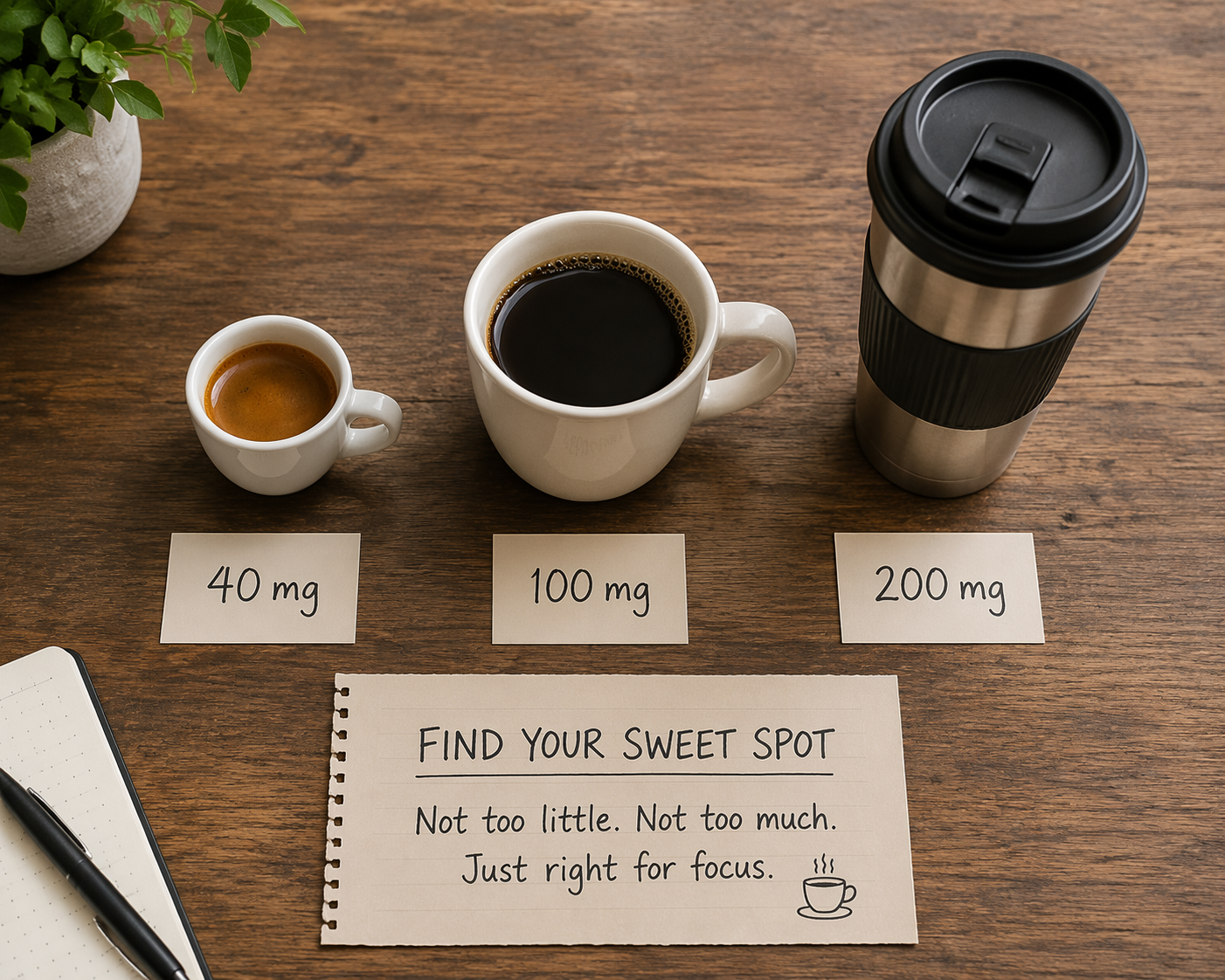
For most healthy adults, the useful coffee dose for productivity focus is about 40 to 200 mg of caffeine per session. In everyday terms, that is roughly half a cup to two cups of ordinary brewed coffee, spaced at least 3 to 4 hours apart. Treat 400 mg in a day as the upper safety ceiling, not as a focus goal to chase.[1][2]
That answer is less tidy than “one or two cups,” but it is much more usable. A cup is a container. Caffeine is the dose. If you are trying to study, write, code, analyze data, or sit through a meeting without drifting, the dose is the part that decides whether coffee helps or turns into hand tremors and scattered attention.
The Useful Range Is Smaller Than the Daily Limit
The 400 mg number gets repeated often because it is a safety benchmark for healthy adults, not because most people focus better after stacking caffeine all the way up to it.[1] A more practical working range is lower: start around 40 to 100 mg when the task needs clean attention, and use 100 to 200 mg when you need a stronger lift and know you tolerate it well.
| Caffeine dose | Approximate coffee equivalent | Best use |
|---|---|---|
| About 40 mg | Roughly half a small brewed coffee, or a low-caffeine serving | A light nudge for reading, admin work, or easing into focused work |
| About 100 mg | Around one standard 8 oz brewed coffee | A practical default for writing, studying, coding, or analytical work |
| About 200 mg | Around two standard brewed cups, depending on strength | A higher-focus session when tolerance is known and sleep is protected |
| 300 mg or more in one sitting | Often a large cafe drink or several home mugs | More likely to bring diminishing returns, jitters, or scattered attention |
| 400 mg per day | Varies widely by drink size and brew method | Daily ceiling for most healthy adults, not a productivity target |
The lower end deserves more respect than it gets. A 1987 study cited in an NCBI Bookshelf review found that as little as 32 mg of caffeine increased auditory vigilance in healthy volunteers.[3] That does not prove 32 mg is the perfect office dose, and the broader review includes sleep-deprivation research that does not map neatly onto a rested workday. But it does puncture the lazy assumption that focus requires a giant cup.
Stop Counting Cups Until You Know What Your Cup Contains
An 8 oz home-brewed coffee averages around 100 mg of caffeine. A Starbucks grande Pike Place roast contains about 310 mg.[4] Those are both “a coffee” in casual speech, but they are not remotely the same focus dose.
This is where a lot of productivity advice becomes accidentally sloppy. Someone says they work well on two cups. One reader imagines two modest mugs at home. Another buys two large cafe coffees and quietly crosses the daily ceiling before lunch. The problem is not coffee; the problem is using cup count as if it were a unit of measurement.
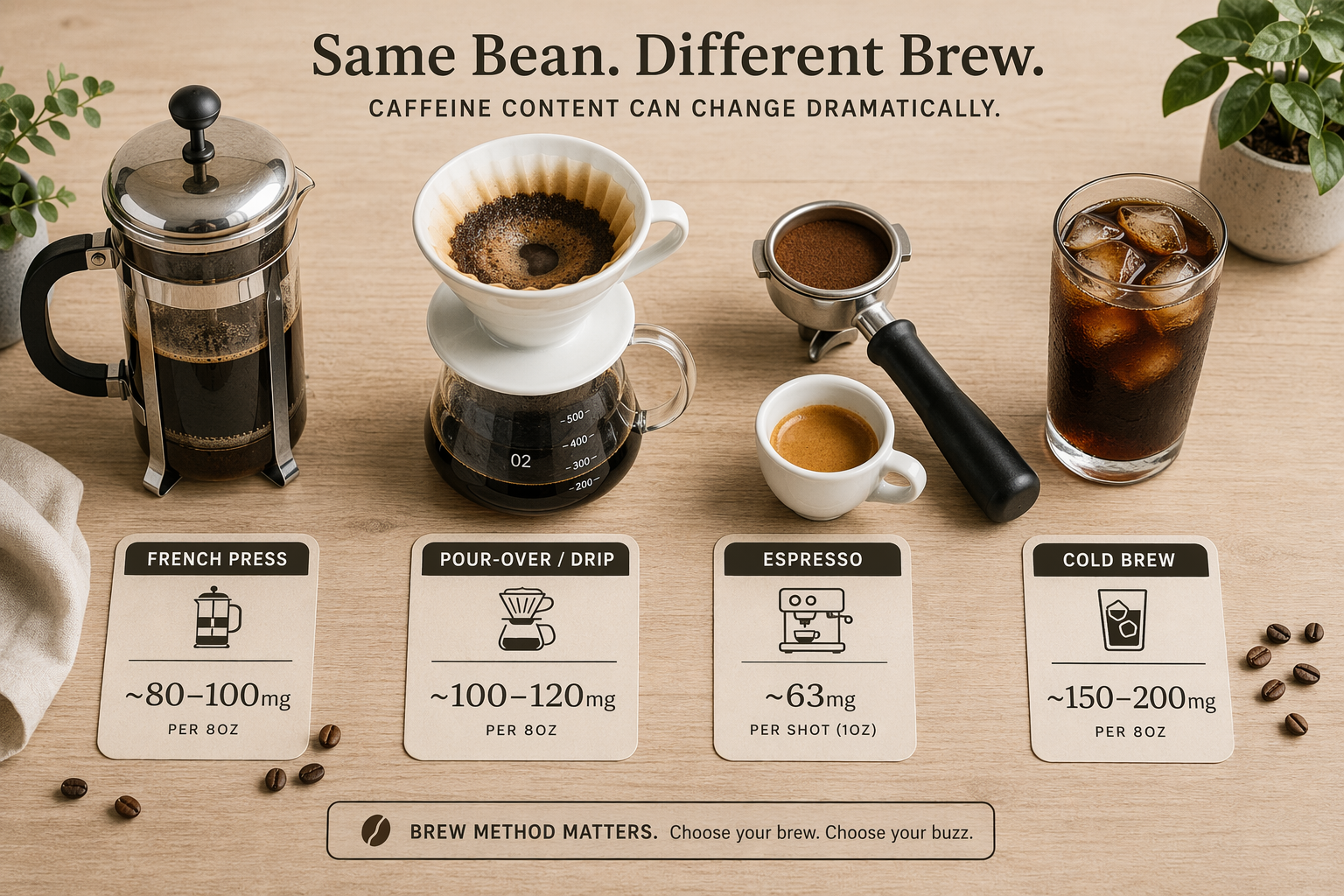
Brew method, serving size, roast, grind, and concentration all change the amount. Cold brew and some cafe servings can move far outside the range people picture when they hear “one cup.”[4] If focus is the goal, the first useful habit is to look up the caffeine content of your usual drink once, then make decisions from that number.
- If your usual coffee is close to 100 mg, one cup is a reasonable focus-session default.
- If your cafe order is around 300 mg, it is already beyond the usual per-session focus range.
- If you sip several refills from a large mug, estimate the total ounces rather than calling it one cup.
- If you switch brew methods, re-check the caffeine estimate instead of assuming your old dose still applies.
Timing Decides Whether the Same Dose Helps or Lingers
The cleanest use of coffee is usually not the cup swallowed in the first minute after waking. Cortisol rises naturally in the morning and is reported to peak about 30 to 45 minutes after waking; waiting 60 to 90 minutes before the first coffee is commonly recommended so caffeine is not competing with that early alertness curve.[5]
This does not mean a 7:01 a.m. coffee is a character flaw. It means that if your first cup feels less effective than it used to, timing may be the cheaper experiment than adding another cup. Move the same dose later before you increase it.
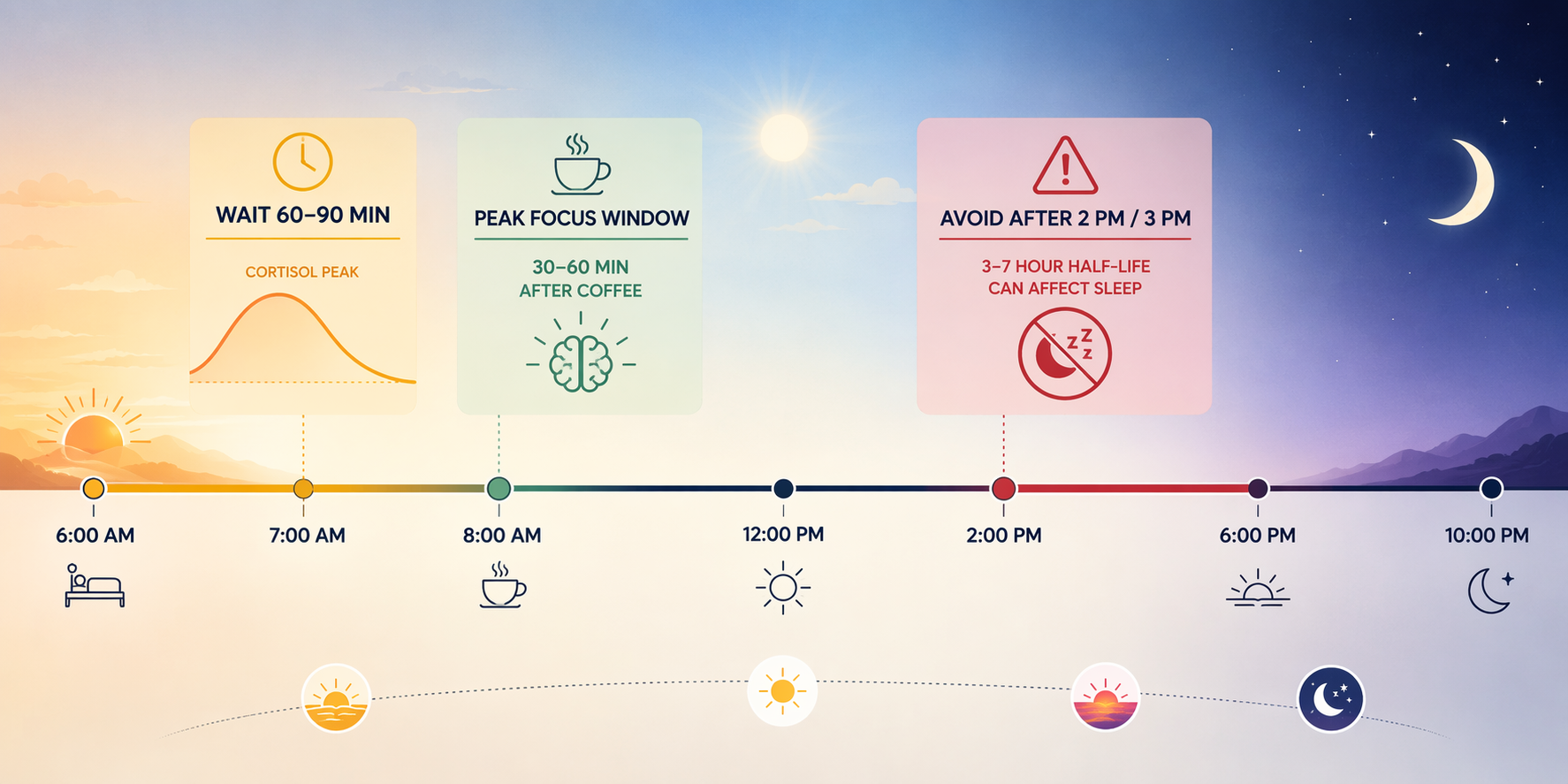
After you drink coffee, caffeine reaches peak blood concentration in about 30 to 60 minutes.[6] For a focused work block, that matters. The best time to drink the cup is usually before the demanding part starts, not halfway through the task when you are already frustrated.
The other timing fact is less pleasant: caffeine has a half-life of roughly 3 to 7 hours.[6] A 3 p.m. dose can still be meaningfully active at night, depending on how quickly you metabolize it. If that cuts into sleep, the productivity cost does not show up immediately. It arrives tomorrow morning, disguised as the need for more coffee.
A Simple Timing Rule
- Wait 60 to 90 minutes after waking before the first focus dose when your schedule allows.
- Take coffee 30 to 60 minutes before the work that needs the most attention.
- Leave at least 3 to 4 hours between meaningful caffeine doses.
- Be cautious with afternoon coffee, especially if sleep quality has slipped.
How to Choose Your Starting Dose
If you already drink coffee, do not start by redesigning your whole morning. Start by measuring your normal caffeine dose. Then decide whether it belongs in the 40 to 200 mg session range or whether your “one coffee” is doing more than you thought.
For many people, 100 mg is the most useful anchor. It is enough to feel, small enough to adjust, and close to the average 8 oz brewed coffee estimate.[4] If you are sensitive to caffeine, anxious under deadline pressure, or trying to protect sleep, start closer to 40 to 75 mg. If you have a stable tolerance and a demanding morning work block, 100 to 200 mg may be reasonable.
Individual metabolism is the part no chart can solve for you. Variants in the CYP1A2 enzyme mean some people process caffeine faster while others feel the same amount for much longer. That is why the best rule is not “drink this exact cup.” It is “change the dose slowly and watch what happens.”
| If this is you | Try this first |
|---|---|
| You rarely drink coffee | Start near 40 mg and avoid late-day dosing |
| You drink one normal home coffee most mornings | Use about 100 mg as your baseline and adjust from there |
| You buy large cafe coffees | Check the posted caffeine amount before assuming it is a single dose |
| You feel alert but physically tense after coffee | Reduce the dose before changing the brew or adding supplements |
| You sleep poorly after afternoon coffee | Move caffeine earlier or cut the later dose, even if it helps in the moment |
Where Coffee Starts Hurting Focus
The obvious warning sign is jitters, but the more expensive one is mental scattering. Racing thoughts, anxiety, restlessness, and the feeling of switching tabs without choosing to are all signs that the dose has moved past useful stimulation.[7][8]
For many people, that risk rises when a single sitting climbs above roughly 300 mg.[7] That does not mean everyone falls apart at 301 mg, and it does not mean 250 mg is automatically wise. It means that once your focus cup looks more like a large cafe drink than a measured dose, you should expect diminishing returns.
Sleep disruption is the delayed warning sign. A dose can feel productive at 2 or 3 p.m. and still make the next morning worse. If you need more caffeine because yesterday’s caffeine shortened or lightened your sleep, the system is no longer helping you focus. It is lending you alertness at interest.
The Ritual Can Help, but It Does Not Cancel the Dose
There is a real behavioral advantage in having a repeatable start cue. Grinding beans, making pour-over, walking to the kitchen, or setting a mug beside a notebook can tell the brain that a focused block is beginning. Productivity writers and coffee companies both point to this ritual effect as part of coffee’s perceived usefulness.[7][8]
That can be useful, especially for habitual drinkers. It is also easy to over-credit. A calming ritual does not make 300 mg behave like 100 mg, and a beautiful brew method does not protect sleep from a late dose. Keep the cue if it helps you start. Measure the caffeine if you want the habit to stay productive.
A Practical Self-Calibration Rule
Pick one usual coffee, find its approximate caffeine content, and test it as a work-session dose for several ordinary days. Start near the low-middle of the range: about 75 to 100 mg if you tolerate caffeine, closer to 40 mg if you are sensitive. Take it 30 to 60 minutes before your most demanding work, and avoid adding more for at least 3 to 4 hours.
Then track the evidence that matters: focus quality, physical tension, anxiety, afternoon crash, and sleep. Adjust by caffeine milligrams, not by cups. If jitters, scattered attention, anxiety, or sleep disruption appear, the dose that looked productive on paper is too high for the way you actually work.
References
- Caffeine: How much is too much? — Mayo Clinic — link
- Coffee and Caffeine — How Much Should You Drink? — Healthline — link
- Effects of Caffeine on Cognitive Performance, Mood, and Alertness in Sleep-Deprived Humans — NCBI Bookshelf — link
- How to maximize your coffee habit to be more productive: experts — CNBC Make It — November 16, 2021 — link
- The best time to drink coffee and how many cups you should have — NY Post — March 14, 2025 — link
- Caffeine Effects on Cognitive Performance: Focus & Memory — Mind Lab Pro — link
- The Science Behind How Coffee Affects Focus and Productivity — Achilles Coffee Roasters — link
- How Coffee and Caffeine Actually Affect Your Productivity — Todoist — link
Comments
Join the discussion with an anonymous comment.