
The first useful correction is also the one that makes coffee easier to use well: coffee does not manufacture focus. Caffeine blocks adenosine receptors, temporarily reducing the brain’s fatigue signal rather than creating new energy out of nowhere.[1] That distinction matters during an ordinary workday. If the cup on your desk makes a slow spreadsheet feel possible again, the effect is real. It is also borrowed.
That is why coffee can improve focus and productivity in one morning and quietly sabotage the next. Used at a moderate dose, at the right time, it can sharpen sustained attention, vigilance, and reaction time. Used too early, too late, or too often without a reset, it can produce jittery concentration, lighter sleep, and the familiar loop of needing more caffeine to compensate for the sleep caffeine helped disturb.

What caffeine is actually doing to your attention
Adenosine builds up as you stay awake. As it accumulates, it helps signal tiredness. Caffeine’s main cognitive trick is to sit on adenosine receptors so that signal is muted for a while.[1] The deadline has not become easier, and your brain has not received a fresh battery. You are perceiving less fatigue, which can be exactly what you need for a focused stretch of work.
This explains why coffee is most noticeable when fatigue is already present: after a short night, during a long afternoon, or in the flat middle of a repetitive task. Research on caffeine and cognitive performance has found benefits for alertness and performance in sleep-deprived people, with findings especially relevant at moderate doses rather than the very high doses used in some military sleep-deprivation contexts.[1]
For knowledge work, the most dependable benefits are not glamorous. Coffee is better supported for sustained attention, vigilance, reaction time, and sometimes working memory than for making someone more imaginative on command.[2] That fits the lived experience of a good cup: it may help you keep your cursor moving through edits, code review, inbox triage, or exam notes. It is less reliable as a shortcut to original thinking.
The sweet spot is moderate, not heroic
The practical dose range to start with is about 75–150 mg of caffeine, roughly the range often described as one to one and a half cups of coffee depending on brew strength.[2] The point is not to see how much caffeine you can tolerate. It is to use enough to improve the task in front of you without crossing into the shaky, over-alert state that makes concentration feel expensive.
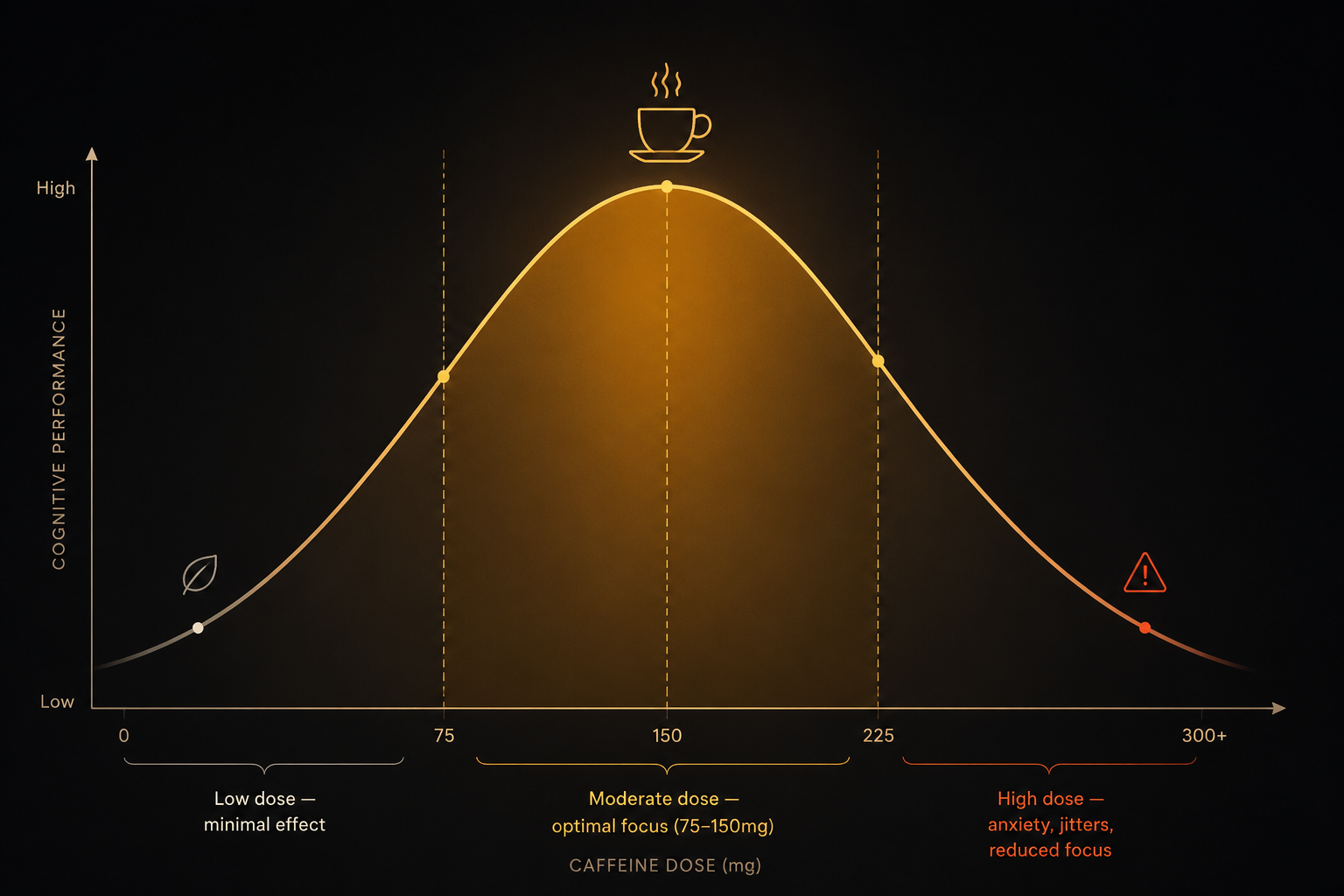
Caffeine follows an inverted U-shaped pattern: too little may do almost nothing, a moderate amount can improve performance, and too much can worsen the very focus people are trying to rescue.[1][2] At higher doses, anxiety, jitteriness, and scattered attention become more likely.[1] A second large coffee may feel like a productivity decision when you pour it; twenty minutes later, it may turn one hard task into six half-started ones.
| Caffeine pattern | Likely work effect | Practical read |
|---|---|---|
| Too little | Minimal noticeable change | You may simply enjoy the ritual |
| Moderate dose, about 75–150 mg | Better sustained attention, vigilance, and reaction time | Best default range for most focused work |
| High dose, often 200 mg or more | Higher risk of anxiety, jitters, and reduced focus | More alert does not necessarily mean more productive |
The table is deliberately plain because the decision usually is. If one normal cup gets you into the working range, the second cup is not automatically an upgrade. For deep work, the better question is whether the next dose will improve the next hour or make it harder to sit still with one problem.
Coffee helps some kinds of work more than others
Caffeine is best matched to work that benefits from alertness and persistence: reading dense material, checking details, writing a first pass, doing routine analysis, preparing slides, or staying vigilant through a long meeting. It is less clearly helpful for divergent or highly creative thinking, where narrowing attention can be a mixed blessing.[2]
That does not mean coffee is bad for creative workers. It means the timing should match the phase of the work. A moderate cup may help during revision, execution, or decision cleanup. For open-ended idea generation, especially when anxiety is already high, more caffeine may push the mind toward premature closure rather than useful exploration.
If you want more tactical pairings of coffee with deep work blocks, the companion guide on coffee productivity hacks for deep work is the place for session-level tactics. The larger rule here is simpler: use coffee for work that benefits from steadier attention, not as a blanket promise that every mental state will improve.
The daily protocol: dose, delay, cutoff, reset
A useful coffee protocol does not need to be fussy. It needs to protect the workday without stealing from the night. Start here, then adjust down if you are prone to anxiety, palpitations, or long-lasting caffeine effects.
| Decision | Default starting point | Why it matters |
|---|---|---|
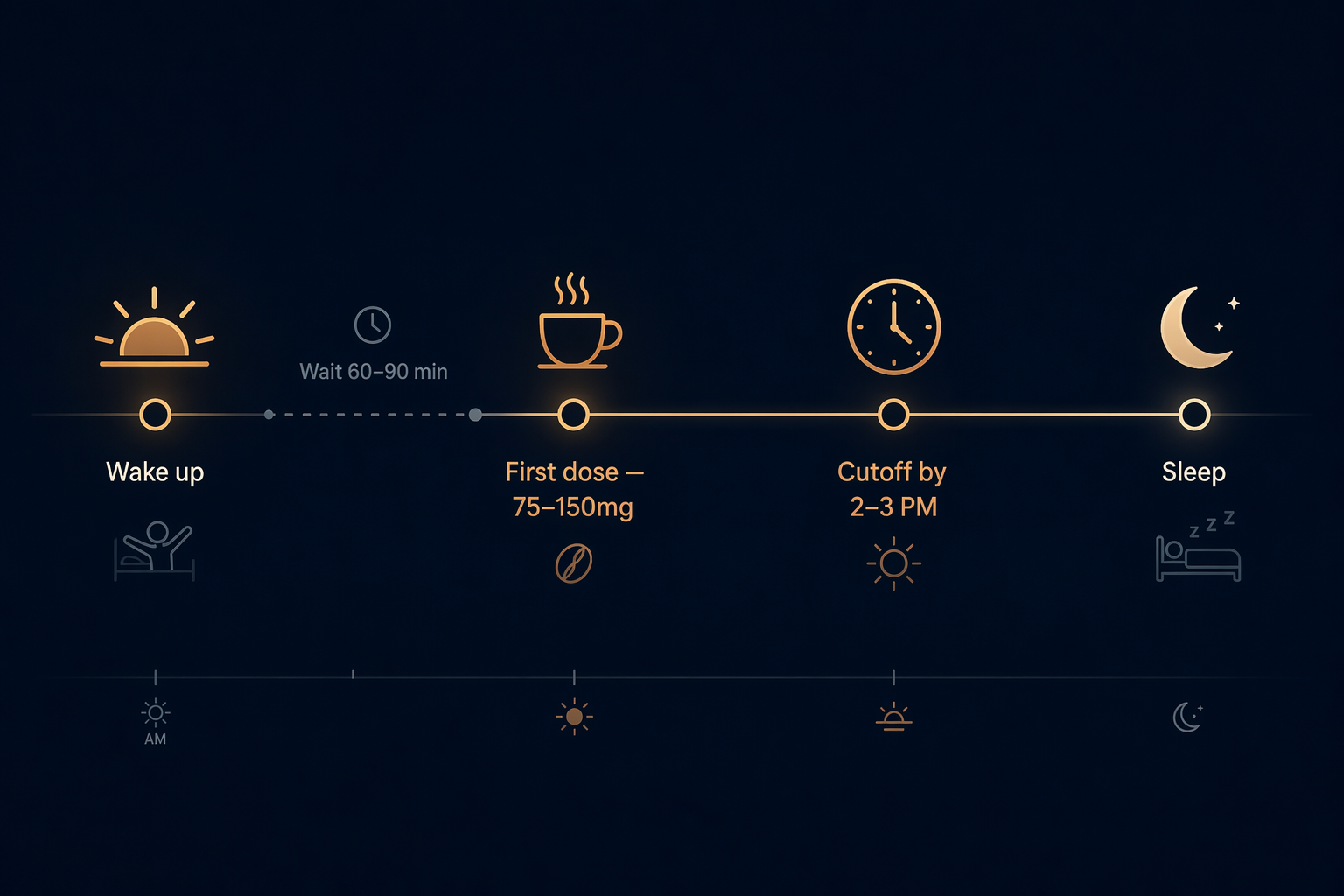
| First coffee | Wait about 60–90 minutes after waking | Lets natural morning alertness rise first and gives caffeine a clearer job |
| Dose | Use about 75–150 mg caffeine | Targets the useful middle of the dose-response curve |
| Afternoon cutoff | Avoid coffee after about 2–3 PM | Reduces the chance that active caffeine will interfere with sleep |
| Tolerance | Take periodic breaks or lower-caffeine days | Helps prevent the same dose from becoming less effective |
Wait before the first cup
The most common coffee mistake is drinking it automatically the minute the laptop opens. A better default is to wait about 60–90 minutes after waking.[2][3] The reasoning is practical: morning cortisol follows its own natural rise, and caffeine has more to do once adenosine pressure has begun to build. If you wake at 7:00, the first cup around 8:00 or 8:30 is often a cleaner intervention than a cup swallowed while still half-asleep.
This is not a purity test. Parents of small children, shift workers, and people starting very early shifts may not have a leisurely 90-minute runway. But if your current pattern is wake, drink coffee, crash midafternoon, sleep lightly, repeat, delaying the first cup is one of the smallest changes with the best chance of changing the whole loop.
Keep the dose boring
For most focus work, boring is good. Stay near 75–150 mg per dose unless you have a clear reason not to.[2] A small coffee before a 90-minute writing block is often more useful than an oversized drink nursed all morning, because it gives you a cleaner start and a cleaner stop.
The exact caffeine content of coffee varies by bean, brew method, serving size, and café. That uncertainty is another reason to start modestly. If you buy large brewed coffees or strong cold brew, your “one coffee” may already be more than one practical dose.
Cut off the afternoon rescue cup
Caffeine’s half-life is commonly described as about 5–6 hours, which means a meaningful amount can still be active well after the cup is finished.[3] A 3 PM coffee may not feel dramatic at dinner, but it can still matter at bedtime. The cost often shows up as slightly worse sleep rather than obvious insomnia, which makes the cause easy to miss.
A 2–3 PM cutoff is a sensible default for a standard daytime schedule.[2][3] If you are a slow caffeine metabolizer, unusually sensitive to caffeine, or trying to repair sleep, move the cutoff earlier. If you work nights, the same principle applies: place caffeine far enough away from your main sleep window that it is not still doing business when you need your brain to stand down.
Plan for tolerance before it plans your morning
Daily caffeine use can build tolerance within 1–2 weeks, and a 1–2 week break can help restore sensitivity.[2][3] That is the quiet reason a cup that once felt crisp can become merely normal. The coffee did not stop containing caffeine; your baseline shifted.
You do not have to become dramatic about this. A tolerance reset might mean a planned lower-caffeine week, half-caf for a stretch, or keeping coffee for high-value work blocks instead of using it as background fluid. The goal is to prevent every morning from starting with a withdrawal negotiation.
When the same cup hits harder
Individual metabolism is not a vague escape clause; it changes the protocol. About 40% of people are described as slow caffeine metabolizers, often discussed in relation to CYP1A2 genotype, and they may experience stronger or longer-lasting effects from the same dose.[2] For those drinkers, the standard advice should be treated as an upper boundary, not a dare.
The clues are usually ordinary: coffee after lunch disturbs sleep, one large cup causes nervous focus, or caffeine seems to linger long after other people have moved on. In that case, reduce the dose before adding rules. Try a smaller cup, half-caf, tea, or an earlier cutoff. The best dose is the one that improves the work without becoming the next problem to manage.
Coffee naps are useful, but optional
A coffee nap, sometimes called a nappuccino, pairs a small coffee with a short nap of about 20 minutes. The idea is that sleep reduces adenosine pressure while caffeine begins to take effect as you wake.[2] It can be useful for a specific slump, especially when a full nap would leave you groggy or when you need one more focused work block.
It should not become a clever way to keep pushing through chronically bad sleep. If the coffee nap is needed every day, the more important intervention is probably the sleep schedule, workload, or afternoon caffeine habit. Coffee can help manage fatigue; it cannot make fatigue irrelevant.
What to make of workplace productivity claims
There are workplace-friendly findings that make coffee sound like an easy productivity lever. One 2024 report described a 23% productivity improvement from coffee breaks, but the study involved 30 participants and was commissioned by a coffee machine vendor.[4] That makes it directional at best, not a foundation for serious advice.
The more durable case for coffee does not depend on a tidy office-break percentage. It rests on the better-supported cognitive pattern: moderate caffeine can improve alertness and attention-related performance, especially when fatigue is present, while excessive or poorly timed caffeine can erode the conditions that make good work possible.[1][2][3]
That also keeps coffee in its proper place among productivity tools. It may support a focused work block, but it does not replace sleep, movement, nutrition, workload design, or sane expectations. If the broader work system is broken, caffeine often becomes a polite disguise for it. For a wider look at the pressures behind that pattern, see the workplace productivity statistics analysis.
A practical default for tomorrow morning
If your coffee habit has become automatic, do not redesign your whole life. Run a simple version for a week:
- Wait 60–90 minutes after waking before the first coffee.
- Keep the dose around 75–150 mg of caffeine.
- Use it before attention-heavy work, not as a reflex between tasks.
- Stop by about 2–3 PM, earlier if sleep or anxiety is an issue.
- Add lower-caffeine days or a planned reset if the same cup stops working.
Coffee improves focus and productivity when it protects the work and preserves the recovery that makes tomorrow’s work possible. Once it starts compensating for damaged sleep, escalating tolerance, or an overloaded schedule, the cup is no longer helping as much as it feels like it is.
References
- Effects of Caffeine on Cognitive Performance, Mood, and Alertness in Sleep-Deprived Humans — NCBI / National Academies of Sciences, 1994.
- Does Coffee Help You Focus? — Coffee Hero.
- How Coffee and Caffeine Actually Affect Your Productivity — Todoist.
- Coffee breaks boost productivity by 23% — HRreview, 2024.
Comments
Join the discussion with an anonymous comment.