
The hard part often starts after the SSDI application is filed. The forms are submitted, the confirmation is saved somewhere, and then weeks pass. Maybe a letter arrives asking for more information. Maybe the online account still says the claim is being reviewed. Maybe nothing happens at all, which is its own kind of message when you are trying to guess whether silence means normal processing or a missing record.
That is the practical answer to how to handle Social Security disability benefits delay: separate the delay you cannot control from the paperwork failures you can. You cannot make a disability examiner finish a queue faster. You can know which doctor has not sent records, which SSA letter has a deadline, what proof you have that a fax or upload went through, and what date you should check again.
In June 2026, SSA reported that disability processing times were 42 days faster than in May 2025 and that the pending disability backlog had dropped 30% to under 830,000 claims.[1] That improvement matters, but it does not erase the kitchen-table reality for an individual applicant. Initial SSDI decisions in 2026 are still commonly described as taking about 6 to 8 months, and national averages can hide much longer local or case-specific waits.[2]

A tracking system will not fix the backlog. It is not a magic folder, and it is not a substitute for medical evidence. Its job is smaller and more useful: to keep your claim from losing time because an envelope sat unopened, a medical record request was assumed to be handled, or an appeal deadline disappeared under other mail.
Start with one claim log
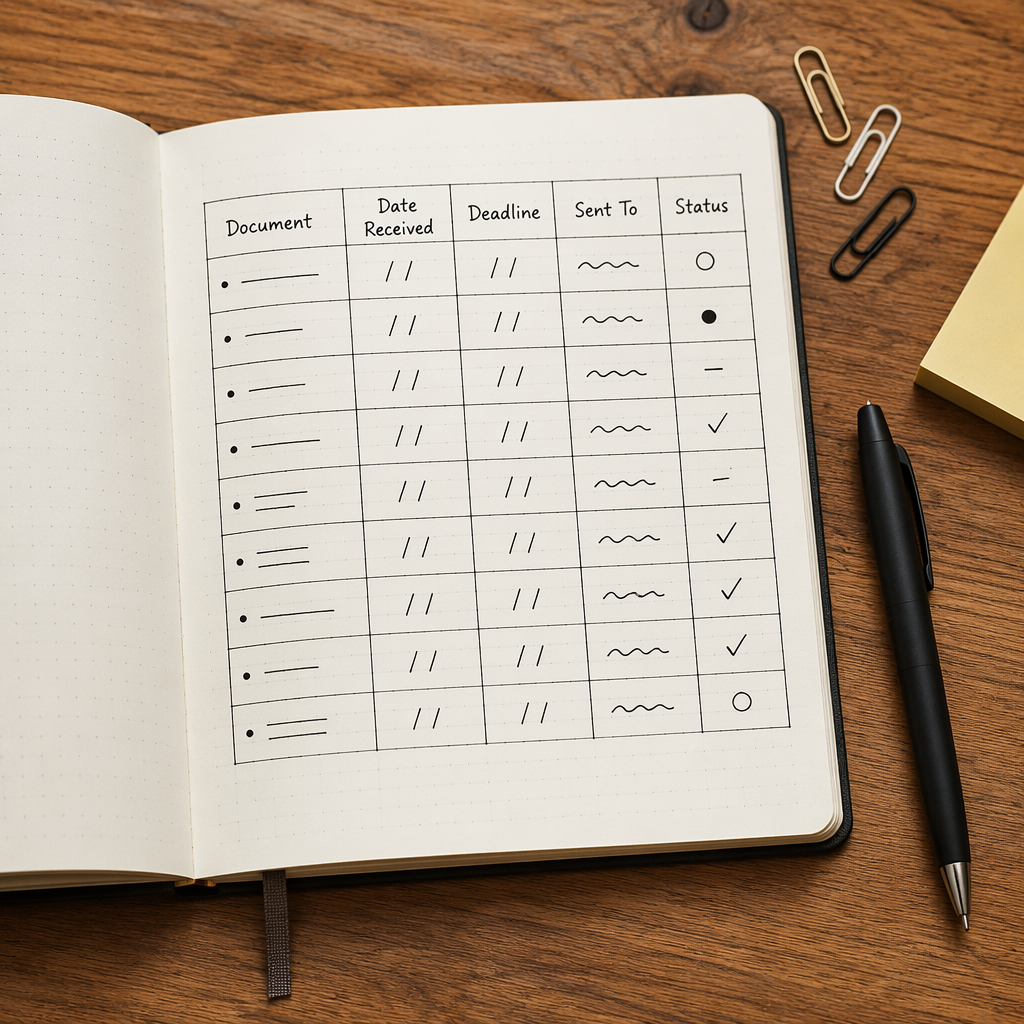
Do not start by shopping for the perfect app. Use whatever you can open on a bad day: a notebook, a spreadsheet, a notes app, or a folder with a printed log sheet. The system is good if it can answer seven questions without making you search through every envelope again:
- What did SSA or DDS ask for?
- What date did the request arrive?
- What is the response deadline?
- Who has the document or information?
- When was it sent, uploaded, mailed, faxed, or delivered?
- What proof exists?
- When should you follow up?
Those questions matter because some of the shortest deadlines in a disability claim are not the formal appeal windows people hear about. DDS evidence follow-up periods may be only 10 to 20 days, and one practitioner summary of SSA policy notes that claims may be denied around 30 days from the original request if there is no response.[3] That is not much time if the request is in a stack of mail, the doctor’s office needs a release form, and you have to call twice to find out whether records were actually sent.
| Log field | What to write down |
|---|---|
| Date received | The date you actually received the letter, voicemail, portal notice, or form |
| Source | SSA, DDS, a medical provider, your representative, or another office |
| Request or update | Exactly what was asked for or what changed |
| Deadline | The response date, appeal date, appointment date, or your own follow-up date |
| Action taken | Called, uploaded, mailed, faxed, signed release, requested records, left voicemail |
| Proof | Confirmation number, fax receipt, certified mail receipt, portal screenshot, name of person spoken to |
| Next check | The date you will verify that the item was received or the status changed |
If you use a notebook, put these fields across two facing pages. If you use a spreadsheet, make each request or contact one row. If you use a notes app, make one running note titled with your claim type and filing date. The format matters less than the habit: one event, one entry, one next date.
Give SSA mail a same-day landing place
SSA mail should not float around the house. Pick one physical place for every disability-related paper: a folder, a box, a binder, or a tray. The rule is simple: open it, date it, log it, then store it. If you cannot deal with it that day, the log still gets the date received and a follow-up action such as “read letter with helper on Friday” or “call SSA Monday.”
The date received is not a decoration. It tells you whether a response window is already running. It also gives you a record if a notice was delayed in the mail or arrived while you were hospitalized, traveling for medical care, or otherwise unable to respond normally.
For each letter, write a plain-language version of what it means. “SSA-827 medical release due.” “Adult Function Report due.” “Work history form received.” “Denial notice—appeal deadline.” Official forms can be confusing, but your log should not be. It is there so you can find the next action in ten seconds.
Track medical evidence like a chain of custody
Medical records are one of the easiest places for an SSDI claim to stall because everyone can believe someone else handled them. SSA may request records. DDS may contact providers. A doctor’s office may say the request is “in process.” None of that tells you whether the examiner has the records in the file.
Make a provider list inside the same claim log. For each doctor, clinic, hospital, therapist, testing center, or specialist, track the provider name, condition treated, dates of treatment, records requested, release signed, date sent, delivery method, and confirmation. If a provider uses a portal, note whether you downloaded records yourself or asked the office to send them directly.
This is where a simple document workflow can help, especially if you already scan paperwork for other household records. A basic naming pattern such as “2026-07-18_SSA_Work-History-Form_submitted” or “2026-07-20_Dr-Smith_records-requested” is enough. If you want a broader file setup, a lightweight process like an internal document workflow can be useful, but the disability claim log should stay readable without opening five tools.
Do not mark a record as “done” just because it was requested. Use different statuses: requested, release sent, provider confirmed, sent to DDS, received by DDS if confirmed. That distinction is tedious until the day someone says, “We never got that,” and you can see exactly where the chain broke.
Use deadlines as alarms, not memories
Every deadline needs two dates: the official due date and your action date. If a form is due in 10 days, the action date may be tomorrow. If a provider has not sent records after a week, the action date is the day you call again. A deadline written only on the original letter is a deadline waiting to be missed.
Appeal deadlines deserve their own line in the log and their own calendar entry. After a denial notice, applicants generally have 60 days to request reconsideration, with SSA regulations treating notice as received 5 days after the date on the notice unless the applicant shows otherwise.[4] Missing that window can force a person to start over rather than continue the existing claim path.
That appeal entry should include the notice date, the assumed receipt date, the appeal deadline, the date you submitted the appeal, and proof of submission. If you work with a representative, still keep the entry. Representation does not remove your need to know whether a deadline exists.
| Event | Date to record | Follow-up rule |
|---|---|---|
| SSA or DDS asks for a form | Date letter or call was received | Set an action date before the due date, not on it |
| Provider records requested | Date request and release were sent | Check whether records were sent, not just requested |
| Records or forms submitted | Date and method of submission | Save proof and verify receipt when possible |
| Online status checked | Date and exact status wording | Check again on a planned cadence unless something changes |
| Denial received | Notice date and date received | Calculate appeal window immediately and submit early if possible |
Check status without turning it into a daily punishment
Status checking is useful when it creates an action. It is not useful when it becomes a daily exercise in watching a vague message refuse to change.
SSA’s online tools can show where a claim is in the process, and status explanations from disability-service sources commonly separate stages such as application received, medical review, non-medical review, and decision made.[5] The important thing for your log is not to interpret every phrase as good or bad news. Write down the date, the exact status wording, and whether the status creates a task.
- If the status shows a request for information, look for the letter or call SSA/DDS to identify the request.
- If the status has not changed, log the check and set the next check date.
- If a decision has been made, watch the mail and prepare to log the notice date as soon as it arrives.
- If something in the portal conflicts with a letter or phone call, log both and ask for clarification.
A reasonable cadence for many people is weekly or every other week while the claim is active, plus immediate checks after mailing, uploading, or faxing major evidence. If phone calls are necessary, log the date, number called, person spoken to if provided, what they said, and what they said would happen next. “Called SSA—said records not received—fax again by Friday” is far more useful than “called about claim.”
Know what the five-month waiting period does and does not explain
SSDI has a separate five-month mandatory waiting period before cash benefits can begin, counted from the established onset date of disability.[6] That rule is often confused with the processing delay. They are not the same thing. The waiting period affects payment timing; it does not mean you should ignore requests, delay medical evidence, or wait passively for a decision.
A person can be stuck in both kinds of waiting at once: a legal waiting period for benefits and an administrative wait for a decision. Your tracking system is aimed at the second problem. It cannot remove the statutory waiting period, but it can reduce the chance that your decision is slowed by missing evidence or unanswered notices.
Fast-track programs still need organized evidence
Some claims may move faster through programs such as Quick Disability Determination or Compassionate Allowances. QDD is described as using predictive modeling to identify claims likely to be allowed quickly, and one practitioner source cites a roughly 2-week median processing time when decisive medical evidence is available.[3] Compassionate Allowances cover more than 300 conditions and can help SSA identify claims where the diagnosis itself strongly supports disability under SSA criteria.[3]
The tracking lesson is not to try to force your claim into a fast-track category. It is to make the decisive evidence easy to find. Use the exact diagnosis language from medical records when listing conditions. Keep pathology reports, genetic testing, imaging, hospital records, specialist notes, and treatment summaries where you can identify them quickly. If SSA or DDS asks for a specific report, the log should tell you where it is and whether anyone has sent it.
When the claim is denied, the log becomes the appeal map
Initial denials are common. One disability-practice source states that about 67% of claims are denied at the initial stage and about 85% at reconsideration, citing SSA-related data.[2] Those numbers should not be used to predict any one person’s claim, but they are enough reason to prepare for the possibility of appeal before a denial letter arrives.
If you receive a denial, do not start by rereading every document in panic. Start a denial entry in the log. Record the notice date, date received, appeal deadline, denial reasons, missing records mentioned, medical issues SSA appears to have accepted or rejected, and any work-history or daily-function issues that need correction.
Then compare the denial reasons with your evidence log. If SSA says records from a specialist were not considered, your log should show whether they were requested, sent, and confirmed. If SSA says there is not enough evidence about functional limits, your log can help you identify recent treatment notes, forms, or provider statements that may address the gap. The appeal is still a legal and medical argument, but the log gives you the inventory.
A representative can help, but do not outsource your only copy of the facts
Complex claims, denied claims, and hearing-stage claims often benefit from legal help. A National Bureau of Economic Research summary of work by Hilary Hoynes, Nicole Maestas, and Alexander Strand found that legal representation at the initial stage increased the probability of benefit allowance by about 23 percentage points and reduced total case processing time by 316 days on average.[7] That is a serious finding, not a reason to treat a notebook as a lawyer.
Even with representation, keep your own log. You are the person most likely to know that a new specialist was added, a medication changed, a test was scheduled, or a letter arrived on a Saturday. A good representative may have a case management system. You still need a simple version you can understand and use when someone calls you back.
Build the system this week
If the claim already feels messy, do not try to rebuild the entire history perfectly. Start with the documents and deadlines that can still affect the claim.
- Gather SSA and DDS letters in one place.
- Put the most recent request, notice, or status update into the log first.
- Add every open deadline and your action date for each one.
- List medical providers whose records may matter to the claim.
- Mark each provider as not requested, requested, sent, or confirmed.
- Save proof of anything already submitted.
- Choose the next status check or follow-up date.
That is enough for the first pass. Later, if you have energy, you can add older application dates, work-history notes, medication lists, appointment history, and copies of portal messages. The emergency work is to protect active requests, appeal windows, and missing medical evidence.
A Social Security disability delay can come from a backlog, a regional queue, examiner workload, missing records, or a deadline problem. Only some of that is yours to manage. A basic claim log will not make SSA move faster, and it will not replace legal advice for a complicated or appealed claim. It does give you a reliable way to protect the parts that too often fall through: evidence, dates, proof, and follow-up.
References
- SSA Performance, Social Security Administration, June 2026
- SSDI Wait Time 2026, Victory Disability
- How to Strengthen Your SSDI Application, Evans Disability
- 20 CFR § 404.909 - How to request reconsideration, Social Security Administration
- SSDI Application Status: How to Check and What Each Status Means, Trajector Disability
- Waiting Period for Social Security Disability Benefits, Graham Law
- Legal Representation in Social Security Disability Insurance Claims, National Bureau of Economic Research
Comments
Join the discussion with an anonymous comment.