
A year ago, many AI productivity tools still felt like something teams had to schedule around: wait for the meeting summary, trim the prompt, avoid running too many generations, decide whether the better model was worth burning through a plan limit. In Q3 2026, the more interesting question is not whether AI tools can help. It is why some of them are becoming fast enough and available enough that teams stop rationing every request.
The practical answer sits underneath the interface. Every AI answer has an inference cost: the cost of running a trained model when a user asks it to summarize a call, draft a proposal, classify a support ticket, generate an image, or decide what an agent should do next. If that cost is high, vendors have to protect margins with slower queues, tight usage caps, expensive tiers, or limits on the most capable models. If that cost falls, vendors get more room to trade the savings for speed, usage, features, or price flexibility.

That is the useful way to read Google’s AI chip productivity benefits. Not as a chip trophy case, and not as a promise that every subscription will suddenly get cheaper, but as a cost mechanism. Better inference hardware makes it less expensive to serve each useful answer. That downward pressure is what knowledge workers eventually feel as shorter waits, fewer rationing decisions, and plans that either get more generous or become harder for vendors to raise without explanation.
The Chip News That Matters to a Tool Budget
Google announced its eighth-generation TPU family in April 2026, splitting the line into TPU 8t for training and TPU 8i for inference. For a team buying AI tools, the inference chip is the part to watch because inference is what happens each time the tool responds to an actual user. Google says TPU 8i is designed for the “agentic era” and offers up to 80% better performance per dollar, 2x better performance per watt than its previous Ironwood generation, 288GB of high-bandwidth memory, and an on-chip Collectives Acceleration Engine that reduces latency by 5x. Google also says TPU 8i uses 60–65% less power than comparable GPUs.[1]
Translated out of infrastructure language, those claims point to three user-facing possibilities:
- More responses per dollar, which gives vendors room to loosen usage limits or protect plan prices.
- Lower energy cost per response, which matters when a product is serving millions of prompts rather than a handful of demos.
- Less waiting, especially for workflows where one request depends on another, such as agents, copilots, and multi-step research assistants.
There is a necessary brake here. TPU 8i has been announced, not broadly proven through general-availability customer workloads. Its performance numbers are Google’s announced targets, not independent production benchmarks. Still, the claims are directionally important because they describe exactly the bottleneck AI vendors have been managing: how to serve more inference without making each customer unprofitable.
Why Inference Cost Decides What Users Actually Get
A productivity tool does not become useful just because the model is impressive. It becomes useful when the model can be called often enough, quickly enough, and cheaply enough to stay inside the workday. A meeting assistant that takes too long to produce notes gets bypassed. A writing assistant with strict usage limits becomes a special-occasion tool. A coding copilot that slows down under load stops feeling like a copilot and starts feeling like another queue.
This is why performance per dollar matters more to most buyers than the name of the accelerator in the data center. If a vendor can serve the same number of answers at a lower cost, it has several choices. It can keep the savings. It can spend them on faster responses. It can raise free-tier limits to acquire more users. It can bundle a stronger model into an existing plan instead of creating a new upsell. Or it can support agentic features that call the model many times behind the scenes.
| Infrastructure change | Vendor lever | What a knowledge worker notices |
|---|---|---|
| Lower cost per inference | More usage included in the same plan | Fewer prompts saved for later or pushed to a paid tier |
| Better performance per watt | Lower operating cost at high volume | More stable availability during busy periods |
| Lower latency | Faster interactive responses | Less context switching while waiting for drafts, summaries, or code suggestions |
| More memory and inference capacity | Larger or more capable workflows | Agents can perform more intermediate steps before asking for approval |
The pass-through is not automatic. A vendor with lower infrastructure costs may decide to improve margins instead of cutting prices. A tool that pays high costs for sales, support, compliance, or data integrations may not be able to move subscription prices much. But the mechanism is real: cheaper inference gives vendors options they did not have when each useful answer was expensive to serve.
The Midjourney Case Makes the Cost Chain Visible
The clearest example in the current evidence is not a benchmark chart. It is Midjourney’s reported migration from NVIDIA clusters to Google TPU v6e infrastructure. A third-party analysis says the move cut Midjourney’s monthly inference spending from $2.1 million to under $700,000, a reduction of about 65%.[2]
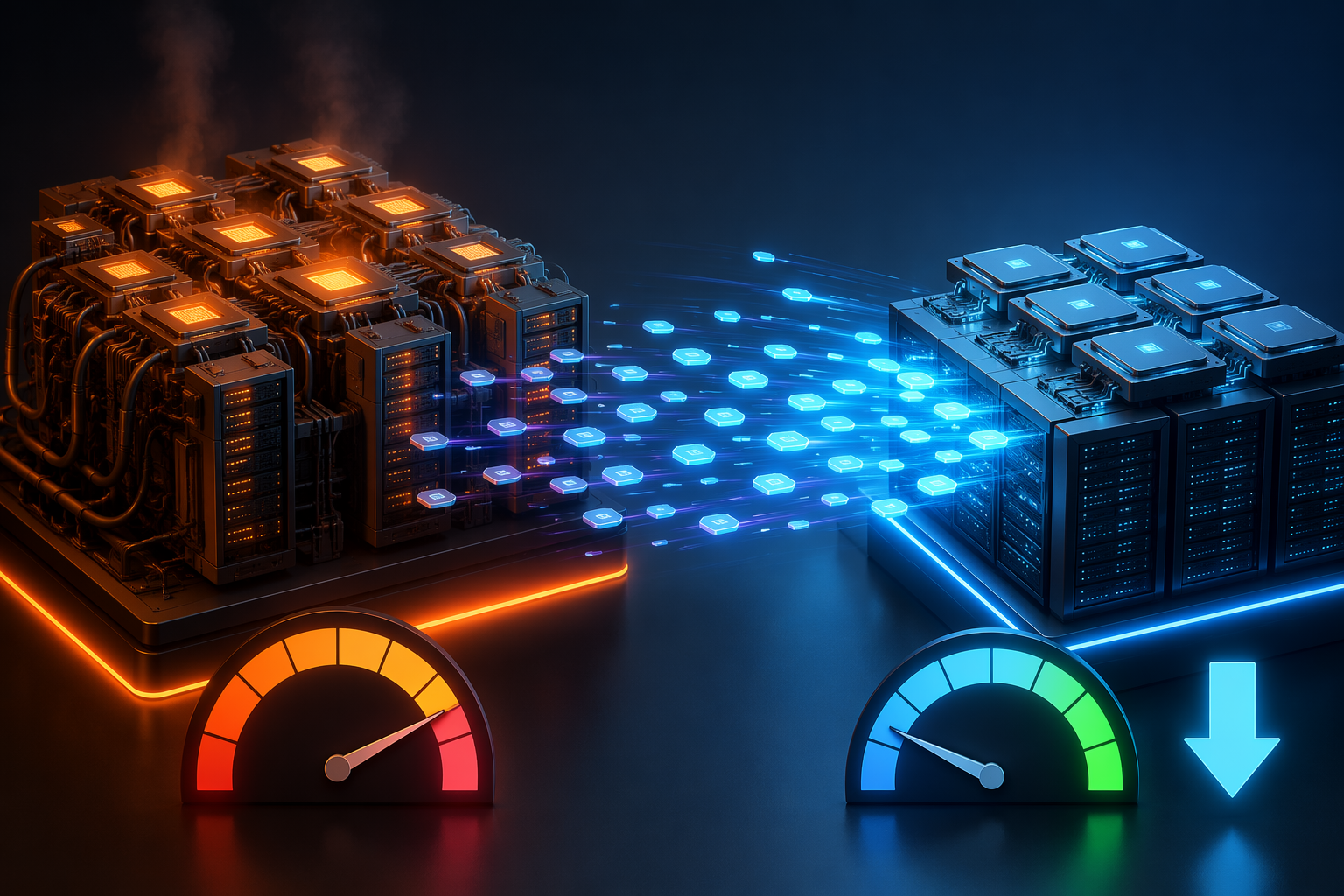
That example deserves attention because it gives managers a scale they can reason from. A vendor spending $2.1 million a month on inference is not deciding between abstract architectures. It is deciding how many generations users can run, how patient users have to be at peak times, how expensive paid plans need to be, and how much room exists for experimentation before the product economics break.
If that monthly bill falls below $700,000, the product team suddenly has a different budget conversation. The savings could support a larger free tier. They could fund faster queues for paid users. They could make it easier to keep existing plan prices stable while adding more capable models. They could also simply improve the vendor’s margin. The important point is narrower than “TPUs make every AI product cheaper.” It is that infrastructure migration can materially change the cost base of an inference-heavy AI service.
There is also a caveat around the evidence. The Midjourney figure is cited through third-party analysis, and the original company-published confirmation was not independently verified in the available research. That makes it a useful case to understand the mechanism, not a universal pricing rule for every AI vendor.
What Lower Inference Costs Can Become for End Users
For a knowledge worker, lower inference cost usually does not arrive as a line item labeled “TPU savings.” It shows up in product behavior. The tool answers faster. The free plan becomes less cramped. The paid plan includes more runs of the better model. A feature that used to be reserved for enterprise users becomes available to smaller teams. Or an agent that previously needed to ask permission after every step can afford to do more background work before returning with a useful result.
Response speed is the most immediate benefit. If a summarizer takes long enough that the team has already moved on, the feature becomes decorative. If a copilot can respond while the user is still in the flow of writing, coding, or reviewing, it has a real chance to change the work pattern. Latency reduction matters because many productivity tasks are conversational: the first answer is rarely the final answer.
Plan stability is the quieter benefit. Teams often do not need an AI vendor to cut the sticker price. They need the vendor to stop narrowing the useful parts of the plan after adoption. When inference is expensive, vendors have strong incentives to move advanced models, larger context windows, or heavy usage into higher tiers. When inference gets cheaper, there is more room to keep capabilities inside existing plans.
Free tiers are where the cost curve becomes especially visible. A generous free tier is not charity; it is a customer-acquisition engine that depends on the vendor’s ability to serve many low- or no-revenue users without losing too much money. Cheaper inference makes broader access more plausible, even if it does not guarantee it.
Agentic workflows raise the stakes because they multiply inference calls. A simple writing assistant may answer once. An agent that researches, compares, drafts, checks, and revises may call the model repeatedly before the user sees the final output. That is why Google’s TPU 8i announcement connects inference efficiency with the agentic era: the more steps a tool takes on a user’s behalf, the more the economics of each step matter.[1]
Productivity Claims Still Need a Budget Filter
The infrastructure story matters because organizations are already trying to justify AI spend with productivity outcomes. Google Cloud’s 2025 ROI of AI report says 52% of executives were deploying AI agents, 39% were seeing productivity at least double, and 70% of leaders reported gains.[3] A separate IDC study commissioned by Google Cloud found that surveyed Google Cloud AI users reported a 36% individual productivity boost, equal to 683 additional hours per year, while organizations achieved an average 727% return on investment over three years with an 8-month payback period.[4]
Those are attention-getting numbers, but they should be used carefully. The IDC study was commissioned by Google Cloud and reflects Google Cloud customers, not an independent audit of every AI tool in the market. The executive survey data also describes reported adoption and reported gains; it does not prove that every organization deploying agents will double productivity.
Still, the numbers help explain why infrastructure efficiency is not just a cloud-provider concern. If a department is paying for AI meeting notes, document drafting, spreadsheet assistance, search, coding support, and customer-service summarization, the renewal question becomes operational: is the tool used often enough, at low enough friction, to change how work gets done? Faster and cheaper inference improves the odds, but it does not replace measurement.
A practical buyer should separate three claims that often get blended together. Adoption means teams are using or deploying AI. Effectiveness means the tool changed output, speed, quality, or capacity. ROI means the value of that change exceeded the cost of licenses, implementation, training, review, and governance. TPU improvements mainly affect the cost and responsiveness side of that equation. They do not automatically solve workflow design, change management, or trust.
How to Watch AI Tool Pricing in Q3 2026
The useful buying move is not to ask whether a vendor uses Google TPUs and stop there. Many products depend on mixed infrastructure, and vendors rarely expose the full cost stack. The better move is to watch whether lower inference costs are showing up in the product terms that affect your team.
- Free-tier limits: Are monthly prompts, generations, meeting hours, or file uploads expanding or shrinking?
- Response speed: Does the tool stay responsive during normal work hours, or does it slow down when the team needs it most?
- Model access: Are stronger models included in the current plan, or are they being moved behind a higher-priced tier?
- Agent features: Does the vendor charge separately for multi-step workflows, or are those capabilities becoming part of the core product?
- Renewal language: Is the vendor raising prices while also tightening usage, or is it adding measurable capacity at the same price?
This is also the right frame for comparing AI productivity suites. A cheaper plan that forces users to wait, ration, or downgrade models may cost more in practice than a more expensive plan that stays fast and available. A higher-priced tool can be worth it if it removes enough manual work. But when vendors claim infrastructure improvements, buyers should expect some visible benefit: more capacity, better latency, broader access, or a clearer reason the price is not moving.
Google’s TPU 8i does not guarantee cheaper AI subscriptions. It does change the economics underneath the tools. The credible claim is that better inference hardware puts downward pressure on the cost of serving AI features, and that pressure can turn into faster responses, more stable paid tiers, expanded free usage, or more capable agents. In Q3 2026, that is enough reason to read AI tool updates and renewal quotes with sharper questions.
References
- Google Cloud’s eighth-generation TPU for the agentic era, Google, April 2026
- Google TPU vs NVIDIA GPU: Infrastructure Decision Framework 2025, Introl
- ROI of AI: How agents help business, Google Cloud, 2025
- How businesses achieve strong ROI with Google Cloud AI, Google Cloud, July 2025
Comments
Join the discussion with an anonymous comment.