
The widely circulated list of Goldie Hawn mindfulness habits for focus and calm needs a correction before it can become a routine. Hawn is directly reported as practicing Transcendental Meditation. The familiar five-part list—breathing, movement, noticing, gratitude walks, and guided meditation—comes from mindfulness teacher Susan Kaiser Greenland, whose advice appeared in the same CNN feature. Those techniques should not be repackaged as Hawn’s daily habits.[1]
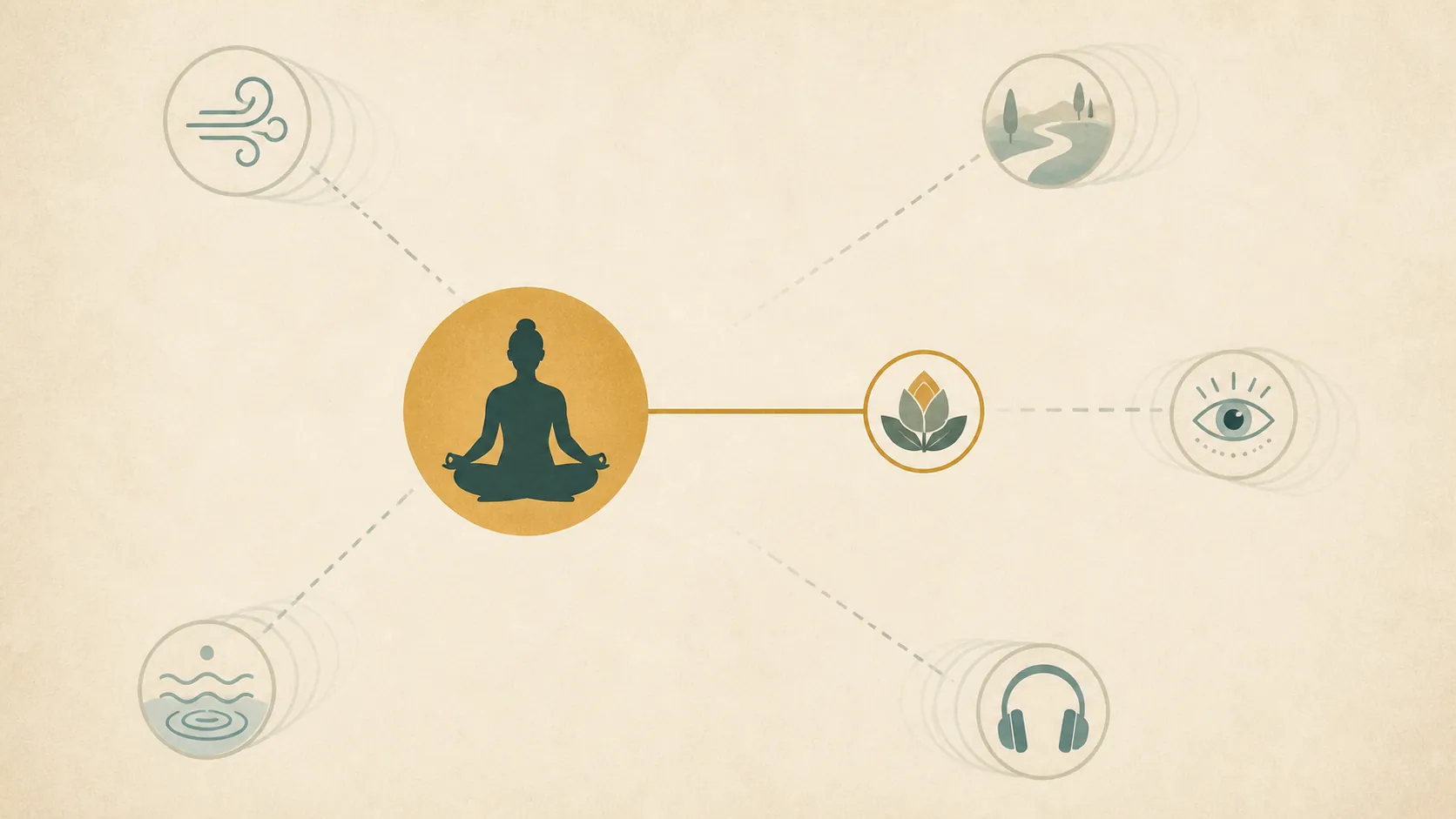
| Practice or claim | Source status | What can responsibly be said |
|---|---|---|
| Transcendental Meditation | Verified as Hawn’s practice | Hawn reported learning it under Maharishi Mahesh Yogi after seeking therapy.[1] |
| Breathing, movement, noticing, gratitude walks, and guided meditation | Not verified as Hawn’s habits | These techniques were presented by Susan Kaiser Greenland in the CNN feature.[1] |
| A routine “for focus and calm” | Editorial | This is a practical organizing frame, not language or a protocol attributable to Hawn. |
| MindUP exercises | Separate school-program context | MindUP is a child- and school-oriented curriculum, not evidence of Hawn’s personal adult routine.[1][2] |
How the attribution drift happened
The confusion is understandable because the material sits close together. CNN’s feature discusses Hawn, her experience with meditation, and her education work. It also includes practical mindfulness suggestions from Kaiser Greenland. Once that article is compressed into a listicle or copied without speaker labels, proximity begins to look like authorship.
But the distinction changes what the list means. Hawn’s reported history supports one personal contemplative practice: Transcendental Meditation, commonly abbreviated as TM. Kaiser Greenland is the source attached to the five other techniques. The latter may still be useful, but usefulness does not transfer ownership.

Hawn’s biography also resists the cleaner story told by many celebrity-wellness summaries. She described panic attacks beginning in childhood, later sought therapy, and then learned TM under Maharishi Mahesh Yogi.[1] Meditation appears in a sequence of care; it does not appear as a solitary cure that made clinical support unnecessary.
That sequence is more informative than a borrowed collection of tips. It shows why her experience cannot responsibly be converted into a universal anxiety protocol. It also sets a boundary for anyone building a routine from it: meditation can be included alongside appropriate care, but this source does not support using it to replace therapy or other clinical help.
What is actually known about Hawn’s meditation habit
The verified record is narrow. It establishes the type of practice and the teacher associated with Hawn’s introduction to it. It does not establish a daily duration, weekly frequency, preferred time, breathing count, posture, body cue, or detailed sequence.[1]
Those missing details should remain missing. Supplying a plausible morning schedule or a neat set of instructions would create a more satisfying celebrity routine, but it would no longer be a sourced account of what Hawn does. It would also risk presenting generic meditation guidance as instructions for TM, a named practice whose method is not described in the available material.
The same restraint applies to the phrase “emotional vaccine,” which Hawn used while discussing mindfulness for children.[1] It is vivid promotional language, not a clinical finding. It should not be read as evidence that meditation prevents a mental-health condition, confers immunity, or produces a medically established protective effect.
A source-tagged routine you can actually use
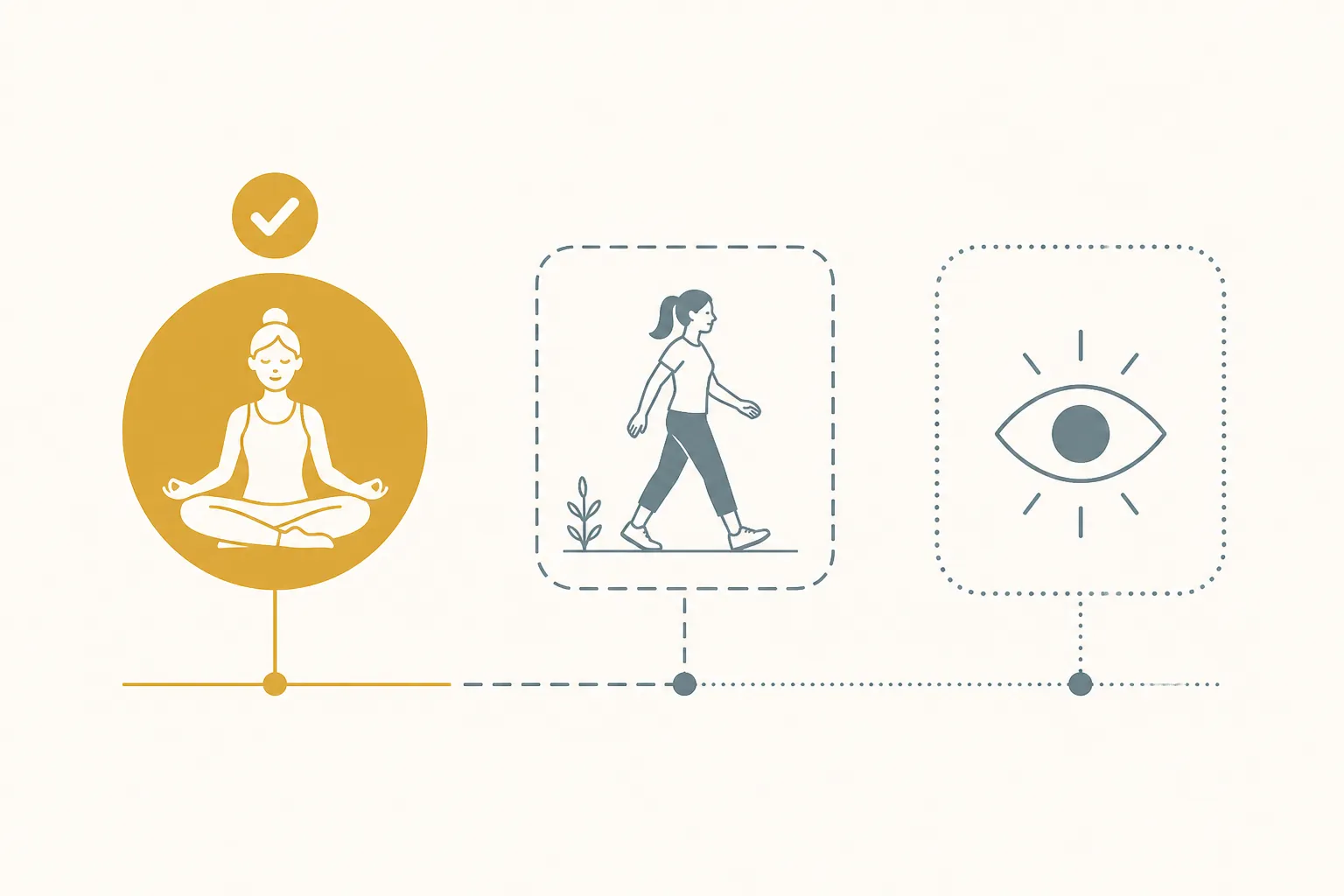
A workable routine does not have to pretend that all its parts came from Hawn. It can begin with the one verified anchor, keep optional practices under their real source, and label the method of arranging them as editorial.
| Place in the routine | Action | Label |
|---|---|---|
| Anchor | Use Transcendental Meditation if it is a practice you have learned from an appropriate source. No duration or frequency is prescribed here. | Verified as Hawn’s practice; implementation details not verified |
| Optional addition | Choose one of the breathing, movement, noticing, gratitude-walk, or guided-meditation practices and follow instructions from a clearly identified teacher or resource. | Associated with Susan Kaiser Greenland in the source; not verified as Hawn’s habit |
| Placement | Decide in advance when the anchor and any optional addition fit into your day rather than implying that Hawn follows the same schedule. | Editorial |
| Observation | Afterward, make a brief note about whether attention or felt calm changed, stayed the same, or became harder to assess. | Editorial self-observation; not a clinical test |
| Review | Keep, remove, or move an optional element based on whether it is workable, while preserving any clinical care you need. | Editorial |
For someone who already practices TM, the anchor is straightforward: continue the practice as it was taught rather than replacing those instructions with an online reconstruction. For someone who has not learned it, the available reporting is insufficient to teach the method. The honest next step is to find an appropriate instructional source, not to fill the gap with invented mantra, timing, or breathing directions.
The optional addition should remain visibly separate. A person might choose mindful movement because sitting is difficult, or a gratitude walk because walking already has a place in the day. Those are ordinary editorial reasons for assembling a personal routine. They are not evidence that Hawn makes the same choice.
Nor does the source material provide enough instruction to recreate Kaiser Greenland’s techniques in detail. The labels indicate the kind of practice discussed, but they do not verify counts, session lengths, movement sequences, or bodily cues. If a specific exercise is added, its instructions should remain attached to the teacher or publication that actually supplies them.
MindUP and the book do not fill in the missing personal routine
Hawn’s MindUP work provides evidence of advocacy and program development, but it answers a different question. The Aspen Institute described MindUP as a school-based curriculum organized around four pillars and reported that it had served more than 400,000 children by 2014.[2] CNN later relayed a claim involving a study of 200,000 children and reported benefits, but the feature did not provide the study design or effect sizes needed to evaluate that claim fully.[1]
Neither figure establishes an adult habit followed by Hawn. Program reach measures adoption, not effectiveness, while a reported finding in children cannot quietly become evidence for an improvised adult routine.
The bibliographic record for Hawn’s book 10 Mindful Minutes identifies a 288-page Hachette UK publication from 2011 and describes an audience that includes children and adults seeking to reduce stress and anxiety.[3] Metadata can establish what the book is and how it is presented; it cannot establish which exercises appear inside it. It therefore cannot be used to recover the missing steps of a supposed Hawn routine.
Does mindfulness improve focus?
The evidence supplied for attention does not permit a clean yes-or-no answer. TIME reported neuroscientist Amishi Jha’s research as showing that mindfulness strengthens attention among adults under high stress, including military populations. The account did not provide study designs or effect sizes, so it communicates a positive research conclusion without enough detail to estimate the size or reliability of the effect.[4]
A randomized trial in PLOS One points in a less encouraging direction. It compared an eight-week Mindfulness-Based Stress Reduction program with an active Health Enhancement Program control and found no sustained-attention difference. The analysis included 29 participants in the mindfulness group and 25 in the control group, and the study was powered only to detect a very large standardized effect of about d = 1.73.[5]
That null result should not be translated into proof that mindfulness has no effect on attention. A trial designed to detect only a very large effect can miss smaller differences. At the same time, the positive TIME account should not be inflated into a guaranteed focus benefit when its underlying designs and effect sizes are absent from the report. The populations, interventions, and claims are not interchangeable, and the material here does not contain review-level evidence capable of resolving the disagreement.
For the routine above, “focus and calm” is therefore a purpose to explore, not a promised outcome. A personal note about feeling more settled or attentive can help decide whether the arrangement is workable, but it does not establish treatment effectiveness or reproduce a sustained-attention test.
Who should not treat this as a self-help substitute
This setup is unsuitable for anyone looking for an official Goldie Hawn method; the evidence supports one Hawn practice, not a complete branded system. It is also unsuitable as a reason to stop or avoid needed clinical support. Hawn’s own account places therapy before her adoption of TM, making meditation part of a broader history of care rather than a replacement for it.[1]
The cited material does not provide an evidence-based list of adverse effects or contraindications, so no claim of universal safety follows from their absence. If panic, anxiety, or other symptoms are persistent, worsening, or interfering with daily life, the source-honest reading of Hawn’s experience is to preserve clinical support while treating meditation only as a possible complement.
What remains is modest but usable: TM as the sole verified Hawn anchor, Kaiser Greenland’s techniques as separately credited options, and any schedule or self-observation method clearly marked as editorial. The routine gains credibility by keeping those labels intact, not by enlarging one documented practice into a celebrity system.
References
- Mindfulness for kids: Goldie Hawn on the power of the practice, CNN, July 6, 2022
- Goldie Hawn Discusses Mindfulness, Importance of Neuroscience in Education, Aspen Institute, December 19, 2014
- 10 Mindful Minutes, Google Books, 2011
- Goldie Hawn and Amishi Jha on the Power of Mindfulness, TIME
- No Sustained Attention Differences in a Longitudinal Randomized Trial Comparing Mindfulness Based Stress Reduction versus Active Control, PLOS One
Comments
Join the discussion with an anonymous comment.