
The best Gen X retirement planning tips do not start with another lecture about discipline. They start with a more useful question: what parts of your retirement plan should stop depending on you remembering to do the right thing every payday?
That matters because many Gen Xers are not ignoring retirement. They are managing too many open loops at once: parent care, kids in or near college, housing costs, health expenses, debt payments, and careers that may not run neatly to age 67. A plan that requires fresh motivation every month is badly designed for that environment.
The gap is real. The National Institute on Retirement Security reported median retirement savings of $40,000 for Gen X households, which is not a comfortable starting point for people now in their late 40s, 50s, and early 60s.[1] But that number should not be used as a panic button and then followed by the useless instruction to “save more.” The practical question is how to build a system where more saving, debt cleanup, health-cost funding, and portfolio maintenance happen with less manual handling.

Build the retirement workflow before debating the perfect number
Retirement estimates can be useful, but they are often presented as if a single large number explains everything. It does not. Different surveys ask different questions, use different assumptions, and capture different populations. The number that matters operationally is the one your current payroll, benefits, debt payments, and investment accounts can begin moving toward now.
There is also evidence that Gen X is already doing more than the scolding version of the story suggests. Fidelity reported that Gen X workers were saving an average of 15.4% of pay, including employer contributions, which is slightly above Fidelity’s own 15% guideline.[2] That does not erase the late-start problem. It does change the diagnosis. For many households, the issue is not laziness; it is that the system started too late, leaks cash into debt, and relies on too many manual decisions.
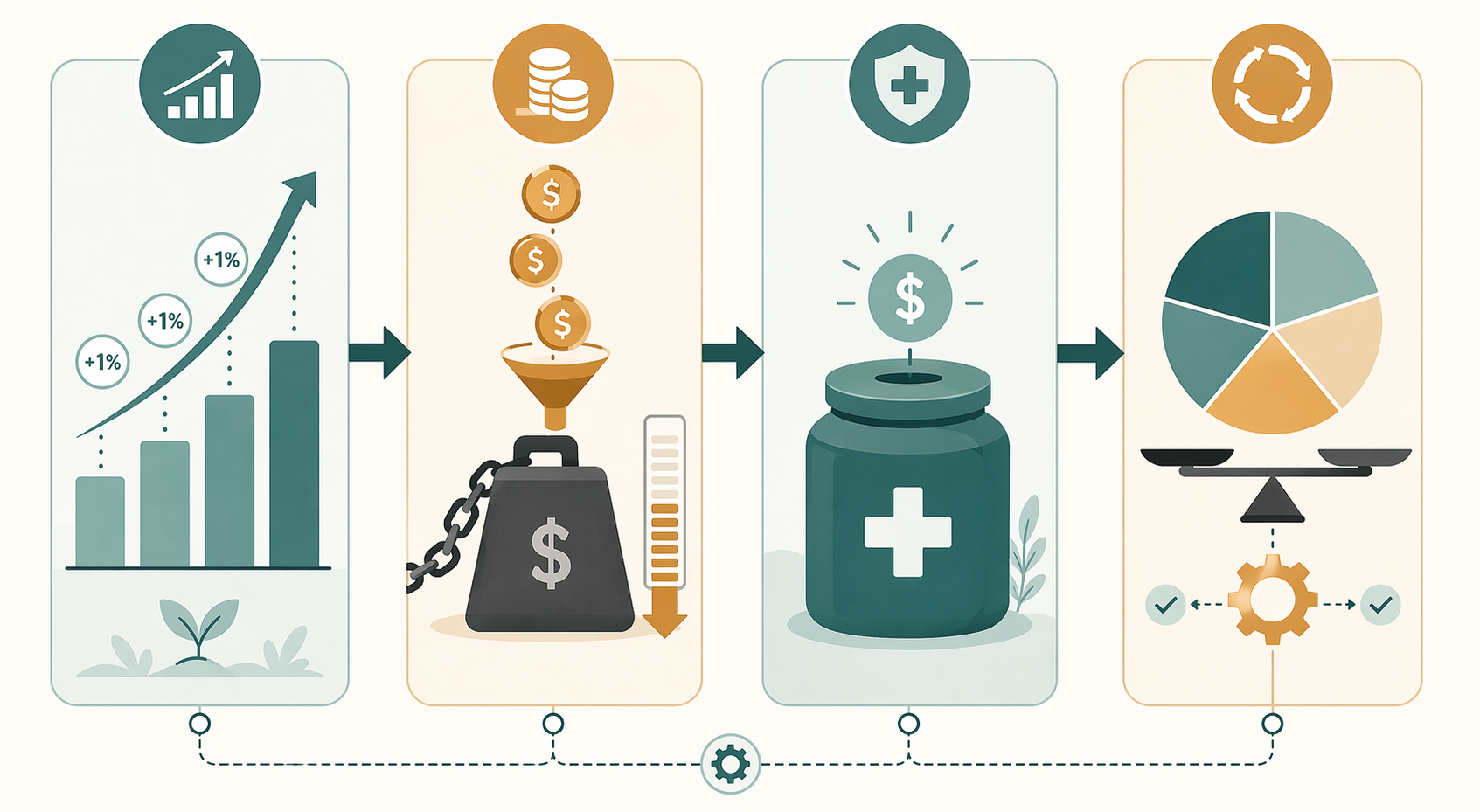
The retirement workflow has four jobs:
- Escalate retirement savings automatically, preferably through payroll.
- Automate debt payoff and redirect freed payments instead of letting them disappear into the checking account.
- Automate HSA contributions when you are eligible and can afford to use the account strategically.
- Use rebalancing triggers so portfolio maintenance does not become another postponed chore.
Pillar 1: Put savings increases on rails
If your 401(k), 403(b), or similar workplace plan offers automatic enrollment, automatic escalation, or a scheduled contribution-rate increase, those settings deserve priority over another spreadsheet. Defaults change behavior because they remove a decision point. Wells Fargo data cited by Benefit News found that auto-enrollment raises plan participation to about 85%.[3] That is what a useful default does: it moves the routine closer to the desired behavior before willpower gets involved.
Start with the match if you are not already getting it. Employer matching dollars are one of the few retirement-planning areas where the operational choice is usually simple: contribute enough to capture the full match unless your cash-flow situation makes that impossible. After that, schedule increases rather than promising yourself you will revisit the decision later.
The cleanest version is the 1% Rule: raise your contribution rate by 1 percentage point on a recurring schedule. Many workplace plans let you set this annually. If yours does not, create a calendar task tied to a predictable event, such as your annual raise cycle, open enrollment, or the first pay period of January. The point is not that 1% is magic. The point is that a small increase you actually schedule beats a larger increase you admire and never implement.
| If this is your current state | Set this default |
|---|---|
| You are below the employer match | Increase your contribution enough to capture the full match first. |
| You are getting the match but below your target rate | Turn on annual auto-escalation, commonly in 1 percentage-point steps if your plan allows it. |
| You receive annual raises or bonuses | Pre-decide what share goes to retirement before the money lands in checking. |
| You are age 50 or older | Check the current IRS catch-up limit inside your payroll or plan portal before setting the year’s contribution target. |
| You change jobs | Confirm the new plan’s enrollment, match, contribution rate, investment default, and old-account rollover decision within the first month. |
The job-change line matters more than most retirement articles admit. Gen X careers have rarely been one clean ladder, and every transition creates a small retirement-system failure point: old 401(k) left behind, new plan contribution set too low, beneficiary missing, asset allocation duplicated by accident. Treat a job change like an app migration. The new system is not live until the essential settings are checked.
Consistency also shows up in the data. Fidelity reported that Gen X workers who remained in the same 401(k) plan for 15 years had average balances of about $700,000.[2] That is not a promise that staying with one employer causes a specific balance. It does show what uninterrupted contributions, market exposure, and plan continuity can look like over a long enough runway.
What to check in the plan portal
- Current employee contribution rate.
- Employer match formula and whether you are capturing all of it.
- Auto-escalation availability and the next scheduled increase date.
- Traditional versus Roth contribution options, if both are available.
- Catch-up contribution settings if you are eligible.
- Default investment, target-date fund selection, or managed-account setting.
- Beneficiary information.
Pillar 2: Turn debt payoff into a retirement feeder system
Debt is not a side issue for Gen X retirement planning. Experian reported that Gen X carried average non-mortgage debt of $30,879 in 2024, the highest average among generations.[4] That number helps explain why a household can be saving a respectable percentage of pay and still feel stuck. Retirement contributions and debt payments are competing for the same cash-flow lane.
The system needs two parts: reliable minimum-payment protection and an intentional payoff lane. Minimum payments should be automated to avoid late fees, penalty rates, and credit damage. Extra payments should be scheduled separately, aimed at the debt method you choose. The method matters less than whether it is actually wired into the calendar.
| Debt workflow decision | Automation setup |
|---|---|
| Avoid missed payments | Turn on autopay for at least the minimum on every debt account. |
| Choose payoff order | Use avalanche for highest interest rate first or snowball for smallest balance first. |
| Schedule extra principal | Set a recurring payment shortly after payday instead of waiting for leftover money. |
| Capture paid-off payments | When one balance reaches zero, redirect that old payment to the next debt or to retirement contributions. |
| Prevent backsliding | Use a budget app or banking alerts to flag new revolving balances before they become normal. |
The redirect step is where many plans leak. Suppose a card payment disappears after the balance is paid off. If nothing is scheduled, the checking account quietly absorbs the freed cash. That feels like breathing room, and sometimes breathing room is necessary. But if the household can afford it, the better workflow is to preassign that former payment before it becomes lifestyle drift.
A simple rule works: every time a non-mortgage debt is paid off, decide within the same week where that payment goes next. It can go to the next debt, to the emergency fund, to the 401(k) contribution rate, to an IRA transfer, or to HSA contributions. What should not happen is a three-month delay while everyone is “thinking about it.” That is how open loops win.
A practical payoff pipeline
- List every non-mortgage debt with balance, rate, minimum payment, due date, and autopay status.
- Turn on minimum-payment autopay for each account.
- Pick one target debt for extra payments.
- Schedule the extra payment for the same pay cycle each month.
- Create a “payment freed” reminder for the month the debt is expected to be paid off.
- Redirect the old payment immediately when the balance hits zero.
This is not a moral cleanup project. It is cash-flow routing. The fewer times you have to reopen the same decision, the more likely the system is to keep working during a bad month.
Pillar 3: Automate HSA contributions if the account fits your health plan
A health savings account can be valuable for eligible people, especially in the years when health costs begin moving from an occasional nuisance to a recurring line item. The catch is that HSAs only apply when you are enrolled in a qualifying high-deductible health plan. If that is not your setup, this pillar does not apply.
If you are eligible, the automation question is straightforward: can contributions come out of payroll, and can the balance above a cash threshold be invested automatically? Payroll contributions are cleaner than ad hoc transfers because they run before the money reaches checking. Some HSA platforms also allow automatic investment once the cash balance exceeds a set amount.
- Check whether your health plan is HSA-eligible.
- Set a per-paycheck contribution rather than relying on occasional manual deposits.
- Decide how much cash to keep available for near-term medical bills.
- If the platform allows it, turn on automatic investment for dollars above that cash threshold.
- Store receipts in a consistent digital folder or inside the HSA platform if reimbursement tracking is part of your plan.
This does not need to become a tax seminar. The working distinction is enough: money you expect to use soon should not be treated the same way as money you can leave invested for later health expenses. The account settings should reflect that difference.
Pillar 4: Use rebalancing triggers instead of portfolio babysitting
Portfolio maintenance is another place where good intentions turn into stale settings. A Gen Xer who set a 401(k) allocation years ago may now have a mix that no longer matches their time horizon, risk tolerance, or other accounts. The fix is not to stare at the market every week. It is to decide what will trigger a review.
Some workplace plans, target-date funds, managed accounts, and robo-advisors handle rebalancing automatically. If you want the investment side to require less attention, that feature is worth looking for directly. Readers comparing outsourced investment tools may also want to review which robo advisor saves more time before adding yet another app to the stack.
| Trigger | What it should prompt |
|---|---|
| Annual or semiannual review date | Confirm asset allocation, contribution rate, fees, beneficiaries, and account locations. |
| Major market movement | Check whether your allocation has drifted far enough to rebalance under your plan’s rules. |
| Job change | Review new plan settings, old 401(k) options, and rollover choices. |
| Debt paid off | Redirect the freed payment to the next priority. |
| Raise, bonus, or promotion | Increase contribution rates before the higher income becomes the new baseline. |
| Five years from expected retirement | Review cash needs, investment risk, Social Security timing, and health coverage assumptions. |
The point of triggers is to reduce random checking. A review that happens because the calendar, payroll, or account balance calls for it is easier to sustain than a vague plan to “stay on top of things.”
Most Gen Xers are running this without an advisor
Only 26% of Gen Xers work with a financial advisor, according to Schroders’ 2025 U.S. Retirement Survey.[5] That means a large share of households are effectively acting as their own retirement operations team. They may not need a 40-page plan, but they do need a control panel.
A workable control panel does not have to be elaborate. It can be a budget app, a net-worth tracker, a spreadsheet, or the dashboard inside your financial institution. The tool matters less than whether it shows the few numbers that change decisions.
- Retirement contribution rate by account.
- Employer match status.
- Retirement balance trend.
- Debt balances and payoff order.
- Emergency fund balance.
- HSA contribution and investment status, if eligible.
- Asset allocation across all investment accounts.
If you do work with an advisor, this same dashboard makes the meetings better. Instead of spending half the session reconstructing what happened, you can use the time on decisions: contribution increases, Roth versus traditional tradeoffs, debt acceleration, Social Security timing, and risk level.
Social Security is a planning lever, not the whole plan
Social Security timing belongs in the system, but not as a substitute for the four automation pillars. AARP notes that delaying benefits from age 62 to 67 can increase monthly benefits by about 30%, and delaying from 67 to 70 can add roughly another 24%.[6] Those percentages are meaningful, but the right claiming age depends on health, work options, spouse or survivor considerations, cash needs, and other assets.
For the workflow, the useful move is to add a Social Security review trigger. Put it on the calendar before the first possible claiming age, then revisit it as retirement gets closer. If there is already an issue with timing or payment, keep the administrative path handy:contact Social Security about a delayed benefit.
The setup sequence
Do not try to rebuild your entire retirement life in one afternoon. Set up the defaults in the order that removes the most future decisions.
- Open your payroll or retirement-plan portal. Confirm your contribution rate, employer match, auto-escalation option, investment default, beneficiary, and catch-up eligibility.
- Turn on auto-escalation or create a recurring calendar reminder to raise contributions by a set amount on a set schedule.
- List non-mortgage debts and turn on minimum-payment autopay for each one.
- Choose one debt for extra payments and schedule those payments shortly after payday.
- Create a redirect rule for paid-off debt: next debt, emergency fund, 401(k), IRA, or HSA.
- If eligible for an HSA, set payroll contributions and decide whether any balance above a cash threshold should be invested automatically.
- Check whether your investment accounts rebalance automatically through target-date funds, managed accounts, robo-advisors, or plan settings.
- Choose one dashboard for tracking retirement balances, debt payoff, contribution rates, HSA status, and net worth.
- Schedule a quarterly cash-flow review and an annual retirement-settings review.
After setup, the human job is smaller but still important. You review the exceptions: income changes, debt paid off, plan changes, investment drift, health-plan changes, and Social Security timing. The background machinery handles the repeating work.
Gen X catch-up is hard. It is harder when the plan depends on memory, mood, and a quiet weekend that never arrives. The enemy is not a lack of seriousness. It is a retirement plan that still runs on attention.
References
- The Forgotten Generation: Generation X Approaches Retirement, National Institute on Retirement Security.
- Gen X retirement guide, Fidelity.
- Wells Fargo: Auto-enrollment raises retirement plan participation, Benefit News.
- Average Debt by Generation, Experian, 2024.
- Generation X and Retirement, Schroders, 2025.
- Gen Xers Can Take These Steps Now to Prepare for Retirement, AARP.
Comments
Join the discussion with an anonymous comment.