
At 10:17 a.m., one email lands badly. Or one meeting gets tense. Or one small miss in a shared document makes you look less prepared than you wanted to look. The event itself may take five minutes. The replay takes the afternoon.
You open the next task, but some part of your mind is still litigating the last one. You revise the sentence you should have said. You imagine how the other person read your tone. You decide, quietly and without evidence, that this is what you always do. The workday has not exploded. It has been colonized.
That is where Federer’s advice becomes useful for productivity. Not with becoming an elite athlete. Not with pretending the mistake did not matter. With one narrower question: how do you keep the next hour from becoming a referendum on the last five minutes?

The 54% Line That Makes the Whole Day Feel Different
In his 2024 Dartmouth commencement address, Roger Federer told graduates, “I want to let you in on a little secret: I only won 54% of the points I played.” He was referring to 1,526 singles matches across his career, by his own account, and used the number to make a point that is easy to miss if you only remember the trophies: even dominant performers lose constantly inside the larger win.[1]
That number is doing more than offering a neat sports fact. It punctures the hidden assumption that a successful day should feel clean. Federer could win a match while losing nearly half the points. A knowledge worker can have a useful day that contains an awkward message, a poor answer, a missed detail, or a meeting that should have gone better.
Federer’s phrasing matters because it is not a poster on a gym wall. “When you’re playing a point, it is the most important thing in the world,” he said. “But when it’s behind you, it’s behind you.” He added that this mindset “frees you to fully commit to the next point.”[1]
There is a discipline in that, but not the brittle kind. The point matters while it is alive. Then it has to stop having voting rights over the next point. That distinction is where Federer’s advice becomes useful outside tennis: focus is not only the ability to care. It is the ability to stop caring in time.
It also helps that Federer did not present calm as an inborn personality trait. In coverage of the same speech, Fortune quoted him saying he “spent years whining, swearing, throwing my racket before I learned to keep my cool.”[2] That detail matters for anyone whose current reset style is less elegant. The skill was trained. It was not simply bestowed.
Rumination Is a Task Switch That Pretends to Be Problem-Solving
The mind has a persuasive argument for replaying the mistake: if you examine it one more time, maybe you will prevent the next one. Sometimes that is true. A missed deadline may need a changed workflow. A harmful comment may need repair. A serious failure may deserve a real conversation, not a breathing exercise.
But the ordinary Tuesday version is often less productive than it feels. You are not solving the problem; you are keeping the problem open while trying to do unrelated work. That creates a cognitive split: the document in front of you gets part of your attention, and the earlier exchange keeps asking for the rest.
The American Psychological Association’s overview of multitasking research describes the costs that come from switching between tasks, especially when the tasks are complex or unfamiliar. It notes that even brief mental shifts can accumulate, and cites estimates that switching costs can take as much as 40% of productive time.[3]
That 40% figure should not be treated as a universal meter running on every human brain. It is a caution sign, not a law of physics. Still, it names something recognizable: attention does not move as cleanly as a cursor. A tense email can become an involuntary background task. A bad meeting can remain open like a tab with audio playing somewhere you cannot find.
Neuropsychologist Judy Ho made a related point in CNBC’s coverage of Federer’s speech, saying that fixation on setbacks “encourages self-criticism and a pessimistic inner monologue that prevents moving forward.”[4] That is the escalation perfectionists know well. The first thought is, “That went badly.” The second is, “I should fix the pattern.” The third is, “This says something about me.”
The damage is not only lost minutes. It is the conversion of a small event into an identity verdict. Once that happens, the next task is no longer just the next task. It becomes a trial in which you are trying to prove you are competent again.
A Four-Step Reset for the Next Point
Federer did not hand Dartmouth graduates a workplace protocol. The steps below are a practical translation of his reset language into the kind of moment that happens between calendar blocks. Use it for micro-losses: the awkward exchange, the minor error, the disappointing update, the small rejection. Do not use it to minimize trauma, chronic overload, harassment, or a workplace problem that needs escalation.
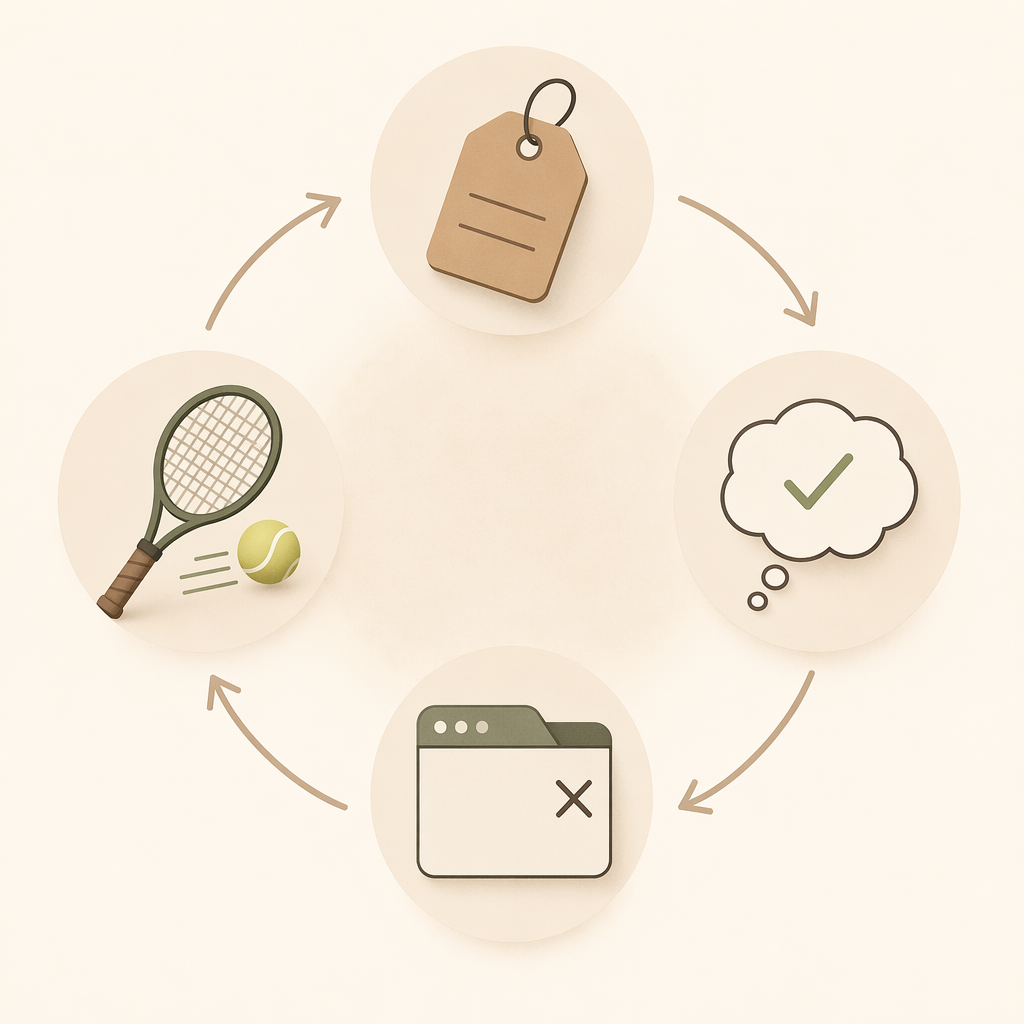
| Step | What You Do | What It Prevents |
|---|---|---|
| Label the loss | Name the setback in one plain sentence. | Turning a specific event into a vague threat. |
| Process briefly | Give the reaction a short, bounded window. | Confusing emotional suppression with recovery. |
| Close the mental tab | Choose the next action and park any real follow-up. | Letting the old task run in the background. |
| Recommit to the next point | Bring full attention to the next controllable move. | Working while half-defending yourself from the past. |
1. Label the Loss
A setback becomes harder to manage when it stays foggy. “Everything is off today” is too large to recover from. “I sounded defensive in the 10 a.m. meeting” is workable. “I missed one number in the client deck” is workable. “My manager asked a sharp question and I froze” is workable.
The label should be brief enough that it cannot become an essay. One sentence is usually enough:
- “I sent a rushed reply and the tone may have landed badly.”
- “I missed the chance to clarify the deadline.”
- “I lost my thread during the update.”
- “I got corrected in public and I am embarrassed.”
This is not positive thinking. It is containment. The mind is less likely to treat the moment as a general emergency once it has been named as a specific loss.
2. Process Briefly
Federer’s Dartmouth advice included room for reaction: “cry it out if you need to.”[1] That clause is easy to skip, but it keeps the reset from becoming emotional denial. Some points sting. Some work moments are embarrassing. Some criticism hits a real insecurity. Pretending otherwise often extends the residue rather than ending it.
The practical move is to give the reaction a boundary. Take two minutes after the meeting. Walk to refill water. Write the unfiltered version in a private note and do not send it. Put one line in a task manager if there is a concrete repair to make. The key is that processing has a job: absorb the emotional hit and identify any necessary follow-up.
A useful brief processing window answers three questions:
- What happened, without the character judgment?
- Is there a repair, clarification, or lesson that belongs on a list?
- What am I doing next?
If the answer to the second question is yes, capture it. If the answer is no, do not keep interrogating the moment in hopes that a more satisfying version of the past will appear.
3. Close the Mental Tab
This is the step most people think they have done when they have only decided they should do it. Closing the mental tab is not saying, “I need to move on.” It is removing the old point from active working memory by giving every legitimate remnant a place to live.
If the tense email needs a repair, schedule the repair. If the missed detail needs a correction, write the correction task. If the meeting raised a real concern, block time to think about it later. If there is no next action, say that explicitly: “No action. Discomfort only.”
That last phrase may sound blunt, but it is often the difference between recovery and disguised rumination. The brain keeps reopening the tab because it suspects there is unfinished business. Your job is to separate unfinished business from unfinished feelings.
A simple closure script can be enough:
The point I lost: ________
The follow-up, if any: ________
The next point: ________
For the next 25 minutes, this is the match.
The time window does not have to be 25 minutes. It can be the next email, the next slide, the next customer reply, the next paragraph. The important part is that the next unit is small enough to fully inhabit.
4. Recommit to the Next Point With Full Intensity
Federer’s line works because it does not make the previous point meaningless. It makes the next point eligible for full attention. At work, recommitting means choosing the next controllable action and making it specific enough that attention has somewhere to land.
“Get back on track” is too vague. “Draft the opening three bullets for the proposal” is better. “Fix the budget tab formula” is better. “Reply to Priya with the revised deadline and one sentence of context” is better. A concrete next point reduces the temptation to keep checking whether you feel recovered yet.
This is also where Federer’s other Dartmouth line has teeth: “Negative energy is wasted energy. You want to become a master at overcoming hard moments. That to me is the sign of a champion.”[1] In a workday, negative energy is not morally wrong. It is expensive. If it teaches you something, take the lesson. If it only keeps charging rent, close the tab.
What This Does Not Fix
A reset protocol is not a substitute for accountability. If the same person keeps derailing your work with vague demands, that is not just your attention problem. If the workload is impossible, focusing harder will not make it honest. If the mistake caused real harm, a two-minute reset may help you act, but it does not replace repair.
The protocol is for the recoverable moments that otherwise recruit the rest of the calendar. It is for the point that is already over but still trying to manage the next one. It gives you a way to respect the setback without letting it become the day’s operating system.
The Next Recoverable Moment
The useful lesson in Federer’s 54% rule is not that losing points is charming in hindsight. It is that the match still requires the next point. The same is true at 10:17 a.m., after the message lands wrong and the mind starts building a courtroom around it.
Label the loss. Process briefly. Close the mental tab. Recommit to the next point. That next point may be an email, a document, a meeting, or one protected block of attention. It does not need to redeem the whole morning. It only needs to stop the last five minutes from taking the rest of the day.
If you want to go deeper into the attention side of this, read science-backed techniques for deep work. For the emotional-regulation side, mental health tips that improve focus and productivity is the better next read. And if your day feels fragmented for reasons larger than one bad moment, the broader workplace context is covered in the real personal productivity crisis.
References
- 2024 Commencement Address by Roger Federer, Dartmouth, June 2024.
- Roger Federer gave grads brutally honest advice on what it takes to win: ‘I spent years whining, swearing, throwing my racket before I learned to keep my cool’, Fortune, June 11, 2024.
- Multitasking: Switching costs, American Psychological Association.
- Roger Federer shared his best advice for being resilient at Dartmouth commencement, CNBC, June 27, 2024.
Comments
Join the discussion with an anonymous comment.