
The expensive part of a loose family business org chart is rarely the diagram itself. It is the hour an employee waits because one sibling approved a purchase, another sibling wants it delayed, and a parent still expects to be asked before anyone commits. It is the non-family manager who stops deciding because a cousin might reverse the decision after dinner. It is the assistant quietly reconciling three versions of the same instruction.
That is why, when owners ask how to structure a family business org chart for productivity, the real question is not “Where do we put the boxes?” The better question is: “Can one employee tell who manages them, who advises them, who owns the final decision, and what role family status plays in any of it?”
There is evidence that this ambiguity carries a measurable cost. Buchanan, Liljeblom, Martikainen, and Nikkinen found that family-managed SMEs in their Finnish manufacturing sample were 3.5–5% less productive than comparable non-family-managed firms, with the worst drag appearing when two or three family owners were involved in daily operations; the same study found that an external non-family Chair or CEO could neutralize the effect.[1] That finding should not be treated as a universal calculator for every family company. The study used 801 firm-years from Finnish manufacturing SMEs between 2005 and 2013.[1] But the pattern will feel familiar in many growing firms: productivity suffers when ownership, family authority, and operating authority all speak through the same hallway.
The survival stakes are not theoretical either. Richter notes the widely cited family-business pattern that only about 30% of family businesses successfully transition to the second generation, and points to organizational structure as one of the practical issues that can either support or strain that transition.[2] A founder can carry a lot by memory and instinct. A second generation usually cannot scale that same arrangement without turning every exception into a family meeting.
Start With the Three Roles People Keep Mixing Together
A family business org chart becomes useful when it stops pretending that every person has only one identity. A daughter may be a shareholder, a sales manager, a potential successor, and a family council participant. An uncle may own shares but hold no operating role. A non-family CFO may run finance but have no ownership vote. The chart has to make those distinctions visible before daily work can move cleanly.
The most practical map for this is the three-circle model developed by Renato Tagiuri and John Davis at Harvard Business School in 1978. It separates the family business system into family, ownership, and business circles, with seven possible overlapping interest groups.[3] Its value is not that it looks elegant on a slide. Its value is that it explains why two people can both be “family” and still need entirely different authority in the company.
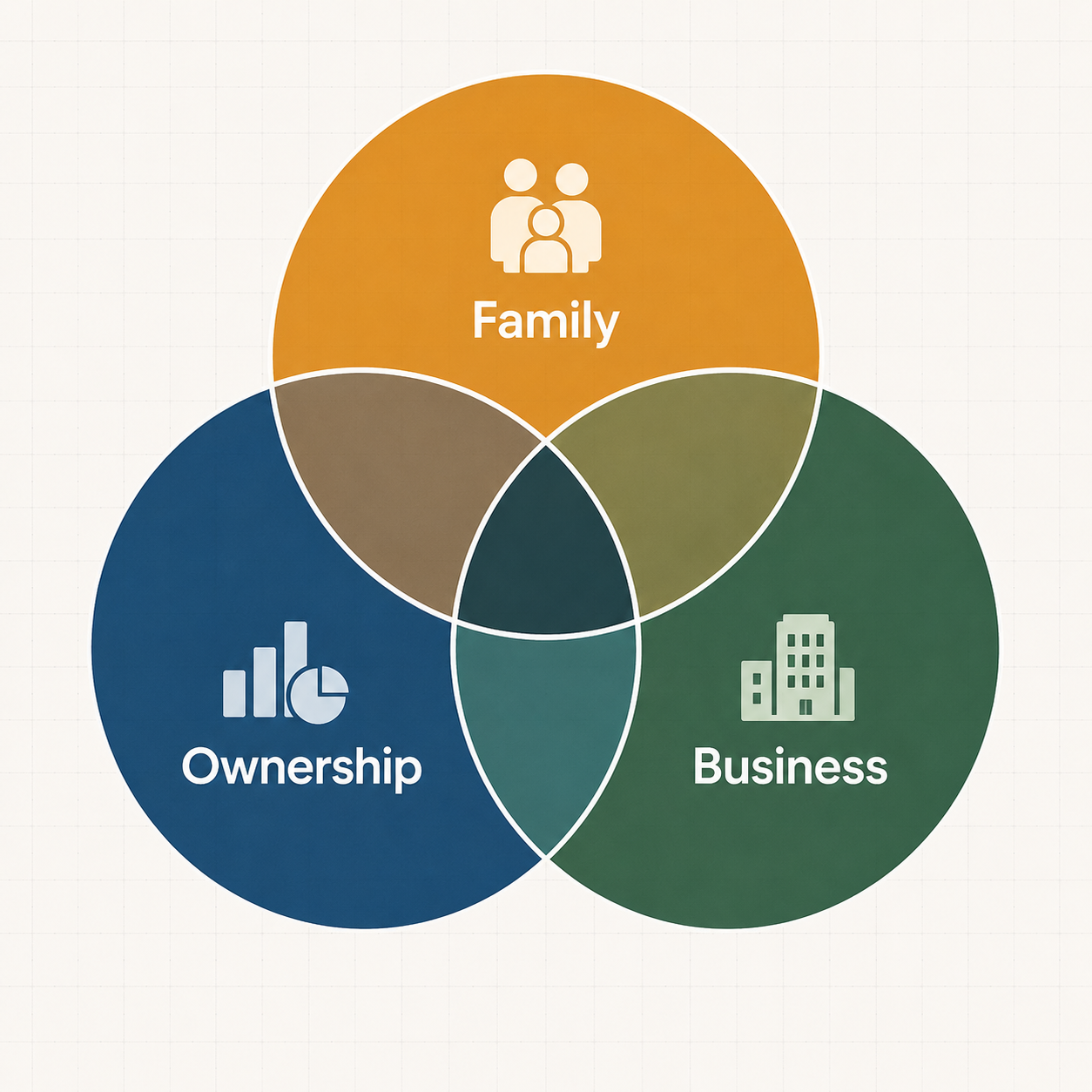
Use the model as a sorting exercise before drawing the org chart. Put every relevant person in the circle or overlap that describes their actual role today, not the role the family assumes they will eventually have. That distinction matters. A family member who owns shares but does not work in the company belongs in ownership governance, not in the operating chain. A family member employed as a plant supervisor belongs in operations, where their manager, goals, and review process should be as clear as anyone else’s.
| Role a person holds | Where it belongs | What the org chart must clarify |
|---|---|---|
| Family member, not owner, not employee | Family governance | How they receive family information and raise family concerns |
| Owner, not employee | Ownership or board governance | How ownership voice is exercised without giving operating instructions |
| Employee, not family, not owner | Business operations | Who manages them and who reviews their performance |
| Family employee | Business operations, with family-employment rules | Their manager, decision rights, and the standards used to evaluate them |
| Family owner working in management | Operations plus ownership governance | Which decisions they make as a manager and which they reserve for owner or board forums |
Some scholars and advisors argue that the original three-circle model needs additions, including a more explicit management circle. That debate is useful, but it should not delay the work. The three-circle model is foundational, not exhaustive. For a growing company trying to reduce waiting, rework, and quiet vetoes, it gives enough structure to ask the first hard question: which hat is this person wearing when they speak?
Separate Governance From the Operating Chain
Most family-business org charts go wrong before the first department box is drawn. They mix governance and management into one authority channel. A family council conversation becomes a staffing instruction. A shareholder preference becomes a purchasing decision. A board discussion turns into a direct order to a warehouse manager. None of those may be meant badly. They still slow the business down because employees cannot tell which instruction counts.
John Davis describes family governance as having three distinct components: the family council sets policy for the family, the board of directors sets policy for the business, and management executes.[4] In that model, a board of five to eight members with a majority of external directors is one way to keep business policy from becoming only a family preference channel.[4] The exact form can vary by company size, but the separation cannot be cosmetic.
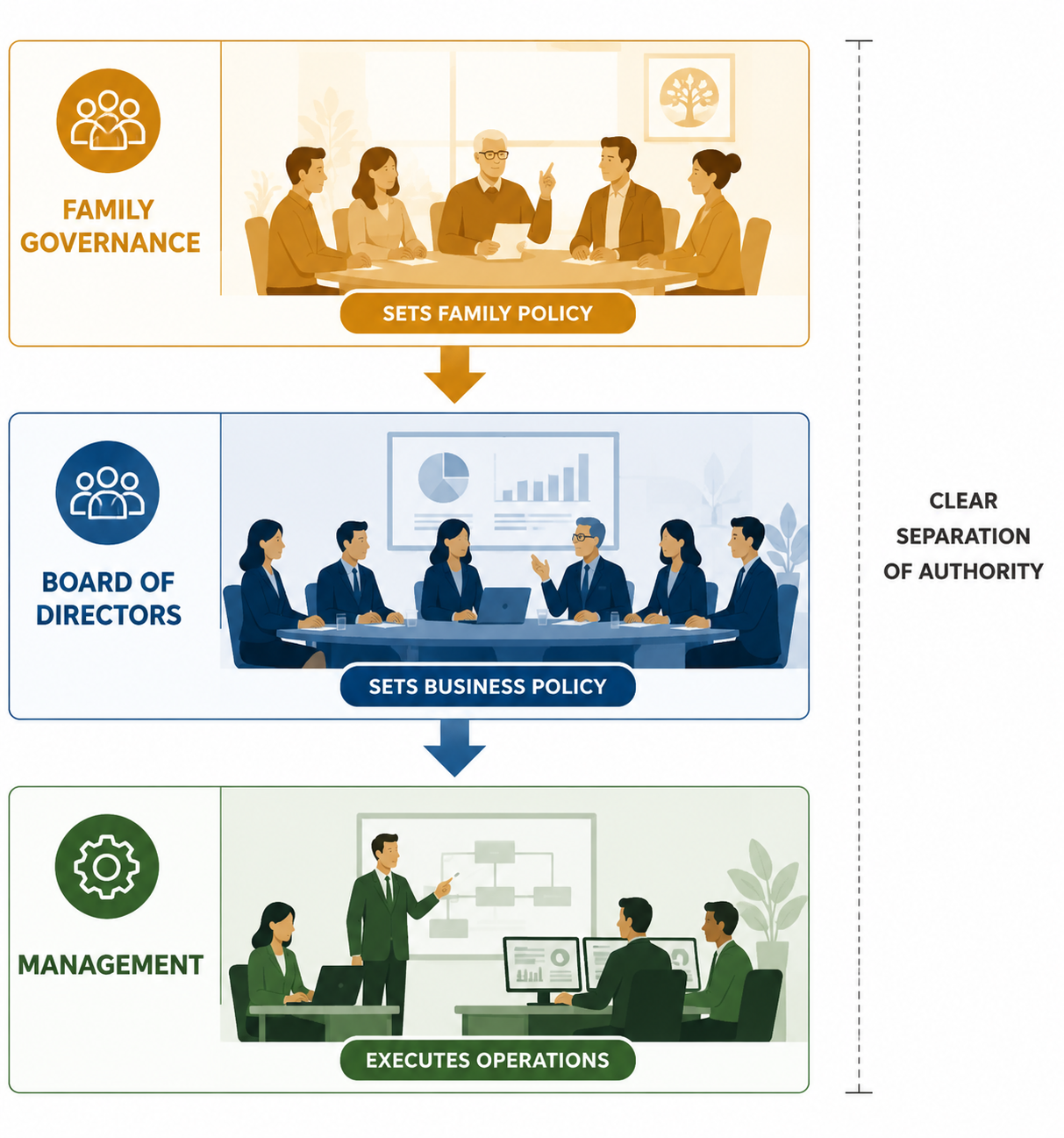
A productive chart therefore needs at least two views. The first is the governance view: family council, ownership group, board, and management leadership. The second is the operating view: CEO or general manager, functional leaders, managers, supervisors, and employees. Do not draw them as one continuous ladder unless they actually operate that way. If a family council member can bypass the CEO and instruct the controller, the company does not have a clean org chart; it has a decorated workaround.
| Body | Proper work | What it should not do |
|---|---|---|
| Family council | Family participation rules, family communication, family employment expectations, conflict protocols | Direct employees or reverse management decisions |
| Ownership group | Ownership rights, major shareholder matters, capital expectations | Act as a shadow executive team |
| Board of directors | Business policy, CEO oversight, strategy approval, risk governance | Manage daily operations through informal family channels |
| Management team | Execution, hiring within authority, performance management, daily operating decisions | Treat every difficult call as a family vote |
This is often the uncomfortable part for founders. The business may have survived because they were reachable, decisive, and willing to personally settle every dispute. Formalizing authority can feel like being pushed out of the company they built. That cost is real. But if the founder remains the informal approval gate for every exception, the company is still organized around their availability, not around the work.
Build the Operating Chart Around Work, Not Birth Order
Once governance is separated, draw the operating chart from the work outward. Start with the business functions that must be managed every week: sales, operations, finance, people, customer service, procurement, production, logistics, or whatever the company actually runs on. Then name the accountable role for each function before naming the person.
That order matters because family companies often assign around people first. “Everyone knows Mark handles vendors.” “Anna is good with customers.” “Dad still approves equipment.” Those statements may be true, but they are not a management system. A usable org chart says which role owns vendor terms, which role approves customer concessions, which role signs off on equipment, and who covers the decision when that person is away.
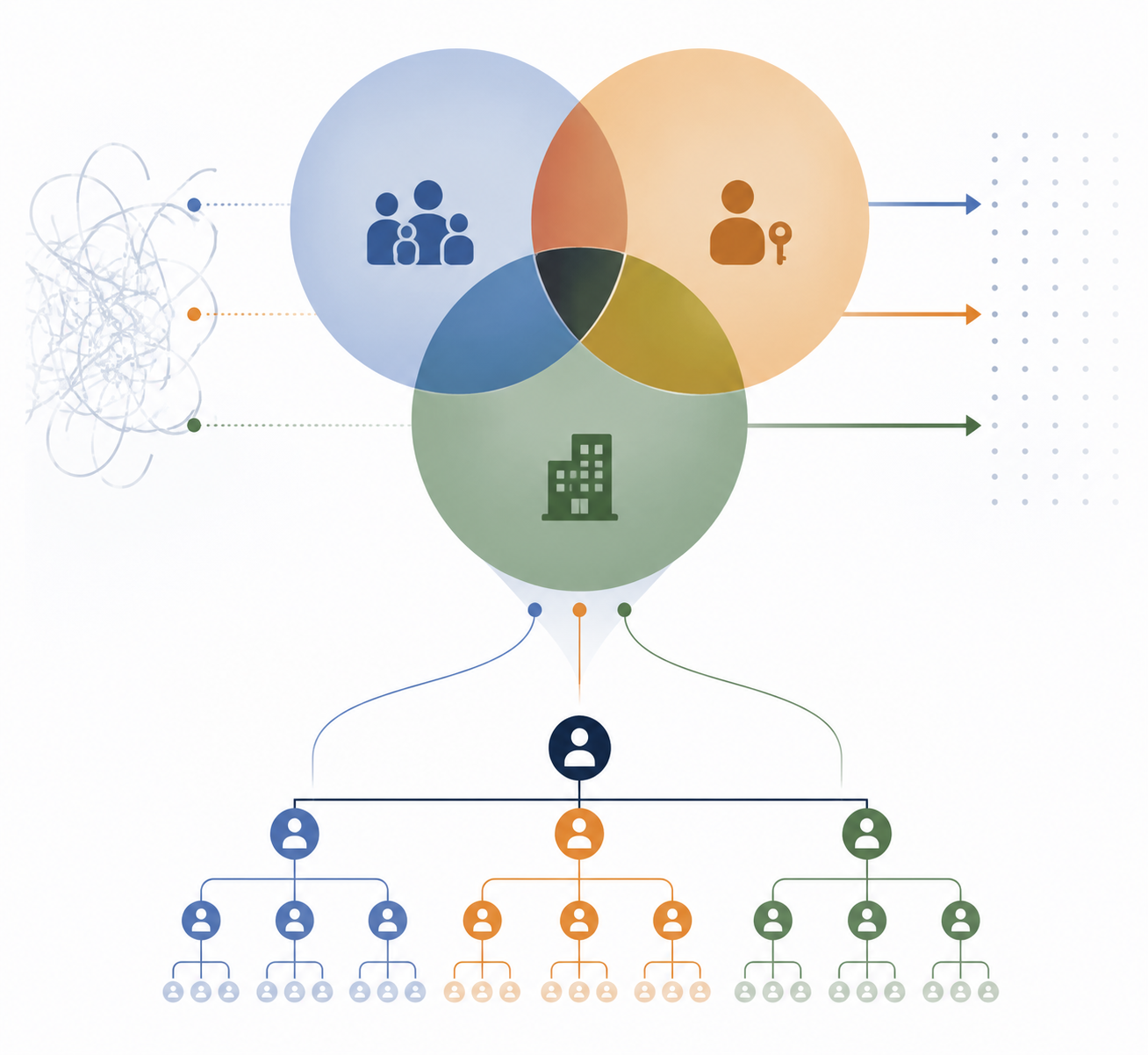
For a company in the 10–50 employee range, the first productive version may be simple. It should still make four things impossible to miss:
- One direct manager for every employee, including family employees.
- A named accountable owner for each core function.
- A reasonable span of control, so one person is not pretending to manage every department.
- Decision rights that show which decisions are made by managers, executives, the board, or owners.
- A visible path for family members to earn roles rather than inherit operating authority by assumption.
Span of control deserves more attention than it usually gets. A founder with nine direct reports may be proud of staying close to the business, but the practical effect is a queue. People wait for approvals. Managers bring operational problems upward because that is where decisions have always landed. Younger family members learn access instead of management. The org chart should expose that bottleneck, not preserve it out of respect.
Competence-based assignment is not anti-family. It is one of the cleaner ways to protect family authority. A son or niece who has the right skills, experience, and accountability can lead with less resentment because the standard is visible. A family member placed into a role because “it is time” inherits suspicion along with the title. Non-family managers notice the difference quickly.
A practical first pass
Do not start by designing the ideal company ten years from now. Start by listing the decisions that currently stall work. Pricing exceptions. Hiring approvals. Vendor selection. Overtime. Capital purchases. Credit terms. Customer refunds. Family employment. Promotion decisions. Then place each one in a decision-rights matrix before updating the chart.
| Decision | Recommends | Decides | Must be consulted | Must be informed |
|---|---|---|---|---|
| Hiring a department employee | Department manager | Functional leader | HR or finance, if applicable | CEO or general manager |
| Hiring a family member | Relevant functional leader | CEO or board committee, depending on policy | Family council for eligibility rules | Direct manager and HR |
| Routine vendor change | Operations or procurement lead | Functional leader | Finance, if cost or terms change | Affected managers |
| Major capital purchase | Management team | CEO, board, or owners based on threshold | Finance and affected function | Managers responsible for implementation |
| Performance issue involving a family employee | Direct manager | Same authority used for non-family employees, with policy oversight | HR or governance contact as defined | Only those with a legitimate role |
The matrix does not need to be elaborate. It needs to be used before conflict starts. If the first time the family discusses who can discipline a cousin is after the cousin has missed targets for six months, the policy is already late.
Add a Real Management Layer When Owners Are the Bottleneck
There is a predictable stage in a growing family company where owners are still doing the work of supervisors, department heads, and executives at the same time. The company may call this “staying lean.” Employees experience it as waiting for the same two or three people to clear every path.
Richter’s organizational design work with a multi-generational Canadian family business is a useful illustration, not a promise of guaranteed savings. In that engagement, the owners were heavily involved in day-to-day management. Richter helped create a middle-management layer, which freed family owners to focus on strategic oversight and uncovered more than $250,000 in immediate cost savings within two months of the new hire.[2]
The lesson is not “hire a manager and savings will appear.” The lesson is that hidden costs become visible when work has an accountable owner close enough to see them. A middle manager can notice duplicated purchasing, overtime patterns, rework, missed handoffs, and approval delays that owners may no longer see because they are spread across too many decisions.
A middle-management layer is worth considering when any of these are true:
- Owners have more direct reports than they can actually coach, review, and unblock.
- Department leads need owner approval for routine operating decisions.
- Non-family managers avoid decisions because family members may override them informally.
- Employees escalate around their manager to whichever family member answers fastest.
- Owners say they want to work on strategy but remain the daily exception desk.
When adding that layer, give it actual authority. A supervisor who can schedule work but not address performance is not a manager. A department head who must ask an owner before enforcing standards with a family employee is not fully accountable. The chart should show where authority sits, and the policy should make that authority safe to use.
Write the Rules That Make the Chart Real
A family business can have a polished chart and still run by hallway rank. The difference is enforcement. If family members can bypass reporting lines, avoid performance reviews, or enter roles without meeting the stated criteria, employees will learn the real chart quickly.
The enforcement layer should cover at least four areas: family employment, outside experience, decision rights, and performance management.
Family employment rules
Family employment rules should answer practical questions before a specific person becomes the exception. What qualifications are required for entry? Who can approve the hire? Can a family member report to another family member? What happens if no suitable role is open? Which compensation bands apply? How are promotions reviewed?
The rule should not be “family members are welcome if we trust them.” Trust is not a job description. A cleaner rule is that family members can apply for defined roles when they meet the qualifications, accept the reporting line, and participate in the same review process as others. If the family wants to support younger members, create internships, mentoring, or development rotations. Do not disguise a development need as a permanent management role.
Outside experience
An outside-work requirement gives the next generation a better way to earn authority. It lets a family member learn under managers who are not relatives, experience consequences outside the family name, and return with a record that is easier for non-family employees to respect. The exact requirement should fit the company and the role, but it should be specific enough that it cannot be waived quietly for the favored candidate.
This is not about assuming outsiders are better. It is about protecting the business from untested authority. A future family executive who has had to meet standards somewhere else will usually enter the org chart with less defensive explanation required.
Decision-rights matrix
The decision-rights matrix is where governance separation becomes visible in daily work. It should identify who recommends, who decides, who must be consulted, and who must be informed for recurring decisions. Use thresholds where needed. A department manager may approve routine spending up to one level, the general manager another, and the board only larger capital commitments. Without thresholds, every unusual purchase becomes a personality test.
The most important test is whether the matrix works when a family member is involved. If a non-family manager can discipline a non-family employee but cannot address the same issue with a family employee, the org chart is two-tiered. People will manage around that fact.
Performance management
Performance management is where many family companies discover whether they meant the chart. Every employee should have goals tied to the role they hold, a manager responsible for feedback, and a review process with consequences. Family employees may need additional sensitivity because performance conversations can follow them home. They do not need a separate standard that leaves their manager powerless.
For founders, this can feel colder than the company’s history. It does not have to be. A well-run review process can preserve dignity by making expectations explicit and reducing whispered judgments. The alternative is not kindness; it is usually avoidance until resentment has already spread through the team.
Avoid Professionalization That Only Looks Professional
Professionalization is necessary when the company outgrows informal trust, but it can fail in two directions. BCG warns against “paper processes,” where a family business adopts formal tools without changing behavior, and “diluted distinctiveness,” where professionalization strips out the culture and family strengths that made the business valuable in the first place.[5]
Both mistakes show up in org-chart work. Paper process is the chart that says the general manager runs operations while everyone still waits for the founder’s private approval. Diluted distinctiveness is the chart that imports corporate layers and committees so heavily that the company loses the speed, loyalty, and customer memory that came from family ownership.
The aim is not bureaucracy. The aim is clean routing. A customer issue should reach the person empowered to solve it. A purchasing decision should not need three family interpretations. A family employment question should go through a known policy instead of becoming a test of loyalty. A board concern should reach management through the CEO or agreed executive channel, not through side instructions to staff.
Keep the family advantages that truly help productivity: long-term orientation, trust, fast commitment when authority is clear, and a reputation people care about protecting. Remove the ambiguity that makes those advantages hard to work inside.
A Productivity Test for the Finished Chart
Before treating the new structure as finished, test it against actual work rather than presentation quality. Choose a recent delayed decision and trace where it would go under the new chart. Choose a family employee’s role and confirm who manages it. Choose a board-level issue and confirm how it reaches management. Choose a non-family manager’s authority and confirm where it can be overridden, if at all.
The chart is not productive because it has neat boxes. It is productive if it reduces waiting, stops duplicate instruction, gives managers enough authority to manage, and gives family members a fair path to earn responsibility without turning every role into a birthright argument.
If the chart cannot tell people who decides, who manages, who advises, and how family members earn roles, it is not yet a productivity tool.
References
- Multiple owners and productivity: evidence from family firms, Taylor & Francis Online, 2021.
- Organizational Design for Family-Owned Businesses, Richter.
- Three-Circle Model of the Family Business System, John Davis.
- The Three Components of Family Governance, Harvard Business School Working Knowledge.
- A Founder’s Guide to Professionalizing a Family Business, Boston Consulting Group, 2017.
Comments
Join the discussion with an anonymous comment.