
The hardest part of a postpartum fitness routine for busy moms is not usually motivation. It is the fantasy hidden inside most fitness advice: a protected block of time, a body that feels predictable, and a day that does not get rearranged by feeding, pumping, crying, contact naps, laundry, work messages, or a pelvic floor that has its own opinion.
That is why exercise snacks deserve attention. An exercise snack is a short burst of movement, usually 2 to 5 minutes, repeated during the day instead of saved for one formal workout. The point is not to make movement look impressive. The point is to lower the starting cost so far that a tired mother can actually do it between tasks, then use the energy lift for the next stretch of caregiving or work.
The adherence signal is the part that matters. A 2025 British Journal of Sports Medicine blog summarizing a meta-analysis by Rodríguez and colleagues reported that exercise snacks of 5 minutes or less, repeated daily, improved cardiorespiratory fitness in inactive adults with more than 90% adherence.[1] That does not prove the same long-term result for every postpartum mother. It does explain why this structure is promising: the routine is designed around the day that actually exists.
For a mother 6 weeks to 1 year postpartum, the productivity question is rarely, “Can I become an exerciser?” It is more often, “Can I get enough energy back to answer an email without rereading it five times, make lunch without snapping, or finish one household task before the baby wakes?” A postpartum fatigue meta-analysis of 9 randomized controlled trials found that mean fatigue scores dropped from 9.9 to 8.1 after exercise interventions, a statistically significant reduction.[2] That is not a miracle. It is a usable margin.
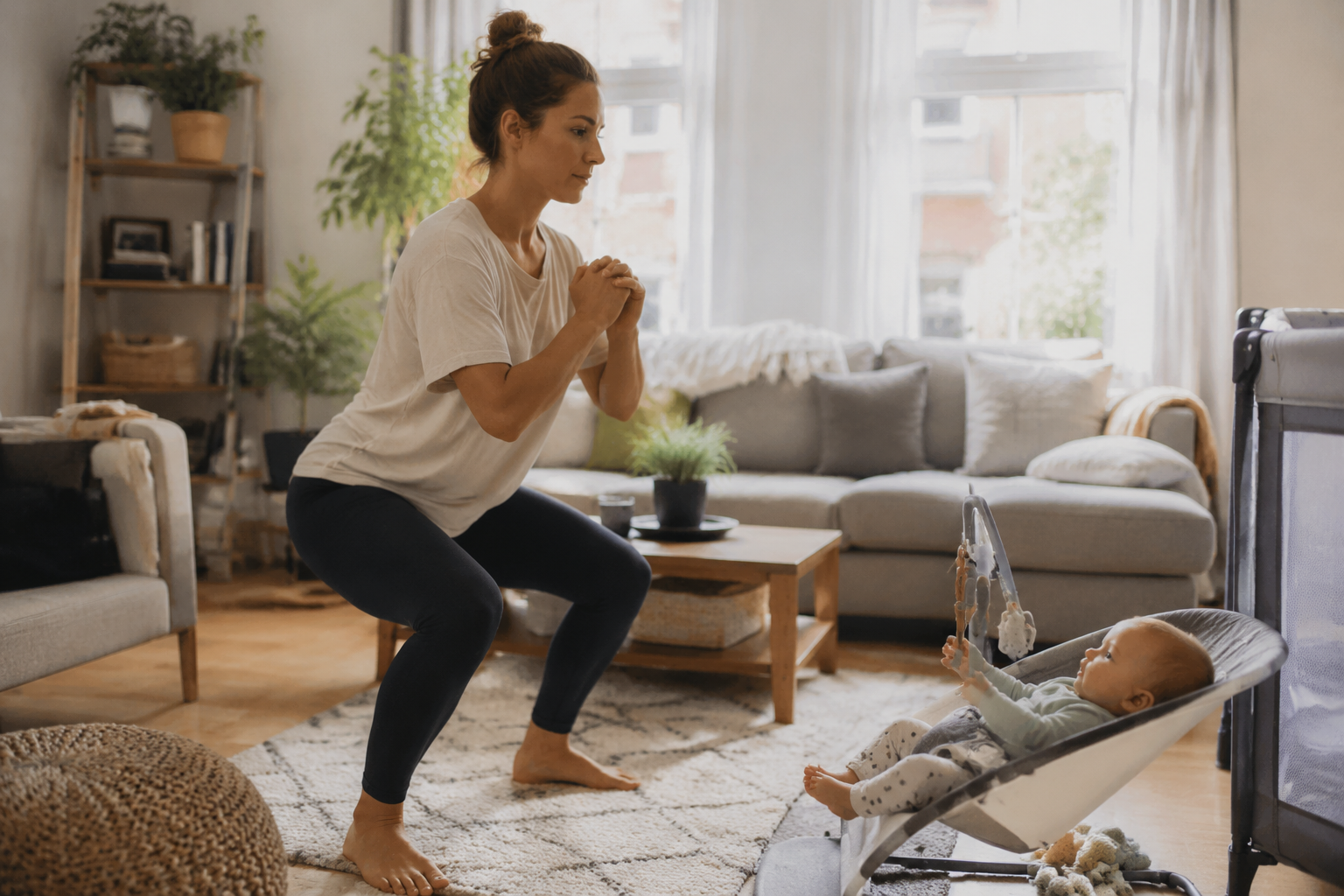
Movement Does Not Have to Be a Workout Block
The conventional workout block asks for too much coordination at once: clothing, space, childcare, energy, recovery, and time. Exercise snacks ask for a smaller decision. Stand up after a feeding. Do wall push-ups while the bottle warms. March in place before opening the laptop. Breathe and reconnect the pelvic floor before lifting the car seat again.
ACOG recommends 150 minutes per week of moderate-intensity aerobic activity after pregnancy and notes that activity can be divided into smaller sessions, including 10-minute blocks.[3] That guidance is useful context, but it is not the most practical entry point for a depleted day. A mother who cannot find 10 clean minutes may still find 2. Expecting Pelvic Health also frames postpartum exercise snacks as small chunks throughout the day rather than one continuous session.[4]
This matters because the body does not only need training. It needs interruptions to the fatigue spiral. A few minutes of movement can raise heart rate, shift breathing, change posture, and move attention away from the mental static that builds during repetitive caregiving. The value shows up when the next task feels slightly less heavy.
Why Tiny Bouts Can Change the Next Two Hours
Short movement bursts are not just symbolic. The Brookings Institution explains that exercise stimulates mitochondrial development, which supports cellular energy for physical exertion and brain function, and releases neurotransmitters that improve mood; the report connects those changes to productivity at work.[5] A postpartum day is not an office wellness case study, but the mechanism is relevant. More available energy and a better mood can change how the next care task lands.
That is where “fitness” becomes a productivity tool. If 3 minutes of marching in place makes the next feeding feel less foggy, it has done something valuable. If wall push-ups after a diaper change make the transition back to a spreadsheet less abrupt, they count. If diaphragmatic breathing keeps a mother from bracing through every lift, that is not a soft benefit; it is a way to protect the body that has to keep working.
The qualitative evidence is small but recognizable. In Lesser and colleagues’ 2023 study of 21 postpartum women who self-selected into group exercise, participants described feeling “less short, more patient throughout the day” and reported better productivity around the home.[6] Because the sample was small and self-selected, it should not be treated as proof that one format works for all mothers. Still, the phrase “less short” captures a real postpartum productivity variable: patience is part of output when the work is caregiving.
The Safety Gate Comes Before the Snack
Exercise snacks are small, but small does not mean automatically safe. Postpartum recovery is not one condition. A mother at 6 weeks after an uncomplicated vaginal birth, a mother recovering from a C-section, a mother with heaviness or leaking, and a mother with abdominal separation symptoms may all need different starting points.
A postpartum rehabilitation timeline published in PMC describes a phased approach: weeks 0 to 2 emphasize diaphragmatic breathing and pelvic tilts, while later phases progress gradually toward fuller activity, with progressive running placed at 13 weeks and beyond.[7] The same review notes that 75% of postpartum runners return to running within 8 weeks of delivery without guided rehabilitation, raising concern about injury risk.[7] That is the warning label for any advice that sounds like “just do what you used to do, but shorter.”
Before choosing a movement snack, use symptoms as information. Pressure or heaviness in the pelvis, urine leaking, pain, bulging or coning along the midline of the abdomen, bleeding that increases with activity, or a feeling that the core cannot manage the movement are reasons to scale down and ask for help. A pelvic floor physical therapist belongs in the decision when symptoms persist, when running or impact is the goal, or when a mother cannot tell whether a movement is helping or making her brace harder.
Mayo Clinic also notes that exercise after pregnancy can boost energy and promote better sleep, but its guidance starts with getting cleared and beginning gradually.[8] That order matters. The goal is not to prove toughness. The goal is to build a routine the body can absorb.
Five Exercise Snacks That Fit a Postpartum Day
The best postpartum exercise snacks are boring in the right way. They do not require shoes, a mat, a full outfit change, or a baby who stays asleep. They also scale easily. A movement can begin as breath and alignment, then become more muscular or more aerobic as recovery allows.
| Movement snack | How to do it | Where it fits |
|---|---|---|
| Diaphragmatic breathing with pelvic floor engagement | Sit, stand, or lie comfortably. Inhale into the ribs and belly. Exhale gently while lifting the pelvic floor as if stopping gas, without gripping the glutes or jaw. | After feeding, before lifting the baby, after a stressful work message |
| Wall push-ups | Place hands on a wall, step back, keep ribs stacked over pelvis, bend elbows, and press away. Move closer to the wall to make it easier. | While a bottle warms, during a nap transition, before opening the laptop |
| Glute bridges | Lie on your back with knees bent. Exhale, gently engage the core and pelvic floor, lift hips, pause, and lower without arching the back. | On the floor during baby playtime, after a diaper change if symptoms allow |
| Heel slides | Lie on your back with knees bent. Exhale, slide one heel away while keeping the pelvis steady, then return and switch sides. | Early core reconnection, evening wind-down, days when upright movement feels like too much |
| Marching in place | Stand tall and march gently, keeping breath steady. Keep it low impact; slow down if pelvic pressure, leaking, or pain appears. | Between meetings, after a long sit, before starting dinner |
Diaphragmatic breathing is the most useful first snack because it doubles as a check-in. If the breath is shallow and the pelvic floor cannot relax, that is information. If the exhale helps the ribs settle and the core feel more coordinated, the body may be ready for a slightly stronger snack later in the day.
Wall push-ups are useful because they bring the upper body back into the conversation without asking the wrists, shoulders, or core to manage a floor push-up. They also map neatly onto real life: counters, walls, doorframes, and kitchen islands are already there.
Glute bridges and heel slides are quieter. They are not the movement snacks most likely to feel energizing in the moment, but they matter for rebuilding the chain that supports lifting, carrying, standing, and walking. On a rough day, two minutes of heel slides may be a better productivity move than forcing a cardio burst that leaves the pelvis feeling heavy.
Marching in place is the easiest bridge between recovery work and alertness. It is also the one most likely to tempt overdoing. Keep it conversational. If it turns into impact, breath-holding, leaking, or pelvic pressure, it is no longer the right snack for that moment.
Attach the Snack to Something Already Happening
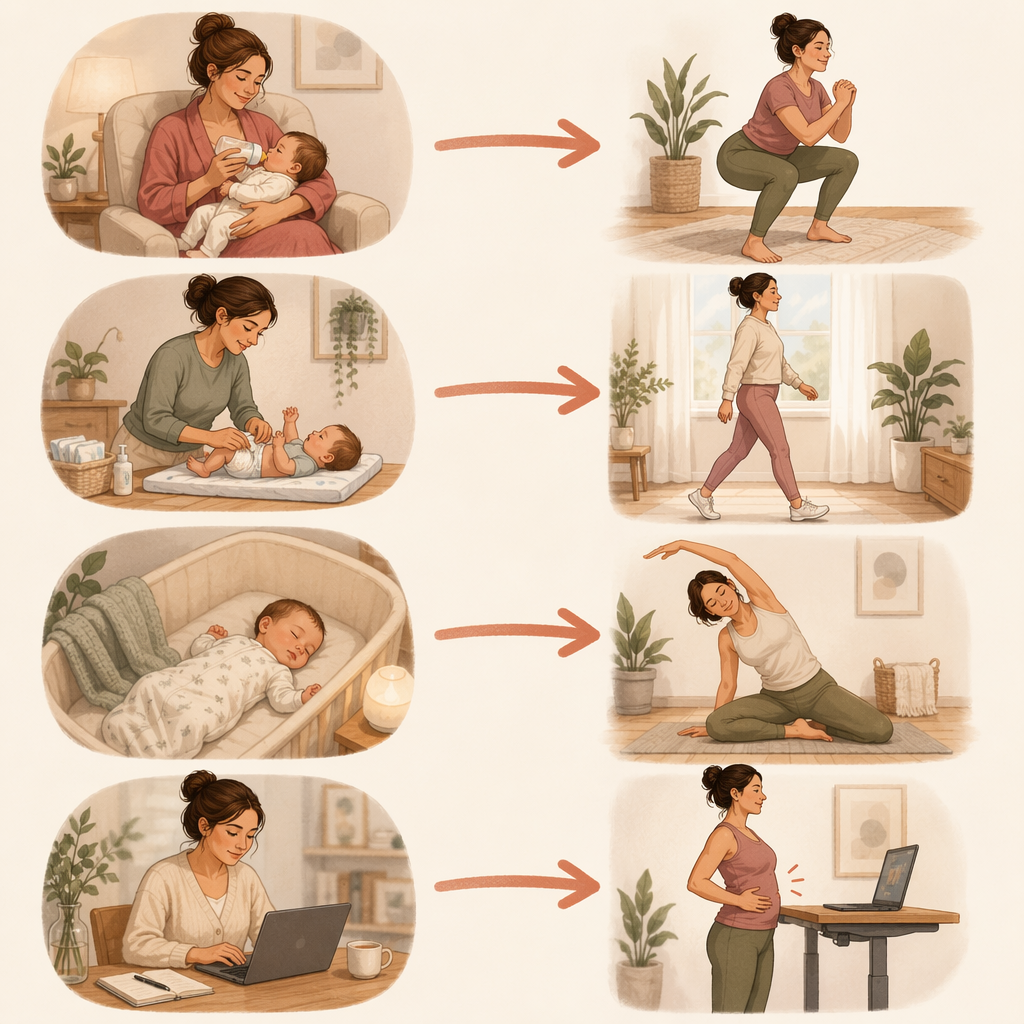
A routine that needs its own reminder, its own setup, and its own protected time is fragile. Exercise snacks work best when they are attached to tasks that already happen whether the day is organized or not. Feeding, diaper changes, naps, and work transitions become cues instead of interruptions.
- After the first morning feeding: 2 minutes of diaphragmatic breathing or heel slides.
- After a diaper change: 5 slow pelvic tilts or 10 gentle wall push-ups.
- When the baby naps: 2 minutes of glute bridges before choosing between rest, work, or chores.
- Before opening work email: 3 minutes of marching in place or a short walk around the room.
- Before the evening caregiving stretch: 1 minute of breathing plus 1 minute of wall push-ups.
This is not a daily calendar. It is a menu of if-then decisions. If the baby feeds, then breathe. If the diaper changes, then reset the pelvis. If work starts, then raise circulation first. The cue carries the routine, so the mother does not have to carry one more plan in her head.
The smallest version still counts. One minute of breathing after a hard night may be the right snack. Two wall push-ups may be enough to keep the habit alive. The point is not to hit a heroic number. It is to make movement available at the exact places where fatigue usually takes over.
How to Scale Without Turning It Into Another Project
Progress can be simple. Add one repetition, one round, or one cue. Do not add all three at once. A mother who starts with breathing after the morning feed might add wall push-ups before lunch. Later, marching in place can become slightly longer or slightly brisker, as long as symptoms stay quiet.
| If this is happening | Choose this adjustment |
|---|---|
| You feel more alert after the snack and symptoms stay quiet | Repeat the same snack at another cue or add 30 to 60 seconds next time. |
| You feel pelvic heaviness, leaking, pain, or abdominal coning | Stop, return to breathing or heel slides, and consider pelvic floor physical therapy. |
| You are exhausted from a broken night | Use breathing, heel slides, or a short walk instead of a higher-effort snack. |
| You want more aerobic benefit | Increase marching pace gradually before adding jumping, running, or impact. |
| You keep forgetting | Attach the snack to a more reliable cue, such as the first feeding or first work login. |
A useful postpartum fitness routine for busy moms does not need to resemble a gym plan. It needs a feedback loop. Did the movement make the next task easier? Did it leave the body feeling steadier? Did it reduce the sense of being trapped in fatigue? If yes, repeat it. If not, change the movement, reduce the effort, or get clinical guidance.
Where Exercise Snacks Fit Beside Longer Workouts
Exercise snacks do not have to replace longer workouts, postpartum rehab, strength training, walking, or a return to running. For some mothers, they are the bridge back to those things. For others, they are the only realistic movement structure for a season. Both uses are legitimate.
The research is still developing, especially for diverse postpartum populations over the long term. The 2025 exercise-snacks evidence is encouraging, but it comes mainly from inactive adult populations rather than being a settled postpartum prescription.[1] The postpartum qualitative evidence on patience and home productivity is also small and self-selected.[6] That keeps the claim narrower and more useful: short movement bursts are a promising, practical way to improve energy, fatigue, mood, and adherence when traditional workout blocks keep failing.
For the 6-week-to-1-year postpartum window, the strongest argument for exercise snacks is not that they are magical. It is that they survive contact with real life. They lower the cost of starting, respect the need for gradual recovery, and return small amounts of focus and steadiness at the points in the day where everything usually starts to fray.
References
- Exercise snacks: small bouts, big benefits — British Journal of Sports Medicine Blog, October 24, 2025.
- Assessing the effects of exercise on post-partum fatigue symptoms — PMC, 2022.
- Exercise After Pregnancy — ACOG.
- Postpartum Exercise Snacks — Expecting Pelvic Health.
- Exercise Increases Productivity — Brookings Institution.
- Moms on the move — PMC, 2023.
- Maximizing Recovery in the Postpartum Period — PMC.
- Exercise after pregnancy: How to get started — Mayo Clinic.
Comments
Join the discussion with an anonymous comment.