
A morning routine can look intact from a distance and still be falling apart at the edges. The person knows they want coffee. They remember where the cereal is. They can say which shirt they prefer. But the mug feels unsafe to carry, the hallway is harder to judge in dim light, the pill organizer is confusing before breakfast, and one poor night of sleep has turned dressing into a thirty-minute negotiation with buttons, balance, and patience.
That is where dementia's physical symptoms meet daily function and productivity. Productivity, here, is not about doing more. It is about protecting the ordinary tasks that let someone remain involved in their own life: washing, eating, moving around the home, taking medications, answering the phone, getting to an appointment, making a simple meal, and leaving the house without everyone holding their breath.

This article is not medical advice, and it cannot diagnose dementia, explain a new symptom, or replace a clinician, physical therapist, occupational therapist, pharmacist, or qualified care team. Sudden changes in walking, weakness, pain, sleep, appetite, swallowing, falls, or confusion deserve medical attention. The practical work here is narrower: how to notice the physical bottleneck in a daily task, reduce the number of ways that task can fail, and choose tools that actually lower dependence.
Physical Symptoms Are Not Side Issues
Dementia is often discussed as memory loss first, but daily independence frequently breaks through the body. Sleep disruption changes the morning. Pain changes willingness to move. Slower gait changes whether a person can reach the bathroom in time. Poor coordination changes whether a person can shave, use utensils, fasten clothing, or step safely into a shower.
Home Instead UK summarizes physical symptoms of dementia as including sleep disturbances, appetite and weight changes, daily pain, gait changes, balance problems, and coordination issues; it reports that 60–70% of people with cognitive impairment experience sleep disturbances and that about 50% experience daily pain, though those exact figures should be treated as orientation unless the underlying studies are checked directly.[1]
The connection between movement and function is not just intuitive. In a 2020 study of 46 older Korean adults with dementia, Lee and colleagues found that step length, stride length, and walk ratio were associated with activities of daily living performance.[2] The sample was small and specific, so it should not be inflated into a universal rule. Still, it gives practical weight to what families often see first: walking differently can mean bathing, dressing, toileting, cooking, and errands are becoming harder, not merely slower.
The useful question is not “Is this symptom part of dementia?” in isolation. The useful question on Monday morning is “Which task is this symptom damaging, and what can we change before another person has to step in?”
Map the Symptom to the Task It Is Disrupting
A symptom list is too blunt to run a household from. “Balance problems” does not tell you whether the danger is the bath mat, the front step, the laundry basket, or the turn from sink to stove. “Dexterity loss” does not tell you whether to buy a pill dispenser, replace shirt buttons, change utensils, or stop expecting a small touchscreen to behave like a lifeline.
| Physical symptom | Daily tasks it can interrupt | What to look for first |
|---|---|---|
| Balance or gait changes | Bathing, toileting, stairs, cooking, walking to the mailbox, getting in and out of a car | Hesitation at thresholds, furniture-walking, shorter steps, avoiding showers or outings |
| Sleep disruption | Dressing, medication, meal preparation, appointments, conversation, safe movement | A routine that works after a good night but collapses after a poor one |
| Pain | Walking, bathing, grooming, housework, sitting through meals, attending appointments | Tasks delayed or refused only when movement is required |
| Motor slowing | Dressing, eating, toileting, answering the phone, leaving the house on time | The person can complete the task but not within the time allowed |
| Dexterity loss | Pills, buttons, zippers, utensils, razors, toothbrushes, keys, remote controls, phones | Small objects dropped, packages left unopened, missed doses, abandoned grooming |
| Coordination problems | Using the shower, transferring food to a plate, pouring drinks, using appliances | Spills, awkward hand placement, fear of hot liquids, trouble sequencing movement |
| Appetite or weight changes | Meal planning, cooking, grocery use, medication timing, hydration | Skipped meals, uneaten prepared food, confusion around choices, fatigue during meals |
This kind of mapping keeps the response proportionate. If the problem is carrying a full mug, the first answer may be a non-slip tray, a travel mug with a lid, or setting up the coffee station beside the breakfast chair. If the problem is a touchscreen, a new reminder app may be less useful than a large-button phone with speed-dial. If the problem is showering after a bad night, a morning shower schedule may be the wrong schedule, not a failure of motivation.
Activities of daily living frameworks commonly break dementia-related support needs into tasks such as bathing, dressing, eating, toileting, mobility, and related household routines.[6] That breakdown is helpful because it stops families from treating “independence” as one giant thing. A person may need help with bathing but still choose clothes, prepare part of breakfast, sort mail, fold towels, or call a friend if the setup is forgiving enough.
Use a Daily-Function Adaptation Process
The process is simple, but it works only if it stays attached to one real task at a time. Do not begin with “make the house dementia-friendly.” Begin with “make breakfast safer,” “make morning pills more reliable,” or “make showering less exhausting.”
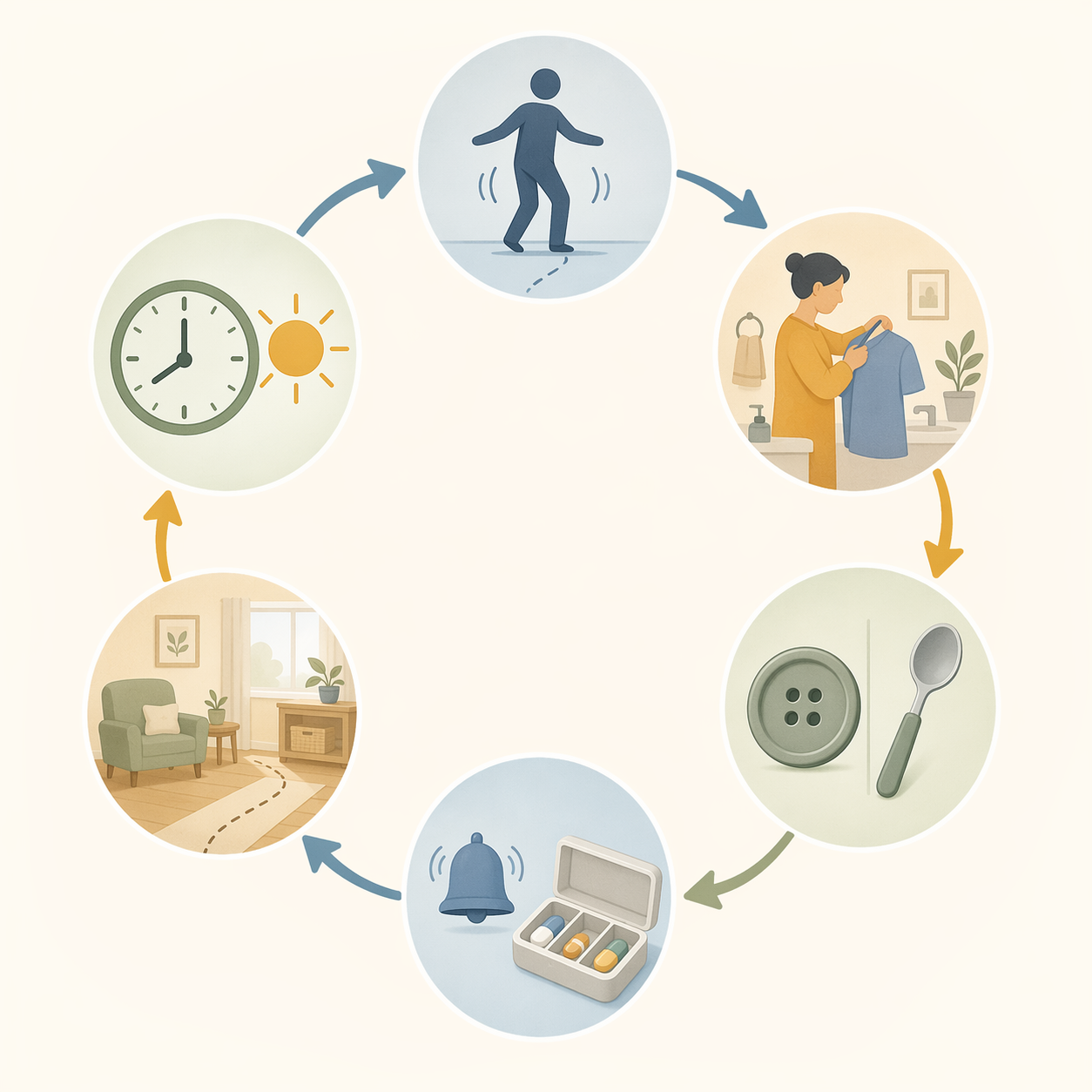
- Identify the physical symptom: balance, pain, sleepiness, motor slowing, dexterity loss, appetite change, coordination, or fatigue.
- Locate the disrupted daily task: bathing, dressing, eating, medication, phone use, mobility, chores, appointments, or meal preparation.
- Simplify the task: remove choices, reduce steps, prepare materials in advance, or switch to an easier version of the same task.
- Add the right cue or tool: a label, checklist, pill box, automatic dispenser, adaptive utensil, voice reminder, locator device, or large-button phone.
- Modify the environment: improve lighting, clear paths, remove trip hazards, add bathroom safety tools, reduce clutter, and keep needed items visible.
- Schedule for the best energy window: place harder tasks when the person is most alert, and leave recovery space before appointments or outings.
- Review dependence: ask whether the change reduced prompting, physical help, risk, delay, conflict, or abandonment of the task.
That last review matters. A tool that looks clever but requires a caregiver to reset it, explain it, charge it, search for it, and calm frustration has not removed work. It has moved work to the backup person.
Build Routines That Lower the Number of Decisions
Structured daily schedules can reduce confusion and anxiety, especially when tasks are broken into simple steps and supported with modeling, visual cues, and labels, according to Alzheimer’s Association guidance for daily care planning.[3] The point is not to make life rigid for the sake of neatness. The point is to stop every ordinary task from becoming a fresh problem to solve.
A workable routine has fewer moving parts than most advice admits. Put the same breakfast items in the same place. Keep the same two or three clothing options available, not the whole closet. Place the toothbrush, toothpaste, razor, and towel in the order they are used. Keep keys, wallet, phone, glasses, and hearing aids in one landing zone. Use one visible calendar rather than three competing systems.
For dressing, simplification may mean elastic waistbands, Velcro closures, front-opening garments, shoes that do not require complex tying, and outfits grouped together. For bathing, it may mean laying out a towel, clean clothes, soap, and a washcloth before the person enters the bathroom. For medication, it may mean pairing the dose with an existing anchor such as breakfast, not relying on memory after a noisy morning.
The best routine often looks almost too plain: wake, bathroom, wash, dress, breakfast, medication, short walk, rest. Plain is not childish. Plain is protective. It gives the person a track to run on when sleep, pain, balance, or attention is not cooperating.
Match Tools to the Point of Failure
Tools help when they remove a specific failure point. They become clutter when they are bought before the task is understood. The same device can preserve independence in one home and create a second job in another.
| Point of friction | Low-tech support | Digital or powered support |
|---|---|---|
| Missed or confused medication | Dosette box, written medication chart, pills stored beside a routine anchor | Automatic pill dispenser, phone alarm, voice assistant reminder |
| Misplaced keys, wallet, phone, or glasses | Single landing tray, wall hook, labeled basket | Locator device attached to key items |
| Difficulty calling for help | Printed contact card, phone kept in one visible place | Large-button phone with speed-dial |
| Trouble eating without spills | Plate guard, non-slip mat, weighted or built-up utensils, lidded cup | Electric can opener or other powered kitchen aid |
| Grooming is too fiddly | Simplified grooming basket, pump bottles, towel laid out in sequence | Electric razor or electric toothbrush |
| Showering feels unsafe | Non-slip mat, grab bars, shower chair, handheld showerhead | Bathroom alert device if appropriate and reliably used |
| Forgetting appointments or steps | Wall calendar, checklist, labels on doors or drawers | Voice assistant, shared digital calendar, reminder app |
Alzheimer’s Society UK lists practical everyday supports including dosette boxes, automatic pill dispensers, locator devices, digital assistants, large-button phones, adaptive utensils, plate guards, Velcro closures, electric razors, and handheld showerheads.[4] These are not symbols of decline. Used well, they are ways to keep the person doing more of the task rather than waiting for someone else to take over.
Start with the lowest-maintenance support that solves the problem. A label on the bathroom cabinet survives a dead battery. A pill box can be checked at a glance. A bright tray by the door can do more for lost keys than an app no one remembers to open. Digital tools earn their place when they reduce repeated prompting, make location safer, or allow a family member to support from a distance without hovering.
Voice assistants can be useful for timed reminders because they do not require small buttons or reading tiny text. But the wording must be specific. “Take your medicine” is less helpful than “Take the morning pills from the blue box on the kitchen counter.” A locator device can help with keys, but only if the phone or hub needed to trigger it is itself findable. A large-button phone with photos or speed-dial may be more dependable than a smartphone full of icons, notifications, and software updates.
Change the Room Before You Blame the Person
A vague routine in a cluttered room turns the caregiver into the missing infrastructure. They remind, fetch, steady, interpret, locate, and reassure. Some of that support may always be needed, but the home should do more of the quiet work.
For balance and gait changes, look first at paths. Clear the route from bed to bathroom. Remove loose rugs or secure them properly. Improve lighting at the bed, hallway, bathroom, kitchen, and entry. Keep frequently used items between shoulder and waist height so the person is not reaching high, bending low, or twisting while holding something hot or breakable. If stairs, thresholds, pets, cords, or laundry baskets interrupt the route, the route is not really clear.
For bathing, the bathroom deserves particular suspicion. Wet floors, poor contrast, slippery mats, low toilet seats, deep tubs, and towel racks pretending to be grab bars are common ways independence fails. A shower chair, properly installed grab bars, a handheld showerhead, non-slip surfaces, and laid-out supplies can reduce the number of balance decisions packed into one task.
For eating, treat the table as a work surface. Use contrast between plate and table if food is hard to see. Reduce dishes to what is needed for that meal. Choose cups that are easy to grip and hard to spill. If tremor, coordination problems, or weakness make utensils frustrating, built-up handles, weighted utensils, plate guards, and non-slip mats can keep the person participating longer.
For phone use and appointments, make the communication system visible. One charging spot. One printed contact list. One calendar. One appointment folder or envelope by the exit. If the person needs to leave the house, stage coat, shoes, glasses, hearing aids, keys, wallet, medication, and paperwork before the energy window starts closing.
Use Energy Windows, Not Wishful Scheduling
A task can be appropriate and still be scheduled badly. Sleep disruption, pain, medication timing, hunger, dehydration, and accumulated effort can make the same person more capable at 9 a.m. than at 4 p.m., or better after lunch than before breakfast. Productivity with dementia means placing harder tasks where the body has the best chance of completing them.
Put bathing, appointments, errands, exercise, and paperwork in the person’s strongest part of the day when possible. Put lighter tasks around the edges: folding towels, watering one plant, wiping a counter, sorting mail with help nearby. If dressing is slow, stop scheduling the departure time as if dressing still takes ten minutes. Build the real time into the routine so motor slowing does not become a daily emergency.
Physical activity belongs in this planning too. Alzheimers.gov advises people with dementia to aim for 30 minutes of physical activity on most days and notes that physical activity can improve cognition, independent functioning, and psychological health; it also recommends balance exercises and assistive devices to help prevent falls.[5] That does not mean every person should start the same exercise plan. It means movement should be discussed with the care team and built into the day in a way that is safe, repeatable, and not so exhausting that it steals function from meals, hygiene, or sleep.
A short walk after breakfast, seated exercises, supervised balance work, or a familiar household task may be more sustainable than an ambitious program that depends on perfect weather, transportation, and motivation. The test is whether the activity supports the rest of the day rather than consuming it.
Keep Agency in the Task, Even When Support Increases
Preserving independence does not always mean doing the whole task alone. It may mean the person chooses the meal while someone else handles the hot pan. It may mean they wash their face and upper body while a helper manages shower setup. It may mean they take pills from an automatic dispenser that someone else fills weekly. It may mean they walk to the mailbox with a cane and a planned rest instead of giving up the mailbox entirely.
When a task starts failing, separate its parts before removing it. Dressing includes choosing clothes, orienting front and back, managing fasteners, balancing while standing, sequencing layers, and tolerating the time it takes. Eating includes recognizing hunger, getting food, opening packaging, using utensils, chewing safely, drinking, and cleaning up. Medication includes remembering the time, identifying the right pills, opening the container, swallowing, and knowing whether the dose was taken.
Once the parts are visible, support can be targeted. Replace buttons but keep clothing choice. Use a plate guard but keep self-feeding. Pre-fill a water bottle but let the person carry it in a safe container. Put the phone on speed-dial but keep the call theirs. This is slower than taking over, which is exactly why it needs a system. Under stress, families default to rescue unless the environment makes participation easier than rescue.
Review One Task at a Time
A useful review is concrete. Pick one task and watch it without turning the person into a project. Where does the first delay happen? What requires a reminder? What requires hands-on help? What creates risk? What creates embarrassment? What does the caregiver quietly fix every day before anyone notices?
- If the person abandons the task, reduce steps or choices.
- If the person starts safely but gets stuck midway, add a visual cue or model the next action.
- If the person understands the task but cannot manage the movement, change the tool or setup.
- If the task works only with repeated verbal prompting, make the cue visible, audible, or built into the environment.
- If the task works one day and fails the next, check sleep, pain, timing, hunger, and fatigue before changing everything.
The review should also protect the caregiver. If a family member has become the memory system, fall-prevention system, medication system, appointment system, and lost-item system, the household does not have a routine; it has a person absorbing all the missing design. Labels, staged supplies, simplified rooms, shared calendars, pill systems, and safer equipment are not luxuries in that situation. They are load-bearing supports.
What This Approach Can and Cannot Promise
Structured routines, adaptive tools, environmental changes, physical activity, and energy management can meaningfully support daily function. They may help delay some functional losses by reducing avoidable failures: the fall risk created by clutter, the missed dose created by a confusing bottle, the skipped shower created by poor setup, the abandoned meal created by utensils that no longer work.
They do not stop dementia progression. They do not replace clinical care. They do not work equally well for every person, every home, or every stage. A strategy that preserves independence in early dementia may need to be revised when balance, swallowing, pain, sleep, judgment, or mobility changes. The habit worth keeping is the review process: one symptom, one disrupted task, one matched adaptation, then a check on whether dependence actually decreased.
That is a realistic kind of productivity. Not speed. Not hustle. A familiar task completed with less risk, less rescue, and more of the person still in it.
References
- The Physical Symptoms of Dementia, Home Instead UK.
- Relationship Between Balance, Gait, and Activities of Daily Living in Older Adults With Dementia, Lee et al., 2020.
- Daily Care Plan, Alzheimer’s Association.
- Managing Everyday Tasks as a Person with Dementia, Alzheimer’s Society UK.
- Tips for People With Dementia, Alzheimers.gov.
- Dementia Effects on Activities of Daily Living (ADLs), NH Dementia Training, January 11, 2023.
Comments
Join the discussion with an anonymous comment.